Israel-Hamas conflict: What is Iron Dome?

 Getty Images
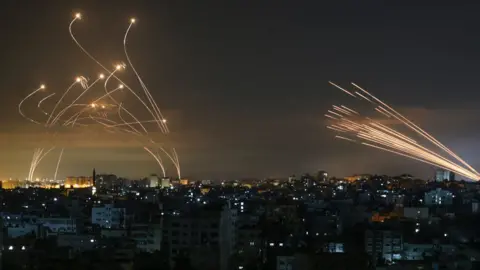
Israel's air defence system, known as Iron Dome, helped defend the country against thousands of rockets fired by Hamas from Gaza at the start of the Palestinian militant group's October offensive.
Some of the rockets were not intercepted and fell on built-up areas.
What is Iron Dome and how does it work?
Iron Dome is an air defence system designed to protect against a range of incoming short-range weapons, which operates in all weather conditions.
It uses radar to track incoming rockets, and can differentiate between those likely to hit built-up areas and those expected to land in uninhabited areas.
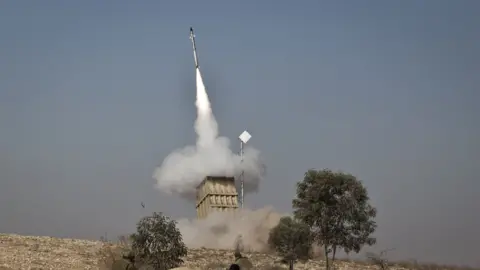
It is thought the system consists of 10 batteries located across Israel, each with three or four launchers. Each launcher contains up to 20 missiles.
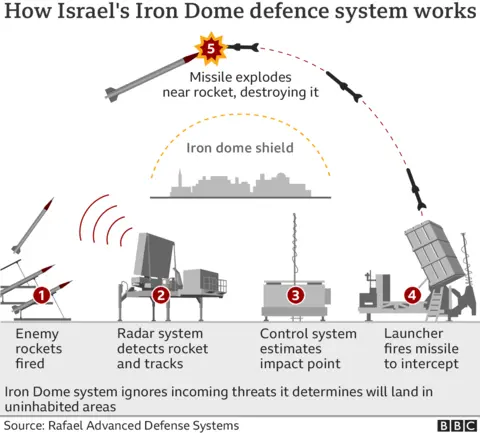
Two Tamir interceptor missiles are fired at each rocket considered a threat.
The Centre for Strategic and International Studies estimates that a battery of missiles costs $100m (£82m) to produce.
However, the system is considered cost-effective because it does not fire on rockets unless they pose a threat to populated areas.
Who developed Iron Dome and when did it become operational?
Iron Dome was developed after the 2006 conflict between Israel and Hezbollah, an Islamist group based in southern Lebanon.
Hezbollah launched thousands of rockets into Israel, causing huge damage and killing dozens of citizens.
A year later, Israel announced its state-run defence firm, Rafael Advanced Defense Systems, would create a new missile defence shield. The US helped to fund the system with a $200m (£164m) grant.
The system was used in combat for the first time in 2011, when it knocked out a missile fired at the southern city of Beersheba from the Gaza Strip, which has been under Hamas' control since 2007.
In 2019, the US announced it would buy and test Iron Dome to complement its Patriot missile defence system.
Patriot works in a similar way to Iron Dome, but is meant primarily to intercept aircraft, cruise missiles, and ballistic missiles rather than short-range weapons.
How effective is Iron Dome?
In 2012, Israel claimed Iron Dome batteries intercepted 84% of the rockets fired by Hamas from Gaza, responding 573 times and knocking down 421 of them.
However, in 2013, defence expert Prof Theodore Postol from the Massachusetts Institute of Technology said that in fact Iron Dome may only have hit 10% of its targets, and possibly none at all.
 Getty
GettyIn 2021, Israel's military claimed Iron Dome had a 90% success rate when Hamas fired 3,000 missiles from the Gaza Strip.
At the start of the current conflict, Hamas claims that it launched 5,000 rockets, although Israel says it probably launched half that number.
Israel's military said the Iron Dome air defence system intercepted 153 of them, with others landing in open areas or inside the Gaza Strip itself.
However, there have been several deaths and injuries from rocket attacks in southern Israel and in the greater Tel Aviv area, according to Israeli media.
