High-rise rules relaxed after internet rollout warning

 Getty Images
The government plans to relax broadband installation rules for high-rise flats in England, after warnings that controls introduced after the Grenfell Tower firecould prevent thousands of residents from upgrading their internet access.
Industry groups have complained that the new fire safety regulations have led to lengthy delays to carry out minor work to install fibre cables.
Labour now plans to remove a requirement for building safety officials to sign off installation works inside buildings before they can go ahead.
It is the latest in a series of moves to speed up the post-Grenfell safety regime, following criticism over the time taken for building work to gain approval.
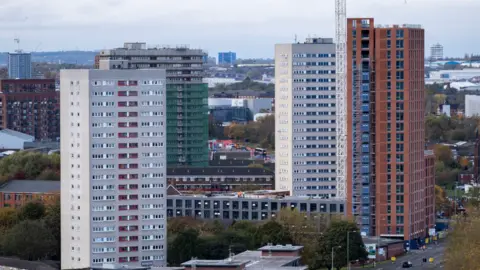
Under rules introduced by the previous government following the Grenfell fire in 2017, owners of residential blocks in England taller than 18 meters need to get prior approval for work from the building safety regulator (BSR).
The construction industry says months-long approval times at the regulator are frustrating the delivery of new homes, particularly in London, and could dash government efforts to build 1.5 million new homes by the next election.
The telecoms industry has also warned the delays are hampering broadband updates in high-rise blocks, with some owners, including councils, refusing to sanction installation work until approval is granted.
The Internet Services Providers Association, an industry body, has estimated hundreds of thousands of upgrades have been effectively put on hold, preventing households from upgrading their connection or switching providers.
'Low-complexity'
In a policy document, the housing department said the delays were an "unintended consequence" of the post-Grenfell safety regime, and risked undermining the government's gigabit-capable broadband targets.
Following meetings towards the end of last year, it has now said it plans to specify that prior BSR approval will not be required to drill holes in internal walls in order to install fibre-optic cabling, describing the work as "low-complexity and routine".
Instead, under the proposed changes, installers would be able to write to the BSR to notify them of the work once it is completed.
The changes would be delivered through a tweak under existing building safety laws, following a short consultation ending in late March.
The government is also promising further measures in the spring to streamline the approvals process for minor building work within homes and on existing fire doors.
In a statement, Building Safety Minister Samantha Dixon promised not to dilute oversight of higher-risk building work, adding: "Building homes quickly and building them safely are not in conflict."
However, Tower Blocks UK, a campaign group, expressed concern that allowing drilling without prior approval risked "hidden pathways for smoke and fire spread" within tall buildings.
The approach went against a "core post-Grenfell principle that safety must be designed in and verified before work takes place", it added.
"Where connectivity is genuinely urgent, interim solutions such as free 4G or 5G provision could be explored while a safe, carefully designed approach is developed".
Watchdog move
The government has previously said it remains committed to the post-Grenfell safety rules, but has announced a series of changes in an attempt to speed up the approvals process at the BSR.
It has announced that the regulator has formally left the Health and Safety Executive, and would now sit within the housing department.
Ministers have also promised to change how applications are handled, and hire additional staff in a bid to get the applications backlog down.
Andy Roe, who became the BSR's chairman last summer, told a conference that average waiting times to approve new high-rise blocks had fallen from over 40 weeks when he took over to "13, 14, 15 weeks".
However, waiting times for remediation work remain slower, with BSR bosses reportedly disclosing on Wednesday the average timeline stood at 34 weeks.
