From wrestling to panto: Theatre marks 125 years

 BBC
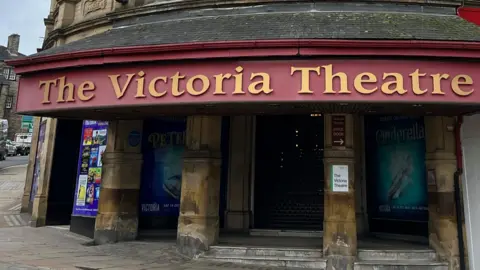
BBCFrom pantomime dames to polar explorers and wrestling heroes, Halifax's Victoria Theatre has been the backdrop to all sorts of colourful events and performances since the curtain first went up there 125 years ago.
It is that history which is now being celebrated in an exhibition showcasing the ever-changing cast of characters who have hit its stage in the last century and a quarter.
Curated by the Friends of the Victoria Theatre group, the exhibition features several artefacts, including from the venue's grand opening in February 1901 and its time as a wrestling venue in the 1960s.
David Russell, secretary of the group, said the theatre had hosted such big names as wrestler Big Daddy, activist and singer Paul Robeson and Antarctic explorer Ernest Shackleton.
"Shackleton had just come back from his first trip to the South Pole and he was short of money and did a national lecture tour and came here in December 1909," Russell explains.
"He was paid £100 for the lecture, which is the annual wage of a labourer in Halifax in the Edwardian period.
"The night he gave the lecture, he was staying with a friend at Kildwick, and there was a blizzard. The only way he could get to Halifax was to sleigh down the hillside and then he managed to get a train.
"So it was this marvellous idea of this great polar explorer having to use a sledge to get to Halifax to talk about his polar adventures."

The theatre originally opened as a concert hall and its first show was a performance featuring the Halle Orchestra and the Halifax Choral Society.
"It was described in the local paper as one of the most important musical events the town had ever seen," Russell explains.
"They wanted to open on Christmas Eve 1900 and then run a light opera for a week, but the floors were made of concrete, for safety reasons, and they couldn't get them to dry out.
"So they started lighting fires in braziers on top of them and the fumes from that led the plumbers who were working to go on strike for a day.
"Once that problem solved itself, they decided to open on 25 January. Then Queen Victoria, who it's named after and dedicated to, was terminally ill and they realised she would die around the time of the opening, which, indeed, she did."
The theatre finally opened on 9 February 1901 and was built and run by local industrialist George Henry Smith, who ran Caledonia Works and was the mayor of Halifax in the late 1890s.
A decade later, the theatre began to be used as a cinema for silent films.
"It was a completely new technology. It was only four or five years old. So, showmen used to tour the country with the films," says Russell.
"For things like the cinema, you'd have got a much wider, bigger audience.
"Although it still held concerts and other activities, this effectively was a cinema from 1910 to 1953 - that was its main business."
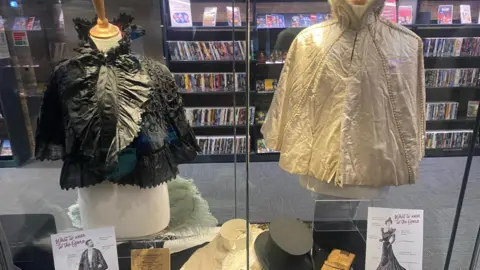
In the 1940s and 1950s, the venue was used as a dance hall - and underneath the current raked floor the original maple sprung dance floor still exists, says Russell.
"Most dance halls in Halifax allowed jiving, but for some reason, which isn't entirely clear, there was opposition here," he explains.
"Gradually, in the late 50s, they opened it up. Live Jive nights were for teenagers on Wednesdays and Friday nights. But they never had jiving here on Saturday nights.
"The dance band leader was opposed to jiving and the management were worried it would bring in Teddy Boys."
In the 1960s and 1970s, fighting - of a sort - was invited inside the theatre itself when it became a hot spot for wrestling matches, including local star Shirley Crabtree, better known as Big Daddy.
"Big Daddy was so famous. Even though he was from Halifax, he was famous nationwide in the 1980s," says Russell.
"He had his own strip in the Buster annual and he nearly got some Sunday morning mainstream TV programme."
Pantomime has also been a big draw for the Victoria Theatre over the years, featuring stars such as singer Helen Shapiro, strongman Geoff Capes, entertainer Danny LaRue and legendary comedian Ken Dodd.
"Doddy was here when he was being investigated for tax fraud and he expected to basically go to prison at the end of the run and he was obviously famously let off," says Russell.
But the venue also played host to more serious voices, such as civil rights campaigner and signer Paul Robeson and Hull pilot Amy Johnson, who both gave lectures.
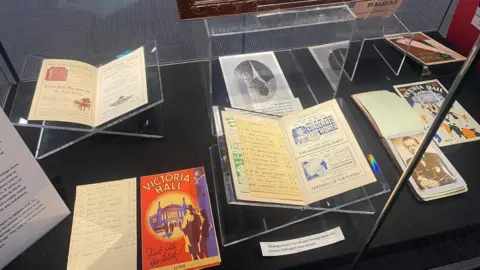
In more recent years, the theatre - which is run by Calderdale Council - has become a focus for comedians and tribute bands, as well as hosting performances by amateur dramatics societies.
Halifax Amateur Operatic Society has been with the theatre since 1902 and this year it is presenting We Will Rock You in April and SpongeBob the Musical in September. The theatre also hosts the Halifax Choral Society.
Chloe Oldman, the venue's business and audience development manager, says the theatre has hosted a number of well-known names in more recent years.
"We've had Florence and the Machine, Gary Barlow, Ocean Colour Scene, Shed 7 and James," she recalls.
"James was quite controversial because they were filming their video, and as part of the video he [singer Tim Booth] walked around the circle actually on the edge and that really got us into some trouble," she says.
"It was a don't-try-this-in-our-theatre moment."
Meanwhile, Oldman says that some themes remain popular draws for the public well over a century after the theatre first opened its doors.
"We had Shackleton back in 1909 and then we've had Ranulph Fiennes, who was also a great explorer," she says.
"Fiennes came a couple of years ago so, 100 years on, we're still having talks on explorers of the world and other adventures."
The free exhibition is at Halifax Central Library until 12 February.
Listen to highlights from West Yorkshire on BBC Sounds, catch up with the latest episode of Look North.
