China says Canada deal does not target the US after Trump tariff threat

 Reuters
Chinese officials said a recent trade agreement with Canada is not meant to undercut other countries, after Donald Trump threatened to impose 100% tariffs on Canadian products if Canada finalises the "deal" with Beijing.
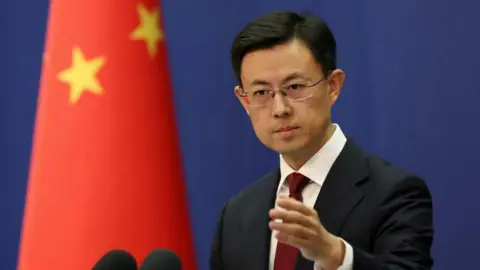
"It does not target any third party," China's foreign ministry spokesperson Guo Jiakun said on Monday of the new "strategic partnership" between Canada and China.
Trump threatened the tariffs in a Truth Social post over the weekend, and warned in subsequent posts that China is "successfully and completely taking over" Canada.
In response, Prime Minister Mark Carney has said that Canada is not pursuing a free-trade deal with China and has "never" considered it.
He added that Canadian officials have made their position clear to their American counterparts.
Asked to respond to Trump's comments at a news conference on Monday, the Canadian prime minister noted that Canada is obligated to notify the US if it plans to sign a free-trade deal with a "non-market economy" as part of the USMCA, the long-standing free trade pact it has signed with the US and Mexico.
"We would have given notice, and then there is a very open and transparent process," Carney said.
The deal agreed upon between Ottawa and Beijing would lower levies on Canadian canola oil from 85% to 15% by March, while Canada will tax a limited number of Chinese electric vehicles, or EVs, at the most-favoured-nation rate, 6.1% – down from 100%.
Jiakun said at a routine news conference on Monday that China views the deal as one that "serves the common interests of the people of both countries".
"China believes countries need to approach state-to-state relations in the spirit of win-win rather than the mentality of zero-sum," he said.
Trump's tariff threat surprised some in Canada, as it appeared to be a reversal from his previously stated position that a Canada-China deal is "a good thing".
But tensions between the US and Canada have grown in recent days, after Carney said in his Davos speech last week that the US-led world order has ruptured.
Carney also urged other "middle powers" to band together in the face of economic coercion by "greater powers", though he did not mention Trump by name.
Trump responded to the remarks in his own speech the next day, saying: "Canada lives because of the United States." He also withdrew Carney's invitation to join his new Board of Peace.
In a series of social media posts over the weekend, Trump threatened steep tariffs "if Canada makes a deal with China", and said that "Canada is systematically destroying itself".
He also warned against Canada becoming a "drop off port" for China to send its goods to the US.
US Treasury Secretary Scott Bessent later clarified Trump's position, telling ABC News on Sunday that the threat applies "if we see that the Canadians are allowing the Chinese to dump goods".
Carney told reporters on Monday that he believed the threat is part of a broader negotiation tactic by Trump ahead of a mandatory USMCA review, which is scheduled for later this year.
"The president is a strong negotiator, and I think some of these comments and positioning should be viewed in the broader context of that," he said.
Carney also underscored his position that Canada needs to diversify its trade portfolio to make itself "less dependent on the United States".
