Unwrapping historic 'presents' at the Ulster Museum

 BBC
BBCEven at the museum Christmas wouldn't be Christmas without any presents.
This month has seen the unveiling of new arrivals from historic artists with strong local ties.
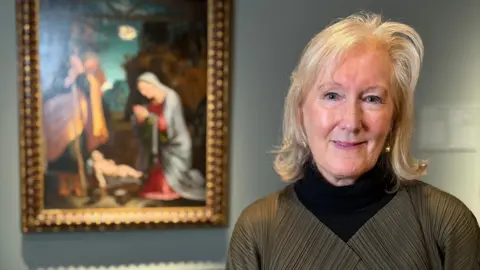
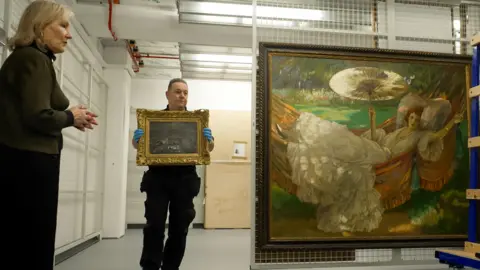
Anne Stewart, senior curator at the Ulster Museum, invited BBC News NI behind the scenes to see these early presents installed ahead of a new exhibition.
The paintings have been carefully unwrapped, not from under the tree, but from specialist storage with the museum's conservation team.
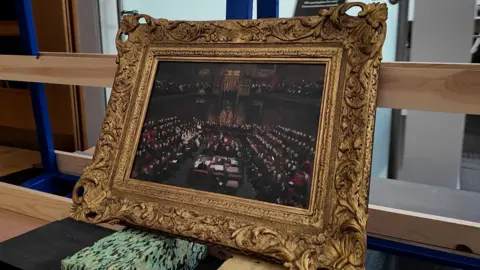
An oil sketch by Sir John Lavery has particular local resonance.
It shows the view the artist had from the gallery in the House of Lords in December 1921, as the chamber below debated the Anglo-Irish Treaty.
That debate and subsequent vote effectively ratified the partition of Ireland, creating the Irish Free State and the boundary commission.
Lavery himself was no stranger to the treaty debates, his home and studio in London serving as a "neutral ground" for negotiators from both sides, with many sitting for portraits.
The Ulster Museum's senior curator, Anne Stewart said it was "a highly charged political moment and Lavery from his early career had perfected using the oil sketch to capture a really significant moment or event".
"We didn't have a little political sketch, so this is going to really play a very important part in the collection," she added.
How do museums come to have paintings like this one?
Some paintings come as gifts from the artists themselves.
Sir John Lavery cemented his status as the Ulster Museum's foundational painter by giving a careful selection of his work while it was still under construction In the 1920s.
When it opened as the Belfast Museum and Art Gallery in 1929, Lavery's work had pride of place.
"Lavery is very important for the collection," Anne Stewart told BBC News NI.
"He gave a very important gift in 1929 of 34 of his paintings and so in many ways, he's our national painter."
The most recent Lavery acquisition came from an unlikely source and a less jolly figure than the traditional festive gift-giver.
This painting came from the tax man.
His Majesty's Revenue and Customs accepts paintings of real artistic and historic significance in lieu of inheritance tax, allocating these works to public galleries and museums.
These new acquisitions come from the estate of Alan and Mary Hobart, founders of the Pyms gallery in London and collectors of modern Irish art.
Anne Stewart said this is a crucial avenue for institutions like the Ulster Museum.
"This in lieu tax arrangement has been hugely beneficial. Sometimes we don't have to pay any money, sometimes there's a hybrid where we have to raise some of the funds, but not nearly as much as it would be if we were buying such works at auction.
"The Renoir, which is also in this exhibition, which was the first Impressionist painting in Northern Ireland was a hybrid acceptance in lieu, otherwise, we could never afford to buy a French Impressionists work and it's a wonderful early Renoir - pure Impressionism."
'A Christmas gift to the nation'
The museum's art collection has been improved through other government interventions.
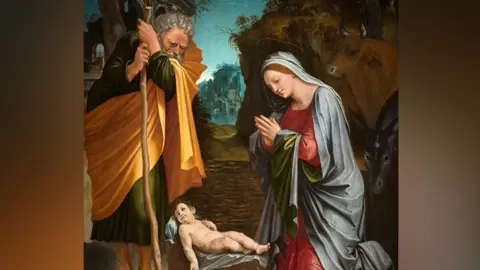
These include a nocturnal nativity scene, by Italian architect and painter Baldassarre Peruzzi - the only high renaissance artwork on display in Northern Ireland.
The painting was acquired after the government issued a temporary export bar to prevent it from leaving the country.
This gave the museum time to secure the funding required to buy the work, with contributions from a range of bodies including the Department for Communities NI and the Art Fund.
Then Minister for Arts and Heritage, Lord Parkinson, described the acquisition as a "Christmas gift to the nation".
 The National Gallery, London
The painting was restored painstakingly by specialists at the National Gallery in London before its arrival at the Ulster Museum.
Scientific analysis revealed some of the painting's artistic secrets, including a layer of finely crushed Italian glass behind the paint.
"It is a really rare painting from the high renaissance. That's what's wonderful about renaissance painting, it brings together science and tradition – and also experimentation and the revolutionary treatment of light."
For Anne Stewart, more than showcasing any individual artwork, the museum has a special role to play in the busy festive period.
"Every Christmas, I say:' If it's all getting too much, come to the Ulster Museum and have a quiet half hour where you can just escape everything and reconnect.'
"The galleries have a wonderful sense of peace and also energy, so depending on your mood, it's always going to be a different visit."
