Canada's conservative leader faces leadership test - and grapples with widening his appeal

 Reuters
Canadian Conservative leader Pierre Poilievre faces a crucial test of his leadership this week, but what lies ahead is a bigger challenge: convincing Canadians that he is the best person to guide the country through its uncertain future.
Party delegates will vote on whether Poilievre should remain leader on Friday at the Conservative convention in Calgary. It is part of an automatic review that is triggered after an election loss - in this case, Poilievre's defeat last April.
Poilievre appears to have wide support heading into the convention, party members have told the BBC, and is expected to win handily.
But he has struggled to broaden his post-election appeal beyond the party and against Prime Minister Mark Carney, especially on how to handle US President Donald Trump. That is an issue front of mind for many Canadians.
At the convention, winning anything above 80% in his leadership review will be considered a success for Poilievre, said David Coletto, founder of polling firm Abacus Data.
That number is in line with recent polling undertaken by Coletto, which shows that a strong majority of the Conservative party base support Poilievre as their leader.
They applaud his ability to hammer the Liberal government's shortcomings on domestic issues like housing and affordability, and his success with younger voters.
Surveys of the broader Canadian public, however, tell a different story, with more than half of Canadians saying they hold a negative view of the Conservative leader. A major challenge has been his tone, which critics often describe as overly combative.
That "deeply polarised" perception of Poilievre will be the main hurdle to overcome if the Conservatives want to form the next government, Coletto said.
The leadership review comes after a difficult year for the Conservatives, marked by a bruising defeat to the Liberals in April's federal election as well as the loss of Poilievre's own seat in an Ottawa-area constituency at the same time.
Two Conservative members of parliament also defected late last year to the Liberals, who under Carney have adopted more centrist polices, inching his government closer to a majority.
In recent months, Poilievre has been faced questions over his ability to clearly define what his party would do differently when dealing with Trump. The US president is deeply unpopular with Canadians, and is viewed by many as an existential threat due to his targeting of country with tariffs and his repeat references to it as the 51st US state.
At times, Poilievre's populist approach to politics has even drawn comparisons to Trump, which has not helped his likeability, Coletto notes.
"Once people have a negative view of something, it is hard to change their mind over time," the pollster says.
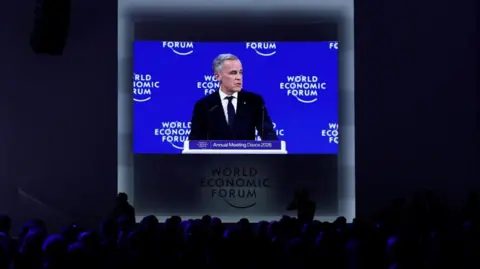
Carney's advantage on Trump recently came into view following his speech at the World Economic Forum in Davos, which was widely lauded by fellow Western politicians and observers as one that clearly defined the US president's impact on the world and how Canada intends to respond.
Shortly after, the Liberal Party shared an old clip on their social media accounts of Poilievre saying that his ministers "would be banned from participating in the World Economic Forum" should the Conservatives form a majority government in Canada.
Carney's Davos speech has been a win for the Liberals, whose support has since grown to 47% among decided voters, the latest polling released on Wednesday by Léger indicates.
That polling would translate in an election into enough votes for the Liberals to form a government.
Notably, the Liberals' gain did not come at the expense of the Conservatives, who themselves rose two points to 38% from previous polls, suggesting the party's own base support remains solid. Instead, support eroded from smaller third parties, like the separatist Bloc Québécois.
 Reuters
Ben Woodfinden, Poilievre's former communications director, acknowledges that the Conservative Party needs to further define its response to Trump to meet the geopolitical moment and broaden its support.
"I don't know when the next election would be, but I would bet that Trump will be president when it happens and his shadow will still loom over it," Woodfinden told the BBC.
But Woodfinden and other Conservatives say that they do not believe the party's current polling deficit falls squarely on the shoulders of Poilievre - who, despite his election defeat, has managed to grow its base to record numbers.
"His support within the party remains quite strong, and he himself has revitalised the party around his brand of conservatism," said Amanda Galbraith, a Conservative strategist and co-founder of the Toronto-based Oyster Group.
Poilievre has kept the pressure on the Liberals on his key issues - like scrapping the consumer price on carbon or tightening immigration levels - and his pressure paid off with some policy shifts from the governing party, Galbraith noted.
As for the path forward, some pundits say they are already noticing a welcome shift in tone from the leader, particularly in his response to Carney's Davos speech.
In a long statement, Poilievre offered rare praise for the prime minister, calling the speech "well-crafted and eloquently delivered". But he also heavily criticised the Liberals for failing to reduce Canada's reliance on the US.
"Unfortunately, after a decade of promises and grand speeches, Liberals have made our economy more costly and dependent than ever before," Poilievre said.
In recent days, Poilievre has also signalled his willingness to co-operate with the Liberals on certain domestic issues, like a grocery tax rebate for lower-income Canadians and bail reform.
Poilievre is expected to deliver a speech to the party faithful just before the vote on Friday.
Woodfinden said he would be among those watching the address closely, to see what hints it would offer on how Poilievre intends to meet the challenges ahead.
