Germany returns stolen fragments of Bayeux Tapestry to France

 Alamy
AlamyGermany has returned two small fragments of the Bayeux Tapestry stolen by a German scientist during the Nazi occupation of France in 1941.
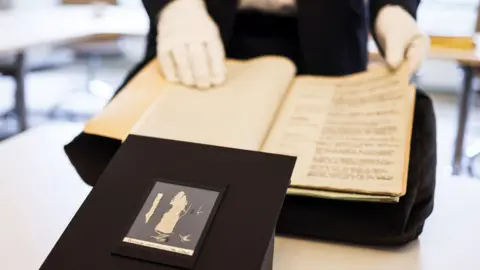
The pieces of unembroidered fabric were discovered by historians in state archives in Schleswig-Holstein in northern Germany as they sifted through the collection of German textile specialist Karl Schlabow.
The fragments were later identified as part of the Bayeux Tapestry - a 70m-long (230ft) embroidery that tells the story of the Norman conquest of England in 1066.
The head of the archive, Rainer Hering, presented the mayor of Bayeux with the pieces of linen on Thursday, saying it was "obvious" they had to be returned to France.
Schlabow, who died in 1984, is assumed to have stolen the fragments, each only a few centimetres long, when he was sent to Bayeux as part of a research team to study Germany's "ancestral heritage" - a racist and antisemitic project run by Adolf Hitler's Nazi SS.
Although Schlabow died in 1984, historians from the Schleswig-Holstein archive carried out an inventory of his collection in 2023 and discovered "a glass plate containing pieces of fabric", Hering told reporters in northern France.
Other documents were found alongside the collection and labelling on the glass plate made it possible to identify the fragments of fabric as those coming from the Bayeux Tapestry, he added.
"For our state archives service, it was obvious that these pieces of fabric taken by the Nazis 85 years earlier had to be returned to France," Hering told Ici Normandie.
The fragments are thought to have been removed from the underside of the tapestry, which is made up of 58 scenes covering 20 years of history with 626 characters and 202 horses. It depicts William the Conqueror becoming the first Norman king of England by seizing the English throne from Harold Godwinson at the Battle of Hastings.
The tapestry is due to go on display at the British Museum in London in September, under a controversial deal agreed between the UK and France.
More than 77,000 people have signed a petition against moving the 11th-Century tapestry, arguing it is too fragile to travel.
UK artist David Hockney said this week that the idea of transporting it across the Channel was "madness". For the renowned British artist, "some things are too precious to take a risk with".
However, the British Museum has vowed to protect the historic tapestry. The UK government is insuring it during its loan to the British Museum for £800m.
Given its significance in British and French history, the tapestry was added to Unesco's "Memory of the World" register in 2007.