From bullet-hole bridge to Death Junction - nine things you might not know about Cardiff

 Getty Images
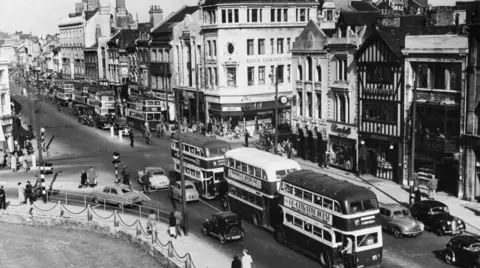
From bullet holes in a railway bridge to an underground bunker - Cardiff has a rich and diverse history.
But among the hustle and bustle of the modern day, hidden nuggets of the stories that shaped it remain.
"Cardiff has always been a friendly city... small enough for people to know one another, but big enough to have things going on," said Helen Stradling of Grangetown Local History Society, who was 11 when when the city was named Wales' capital.
In a ceremony on 20 December 1955 at Cardiff City Hall, its capital city was officially declared after a competition spanning four years with other contenders including Caernarfon and Aberystwyth.
Now, 70 years on, here are just some of Cardiff's historical gems you may just have missed.
1. Bullet-hole bridge
 Graham Loveluck-Edwards
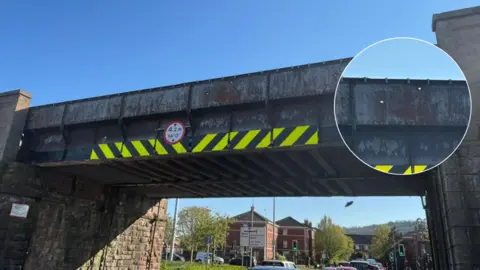
If you look closely at the railway bridges in Canton, one in particular stands out.
The bridge, positioned where Lansdowne Road meets Grosvenor Street, has a series of small bullet holes, thought to date back to the Cardiff blitz era of World War Two.
As Cardiff docks constituted the biggest coal exporting port in the United Kingdom when the war broke out, the city was a major target.
There were several raids during the war, with the worst being on 2 January 1941 when a fleet of 100 German planes droned in across the Severn Estuary.
A total of 165 people were killed that night and more than 350 homes were destroyed in the 10-hour raid that saw Llandaff Cathedral badly damaged and both the Canton and Riverside areas seriously hit.
2. Chapel hidden inside a department store
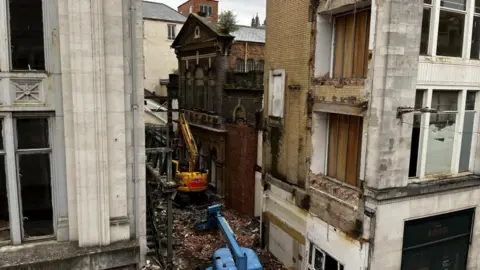
In 2023, the 200-year-old Bethany Baptist Chapel was uncovered as redevelopment work on the department store building that had engulfed it began.
The chapel was built in 1807 on St Mary Street, then rebuilt and enlarged between 1821 and 1827 before being rebuilt again in 1865 to the design of John Hartland of Cardiff.
When Howells department store opened in 1867, it quickly took over the chapel, but kept many of the original features such as the lower front arches, memorial plaque, balcony arcade and the cast-iron pillars.
After trading for more than 150 years, the store shut in March 2023 and work to redevelop the Grade II listed building unveiled the hidden chapel, the congregation of which had long ago moved to another area of the city.
3. Death junction
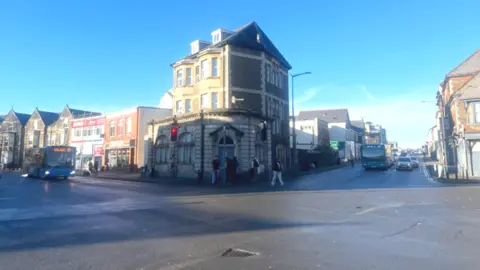
Some may think the nickname Death Junction - given to the Roath intersection between Richmond Road, Albany Road, City Road, Crwys Road and Mackintosh Place - came from how dangerous it can be at busy periods.
In truth, the label has roots pre-dating the modern car.
The word Crwys is Welsh for cross, named after the town cross that once stood there.
Adjacent to this site was Gallows Field, which Mrs Stradling said was "a term familiar to my grandparents as it was the site of the town gallows where public executions took place".
Public hangings are thought to have begun in Cardiff as early as the 15th Century, but would have ended by the 1860s, when executions were moved inside prisons.
Historian and author Graham Loveluck-Edwards, who creates social media content on Welsh history, said the area was, at that time, "not technically a part of Cardiff" but rather a "very rural area surrounded by farmland".
"There used to be tradition in old cities like Cardiff where the gallows were outside the medieval town walls."
4. A medieval farm
 John Lord/Geograph
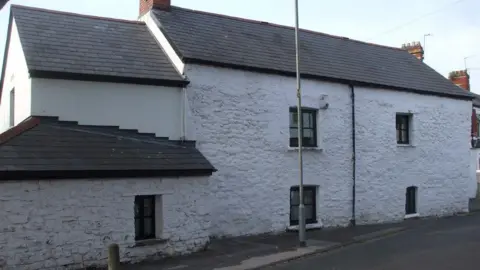
The 800-year-old Grange Farm is Grangetown's oldest surviving building and the one that gave the Cardiff suburb its name.
According to Grangetown Local History Society, it dates back to medieval times when the Cistercian monks of Margam Abbey - near modern-day Port Talbot - established a grange to farm the land.
Now, the building sits just off Clive Street - a busy residential area these days.
Mrs Stradling explained that the reason why archaeologists must dig to find traces of the past is really clear at Grange Farm - some of its windows are now at ground level as the surrounding land has built up around it over the centuries and the floor inside is now much lower than the ground level outside.
The building has been occupied by several members of the society, with the present owner being its current treasurer.
5. Oldest street
 Jeremy Segrott/WikiCommons
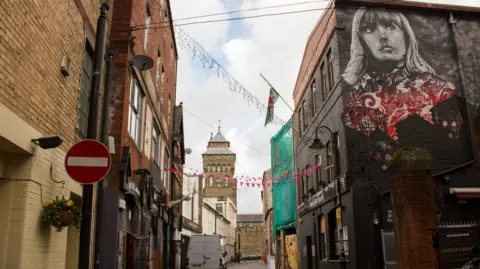
Now a popular spot amid Cardiff's nightlife scene, Womanby Street - just a stone's throw from Cardiff Castle - is thought to be one of the city's oldest streets, and could even be its very oldest.
As a variation on the Old Norse, Hummanbye Stret, it means Hound-man Street or Dwelling of the Keeper of the Hounds.
But an alternative explanation could come from its early Teutonic translation, "the abode of the foreigners".
6. Captain Scott hotel
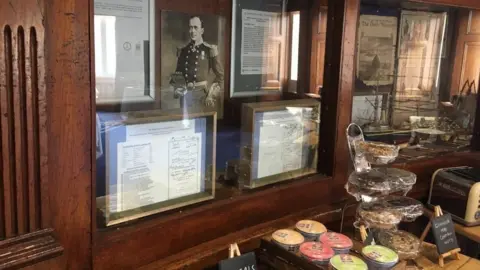
Cardiff's oldest hotel - The Royal - situated on the bustling St Mary Street, has a colourful past. But did you know it is where Captain Scott set off from on his ill-fated trip to the Antarctic in 1910?
Much of the 1866 hotel's documented history has been lost over the years, due to fires and changes in ownership.
But the venue still celebrates its links to Captain Scott - who is also commemorated with the Scott Memorial Lighthouse in Roath Park - and the three-course meal he enjoyed there before setting sail on his doomed voyage.
7. Lost canal
 Getty Images
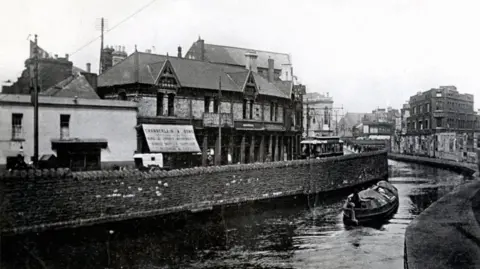
Mill Lane in Cardiff is almost impossible to recognise from its old photos after the Glamorganshire Canal was covered over in 1958.
There was much excitement when the canal quarter project uncovered a waterway hidden for more than 70 years in the city's Churchill Way area in 2023.
But did you know Cardiff once had a vast network of waterways stretching through the city, including the 25-mile Glamorganshire Canal?
It was used to transport steel and iron between Cardiff and Merthyr, but its role was replaced by the railway by 1900.
It is hard to imagine water running through Mill Lane - a hub of restaurant and bars these days.
8. Nuclear bunker
 Cadw
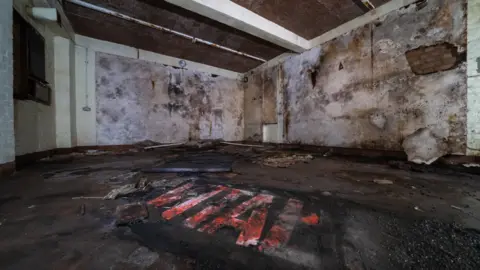
CadwA Cold War-era nuclear bunker is perhaps not what you would expect to stumble across in Llandaff.
Described by the Welsh government's historic environment service Cadw as a sobering reminder of how perilous the thought of nuclear annihilation was in the late 20th Century, the site is now nothing more than a "poignant monument".
Situated on the edge of the gardens of Insole Court - a Victorian mansion which was an emergency service centre during the Cardiff blitz - it was one of two built after the Civil Defence Corps (CDC) was revived in 1948 and Cardiff council began to make contingency plans for the possible outbreak of World War Three.
Inside the bunker are the remains of ventilation systems, electricity generators and steel bunk beds in separate rooms for men and women in the CDC.
In 2022, Cadw announced the sub-control centre would be granted Grade II listed status.
It said the building, on Vaughan Avenue, is rarely noticed by members of the public, and most wouldn't know it was there just by looking at the outside.
9. Bull ring
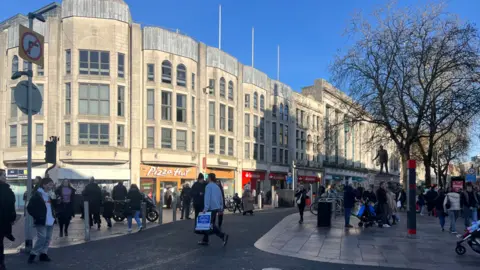
The busy intersection between Cardiff Castle and Queen Street is today home to a conveyor belt of buskers, leaflet distributors, a statue of Aneurin Bevan and the occassional march or protest.
But the area where St John Street meets Duke Street was once a historical bull ring, where the blood sport of bull-baiting took place until it was outlawed in 1835.
The premise was that the bull would be chained to a post in the centre of a crowd, and dogs would be let loose on it with people placing bets on how long each of the dogs would last.
What was Cardiff like in the 1950s?
Mrs Stradling - now 81 - was born and raised in Grangetown but moved to Penarth when she married her late husband, Cardiff University history Professor Robert Stradling.
She has "fond memories" of growing up in Cardiff, adding: "We felt it had everything in the 1950s, because no city had very much really. I've always loved Cardiff, because it's home."
While she remembers the capital city status being endowed, she doesn't recall much immediate change for young people like her.
The 1950s, she said, saw the end of tram transport in Cardiff, replaced by trolleybuses, while the average weekly wage for a working man was about £9.
A steam train to Barry was a popular day out in her childhood, but by 1955 holidays slightly further afield had begun.
"My family first did so in 1956 and Cornwall seemed very exotic to us, as the sea was blue, not grey like in Barry, and the beaches had lots of shellfish and wonderful coloured shells to collect.
"It was just like stepping into an Enid Blyton story for a Cardiff child."
She said she felt life was "happier and more innocent in those days" and that not all of the changes of the past 70 years had been for the better.
But, she added, while the "main streets were always lovely", the rest of the city centre used to be "very run down" and milestones such as the opening of the St David's Centre in 1981 and the development of Cardiff Bay in 1987 had been a "huge injection of life and vitality", making it a "much more vibrant" place.
