Danish PM in Greenland for 'show of support' after Trump threats

 Reuters
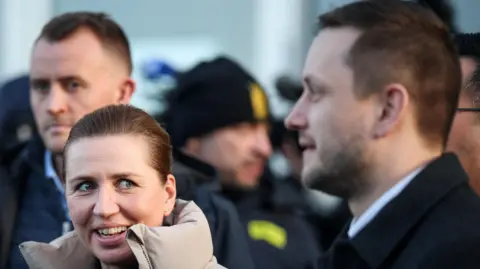
Danish PM Mette Frederiksen is visiting Greenland's capital Nuuk for talks with the territory's leader, Jens-Frederik Nielsen, after a rollercoaster week that saw US President Donald Trump roll back his threats to forcibly take over the Arctic island and agree to further negotiations.
Tensions had risen precariously over the past couple of weeks, until a stunning turnaround on Wednesday, when Trump suddenly ruled out military action, and withdrew his threats to slap tariffs on several European allies.
Trump posted on social media that a "framework of a future deal with respect to Greenland" had been reached, following his meeting with Nato chief Mark Rutte at the World Economic Forum in Davos.
However, few details have been given, and there are questions about what exactly was agreed between the US president and the secretary general.
The Danish prime minister travelled directly from Brussels, where she also met face-to-face with Rutte earlier on Friday morning. According to Rutte's post on X, they agreed "to enhance deterrence and defence in the Arctic".
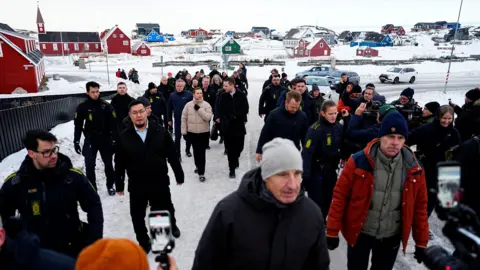
After landing at Nuuk airport, Frederiksen was greeted on the tarmac by Nielsen, who gave her a hug.
"I am first and foremost in Greenland today to show our strong Danish support for the Greenlandic people," she told reporters. "It's a very difficult time, everyone can see that."
"It is a serious situation we are in. Everyone can see that. Now there is a diplomatic, political track that we will pursue," she said. Her trip was a "working" visit to prepare their "next steps," she said.
On Thursday, Trump told Fox News that the US "gets everything we want at no cost" and that a "piece" of his planned "Golden Dome" missile defence system would be placed on Greenland.
When asked if this was an actual "acquisition", he answered: "It's total access. There's no end, there's no time limit." Notably, Trump did not mention American ownership of Greenland.
For former Danish foreign minister, Martin Lidegaard, that's a sign of positivity.
"I hear a change in the language from the President," he told the BBC "He does not necessarily think he has to own [Greenland]."
"I'm a bit more optimistic than I have been for quite a long time, where we saw only escalation after escalation after escalation," says Lidegaard, who's also known for inspiring the latest series of Borgen, a Danish political drama, which features a plotline about a power struggle over Greenland.
But despite Trump's climbdown, Greenlandic MP Aaja Chemnitz told the BBC it will take much more to rebuild trust among her compatriots. "I think it's too early to lower our shoulder… Many people are confused and concerned."
Earlier Trump had also told CNBC that an "ultimate long-term deal" over Greenland "pertains to security and minerals, and everything else".
Chemnitz is sceptical. "Minerals haven't been discussed with Nato. Why should they do that? This is completely up to Greenland," she said, which has legal authority over its own land and resources.
Likewise, Per Stig Moeller, another former Danish Foreign Minister, remains cautious.
He said the situation is "still very delicate" and "might change tomorrow", pointing to recent meetings in Washington, and the White House's diverging interpretation of what had been agreed.
"That's why it's very important that we insist, it all happens inside NATO," he suggests.
Previously the New York Times reported that one idea under discussion was Denmark ceding sovereignty over small pockets of land where the US would build military bases.
However Danish and Greenlandic officials have pushed back strongly against giving up any sovereignty, making clear that it is a "red line".
Frederiksen has said it was non-negotiable, although Denmark was willing to work on "security".
Trump has argued that taking control over Greenland is necessary for the security of the United States, pointing to a growing presence of China and Russia in the Arctic.
In response Denmark and its European allies have sought to reassure the US that they'll boost Arctic security, while calling for a more substantive Nato presence.
 Reuters
The US has around 150 military personnel at its single Pituffik base in the north-western tip of the territory.
Under a defence pact with Denmark, dating back to 1951, the US can already build up its military presence and deploy further troops.
"They withdrew bases. They withdrew soldiers," says Per Stig Moeller. "Did we throw them out? No, we did not. They went themselves."
That was updated in 2004, jointly with the Bush administration, to include Greenland as an equal partner to the deal.
"We signed it together," says Moeller, who was Denmark's foreign secretary at the time. "It's the real working treaty today."
"[The US] can make important changes to their military, to bases in Greenland. They just have to inform us or confer with us," he adds.
AFP has reported that sources familiar with talks had said the US and Denmark would renegotiate the 1951 agreement.
Danish national newspaper Berlingske also writes that a renegotiation is possible, that the Danish and Greenlandic sides have not ruled out revising that deal. However, mineral rights or the surrender of territory have never been on the table.
The BBC has reached out to Denmark's Ministry of Defence, which declined to comment.
Whatever is negotiated, Aaja Chemnitz says it could be an uphill battle for the United States to win Greenlandic hearts and minds.
"When Trump's talking about a 'big chunk of ice' that he wants," she says, referring to the US president's speech in Davos, "this is very, very disrespectful towards the people of Greenland".
"I think it will be much more difficult for the US to make an agreement," she adds. "The people of Greenland are really pushing away from the US, after everything that has happened this last year."
Meanwhile Danish Foreign Minister Lars Lokke Rasmussen said on Friday there had been no detailed plan, but that negotiations would start soon, focusing on "security, security, and security".
