Why Sydney is preserving thousands of flowers after deadly Bondi attack

 Reuters
From the outside, the vacant shop on the corner of a busy avenue in central Sydney looks abandoned. Plastic sheeting is taped across all the windows and there's a large padlock hanging on the door handle.
Step inside, though, and you're greeted by cuddly toys, candles, trinkets and messages of hope scribbled on large sheets.
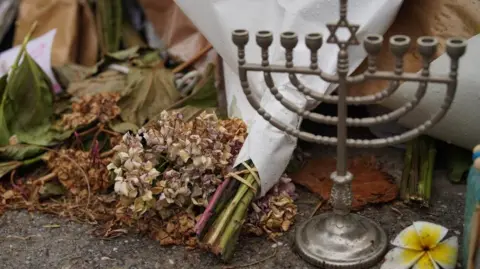
All of them come from a makeshift memorial that was created after the 14 December attack at Bondi Beach that killed 15 people.
So when the Sydney Jewish Museum and the Australian Jewish Historical Society heard that the memorial would be removed by the local council, they sprang into action to ensure everything contained within it could live on.
 BBC/Katy Watson
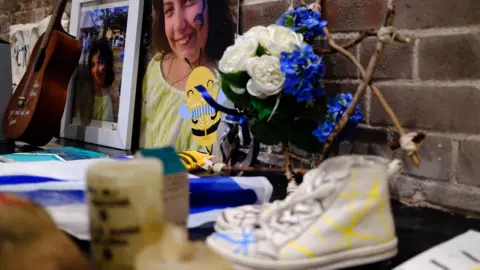
Many of the items now live in neat squares made out of masking tape on the shop floor.
One says "bees" - within it are dozens of knitted and cuddly insects - a nod to 10-year-old Matilda Bee, the youngest victim of the attack.
Another has a heap of deflated foil balloons – again, mostly bees.
There's also a box of stones – Jewish mourners traditionally place a stone on a grave instead of flowers – as well as flags, books, Christmas decorations and even a Barbie cracker.
Some families who were unable to go to any of the vigils in Bondi have also paid a visit to the spaces housing the tributes.
"It was too overwhelming to be in Bondi, but in this space it was very quiet. And I think to see everything laid out and the amount, they found it really moving and meaningful," said Shannon Biederman, the senior curator at the Sydney Jewish Museum.
Families also came to the flower space and were given flower pressing to do, while artists and community members joined in too.
For Shannon, memorialising the items is a deeply personal task.
Her family were regular attendees of Chanukah by the Sea - the festival targeted by the alleged gunmen. They had bought tickets to go but at the last minute, they changed their mind.
They also knew the family of Rabbi Eli Schlanger, one of the 15 victims.
"I do work in a Holocaust museum, so the murder of Jews isn't something that I'm not used to, and I've learned to compartmentalise," she says.
"But it's different because I'm used to working with history and this is now, and we are a museum of memory, but we're still very much live in [this].
 BBC/Katy Watson
Australian Prime Minister Anthony Albanese was among the first to lay a bouquet in front of the Bondi Pavilion the morning after the attack. Over the course of a week, the tributes spread like a wave across the forecourt.
The massacre at Bondi was Australia's worst mass shooting in nearly three decades and left the country reeling. It also saw people pointing the blame at the government for letting something like this happen to a community that had been repeatedly warning authorities about a rise in antisemitism in recent years.
But the conversation is now trying to focus on bringing people together - a sentiment the community wants to see continued in a permanent memorial to the dead.
On Thursday, landmarks across the country will also be lit up and a minute's silence held in honour of the victims. Australians are also being asked to perform a mitzvah – an everyday act of kindness such as checking in on a neighbour or a donation - a Jewish tradition and a way to bring people together after last month's attack.
How the memorial will live on is still unclear – several artists have come forward, keen to work with some of the material but a committee will make the final decisions.
'I started with a lot of anger'
And while the toys and trinkets were catalogued - there was the greater challenge of dealing with the flowers that had been left behind.
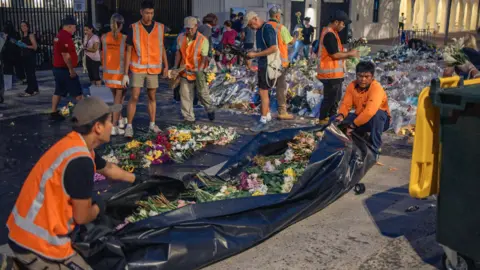
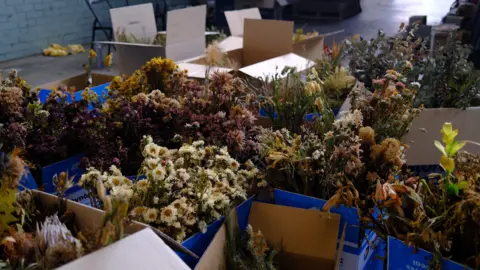
Volunteers helped to preserve the three tonnes of bouquets and wreaths that were loaded into black bags and taken to a separate warehouse in North Sydney.
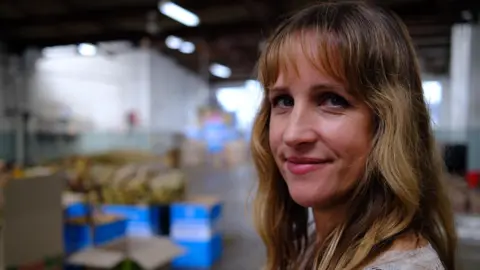
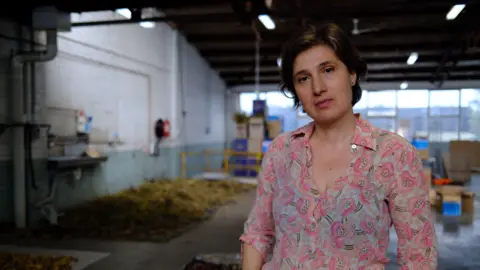
The process was confronting, says Nina Sanadze, a Jewish artist from Melbourne, whose idea it was to save all the flowers and oversaw the operation.
"When they brought them here, they looked like 100 bodies," Nina says. "It was shocking again."
Once at the warehouse, dozens of volunteers began the slow process of hanging them up on metal fences that had also been sourced in haste.
They also had to wear masks to protect themselves from the large amount of pollen circulating.
 Instagram/@picciesforpotato
Shannon also feared that the sheer quantity of flowers and the gases they were emitting could create a compost fire, so volunteers had to monitor temperatures carefully and brought in fans.
"The smell and the moisture here in the warehouse was overwhelming," says Nina. "It was like being inside a perfume shop."
Meanwhile the flowers kept on coming.
"After the council made decision to clean up this big collection of flowers, people continued to bring them," explains Nina. "We had volunteers to go at night and collect them otherwise they'd get thrown away."
 BBC/Katy Watson
The stalks have been saved for compost – which Nina says she's considering turned into some kind of furniture.
Some of the rose buds had also started to rot, but she's dried them out and made a resin artwork scattered with the salvageable petals.
"There's a lot of decay and sadness as well as beauty," she says of her improvised creation. "[It] takes it straight into the storytelling of what happened - it's not a thing of perfect beauty but it's a story, it's a heartbreak and love all together."
Though a heavy task, for many of the volunteers, helping preserve the mountain of tributes left at the site is a form of therapy.
And while the concept for the memorial is still germinating, Nina has already pinned down the title.
"Petal by Petal," she says confidently. It speaks to the way volunteers have had to methodically go about preserving the material, and symbolises her own slow processing of the attack.
"I started with a lot of anger coming here," Nina admits. "I feel like I'm leaving in better spirits."
She hopes the resulting artworks and memorials can help the community do the same.
"It can soften hearts, it can communicate," she says. "And one of the things with flowers is not only they speak of the fragility of humans, but also they have no language, everybody understands flowers."
 BBC/Katy Watson