'Rare' plate could fetch up to £20,000 at auction

 Woolley and Wallis
An "exceptionally rare" porcelain plate found hidden in an attic for more than half a century is expected to fetch tens of thousands of pounds when it goes under the hammer.
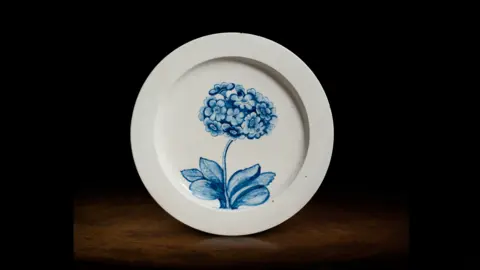
Woolley and Wallis is auctioning off what it describes as a "historically important" plate which was made at the Lowestoft Porcelain Factory, Suffolk.
Dating from 1766, the piece, which measures 0.7ft (22.7 cm) in diameter, was discovered carefully wrapped in wood wool in a tea chest, among a collection of nearly 80 pieces, at a property in London.
The plate is estimated to sell for £10,000-£20,000 when it is auctioned as part of the British and Continental Ceramics and Glass sale in London on Thursday.
John Axford, the auction house's chairman and its Asian art and ceramics specialist, said: "It is a great pleasure to be offering for sale a collection that has remained hidden for 57 years."
 Woolley and Wallis
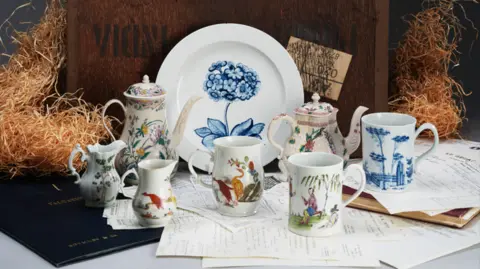
The collection of rare 18th Century English porcelain, pottery and stoneware was assembled by the late Annemarie Lobbenberg.
The clothes designer and passionate collector's prized possessions were packed away after her death in 1971, only coming to light a few months ago.
According to Woolley and Wallis, it is the porcelain plate that is considered the "rare gem" and "crème de la crème" within the collection.
 Woolley and Wallis
Lobbenberg, who was born in what is now the Czech Republic and fled to England from Nazi Germany in 1938, bought the plate when it last appeared on the open market in 1968.
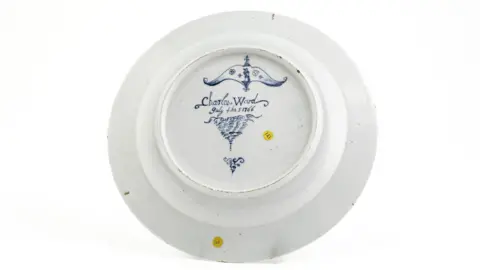
Made at the renowned Lowestoft Porcelain Factory, which was founded in the 1750s, the plate has its original dedication and date.
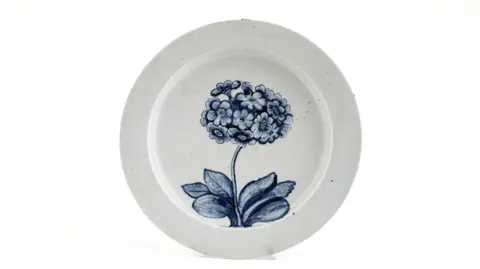
Painted in underglaze blue with a flowering auricula, it bears symbolic motifs and a hand-inscribed dedication to "Charles Ward… July the 5 1766".
It has also been formally documented, meaning it has been analysed and published within academic, museum, or expert literature.
For example, it was illustrated and discussed in Geoffrey A Godden's authoritative The Illustrated Guide to Lowestoft Porcelain published in 1969.
 Woolley and Wallis
"Finds of this quality, with such clear provenance and scholarly importance, are exceptionally rare," added Axford.
"Such pieces are exceptionally scarce, as very few objects survive that speak directly from the 18th Century and have been securely anchored within the scholarly record."
Follow Suffolk news on BBC Sounds, Facebook, Instagram and X.
