Constable who 'harassed' female colleague loses job

 Google
A police constable diagnosed with autism has failed in a bid to keep his job after a disciplinary panel ruled he had harassed a younger woman officer.
The married officer, who worked for Cambridgeshire Police in Peterborough, had apologised for his behaviour and asked the panel to let him prove he could "continue to serve".
But the panel, which said some of the officer's behaviour towards the woman had been "punctuated with sexually inappropriate language" and amounted to gross misconduct, ruled he should be dismissed.
The panel ruled that neither the constable in question, nor the woman, should be identified in media reports.
The constable, who is in his late 20s, told the hearing in Tempsford, Bedfordshire, that he had "disappointed" his colleagues, the force, his family and himself.
An expert had diagnosed autism and attention deficit hyperactivity disorder (ADHD) after complaints were made about his behaviour, the panel heard.
The officer said his mental health problems, which were undiagnosed at the time, meant he had not understood the impact of his behaviour.
"Being a police officer has been the greatest honour of my life," he said at the end of the four-day hearing.
"I only ask the panel to allow me to prove that I can continue to serve."
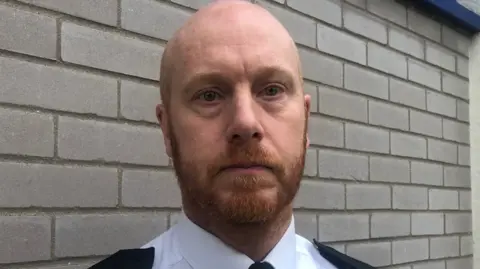 Phil Shepka/BBC
Thom Dyke, a barrister representing Cambridgeshire Police, outlined a number of allegations about the way the constable behaved towards his colleague, who is in her early 20s, over several months in 2024.
These included:
- Touching the woman's torso when rearranging her kit
- Dropping her warrant card telling her to pick it up
- Being heard to say "I would" when discussing her
- Poking her thigh and telling her she had "podgy legs"
- Putting his head near her midriff and joking about smelling the ocean
- Making a comment about what he "would do" to a part of her body, if "only I wasn't happily married"
Dyke said there had been a criminal investigation but the force had decided to take no further action and the constable had not been charged with any offence.
'Extremely embarrassed'
When she gave evidence, there was a screen between the woman officer and the male constable.
She said he had made the ocean remark in front of two other people.
The woman said she perceived the joke to be a "reference to my vagina"and told the panel that she was "extremely embarrassed" and "disgusted".
She said she did not think it appropriate for a "male colleague" to touch her thigh.
The woman said she thought the officer told her to pick up the warrant card because "he wanted me to bend over".
Barrister Colin Banham, representing the male constable, argued his client should be given a final warning.
He said it was highly likely the undiagnosed problems had an effect on him.
Banham said there had been no "sexual harassment" or "sexual intent".
The constable disagreed with some of the woman's recollections - and said he had been trying to show her how a warrant card could easily by stolen.
Dyke said the constable had tried to "cloak himself" in the "mantle of mental health" in order to "disguise" what was "sexual and grossly inappropriate behaviour".
'Objectified'
The panel's chairman John Massey, who is a temporary assistant chief constable, said the conduct "amounted to harassment... punctuated with sexually inappropriate language".
He added the "sexually aggressive" language had "objectified" the woman.
He said the public would be "outraged and appalled" if the constable kept his job.
He added that the constable's autism and ADHD had been taken into account.
Police officers at the centre of public disciplinary hearings can normally be named by journalists.
But Massey ruled the constable could not be identified because of his mental health problems and his welfare had to be considered.
He concluded that publication of his name could lead to a "risk of serious harm".
Follow Beds, Herts and Bucks news on BBC Sounds, Facebook, Instagram and X.
