Panama voids Hong Kong-based firm's canal port contracts

 Reuters
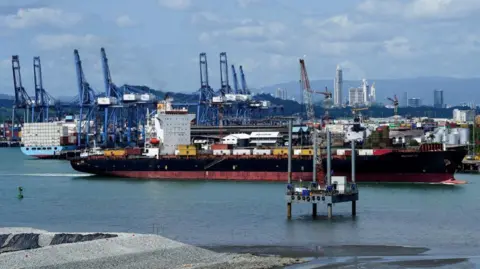
Panama's Supreme Court has annulled contracts allowing a Hong Kong-based company to operate container ports on the Panama Canal.
The ruling comes a year after US President Donald Trump claimed China was "operating the Panama Canal" - the main shipping link between the Atlantic and Pacific oceans - in his inaugural speech.
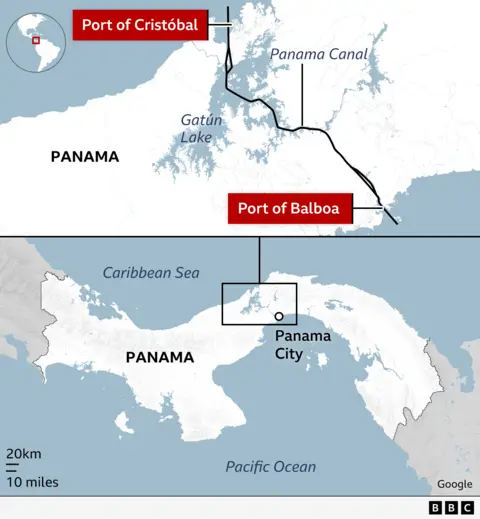
CK Hutchison Holding, through its subsidiary the Panama Ports Company (PPC), has operated two of the five ports since the 1990s. It had previously agreed to sell them to a group led by a US investment firm under a wider deal.
The court found that laws allowing the firm to operate the ports were "unconstitutional", but PPC said the ruling "lacks legal basis".
Trump has made repeated claims that the Central American canal is under Chinese control.
During his address last January, he said: "China is operating the Panama Canal and we didn't give it to China. We gave it to Panama and we're taking it back."
The following month, US Secretary of State Marco Rubio also demanded that Panama make "immediate changes" to what he called the "influence and control" of China over the canal.
Panama has previously rejected the US government's claims and President Jose Raul Mulino has said the canal "is and will remain" in his country's hands.
There is no public evidence to suggest China exercises control over the canal, though Chinese companies have a significant presence there.
CK Hutchison, founded by Hong Kong billionaire Li Ka-shing, is not owned by the Chinese government.
But Beijing's tighter political control over Hong Kong in recent years has changed how the company is viewed internationally. Its global assets - which include ports and logistics hubs - are now often seen through the lens of wider concerns about China's influence.
Against a backdrop of rivalry between the US and China over global trade routes, as well as the Trump administration's focus on US dominance over the western hemisphere, the ruling on Thursday is likely to be seen as a victory for Washington.
Panama's Supreme Court said in a statement published on its website that, after "extensive deliberation", it had found that laws that underpin a concession contract between the state and PPC at the ports of Balbao and Cristóbal were unconstitutional.
In response, PPC said the new ruling lacks legal basis, and "jeopardises not only PPC and its contract, but also the well-being and stability of thousands of Panamanian families who depend directly and indirectly on port activity".
Its statement added that it had invested more than $1.8bn (£1.3bn) in infrastructure and technology since it began operating the ports in 1997.
Mulino said ports in the country will continue to operate without disruption despite the ruling.
APM Terminals Panama, a subsidiary of Danish shipping company Maersk, will temporarily manage the Balboa and Cristóbal sites.
The company told the BBC in a statement that it "aims to mitigate any risks that could impact essential services for regional and global trade".
On Friday, Chinese foreign ministry spokesman Guo Jiakun said that the country would take "all necessary measures to resolutely safeguard the legitimate rights and interests of Chinese companies".
Hong Kong's government also said it firmly rejected the ruling.
The Panamanian court's decision could disrupt plans by CK Hutchison to sell its interests in ports worldwide to a consortium led by US investment firm BlackRock and shipping group MSC under a deal worth $22.8bn.
Both firms have been contacted for comment by the BBC.
The sale was widely seen as an attempt by CK Hutchison to reduce political risk in sensitive locations while raising money from valuable assets.
Trump had previously hailed the plans, which would place key assets under majority US ownership,while the Chinese government had criticised them for not being in the national interest.
Markets reacted quickly to the court decision.
CK Hutchison's shares fell 4.6% in Hong Kong trading, pushing down the Hang Seng Index down by more than 2% - a sign of both the company's importance to the market and growing investor concern about political risk.
Up to 14,000 ships use the 51-mile (82km) Panama Canal each year as a shortcut between the Atlantic and Pacific.
The waterway, which handles about 5% of global maritime trade volume, is operated by the Panama Canal Authority, an agency of the Panamanian government.
From October 2023 to September 2024, China accounted for 21.4% of the cargo volume transiting the canal, making it the second-largest user after the US.
