Government has duty to help pass assisted dying bill, says Leadbeater

 PA Media
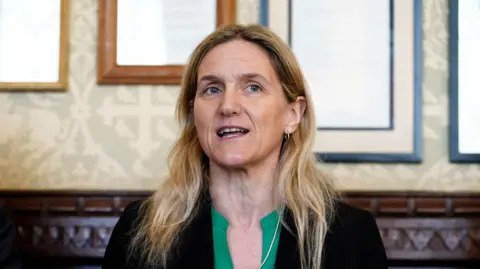
The government has a "duty" to help get the assisted dying bill through Parliament, Labour MP Kim Leadbeater has said, as concerns grow that time is running out for the legislation.
Leadbeater, who introduced the bill to Parliament, told the BBC the government should "respect the will of the democratically-elected members of Parliament".
The bill was backed by MPs in June of last year by a majority of 23, but has made slow progress in the House of Lords due to the huge number of amendments tabled.
Some Labour opponents of the bill have reacted angrily to suggestions the legislation could be forced through, overriding objections in the House of Lords.
Speaking during his visit to China, Prime Minister Sir Keir Starmer said the government was "going to remain neutral" on the bill.
If the bill is not passed by both the House of Commons and the House of Lords by the end of the parliamentary session, expected in May, it will not become law.
Sir Keir has previously spoken in favour of changing the law on assisted dying and voted to back Leadbeater's legislation.
However, the government as a whole has stayed neutral on the issue, with ministers and MPs able to vote with their conscience rather than having to stick to a party line.
Yet as the deadline for passing the bill in the Lords looms, the prime minister is facing pressure to help get it through Parliament.
The government could promise to make more time for the current bill to be debated this session or, if a backbench MP re-introduces it to Parliament, in the next session.
It has already ruled out re-introducing the legislation as a government bill with Lord Kennedy, the chief whip in the Lords, saying: "I have enough problems getting the government's programme through at the moment, let alone trying to deal with this bill.
"So I promise you it is not going to come back as a government bill."
Speaking to the BBC, Leadbeater said: "We now have a piece of legislation which has been voted through by members of Parliament in the Commons.
"I think the government has got a duty to respect that and from a democratic perspective to support getting the bill through.
"The government have been brilliant and have been very neutral because they are very respectful of different views there are in the cabinet and across Parliament.
"But I also think they have a duty to respect the will of the democratically-elected members of Parliament who voted for it."
A senior Labour MP who asked not to be named warned the prime minister against intervening.
"It would provoke a massive split amongst Labour MPs and the prime minister is not strong enough to bear that," they said.
Leadbeater has said the majority of peers back her proposals but that a small group of opponents were trying to talk the bill out, also known as filibustering.
Nikki Da Costa - former No 10 adviser and an opponent of the legislation - said peers were not trying to block progress but rather were "doing their best to patch the holes" in "an unsafe, deficient bill".
Lord Falconer, who along with Leadbeater is shepherding the bill through Parliament, has said the legislation has "absolutely no hope" of becoming law without a "fundamental change" in the House of Lords' approach.
He has suggested using the rarely-deployed Parliament Act to override peers' objections, a move that would be tricky as well as controversial.
The act allows for an identical bill that passes the Commons twice to become law, even without the Lords' consent.
It would mean that if an MP brought the same bill back, the Lords could not block it for a second time and the legislation would become law at the end of that second session even without the Lords' approval.
Opponents of the bill have reacted furiously to Lord Falconer's proposal.
Labour's David Smith said it would be a "grossly unjust use of parliamentary procedure".
Jess Asato, another Labour critic of the legislation, said "a bill like this with such profound life-and-death impacts... must not be forced through without the scrutiny it deserves".
In the House of Lords, where debate on the bill has resumed,some peers also criticised Lord Falconer's proposal with former minister Lord Ahmad warning it would be "setting a very different precedent".
However, Lord Pannick KC, a crossbench peer, said: "The reason why the Parliament Act is being discussed at the moment is because this is day eight of this committee and we are still on clause one."
