Labour's plans to get Anas Sarwar into Bute House

 Getty Images
With the turn of the year, Scotland is on the way towards one its most consequential elections in years. But for Scottish Labour, the old joke applies - you wouldn't start from here.
Just 18 months ago, in the wake of a landslide general election victory, Anas Sarwar might have dared to imagine himself on the steps of Bute House in May 2026.
Now, his party trails far behind in the polls, and could face a fight just to stay in third place.
This election may decide Sir Keir Starmer's political future - and the result feels existential for Scottish Labour, too.
But when I speak to Scottish Labour MPs and senior party figures, the mood isn't one of despair or panic.
Morale feels lower around Sir Keir, who doesn't have to fight a general election for nearly four years, than it does around Sarwar, who faces the voters in just four months.
So what gives Scottish Labour the confidence it can turn things around? And how does the party plan to do it?
I've tried to find out - and what's emerged is a strategy where success relies on this being one of the most tactical, and closest, Scottish elections of the devolution era.
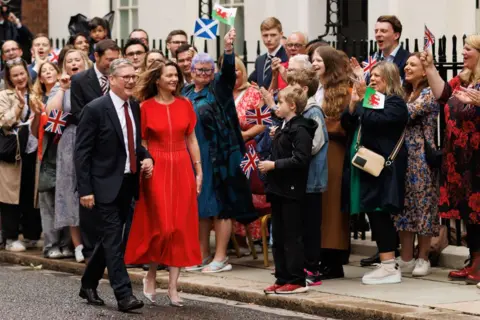 Getty Images
On Monday, Sarwar kicked off the election year with an admission that he'd have to win "in defiance" of the UK government and the prime minister's unpopularity.
That's been interpreted by some as an attempt to put distance between himself and Sir Keir.
But senior Scottish Labour figures have been telling me for some time that they're under no illusions about the popularity of either the Westminster government or the PM.
They know that if this election becomes a referendum on Sir Keir, they lose. And every moment spent talking about him or his government is a moment wasted that could have been spent focusing on the SNP's record.
When I asked how often the prime minister would be out on the campaign trail in Scotland and what that would look like, one source compared it to the speeches David Cameron gave in the final days of the referendum campaign in 2014.
That means highly stage-managed appearances where the timing, venue and message were effectively decided by the No campaign, in Scotland.
And senior Scottish party figures even question how popular Labour was when it won its landslide majority at Westminster in 2024.
That victory, they acknowledge, was less a vote for Labour and more a rejection of the Conservatives after 14 years in power by a broad coalition of voters.
Scottish Labour strategists see the coming Holyrood election in a similar way.
To them, this campaign isn't about changing minds. They see the current level of support for the SNP - which polls suggest stands at about a third of the vote - as being close to the bedrock of the most committed believers in Scottish independence.
It's the other two thirds of the electorate Scottish Labour is interested in, and where they see a potential path to victory. The job for Sarwar is to convince voters ready to kick the SNP out of power that voting Labour is the best way to do it.
And that's going to be much harder with Reform surging ahead in the polls and into second place, ahead of Labour.
Senior party sources acknowledge the new challenge posed by Reform, whose voters are likely to be just as angry with Labour at Westminster as they are with the SNP at Holyrood.
Their argument will be that only Labour can actually overtake the SNP and form a government in Scotland.
And this is where the proportional voting system for the Scottish Parliament is significant.
One senior Labour figure told me they've already had conversations on doorsteps with Reform supporters, asking them to lend their vote to Labour in order to oust an SNP MSP, while backing Reform on the regional list.
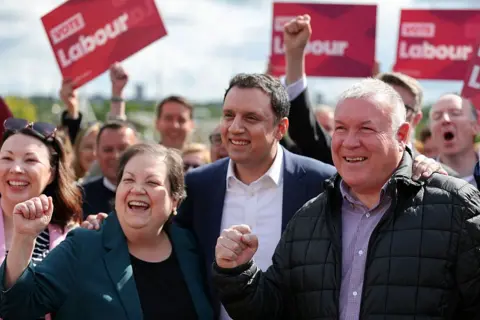
The blueprint is last year's Hamilton, Larkhall and Stonehouse by-election, which Labour won by just 600 votes from the SNP, and fewer than 1,500 votes ahead of third-placed Reform.
That Scottish Parliament seat was won thanks to Labour's campaign machine on the ground, which used its volunteers to collect impeccable data on where its likely voters were.
On polling day, Labour says it knocked on around 8,000 doors to get out the vote - roughly the same number of ballots the party actually got.
 Getty Images
Scottish Labour strategists say their focus will be Scotland's 73 constituencies, seeking to turn each one into a similar kind of by-election contest.
Votes on the regional list "top-up" the number of MSPs for each party. So if Labour wins enough constituencies from the SNP, Reform's support on the regional list will begin to "cannibalise" the nationalists' vote.
That's the theory, anyway.
In fact, one senior figure told me that if Labour does manage to turn things around and win in May, it could end up being a few thousand, or even a few hundred, ballots in a handful of key constituencies that decide who is first minister.
Victory in Hamilton, Larkhall and Stonehouse was about having organised, motivated activists, and big resources.
When it comes to organisation, senior Scottish Labour figures claim that in Kate Watson, the party general secretary who was Sarwar's chief of staff, they have someone who knows everything worth knowing about the "ground game" of elections.
In terms of motivation, Scottish party insiders describe a party that has been rebuilt from rock bottom since Sarwar took over in 2021 with the sole purpose of fighting the coming election.
One person compared the party to a start-up company, with staff, candidates and message all crafted around the goal of putting Sarwar into Bute House.
And party figures argue that now, more than ever, the tag of "branch office" which has long been attached to Scottish Labour is no longer true.
In elections gone by, their Glasgow HQ would have to call on staff, expertise and resources from London. They say that capability is now independent and in-house.
 Getty Images
Crucially, when it comes to resources, Labour believes it can outspend the SNP all the way up to polling day.
This week, Sarwar boasted he already had a £1m election fund. And senior Scottish Labour figures tell me the party will be reporting "serious money" to fight its campaign with when the Electoral Commission publishes its next round of party fundraising declarations.
As well as the traditional leaflets and adverts, some of that money is helping to pay for an overhaul of the Scottish party's presence online.
Social media has played an important role in elections for years, but it's already obvious how much more effort all parties are putting into video content for online audiences.
My sources say Scottish Labour's press office has been overhauled in the past five years, with dedicated videographers and content producers hired to build something like an in-house content studio.
It is modelled on social media advertising agencies of the kind that many brands now have to promote their image directly to consumers, in the age of Instagram and TikTok.
The effect can be seen in some of the elaborate and polished videos being posted by Sarwar in recent months, including an advent calendar which promoted Scottish Labour policies.
And individual candidates are using the same platforms to boost their visibility in their communities, focusing on local issues and public services.
Of course, a five-year plan is only as good as the results in year five. National elections are very different from by-elections, where resources can be concentrated in a single constituency. Reform voters may not be open to Labour's message.
One Scottish Labour MP admitted to me recently that the national mood music will be the most important factor when it comes to May's election.
It's Sir Keir Starmer who determines that. From 10 Downing Street.
