'I don't want anyone else to die by suicide'

 BBC
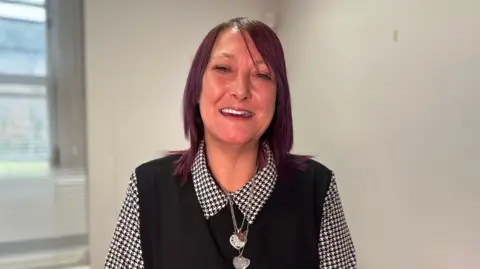
BBCA woman who has lost several members of her family to suicide has said more funding is needed for suicide prevention.
Claire Curran now uses her loss to help other families bereaved through suicide.
It comes as it was announced a new cross-party inquiry will examine how suicide prevention services are funded in Northern Ireland and how best to tackle the rising numbers.
New figures confirm that 290 deaths by suicide were registered in Northern Ireland in 2024.
The inquiry was launched by the All-Party Group (APG) on Suicide Prevention on Tuesday.
MLAs, community groups and charity leaders gathered at Stormont for the launch.
Many of the attendees, like Curran, had firsthand experience of losing a loved one to suicide.
'Services are closing, and when services close, they don't reopen'
She works with the Families' Voices Forum and Samaritans and believes such community groups could face closure unless more funding is allocated.
"It's really difficult for services, community and voluntary, who don't have sustainable funding, so they don't know that they're going to be there," she said.
"They're taking clients, they're working with them, they're helping and supporting them, but they don't know whether they're going to be there if they need more. They don't know what's going to happen next year."
"Services are closing, and when services close, they don't reopen. Our health service, our mental health service, has waiting lists. They are struggling to cope," she added.
"If we lose our community and voluntary sector, what happens to all of those people who are struggling, who need help and support? We have to be able to provide that for them."
Curran is hopeful that the inquiry will ensure that funding is made available to keep suicide prevention services open.
"I'm no one special. I'm just this wee girl who wants to make a difference, who wants to help people, who doesn't want anyone else to die by suicide.
"I know that we can't stop everyone, but we can greatly reduce the numbers," she said.
"Everyone needs to get behind this because suicide is everybody's business.
"We all have a role to play, so actually let's step up and do that. Let's make sure that those who are making the decisions step up to do that too."
'Financial constraints'
The Samaritans say those phoning their helpline call for many different reasons - reasons that do not sit in the health portfolio.
Callers have reached a crisis point because of problems with housing, the criminal justice system or social services.
Sarah O'Toole of Samaritans Ireland believes a joined-up and cross-departmental approach by Stormont could be the answer.
"The large proportion of funding around suicide prevention does go into the health budget, but unfortunately some of the actions around the mental health strategy have been paused or stopped due to financial constraints," she said.
"What we would really like to see is suicide prevention policies that exists across departments, working together, but within those policies you have plans that are fundable and are actioned as well."
'Life-saving'
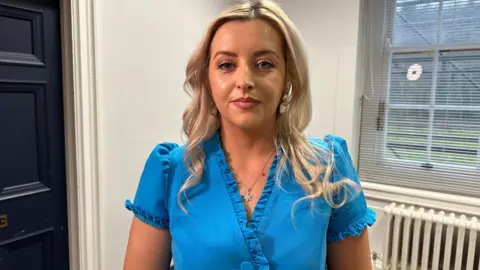
APG chair Órlaithí Flynn MLA has praised the work of community groups, but said politicians need to come together to support them.
She said there is "so many wonderful suicide prevention groups that are constantly doing life-saving work out in our local communities".
She added that "many of them aren't in receipt of any core funding from the Department of Health because that pot of money is very, very small and many of them are surviving on local fundraising initiatives".
"What we hope is to highlight the importance - the life-saving importance - of these groups and the work that they're doing and potentially to look at any cross-departmental options that are available."
Health Minister Mike Nesbitt MLA, who officially launched the inquiry, said suicide prevention could not be delivered by one department alone.
"The factors that place people at risk span health, housing, education, justice, community safety and economic pressures," he said.
"I welcome this inquiry and the opportunity it creates to strengthen how government works together to support prevention, early intervention and community resilience."
What do the latest figures tell us?
Latest figures from statistics agency Nisra show that 290 suicides were registered in Northern Ireland in 2024.
The average number of registered suicides for each year between 2014 and 2017 was 205.
That number jumped to an average of 238 each year between 2021 and 2024.
Suicide remains the leading cause of death in men under 50.
In 2024, almost eight in 10 of the suicide deaths registered were men.
For support and more information on emotional distress, help is available on the BBC Action Line.
