Torpedo attack survivor praises defiant islanders

 BBC
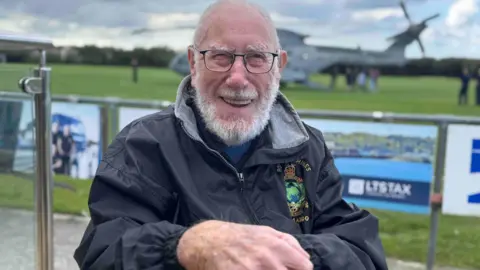
BBCOne of the last surviving crew members of a World War Two shipwreck has thanked Channel Islanders for helping keep the memory of his fallen comrades alive.
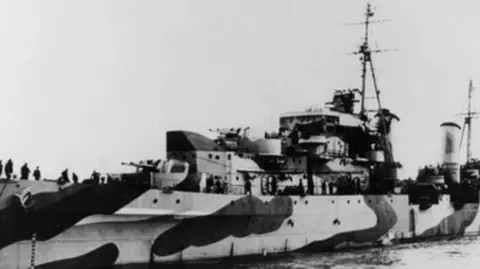
More than 500 people died when two Royal Navy warships, HMS Charybdis and HMS Limbourne, were torpedoed by German E-boats in the English Channel in 1943.
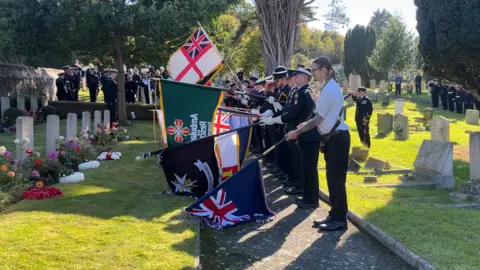
When 21 bodies washed ashore in Guernsey, they were buried with full military honours and the island held a memorial service for them on Sunday - as it has done since 1947.
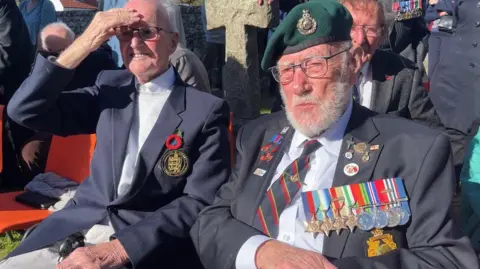
John Eskdale, 101, who was the last survivor to be rescued and was at the service, said: "If anybody went through anything, it was the Guernsey people and turning up at that grave in defiance of the Germans."
 Jack Silver/BBC
Mr Eskdale said the attack was "pretty horrific - some of the boys were crying out for their mothers".
He said some crew members "just slipped away as the night went by" while others "would be right next to you and then the next minute they were gone".
Some even said "cheerio chaps" before letting go, a memory Mr Eskdale said would "stay with me for the rest of my life".
Mr Eskdale, who was 17 when he enlisted two years before, spent more than five hours "doggy paddling" in the water after his ship HMS Charybdis was torpedoed twice.
A British ship that was sweeping the area twice passed him without seeing him or hearing his cries for help, which was "heartbreaking", he said.
The third time the ship passed, someone saw Mr Eskdale and pulled him to safety.
By then he was covered in oil.
"All you could see was my eyes," he said, adding it took "months" for the oil to wash off.
 Ministry of Defence
Mr Eskdale visited Guernsey this week for the annual memorial service at Le Foulon Cemetery, St Peter Port, held on Sunday.
He praised islanders for continuing to commemorate the sinkings as it had allowed the survivors to come together as a "family".
On what was likely to be his "final" visit of nearly 50 to Guernsey, Mr Eskdale said he wanted "to say thank you every time" to islanders.
"The other reason we come [back] is because our colleagues are here, so we want to tell them that they're not forgotten, they never will be," he said.
 Jack Silver/BBC
Eileen Glass, 96, was one of the roughly 5,000 islanders who showed up with flowers to the 1943 funeral - far more than the occupying Germans had expected or allowed.
Then a teenager, her father had found one of the crew members' bodies after it washed up on Grande Rocques beach.
Mrs Glass remembered that first service as "wonderful - they were buried with full military honours".
Guernsey sea cadet Sam, 17, was a grave sentry during the latest ceremony.
He said it was important for everyone to "pay their respects" and come together for "such a special moment".
 Jack Silver/BBC
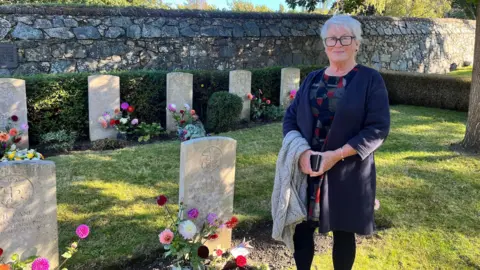
Lilian Munden, from Falmouth, Cornwall, was just 10 months old when her father, William John Charnock, was lost at sea with the HMS Charybdis.
She said she brought a wooden elephant that her father carved while at sea with her.
"It's the only thing I've got of him that he actually touched," she said.
Now 82, she said attending the ceremony for the first time meant "everything" to her.
Mrs Munden said Mr Eskdale told her "everything that happened" the night her father died.
She said now she could tell her two sons what happened to her father.
Follow BBC Guernsey on X and Facebook and Instagram. Send your story ideas to [email protected].
