The objects designed to be as uncomfortable as possible

 Katerina Kamprani
A Greek designer has turned objects we use every day into purposely bad designs guaranteed to frustrate.
 Katerina Kamprani
Most of the objects we use in our daily lives are the result of generations of design tweaks that have made them as comfortable to use as possible.
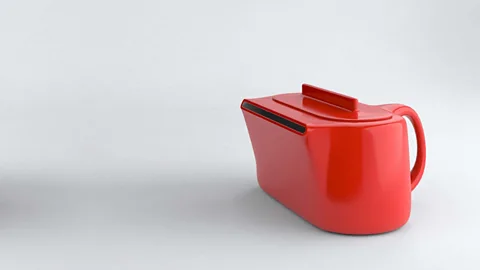
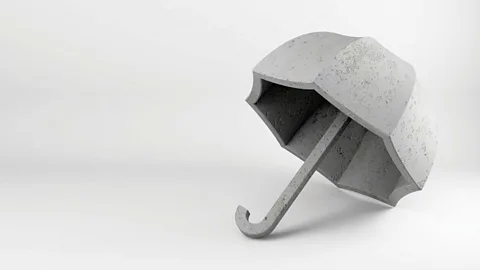
Greek designer Katerina Kamprani, however, has reworked some everyday items into almost nightmarish visions of frustration. The results are maddening objects that delete those years of refinement that made them so functional.
She’s called this project ‘The Uncomfortable’.
 Katerina Kamprani
“I was very interested in contemporary industrial design and many years ago I started a postgraduate degree in design, but I never finished it,” says Kamprani, who is based in Athens, Greece. “Nevertheless, I learned a lot about user experience, a term that refers to the overall experience of a person using a product, especially in terms of how easy or pleasing it is to use.
“This inspired me to do exactly the opposite. I just thought it was funny to think about products in an unconventional way and I was amazed by how difficult it was to deconstruct everyday objects in my mind.”
 Katerina Kamprani
Kamprani’s renders of objects cover everything from unusable cutlery to design deadends, like this infuriatingly unergonomic key.
“One of the reasons I started designing uncomfortable products instead of focusing on realistic products is because I was convinced that I would never succeed as an industrial designer in a country with a rapidly declining economy,” says Kamprani. “But this was a blessing in disguise, since the Uncomfortable project has kept me in touch with design and it surely provided me with fun times and later success.”
 Katerina Kamprani
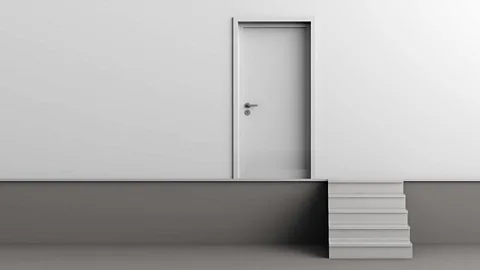
Some of the designer’s three dimensional computer-generated images include doors that are frustratingly hard to get into – like this one set just out of reach from the stair case.
“The first thing I sketched was a restroom,” Kamprani says. “Everything in it was normal, but the room itself and the door leading to it was much higher than the floor and the only means to go in it was a metallic ladder. I really don't know why I did it, I was just doodling, but I laughed out loud on the thought of a toilet emergency! After that I started thinking of more uncomfortable situations and later I focused on objects.”
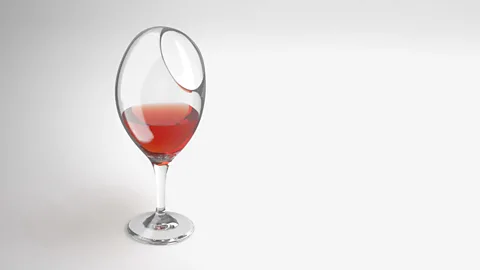 Katerina Kamprani
Kamprani’s creations have drawn interest from across the globe – no doubt partly because the renders lend a tactile feel to their qualities. Because these objects are so familiar to us, the effect is all the more jarring.
“It has to be a very well-known object and simple to use,” says Kamprani. “I avoid complicated objects and anything that uses technology, these things are already uncomfortable to use after all.
“Then I analyse the function and every little step in the user interaction and I try to sabotage discretely one of these steps. I do not stop on my first thought, I really try to come up with many different ways to make something uncomfortable. The solution that surprises even myself and makes me laugh out loud makes the cut.”
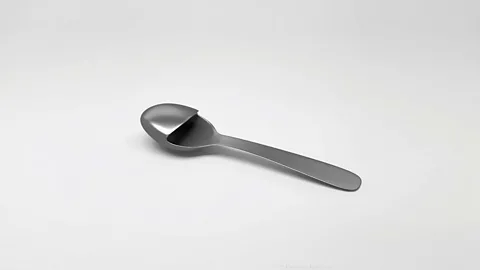 Katerina Kamprani
The initial idea might come from a burst of inspiration, but the route to a finished design “might take minutes or months”, says Kamprani. “I think it depends on the geometry of the object, the simpler the object is, the harder it is to tweak it without making it un-recognisable or looking like a different object.
“For example, a spoon with lots of holes is fun idea, but it actually exists as an object, it is a drainer spoon. Also, some objects are so engrained in our brains, it is quite hard to see them differently. I have done a lot of designs for chairs, but it took me months to do the first one.”
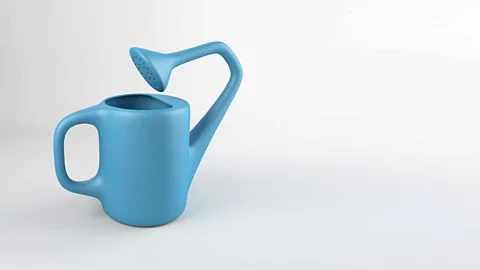 Katerina Kamprani
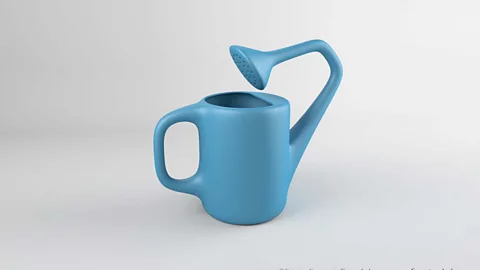
“I am most proud of the watering can,” says the designer, who has created real-life versions of some of her designs for a show at Zagreb Design Week in Croatia.
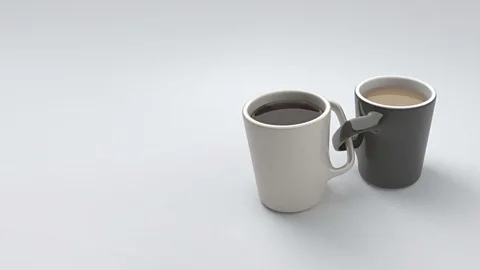
“It is very strong image in my opinion and it could be interpreted in many different ways. I am also very proud of the engagement mugs. Mainly because it was the most challenging object to construct and in the end it worked. I loved the challenge.”
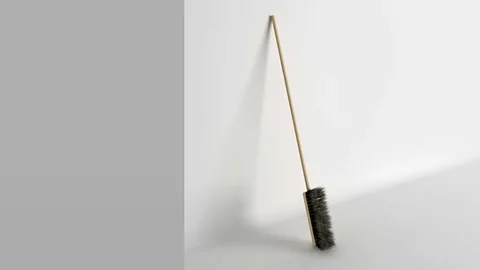 Katerina Kamprani
Kamprani has come up with the idea for all the objects she’s created herself – though many more have been volunteered by friends, or by people who’ve had their imagination sparked by the project.
“I do not feel comfortable using other people's ideas, although they are hilarious,” Kamprani says. “Some people even send me suggestions which are really good, but I feel like even if I design them and mention their name, it would not be OK to use them if I make an exhibition or a publication. So better safe than sorry.”
 Katerina Kamprani
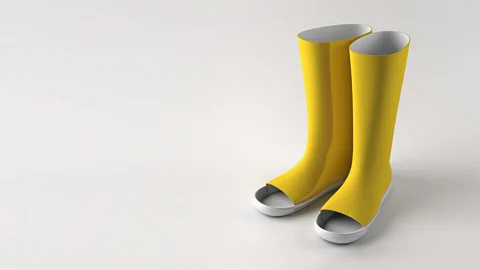
‘The Uncomfortable’ has been heavily featured by design titles and internet sites since it first appeared in 2014. “The watering can, the rain boots and the fork with chain are very popular,” says Kamprani. “And lately the long teapot and mug have been receiving a lot of attention and people are also interested in buying it as a set, if it existed as a product.”
 Katerina Kamprani
‘The Uncomfortable’ has been heavily featured by design titles and internet sites since it first appeared in 2014. “The watering can, the rain boots and the fork with chain are very popular,” says Kamprani. “And lately the long teapot and mug have been receiving a lot of attention and people are also interested in buying it as a set, if it existed as a product.”
