The ghostly fishing fleet stranded in a desert

 Ville Palonen/Alamy
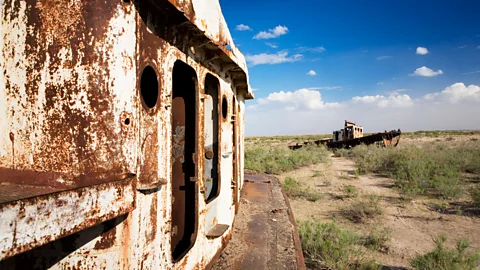
When an ill-judged Soviet decision caused the Aral Sea to dry up, a fleet of fishing boats was left abandoned and rusting in the middle of the desert.
 Boaz Rottem/Alamy
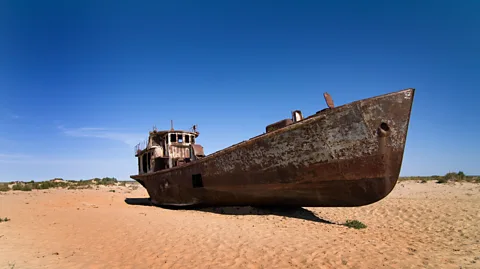
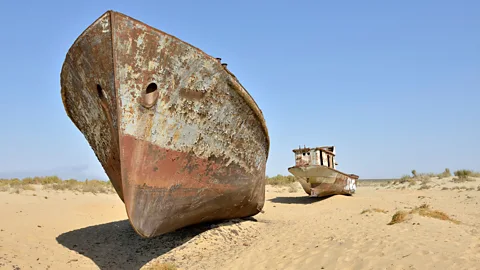
On the border of Kazakhstan and Uzbekistan, in the vast Central Asian steppes formerly part of the Soviet Union, a vast fishing fleet rusts on what was once the shore. The fish have gone. So has the water. The fishing boats now lie dozens of kilometres from what was once the fourth-largest inland sea in the world – the Aral Sea. Much of it is now a salty, poisoned wasteland called the Aralkum Desert.
 Kasia Nowak
The waters of the Aral Sea once supported a fishing industry that supported thousands. The town of Moynaq became the home of a huge fishing fleet and a canning industry which processed the fishermens’ catch.
But the controversial Soviet decision to divert the rivers feeding the Aral – in order to irrigate Uzbekistan’s cotton fields – starved the Aral Sea of water. The lake began to evaporate and recede in the 1960s.
As the waters shrank, the sea became saltier, and the fish began to die due to the rising concentration of fertilisers and pesticides.
 Robert Harding/Alamy
In 2015, former fisherman Khojabay was interviewed by the BBC, and talked of Moynaq’s past, back in its bustling heyday. “There were fishermen, chefs, sailors and engineers. These big ships could not reach shallow docks when the sea started shrinking. One by one they stranded in the soft mud, and the mud became the sand in the wind you see now.”
 Alamy
AlamyTowns like Moynaq and Aralsk suffered tremendously. The sea’s fleets had caught up to one-sixth of the Soviet Union’s fishing catch; unemployment rose, and many locals moved elsewhere .
 Theodore Kaye/Alamy
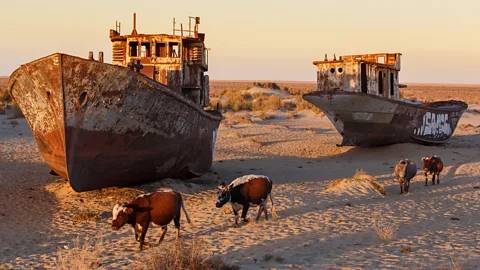
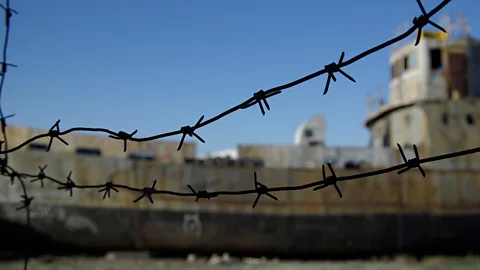
The trawlers – some of which, Kjojabay said, could carry 40 men – now lie rusting on the edge of what was Moynaq’s harbour, a ghost fleet in a place where the sea is now a memory. In places where vegetation still grows – the shrinking of the sea has also had a catastrophic effect on the area’s climate – the rusting hulks are visited by local cattle.
 Mario Pereda/Alamy
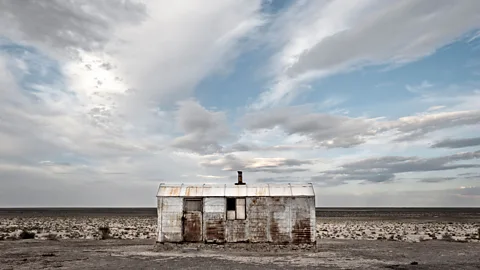
The seaside towns boasted ports and canning centres to deal with the catch. Now these buildings lie empty and derelict.
 Reuters/Alamy
The towns that were once supported these beached fleets are plagued by health problems, many of them thought to be caused by the toxic dust that is whipped up from the bed of the Aralkum.
But in years to come, a growing will to reverse this man-made disaster may see these ghostly ships submerged where they lie. Allowing the rivers to flow back into the North Aral Sea in Kazakhstan has lowered the salinity, and fish have returned. In the decades to come – and after enormous effort – the waters may swallow the Aral’s lost fleet.
Read more: Waiting for the sea, a multimedia feature from BBC News about the Aral Sea’s disappearance.
--
