The fragile future of roads and buildings built on permafrost

 Guy Dore
As permafrost thaws around the world, the steel, concrete and tarmac structures sitting on top are warping and crumbling. Is there anything engineers can do to adapt?
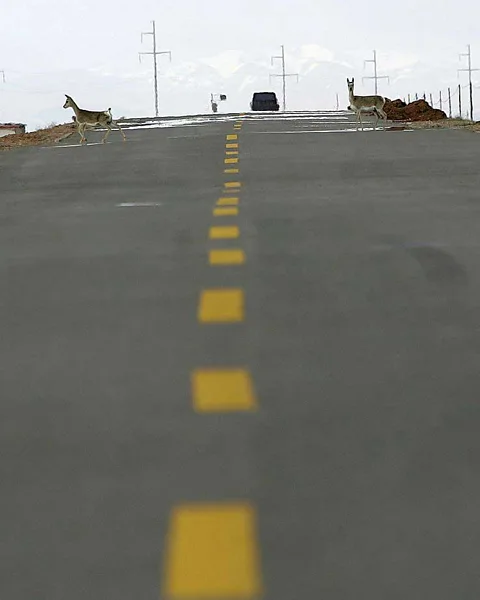
High in the mountains of China, a lonely road snakes its way to Tibet. Running for more than a thousand kilometres, the Qinghai-Tibet Highway has at times carried 85% of all goods in and out of the region. But it was built on shifting sands. Or, rather, melting ground.
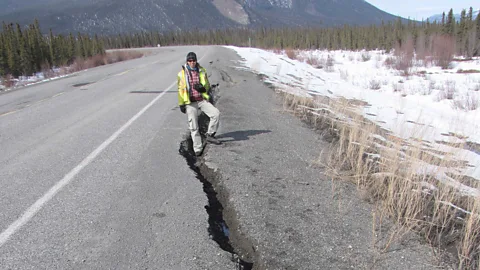
Permafrost beneath the highway is thawing, causing the terrain to sag. That in turn flexes and distorts the road itself. Some stretches of the highway are now plagued by large cracks in the asphalt. In other places, the road surface has become wavy and irregular, warping as the ground below crumples.
Researchers in China who have studied these changes over time note that the rate of permafrost melt is increasing, and so too is the rate of damage accumulated on this highway and others. A paper published in April 2020 states that those responsible for building and maintaining roads in permafrost areas in this part of the world face "significant engineering challenges" as thawing exacerbates during the next 100 years. Railway engineers will face similar problems.
 Getty Images
In this region – and various other cold climates – permafrost that held fast for thousands of years is now seeping away in the warming ground. Buildings, roads, railways and pipelines constructed in these areas are increasingly at risk of damage.
Melting permafrost poses a danger for the entire world, since it stores huge volumes of carbon that could be released into the atmosphere. But in the near-term, it is people living in these regions who are feeling the impact first because warming is happening faster in the Arctic and mountainous places, for example.
For many centuries, indigenous people living in cold regions were able to adapt with the climate. But when industrialised societies spread out to these remote places, they sought to master the Arctic wilderness with concrete and steel. Unfortunately, industrialisation has also accelerated climate change, bringing warmer winters to these regions.
The list of structures and buildings known to be damaged by permafrost is long and varied. It includes the walls of apartment blocks in the Russian city of Yakutsk, which are now cracking apart. Pipelines in Russia and other countries are at risk of breaking thanks to ground shift, potentially leading to disastrous oil spills. Or take the Our Lady of Victory church in Inuvik, in the Northwest Territories of Canada, where clergy have watched the building warp over the years as the ground subsides below.
Engineers must now reckon with the hazardous fluctuations of once-solid ground. As they do so, they are coming up with innovative ways of cooling the Earth beneath their feet, to try and save human structures from the great, destabilising thaw.
You may also like:
- The great thaw of America's north is coming
- The poisons released by melting Arctic ice
- How the Soviet Union's end sparked a grand rewilding
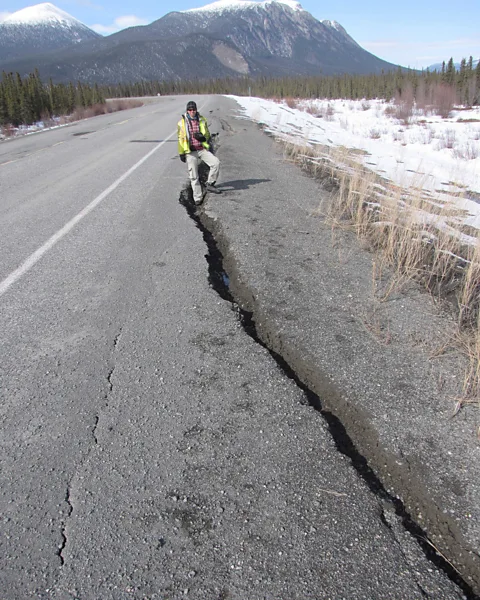
Guy Doré has seen the local effects for himself. The long cracks in the asphalt of a road can spread so wide that you can get your foot down into the gap. Doré, at Laval University in Canada, has studied the effects of thawing permafrost on built infrastructure for years. "The problems are huge," he says, adding that roughly half of the 3-4,000km (1800-2500 miles) of road constructed in permafrost areas in Canada are at risk of becoming unstable due to thawing: "We’re talking millions of dollars in additional maintenance costs in areas where you don’t have much resource to do it."
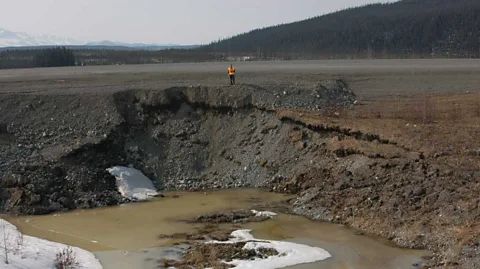
Ground settlement due to permafrost melt is a slow, gradual process. If a stretch of asphalt cracks, you can't just resurface it and leave it. As the ground continues to deform, the damage will emerge again, perhaps as soon as a year later.
When people built roads in these isolated areas in the first place, they assumed that ice thawing in the ground could threaten the roads' stability, says Doré. As such, mid-20th Century engineers generally spread gravel on ice-rich ground before building their road on top. This gravel had the effect of insulating the ground below, causing the permafrost layer to rise to a higher level, stabilising the terrain. But in some places this buffer is no longer effective because so much of the ice has thawed.
"We’re at the point where the degradation is happening in the old permafrost, the permafrost that never melted," says Doré.
 Eva Stephani
Climate change may be a major factor behind these changes, but it is not the only one. The dark asphalt used in many roads soaks up heat from the Sun and distributes it to the ground below, which further accelerates thawing.
The damage tends to occur in a localised way. For example, roughly 20% of the Qinghai-Tibet Highway has accumulated damage due to ground settlement to date, while the rest remains relatively stable, for now.
Buildings, despite their much smaller footprint, are at risk, too. According to the New York Times, thawing permafrost has led to subsidence and damage in around 1,000 buildings in the Russian city of Yakutsk. With a population of 280,000 people, it is the largest city in the world built in a permafrost area.
A similar story has emerged in Svalbard, the Norwegian archipelago between Norway and the North Pole. Hundreds of homes there have been torn down in recent years because they were built on wooden foundations that have now become unstable on the flexing ground. Unfortunately, such headaches only look set to worsen over time.
In 2020, local researchers recorded the warmest summer in Svalbard since records began. "We saw unprecedented melting in the glaciers and thawing of permafrost," says polar scientist Kim Holmén at the Norwegian Polar Institute.
It's possible to slow the impact on buildings by using sturdier foundations or improving ventilation under the structure. For instance, in some Russian towns, a third or a half of the buildings are thought to have accumulated damage due to permafrost loss – but some of this damage could perhaps have been averted with better maintenance over the years. One estimate, published in 2018, suggested that a third of Arctic's built infrastructure is at risk of permafrost damage in the coming years.
 Alamy
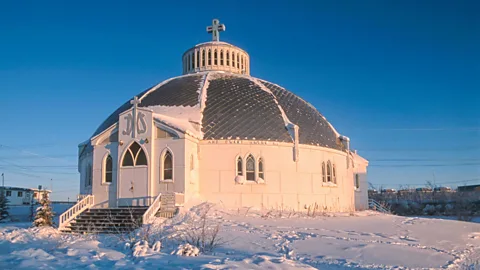
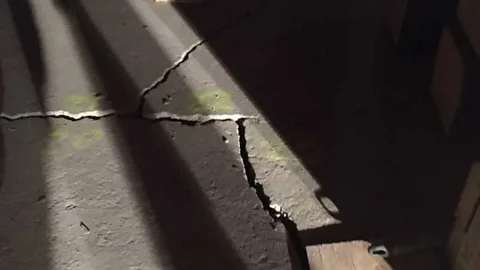
AlamyIn northern Canada, there is one building that reveals just how difficult it can be to mitigate these pressures. The Our Lady of Victory church in the small town of Inuvik was built in the shape of an igloo 50 years ago. The missionary who oversaw its construction later explained that the cylindrical form of the church was intended to help redistribute stresses from the ground as it froze and thawed over time. The church also sits atop a strong concrete slab in the shape of a giant saucer, with a layer of gravel underneath. This has protected the building from frost warping the ground in the past, but with increased permafrost loss, the church has now begun to tilt – like a concrete-bottomed boat slowly pitching on a sea of moving soil.
Jon Hansen, Catholic Bishop for the Diocese of Mackenzie-Fort Smith, knows the church well. He was once its pastor and now the church is part of his diocese. He says the foundational saucer has begun to crack, the floor now slopes unevenly and in some places has risen up to block doorways. It has got so bad that staff must adjust the interior doors every year, to stop them from sticking in their frames.
"The church is still usable but its future is uncertain," says Hansen.
He adds that he thinks warming temperatures have caused the permafrost to thaw, but the church's problems have likely been exacerbated by increased construction nearby. More buildings mean that the ground is less able to cool down.
 Joe Lavoie
In a fight against climate change, staff at the church have explored ways of adjusting the structure to make it more resilient to subsidence, such as replacing wooden posts supporting the building with adjustable steel ones. They have also begun ventilating the crawl space beneath the building's floor, above the concrete foundation, in order to keep the ground below as cold as possible. Local researchers are monitoring these interventions to see whether they prove effective.
The church's design, says Hansen, is a testament to the ingenuity of early Arctic pioneers, but also a warning of how much the global climate is changing. Technology to refreeze the ground and stabilise the church could in theory be installed, but that, says Hansen, would be far beyond the church's budget.
Elsewhere in the Arctic, companies with deep pockets are turning to technology to keep the ground frozen and stable. Some oil companies, for example, install tubes called thermosiphons, which allow heat to escape from the ground and keep it cold, so that the soil supporting their pipelines does not shift enough to endanger their integrity.
 Guy Doré
Among the firms using this approach is ConocoPhillips. According to the company, the devices contain a fluid that circulates passively, bringing heat from the ground to the surface where it then dissipates. The 1,300km (800 mile) Trans-Alaska Pipeline System uses more than 124,000 of these devices.
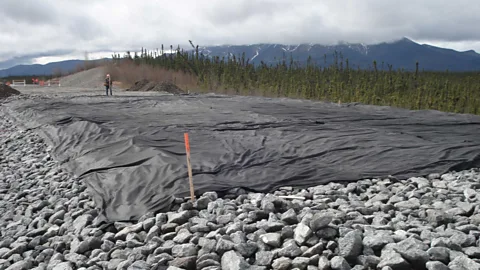
Doré and his colleagues have spent years investigating the efficacy of various other techniques designed to keep the ground cool in the face of rising global temperatures. One simple approach is to build road embankments using large stones that have sizeable gaps between them. The gaps act as pores, allowing heat to escape to the surface.
Experiments along the Alaska Highway between 2008 and 2011 revealed how this could keep permafrost frozen throughout the year. Other measures such as using light-coloured road materials and shielding the road embankment under a wooden shed can also mitigate the effects of warming.
 Brian Mercier
At scale, any of these techniques require significant money and effort, meaning they are not always viable options for road builders. On the Tibetan Plateau, various innovative methods have been adopted. Along the Gonghe-Yushu Expressway that winds its way across the permafrost to the east of Qinghai-Tibet highway, porous rock layers and ventilation ducts allow air to bring heat from beneath the road to the surface, cooling the ground.
"Based on several years of performance monitoring, these mitigation methods appear to have been effective," wrote researchers in the 2020 study.
Doré says he sometimes hears people say that damage caused by permafrost degradation won't be a problem for long, because soon the permafrost in these areas will have all melted away, leaving the ground to settle permanently. But permafrost actually melts incredibly slowly. "We're not going to see permafrost go away in the next 30 years," he says. In fact, engineering problems associated with it will probably continue for the next 100 years. And, given the consequences that would be associated with accelerated climate change and total permafrost loss, that's a day no-one should wish for.
As long as the world keeps warming, ice buried in the ground will keep melting away: damaging buildings, roads and railways. It's already been happening for years – and could get far worse as the slow thaw continues unless we work out a way to halt or reverse it.
--
Join one million Future fans by liking us on Facebook, or follow us on Twitter or Instagram.
If you liked this story, sign up for the weekly bbc.com features newsletter, called "The Essential List". A handpicked selection of stories from BBC Future, Culture, Worklife, and Travel, delivered to your inbox every Friday.
