11 world-changing ideas that fit on a postcard

 Richard Fisher
We asked attendees at our recent event in Sydney to write to us about the big ideas they’d like to see implemented by humanity. Here are some of the best.
How do good ideas succeed? It’s not enough to dream them up, you then have to share them.
As the Editor of BBC Future, people often tell me about their bright ideas to improve the world, and it’s a pleasure to help bring them to a wider audience. This was one of the reasons we decided to hold our World-Changing Ideas Summit last week, featuring speakers from the worlds of science, food, psychology, space travel and more.
During the event, we handed out postcards and asked our attendees to write their own world-changing ideas on the back. Why postcards? We may live in a world of screens and digital discourse, but sometimes the written word feels more personal – more direct – and postcards encourage a brevity and clarity of thought. Indeed, one attendee Natasha Kostaka, wrote on her postcard about the “beauty and simplicity of handwritten notes…the art of writing is a world-changing idea, and even though technology has taken over (to some respects) we should embrace the true art form of writing by hand to express how we feel.” I couldn’t agree more.
 Richard Fisher
Here’s a selection from what people wrote, starting with energy and resources…
Audience member Rachel Carberry proposed an exotic idea to generate electricity:
“Gyms should be freely available to all because the machinery and apparatus within them harnesses energy. Rowing machines and weights should be easy to adapt.”
People also wrote with their ideas for preserving global resources. We’d heard earlier onstage from researcher Veena Sahajwalla about her concept for e-waste “microfactories”, to recycle the gold, platinum and so on from electronic devices. One attendee proposed an idea that goes a step further:
“Make recycled metal by leasing, rather than selling it – it then goes back to the mine to recycle. Now the miner has a choice – recycle, or mine more ore, closing the circle.”
Environmental concerns also motivated one attendee to call for the adoption of intelligent “platooning” of cars and trucks, which could help increase fuel economy:
“For long-hauls, vehicles could connect to form “car-trains”. When close to destination, they could then uncouple and drive independently.”
Food was also a strong theme. Nutritionist Rosemary Stanton had pointed out onstage earlier that Australians are now the world’s greatest consumers of meat, so one attendee argued for the virtues of vegetarianism:
“I think we should all consider moving to a plant-based diet. Greater health and wellbeing, good for environment!”
Our speakers also couldn’t resist feeding in. The BBC TV presenter Michael Mosley wrote to me:
“Hi Richard, as I’m sure you will have guessed, my world-changing idea is to reverse and prevent type 2 diabetes by the eight-week blood sugar diet!”
Mosley has written a book on the diet, which involves low-carbohydrate Mediterranean-style meals, and says it helped him tackle his own diagnosis of diabetes in 2012.
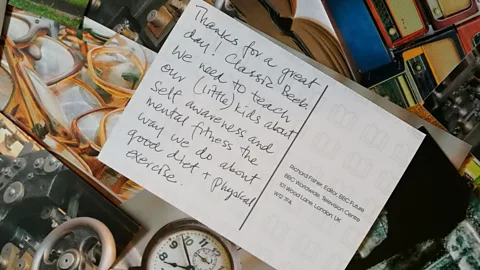
Meanwhile, one attendee argued that promoting healthy eating is not enough:
“We need to teach our (little) kids about self-awareness and mental fitness the way we do about good diet and physical exercise.”
 Richard Fisher
A strong theme that emerged from the day was the importance of widening our perspective on the world. Our keynote speaker, former astronaut Ron Garan, spoke about how going to space changed how he sees the Earth. He lives in Arizona, but when he thinks of ‘home’ now, he pictures Earth instead. National borders, he argued, feel like barriers to understanding when you see them from space.
In that light, audience member Adam Jacobs proposed a radical idea:
“For entire nations to swap countries (live in each other’s geographies) for a period of time. Gain new perspective!”
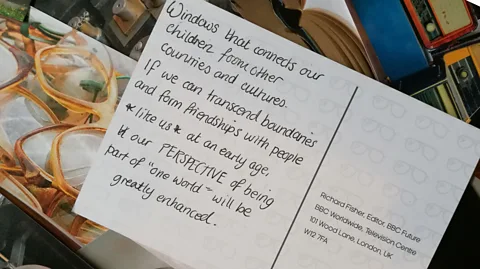
Yes, totally unrealistic, but it could also be read as an appeal for the importance of travel. A perhaps more achievable way to achieve perspective shift was proposed by another attendee:
“Windows that connect our children from other countries and cultures. If we can transcend boundaries and form friendships with people like us at an early age, our perspective of being part of ‘one world’ with be greatly enhanced.”
There’s no reason that technology – webcams, video chat – could not achieve this ‘window’ in schools. Imagine a screen that allows children to communicate with other cultures whenever they choose.
According to one attendee, participatory technology could also play a much larger role in other realms – particularly democracy. They called for:
“A smartphone app to allow a wide voting population…capable of testing whether political ideas are acceptable to the populace. A new form of real-time democracy.”
 Richard Fisher
Finally, there were also a few ideas submitted to make the world just a bit more fun:
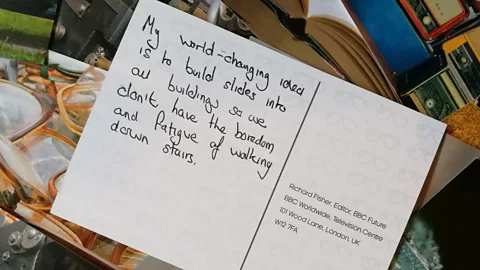
“My world-changing idea is to build slides into all buildings so we don’t have the boredom and fatigue of walking down stairs.”
And one member of the BBC’s event team, who clearly doesn’t enjoy his commute to work, wrote:
“Replace all train carriages with bouncy castles.”
What world-changing idea would you like to see implemented by humanity? Let us know via our Facebook page, or Twitter.
Read more about BBC Future’s World-Changing Ideas Summit.
