Arts and culture stars who died in 2017

 Alamy
Alamy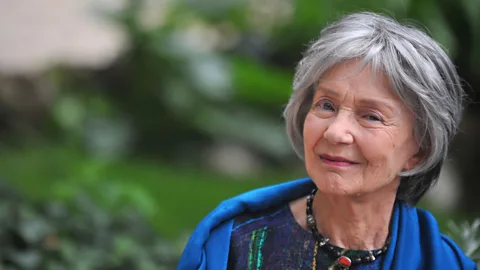 Getty
GettyEmmanuelle Riva
There are so many high points in Emmanuelle Riva’s career that it can be easy to forget the actual number of roles she portrayed was quite small. Falling into acting merely because of an advertisement she saw for a drama school in a French newspaper, Riva went on to play the co-lead in the film that, as much as any, launched the French New Wave: Hiroshima, Mon Amour. A discursive, diary-like collage of passion, grief and remembrance, the film upended cinematic form every bit as much as The 400 Blows or Breathless. Riva’s artistic inquisitiveness took many forms: while making Hiroshima, Mon Amour she took photos of the first city devastated by nuclear war that would later form the basis of a photography exhibition she’d headline. But she’s best known for her acting, as someone who doesn’t really take charge of a film the way a Brando or Dean would but as someone who knew how to serve her character and the vision of the filmmaker – she worked with auteurs as different as Jean-Pierre Melville, Georges Franju, Marco Bellocchio and Michael Haneke in her career. It was her work in Haneke’s Amour that earned her an Oscar nomination in 2013, when she was 85. (The statuette ultimately went to Jennifer Lawrence, but is there anyone who thinks Riva shouldn’t have won?) Riva died of cancer on 27 January, aged 89.
 Alamy
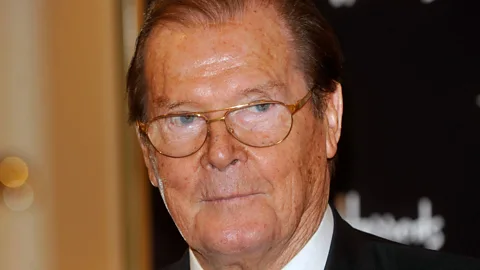
AlamySir Roger Moore
Was Roger Moore the best Bond? It’s debatable. This author thinks so. But how possibly could he compete with Sean Connery, who created the cinematic incarnation of 007? The genius of Moore’s interpretation was that he didn’t even try. His Bond was no Connery retread – he made the secret agent completely his unknown, even if that meant he sometimes planted his tongue firmly in cheek. Certainly, no one can deny that Moore appeared to be the Bond who had the most fun in the role. By his own admission, his acting range was limited – he used to joke that all he could do was arch one eyebrow on demand. But if his talent was that meagre, how did he act in films, including a direct-to-video remake released in 2017 of his signature non-Bond character The Saint, for nearly 70 years? Moore seemed to embody panache, with a velveteen voice and sense of personal style that made him seem like he just won more at chemin de fer than you make in a year – and tipped the croupier handsomely without letting anyone know he did. At 87 he was even on GQ’s list of the 50 Best-Dressed British Men. I raise an imaginary glass of slightly-chilled Bollinger ’73 in your honour, sir.
 Alamy
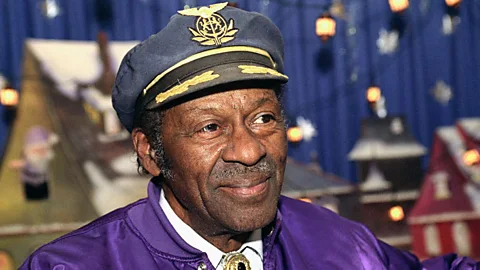
AlamyChuck Berry
Saying that Chuck Berry invented rock ‘n’ roll is like saying George Washington invented America. It’s not accurate, even if it feels right. But certainly Berry was among rock ‘n’ roll’s Founding Fathers. Roll Over Beethoven was his Declaration of Independence – a lyrical statement about breaking with the past, and all its incumbent social, cultural and aesthetic hierarchies, as revolutionary as that document itself. Actually more so, since Berry shattered racial hierarchies as well: every white rock ‘n’ roller who plugged a Stratocaster into an amp from 1955 to 1965 stole liberally from him – The Beatles covered Roll Over Beethoven and Rock and Roll Music, the latter song the Constitution to Roll Over’s Declaration. The Beach Boys covered Rock and Roll Music too and outright stole the guitar intro of Johnny B Goode for their own Fun, Fun, Fun – no matter, Berry had stolen it himself from Louis Jordan’s Ain’t That Just Like a Woman. None of them could touch Berry’s molasses drawl or furious licks. To this day, if you want to crank up a dance party, just put on Maybellene, Brown Eyed Handsome Man or You Never Can Tell. Just 12 months ago, you could have heard Berry, who toured and performed right up until his death on 18 March aged 90, play them live. Made immortal in his songs, does a man like Berry ever truly die? I choose to believe that, like the lyrics of Roll Over Beethoven, it was “the rockin’ pneumonia” that finally claimed him. And whenever we listen to one of his songs he keeps on giving us a restorative shot of rhythm and blues from beyond.
 Alamy
AlamyFats Domino
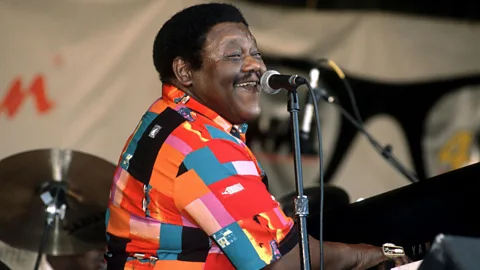
Only Elvis Presley had more hits from 1955 to 1960 than Fats Domino: New Orleans ivory tickler and, like the King and Chuck Berry, a founding father of rock ‘n’ roll. Domino was more deeply rooted in rhythm and blues, though. Music critic Robert Christgau said of Domino’s style, “If rock is a music of voices and guitars, its New Orleans variant is a music of pianos and drums. It rocks, sure, but people love it for the way it rolls.” That’s right, Domino was the roll to Berry’s rock. And maybe a hit song like Domino’s Blueberry Hill was a honky-tonk lament more than a cry from the gut, but lather some more production on it and give his vocals an echo effect and you’d have yourself a Phil Spector track. Listeners knew what they heard was like nothing else before it – his 1949 single The Fat Man was arguably the first real rock ‘n’ roll record to sell a million copies. And he kept rollin’ on, releasing his final studio album in 2006, following false reports that he had died the year before when Hurricane Katrina devastated New Orleans – that last record, titled Alive and Kickin’, to benefit Tipitina’s Foundation, which helps support New Orleans musicians. He died on 24 October aged 89.
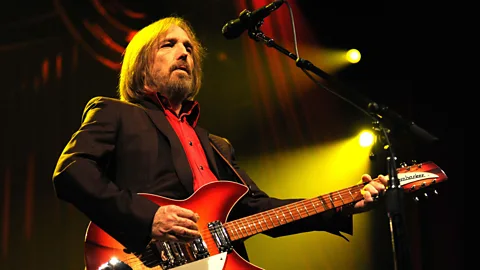
AlamyTom Petty
Tom Petty was celebrated as one of America’s greatest songwriters. After meeting Elvis Presley at the age of 10, he traded a toy slingshot for a set of Elvis records, and was inspired to become a musician at 13. He later said in an interview: “The minute I saw the Beatles on the Ed Sullivan Show – and it’s true of thousands of guys – there was the way out. There was the way to do it. You get your friends and you're a self-contained unit. And you make the music.” He formed Tom Petty and the Heartbreakers in 1976, and went on to have a successful solo career, recording hits such as I Won’t Back Down, Free Fallin’ and Runnin’ Down A Dream on his debut solo album Full Moon Fever, released in 1989. It included contributions from several co-members in George Harrison’s supergroup The Traveling Wilburys, which featured Bob Dylan, Roy Orbison and ELO’s Jeff Lynne. He performed with the Heartbreakers a week before his death, closing their 40th anniversary tour at the Hollywood Bowl – their final song was American Girl. “The American Girl is just one example of this character I write about a lot,” he once said. “The small-town kid who knows there’s something more out there.” Tom Petty died on 2 October 2017 at the age of 66.
 Alamy
AlamyVinod Khanna
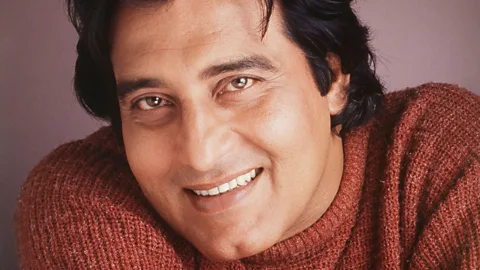
Known as Bollywood’s original heartthrob, Vinod Khanna’s death prompted an outpouring of grief from fellow actors and fans – and Indian President Pranab Mukherjee – on social media. The Indian actor made his film debut in 1968, starting out playing villains before moving on to play the hero: his first break as the solo lead hero was in the 1971 film Hum Tum Aur Woh, followed in the same year by Mere Apne, directed by Gulzar. In 1999, Khanna received a Filmfare Lifetime Achievement Award for a career spanning more than three decades, including romantic roles in Jurm and Chandni as well as action films such as Amar Akbar Anthony. He entered politics in 1997, joining the Hindu nationalist Bharatiya Janata Party and going on to represent the Gurdaspur constituency in northern Punjab in parliament. He was also a junior external affairs minister and culture and tourism minister. Khanna didn’t just settle for popular roles, playing riskier parts like a murder suspect in Shaque, too. He also took a five-year break from acting between 1982 and 1987 to join a spiritual guru, later saying: “I have always been a seeker. In the film industry, I had money, glamour, fame but wondered now what?” Vinod Khanna died on 27 April 2017 at the age of 70.
 Getty
GettySir Howard Hodgkin
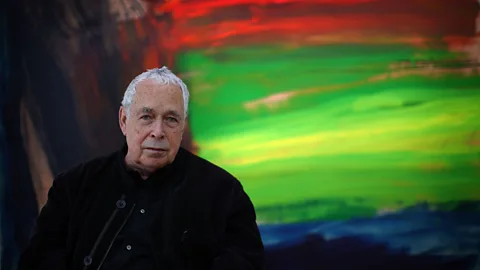
The British painter and printmaker Sir Howard Hodgkin could be a contradictory character. He claimed to be an outsider, yet over the course of his career he was awarded a CBE (1976), a knighthood (1992) and trusteeships of the Tate and the National Gallery. He also represented Britain at the 1984 Venice Biennale and won the Turner Prize the following year. He decided to become an artist at the age of five, but was 30 by the time had his first solo show: he liked to rework his paintings, producing 10 or so a year. Despite being known for his brightly coloured abstract works, he liked to refer to himself as “a figurative painter of emotional situations.” Influenced by the French artist Edouard Vuillard, Hodgkin worked with colour for more than 60 years to become someone who “uses paint like a poet.” By the time of his death, Hodgkin was a master of colour, remarking “I have ways of making yellow melancholy.” Sir Howard Hodgkin died on 9 March 2017 at the age of 84.
 Alamy
AlamySir John Hurt
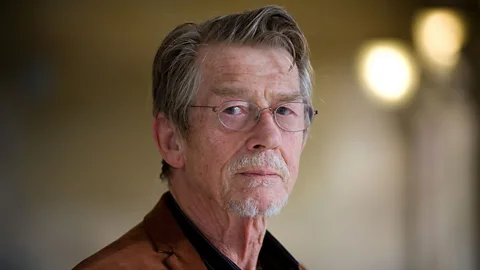
Sir John Hurt once recalled, “as Beckett said, ‘it's not enough to die, one has to be forgotten as well.’” David Lynch called him “the greatest actor in the world”, and he was certainly one of Britain’s best-loved and most versatile performers. Born in Derbyshire in 1940, he rebelled against his strict upbringing by attending firstly art school, then RADA, making his stage debut with the RSC. His theatre roles included Hamlet, Little Malcolm and His Struggle Against the Eunuchs and Krapp’s Last Tape. But it was his performance as the English writer, raconteur and gay icon Quentin Crisp in the TV film The Naked Civil Servant (1975) that really launched his career. It was a role that he would reprise in 2009 in An Englishman in New York. Crisp referred to Hurt as “my representative here on Earth.” Film roles followed, including Alien (1979), in which an extraterrestrial bursts out of Hurt’s stomach – widely considered one of cinema’s most memorable moments – as well as Lynch’s The Elephant Man and Heaven’s Gate (both 1980). In later years, he appeared in Tinker, Tailor, Solder, Spy, the Harry Potter and Hellboy films and in 2013 he played the War Doctor in Doctor Who. Hurt’s marvellously rich tones lent themselves to voice work, notably as Hazel in the terrifying children’s animation of Watership Down (1978) and as Aragorn in an animated version of The Lord of the Rings. With a reputation as a hell-raiser in his younger years, Hurt was married four times and is survived by his wife Anwen Rees-Myers and two sons. When asked about regrets, Hurt said, “Someone once asked me, ‘Is there anything you regret?’ and I said, ‘Everything!’ Whatever you do, there was always a better choice.” He died on 25 January 2017 at the age of 77.
 Alamy
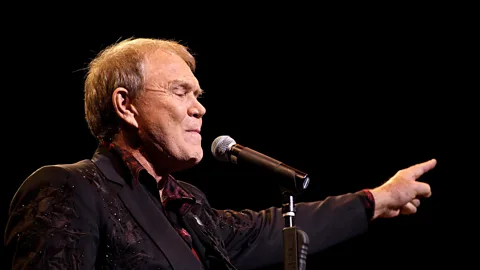
AlamyGlen Campbell
Glen Travis Campbell was born in 1936 in Billstown Arkansas, the seventh son of 12 children. In his youth, fascinated by the jazz guitarist Django Reinhardt, he quickly picked up the instrument and left home for Los Angeles, where he became a player with a group of session musicians known as the Wrecking Crew. Fellow group member Leon Russell referred to Campbell as “the best guitar player I’d heard before or since.” He scored a big break in 1964 by filling in for Brian Wilson after the Beach Boys singer had a nervous breakdown. “He fit right in,” said Wilson. Campbell’s first hit was Universal Soldier, a cover of an anti-war song by Buffy Sainte-Marie, and further hits in the 1960s and ‘70s included Gentle on My Mind, Wichita Lineman, By the Time I Get to Phoenix and the 1975 smash Rhinestone Cowboy. He made Grammy history in 1967 by winning four awards in both the country and pop categories, and in the late ‘60s he branched out into other territories, appearing in the 1969 film True Grit. After a successful stint guest hosting the Smothers Brothers Comedy Hour in 1968, Campbell fronted his own television show, The Glen Campbell Goodtime Hour, which featured country stars such as Kenny Rogers and Johnny Cash. Married four times, he struggled with drug and alcohol abuse, becoming sober but relapsing in 2003 before becoming a born-again Christian. In 2011 he announced that he had been diagnosed with Alzheimer’s disease and allowed a crew to follow him on his final tour for the film I’ll Be Me, becoming a public face for the condition. He released his final album, Ghost on the Canvas, and was accompanied by three of his eight children on the farewell tour. Campbell received the Grammy Lifetime Achievement Award in 2012. He died on 8 August 2017 at the age of 81.
 Alamy
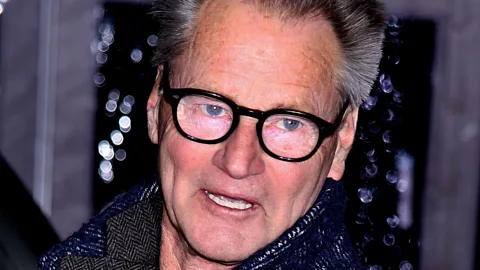
AlamySam Shepard
The actor, screenwriter and playwright Sam Shepard was considered one of the leading lights in US theatre, creating his own vision of America by deconstructing and questioning its archetypes, myths and heroes. He wrote around 50 plays, including the Pulitzer Prize-winning Buried Child (1978), True West (1980) and Fool for Love (1983), becoming the second most-performed US playwright after Tennessee Williams. Like Williams, Shepard excelled at capturing dysfunctional families trapped in domestic locations. It was described by Ryan Gilbey for The Guardian as “like Beckett performed in cowboy duds.” Shepard also wrote and co-wrote several film screenplays, including Antonioni’s Zabriskie Point (1970) and Wim Wenders’ Paris, Texas (1984), which won the Palme d’Or that year at the Cannes Film Festival. He also ventured into prose and music, collaborating with Bob Dylan on the singer’s Rolling Thunder revue and co-writing his song Brownsville Girl. He had a high-profile relationship with Patti Smith and a brief one with Joni Mitchell. His longest-running and most highly scrutinised love affair, however, was with the actress Jessica Lange – their somewhat tumultuous relationship lasted nearly 30 years and they had two children together. Possessed of classic movie-star looks, as an actor Shepard’s most notable early performances were as a dying farmer in Terrence Malick’s 1978 film Days of Heaven and as the pilot Chuck Yeager in The Right Stuff (1983). Growing craggier in his later years, Shepard starred in an adaptation of Cormac McCarthy’s All the Pretty Horses (2000), The Assassination of Jesse James by the Coward Robert Ford (2007) and as a grizzly patriarch in Netflix’s Bloodline (2015). His other films included Steel Magnolias (1989), Black Hawk Down (2001) and August: Osage County (2013). He died on 27 July 2017 at the age of 73.
 Alamy
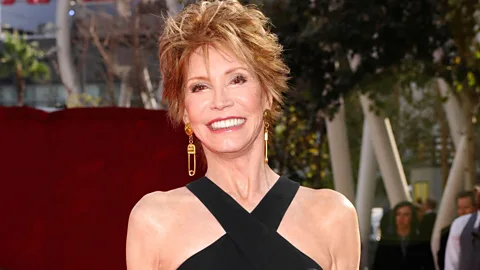
AlamyMary Tyler Moore
Mary Tyler Moore’ is often credited for changing the landscape for women in entertainment. She was best known for her roles in the 1960s sitcom The Dick Van Dyke Show and The Mary Tyler Moore Show, which ran from 1970 to 1977 and was named by Time magazine as one of 17 shows that changed television. Ahead of its time, weaving issues from equal pay to infertility and homosexuality into comedic plots, the show received an Emmy for outstanding comedic series three years running. Moore’s turn, as a single woman navigating modern life, helped female actors to break away from the traditional and unassuming housewife role and into more colourful, amusing and fallible characters. MTM Enterprises, which she created with her second husband Grant Tinker, produced the show and other programmes including Hill Street Blues and Remington Steele. In the film Ordinary People, Moore’s performance as a bitter mother who loses her son in an accident earned her Golden Globe and Oscar nods. In her memoir, After All, Moore revealed that her own life had been peppered with tragedy and turmoil. She suffered from alcohol problems, while her family life was rife with substance abuse and addiction: her younger sister died of a drug overdose aged just 21, and her only child, Richie, born during her first marriage to Richard Meeker, struggled with drug abuse and accidentally shot himself dead aged 24. A type 1 diabetic, Moore campaigned for advances in treatment of the disease, and was a supporter of animal rights. Her husband Robert Levine, a doctor who had treated her mother, was by her side when she died on 25 January at the age of 80.
 Alamy
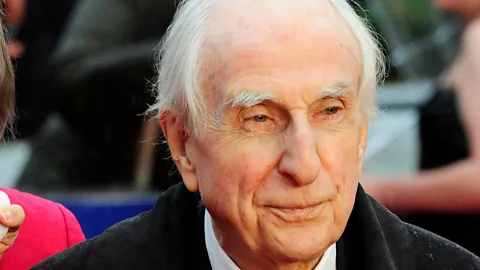
AlamyMichael Bond
In June, the world lost one of its most beloved children’s authors in Paddington Bear creator Michael Bond. His first book, A Bear Called Paddington, was published in 1958. While a teddy bear purchased for his wife inspired the form of Bond’s most famous character, Paddington’s mild manners and ever-present hat were inspired by Bond’s father, a local post office manager. Inspiration for Paddington’s overriding story – that of a bear looking for a home – had subtly taken root with Bond during World War Two. "I had memories of children being evacuated from London with a label around their necks and all their possessions in a suitcase, and this became part of Paddington as well," he said. "Paddington Bear was a refugee with a label - 'Please look after this bear. Thank you.’” His career took him from positions in the RAF and British Army to longstanding work with the BBC, but Bond was always a prolific writer, with other successful books and TV series including The Herbs, Olga da Polga and Monsieur Pamplemousse, a retired detective turned restaurant critic always accompanied by his bloodhound, Pommes Frites. All of Bond’s creations were punctuated with endearing characters and his distinctively wry humour, giving them an enduring appeal. In 2014, StudioCanal released a feature film of Paddington, in which Bond had a cameo role. He called the film "absolutely delightful". Its sequel, released this year, stormed the box office. More than 150 Paddington titles have been published, and more than 35 million copies sold worldwide in more than 40 languages. Paddington's Finest Hour - letters from the bear to his Aunt Lucy in Peru - was published in April of this year. Michael Bond died on 27 June 2017 at the age of 91.
 Alamy
AlamyAzzedine Alaïa
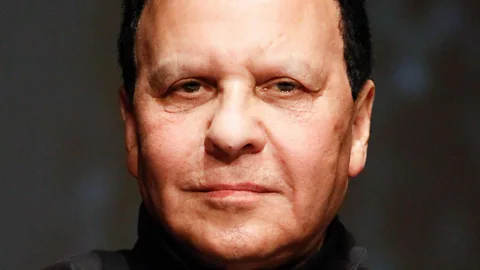
Fashion designer Azzedine Alaïa was known as the ‘King of Cling’ because of his artfully flattering, body-conscious dresses. He was a master of cut, and his sculpted creations fitted their wearers like a second skin. A diminutive, maverick outsider, he became a leading figure in fashion throughout his long and creative career. He was born the son of a Tunisian farmer, he then went on to study sculpture in Tunis. Nuns taught his twin sister Hafida to sew, and she passed on her skills to her brother so that he could support himself. Having moved to Paris he was soon being commissioned by the city’s glamorous set, and he created dresses for Greta Garbo, the Rothschild family, and dancers at the famous Crazy Horse cabaret. He founded his own fashion house in 1979, and went on to create alliances with many strong and talented women, dressing the likes of Grace Jones, Cindy Crawford and Tina Turner. He was loved and respected by his peers, and a father figure to supermodel Naomi Campbell, having helped her in her early days of modelling. She called him ‘Papa’. He died on 18 November 2017 at the age of 77, and is survived by his partner, the painter Christoph von Weyhe.
 Alamy
AlamyAnita Pallenberg
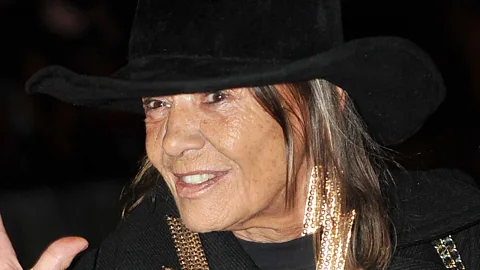
The German-Italian actress, model and artist Anita Pallenberg encapsulated 1960s glamour, and was best known as one of the decade’s favourite It girls and the muse of the Rolling Stones. She was in a relationship first with Brian Jones and later with Keith Richards, with whom she had three children. Born in Rome, she was expelled from boarding school as a teenager, and made her way to New York where she spent time at Andy Warhol’s Factory. Then in Paris she started modelling and was soon also acting. She appeared in more than a dozen films, including Roger Vadim’s Barbarella, and the avant-garde Performance. More than a muse, Pallenberg also played a role in shaping the look and sound of the Stones, and once said “I feel as though I’m rather like the sixth Rolling Stone.” She also provided backing vocals, along with Marianne Faithful, for the classic Stones’ song Sympathy for Devil. After overcoming a struggle with drug addiction, in later life she studied as a mature student, completing a fashion course in London. The quintessential rock chick, she appeared as herself in the film, Absolutely Fabulous. Pallenberg died on 13 June 2017 at the age of 75.
