The imaginative, elegant furniture of Latin America

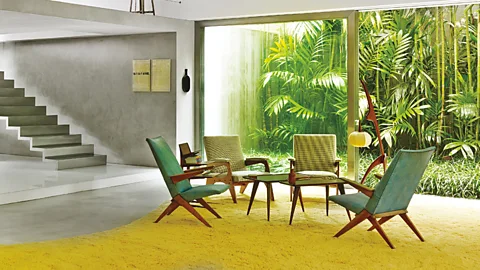
At this year’s Design Miami fair, exhibits by designers from Brazil and Chile are taking centre stage. It’s about time, says Dominic Lutyens
For years overshadowed by the more famous output of European and North American designers, Latin American design is finally taking centre stage. The work of key South American creatives such as the late architect and designer Sergio Rodrigues, artist and designer Joaquim Tenreiro and artist, designer and architect José Zanine Caldas may be less well-known than that of internationally renowned US luminaries Charles and Ray Eames, say, or France’s Jean Prouvé and Charlotte Perriand. But the region’s furniture and homeware are being recognised for what they are - an important part of the mid-century design canon.
 Espasso/ Eliseu Cavalcante
There is a growing demand for both mid-century and contemporary Latin American design, judging by its strong presence this year at Design Miami/, the annual fair held at Miami Beach (from 6 to 10 December), where 31 international galleries are taking part.
Embracing colour and idiosyncratic, sculptural forms, mid-century-modern design offered a more relaxed alternative to strictly functionalist early 20th-Century modernism. And, arguably, Latin American furniture is one of the most expressive branches of mid-century design: its chunky, sculptural, often hand-made forms were fashioned from indigenous woods, such as jacaranda (a type of rosewood) in rich, syrupy hues, leather and rattan. And, since the 1980s, younger designers, notably the São Paulo-based Campana Brothers, have upheld this tradition, creating work that prioritises form over function.
 Espasso/ Eliseu Cavalcante
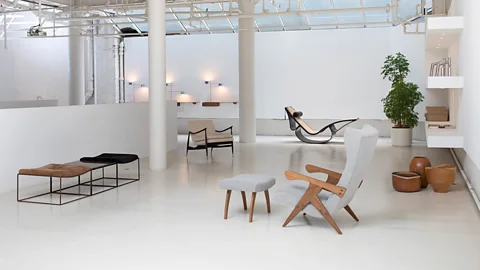
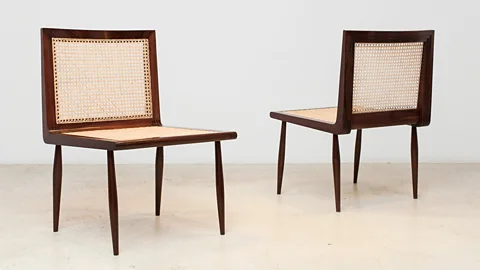
ESPASSO, a gallery with a permanent location in Miami, sells vintage, re-edition and contemporary Brazilian design by Sergio Rodrigues, Zanine Caldas and Joaquim Tenreiro, and is unveiling its newly expanded gallery in Ironside. Tenreiro, who was born in Portugal, and moved to Rio in the 1920s, created work that bridges a European modernist aesthetic with more ruggedly sculptural Brazilian qualities. He created sleek, European-looking sideboards yet his 1940s rocking chair in rattan and dark rosewood — on show at Rio gallery Mercado Moderno — epitomises the Brazilian taste for organic forms. Tenreiro created many pieces for celebrated Brazilian architect Oscar Niemeyer, whose aesthetic was similarly organic.
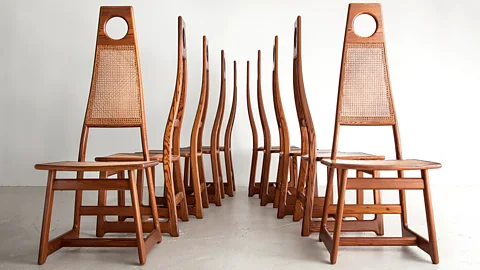
Meanwhile, at Design Miami/, New York gallery R & Company, which also sells Scandinavian and Italian mid-century furniture, will display Rodrigues’ Mesa Parker pine dining table and 10 pine-and-cane dining chairs, created in 1978. The tall chairs have an anthropomorphic air, suggesting people seated around a table. They are narrow at the top with circles cut out of the wood evoking human heads, while their curving backrests recall human spines.
 Sergio Rodrigues/ R & Company
“This set gets its name from the Parker family who commissioned it for their home in Rio de Janeiro,” says the gallery’s founder Zesty Meyers. “It’s the first time we’re showcasing this work. It was Rodrigues’ favourite design, and demonstrates his mastery of craft and proportion.”
In fact, the relationship between avant-garde, mid-century Latin American architecture and furniture is partly responsible for the renewed interest in South American design. “Design didn’t attract us to Brazil, it was Niemeyer’s architecture that did,” says Meyers, who co-founded his gallery in 1997. “We were interested in how he reimagined architecture in Brazil, which led us to travel there and discover work by Tenreiro, Rodrigues and Zanine Caldas.”
This view accords with one theory that Rodman Primack, chief creative officer of Design Miami/, has for why Latin American furniture is popular. “Part of what drives collectors is the new worlds they discover through collecting. They learn about a country’s history, culture, its design language and get excited about finding out more,” he says.
 Fernando Laszlo/ courtesy of Friedman Benda and Estudio Campana
Yet political regimes have sometimes made it impossible for collectors to make such discoveries — as happened in Brazil until democracy was restored to the country after years of military dictatorship. “The world didn’t have access to Brazilian design before the 1980s as it was illegal to export it during the dictatorship [from 1964 to 1985],” says Meyers. “So Brazilian modern design is truly the last great discovery of mid-century furniture.”
It’s no coincidence, therefore, that Brazilian design began to flourish again in the 1980s. Spearheading the revival were The Campana Brothers whose jagged, metal 1989 Flama chair is on display at Mercado Moderno. In some ways, their work represents a break from the Brazilian mid-century modernists in that they show no interest in using high-quality Brazilian wood: their iconic 1990s Favela chair is made of raw wood chips. Yet the name references the country’s favelas.
 Courtesy Friedman Benda and gt2P
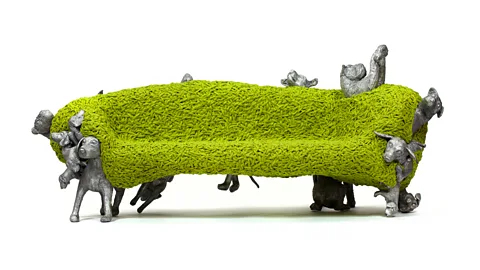
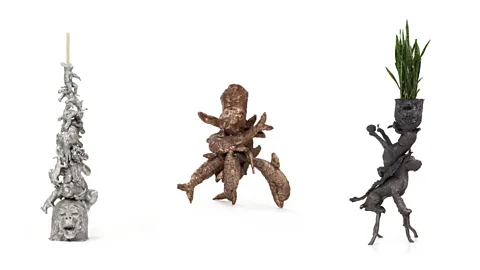
And like the mid-century modernists, the Campana Brothers rejected functionalism and took things even further, creating utterly wayward, eccentric work. On view at New York gallery Friedman Benda are pieces from the Campana Brothers’ thoroughly madcap 2017 Hybridism collection, including its Noah bench whose lime green upholstery is supported by a pack of cast-aluminium dogs.
 Fernando Laszlo/ Courtesy of Friedman Benda and Estudio Campana
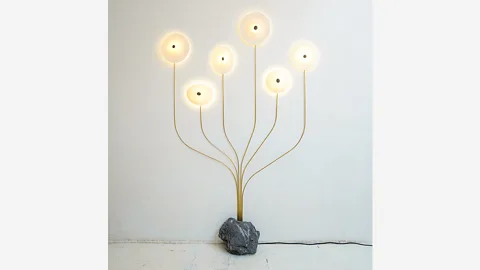
Friedman Benda is also showing pieces by GT2P (short for Great Things to People), a Chilean outfit founded in 2009. These include a light with a lava rock as a base, brass arms and ceramic shades as well as stools made of Chilean lava which has been subjected to the same firing method as the one used for ceramics. New ideas were being generated in Latin America in the postwar years and are proliferating once again in the 21st Century.
For more information, visit Design Miami and ESPASSO
To comment on and see more stories from BBC Designed, you can follow us on Facebook, Twitter and Instagram. You can also see more stories from BBC Culture on Facebook and Twitter.
If you liked this story, sign up for the weekly bbc.com features newsletter called "If You Only Read 6 Things This Week". A handpicked selection of stories from BBC Future, Culture, Capital and Travel, delivered to your inbox every Friday.
