‘The moment when things can start again’

 Hamza Al-Ajweh/AFP/Getty Images
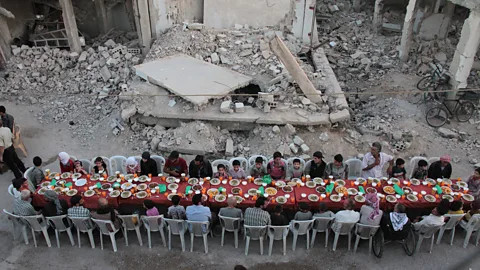
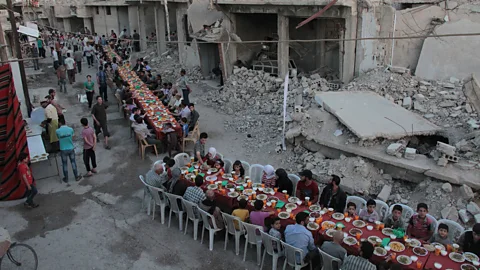
Inhabitants of the besieged rebel-held Syrian town of Douma broke their Ramadan fast in the open air this week. Kelly Grovier looks at how people have defied the chaos of ruins.
In the Frame
Each week Kelly Grovier takes a photo from the news and likens it to a great work of art.
The history of art and literature is strewn with ruins. Artists and poets – from Nicolas Poussin to William Wordsworth, from Salvator Rosa to Sylvia Plath (whose poem Conversation Among the Ruins conjures the “bleak light” of “fractured pillars”) – have been drawn to the time-whittled columns and broken bas reliefs of once vital cultures that have since evaporated. “The stones here speak,” the 19th-Century German poet and essayist Heinrich Heine wrote in 1828, “and I understand their dumb language … I am a ruin myself, wandering among ruins.” The slow disintegration of ancient structures that Heine saw all around him as he journeyed through Italy – “a broken pillar of the time of the Romans, a crumbling Lombard tower, or a weather-beaten Gothic arch” – appeared to him as outward projections of his inner being: “they seem to feel deeply what I am thinking”.
The romance of wreckage and eerie allure of decay niggled uncomfortably in the back of my mind this week with the circulation in the news of photos from the rebel-held, war-ravaged Syrian town of Douma. The affecting images document how the ravages of unromanticised destruction figure in the lives of those for whom rubble is not a picturesque aesthetic to be pondered poetically but a terrifying fact of everyday existence.
 Hamza Al-Ajweh/AFP/Getty Images
Determined not to be deterred from celebrating the breaking of the Ramadan fast, Douma’s residents laid out in the open air long banquet tables for a joyous feast amid the shattered facades of buildings recently hammered by repeated airstrikes. Suddenly, in the light of these extraordinary photos, countless lyrical landscapes we encounter on the walls of museums – from Claude Lorrain to JMW Turner – darken into irrelevance. Re-read through the cruel lens of Douma, the Romantic habit of likening external ruination with interior distress seems, too, in retrospect a kind of naive indulgence.
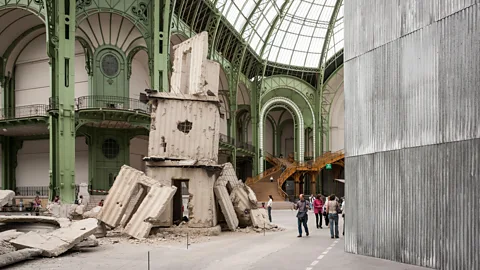
For a more sensitive parallel with the affecting photos from Douma, one must turn instead to an artist whose imagination was forged from the trauma and debris of cultural wreckage. Born just two months before the Nazis surrendered to the Allies in May 1945, the German artist Anselm Kiefer has long been obsessed by the forces that destroy civilisation and by the resolve that regenerates it. In 2007 for his ambitious installation as part of Paris’s Monumenta art initiative, in which a large work fills the nave of the Grand Palais each year, Kiefer invited visitors into ramshackle rooms he’d constructed amid the rubble of broken concrete slabs and crumpled sheets of corrugated iron.
 Victor Korchenko/Alamy
A pair of teetering towers rose precariously from Kiefer’s orchestrated shambles. Describing the audacious ambience of his work, the artist gave voice to a sentiment that could as easily describe the fortitude of the residents of Douma as the motivating spirit of his own work: “I feel ruins are moments when things show themselves. A ruin is not a catastrophe. It is the moment when things can start again.”
If you would like to comment on this story or anything else you have seen on BBC Culture, head over to our Facebook page or message us onTwitter.
And if you liked this story, sign up for the weekly bbc.com features newsletter, called “If You Only Read 6 Things This Week”. A handpicked selection of stories from BBC Future, Earth, Culture, Capital and Travel, delivered to your inbox every Friday.
