A leap into the unknown

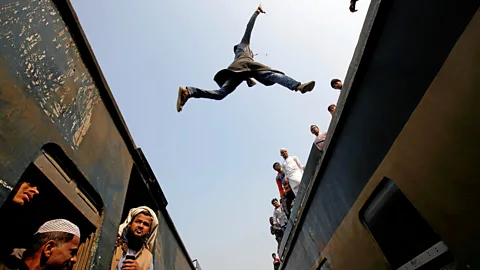 Mohammad Ponir Hossain/Reuters
Photos of rail passengers jumping from train to train in Bangladesh this week prompted Kelly Grovier to look at an artist who took flight for a moment that’s been frozen in time.
Is there a more life-affirming action one can take than to leap? When the American astronaut Neil Armstrong became the first human being to set foot on the moon, he immediately cast the “small step” he’d taken in the sprightly language of a “leap”. Leaping is how, in a single bound, superheroes conquer tall buildings and how the rest of us respond to lucky breaks. We don’t hop at life’s chances, we leap at them. Progress is never measured in titanic vaults, but in quantum leaps. When the Romantic poet William Wordsworth was deeply moved by the evaporative sight of a rainbow, his spleen didn’t shiver; his heart leapt up. And when we’re tired of waiting for the right moment to act and are finally ready to make our move, we don’t mosey into motion; we leap into action.
Mohammad Ponir Hossain/ReutersLeaping alters us from passive spectator on life to active agent in it. Acrobatic images captured this week in Bangladesh of rail passengers leaping from train to train in the town of Tongi, on the outskirts of Dhaka, seem to embody the very essence of existential leaping. Making their way to the Biswa Ijtema, the world’s second-largest gathering of Muslims after the Hajj, the spry commuters who bounded energetically from carriage to carriage appeared to exemplify the devotional verve that the Danish philosopher Søren Kierkegaard famously described not, as is often misremembered, a “leap of faith” but rather a “leap to faith”.
Such exuberant bounding is, needless to say, propelled by boundless confidence that there will be space for a safe landing on the other side. The terrifying prospect that there is no stable ground on the other side of that abyss calls to mind another memorable photo, one created at a moment in cultural history when lasting world peace seemed equally unpredictable.
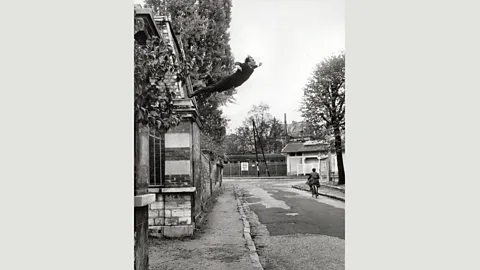 Wikimedia
French post-War artist Yves Klein’s photomontage Le Saut dans le Vide (Leap into the Void), which Klein spliced together in October 1960, shows the artist hurling himself precariously from a Parisian window – his lobbed body frozen forever on the verge either of taking flight or of plummeting perilously to the pavement below. Perceived by some as a comment on Nasa’s (at the time) lofty ambition to reach the moon and by others as a response to the accelerating iciness of Cold War relations, Klein’s Leap into the Void captured for many the dicey mood of the moment. Fifty-six years later, the world once again finds itself suspended in mid air – one foot pointing backwards to whom we were in the past, the other forward, to whom we wish to be.
If you would like to comment on this story or anything else you have seen on BBC Culture, head over to our Facebook page or message us onTwitter.
And if you liked this story, sign up for the weekly bbc.com features newsletter, called “If You Only Read 6 Things This Week”. A handpicked selection of stories from BBC Future, Earth, Culture, Capital, Travel and Autos, delivered to your inbox every Friday.
