Why we see these legs as shiny

 Hunter Culverhouse
All it takes is a few strokes of white paint to transform our perceptions, writes Kelly Grovier.
It doesn’t take much to send social media into overdrive, or, for that matter, to turn a 17th-Century portrait into an incontestable masterpiece. All you need is a dab of pure white paint and a functional primary visual cortex. Taken together, those two key ingredients – one available from any good art shop, the other found in the occipital lobe of every human brain – are responsible for the magic behind both a viral photo that’s currently wrecking the eyes of internet users all around the world and one of the most hypnotic paintings in Western art.
 Hunter Culverhouse
What started innocuously at the beginning of the week as nothing more than a quirky point-of-view snap of an Instagram user’s legs has quickly escalated into an internet sensation on a scale not seen since the hotly contested colour of ‘that dress’ in 2015 made the world want to tear its eyes out. At issue in the current hullabaloo is whether we initially perceive an unusual slickness to the skin, as if the legs had been oiled, or whether we see merely a few streaks of white paint smudged on her bare outstretched pins.
In the 48 hours since the photo of Hunter Culverhouse’s legs was re-posted on Wednesday by a mischief-making Twitter user, social media hasn’t stopped wringing its hands over what is and isn’t visible. Particularly unnerving to some viewers of the photo has been their inability to re-see the initial shininess that they had first perceived and to unsee the painted streaks that – look away now if you don’t want to know the score – are really what’s responsible for conjuring the appearance of glossiness.
Though the deceptively simple optical trick has caught the world by surprise this week, in fact the principle behind it is a very familiar one to many, even if they don’t realise it. The illusion is a product of our suggestibility as a species – an innate impressionability with which our brains are hardwired. Put simply, our minds are desperate to comprehend larger patterns – an evolutionary proclivity that has helped us survive and thrive. (Shininess, in this case, is arguably the larger pattern capable of explaining the streaky glare of white paint, so we extrapolate.)
 Wikipedia
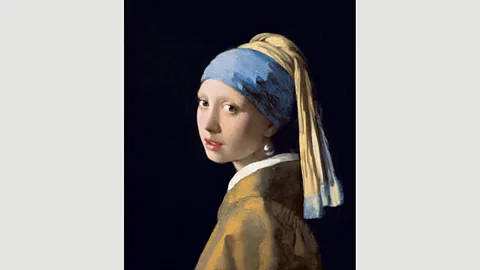
Great artists have long understood and instinctively exploited the tendency of our primary visual cortices to leap to unfounded conclusions. All it takes is for the 17th-Century Dutch master Johannes Vermeer to entitle his painting Girl with a Pearl Earring for our brains to begin forming pearls out of thin air. Incorrigibly susceptible to persuasion, our imaginations embellish the daintiest dabs of white paint that Vermeer has insinuated beneath the girl’s ear into the hefty opulence of a preposterously enormous pearl that, in actual fact, is barely hinted at all by the artist’s brush. Ultimately, the mind sees what the mind wants. And the mind always wants something shiny.
If you would like to comment on this story or anything else you have seen on BBC Culture, head over to our Facebook page or message us onTwitter.
And if you liked this story, sign up for the weekly bbc.com features newsletter, called “If You Only Read 6 Things This Week”. A handpicked selection of stories from BBC Future, Earth, Culture, Capital, Travel and Autos, delivered to your inbox every Friday.
