The exciting and innovative buildings opening in 2018

 Kengo Kuma & Associates
Jonathan Glancey rounds up the beautiful architecture coming to a city near you in 2018.
 Heneghan Peng
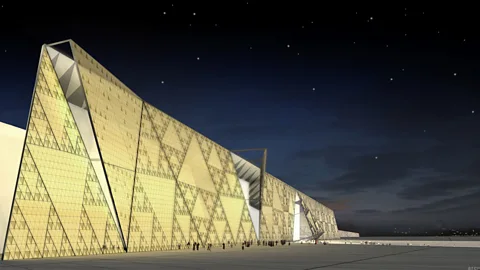
In development and construction for the past 15 years, the Grand Egyptian Museum is scheduled to open in 2018. Here you will find all 5,000 items of the Tutankhamun collection on display among a wealth of ancient Egyptian treasures, many stored for decades or never seen before.
The new museum, set on a desert plateau 2 km from the pyramids of Giza and screened by an astonishing translucent alabaster wall, is a phenomenal design, a thing of complex geometry and an appropriate degree of architectural sorcery.
Its Irish architects – Róisín Heneghan and Shi-Fu Peng, their design chosen from 1,557 entries from 82 countries – have given generous accommodation to a permanent collection of 50,000 objects attended by a conference centre, temporary exhibition space, conservation laboratories, an 800-seat auditorium and the ancient gods only know what. The pyramids themselves remain enigmatic and enticingly unexplained.
 JKMM
JKMMAmos Anderson (1878-1961) was a Finnish Member of Parliament, proprietor of the Swedish-language Hufvudstadsbladet newspaper, art collector and patron. In 1913 he commissioned his own office and home in Helsinki.
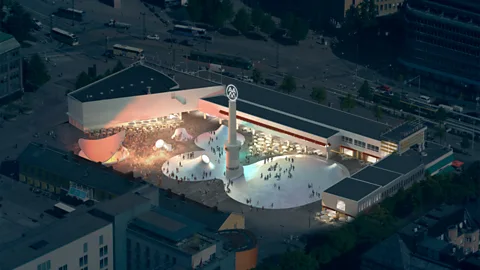
Since 1965 this handsome building has been home to the Amos Anderson Museum, its extensive collection of 19th and 20th Century Finnish art and an acclaimed temporary exhibitions programme. Now, the museum is expanding into a spacious new home, Amos Rex, opening on August 1. Designed by Helsinki’s JKMM architects, Amos Rex centres on an impressive 2,000 sq m exhibition hall set under a public square that was once the city’s central bus station.
Sculpted skylights clustered around a streamlined 1930s clock tower mark the museum’s presence. The exhibition hall connects to a cinema-auditorium and restaurant housed in a much-loved Modernist pavilion (1936) designed by the young Finnish architects Viljo Revellin, Heimo Riihimäen and Niilo Koko, and since sympathetically renovated by JKMM.
 Adrian Smith + Gordon Gill Architecture
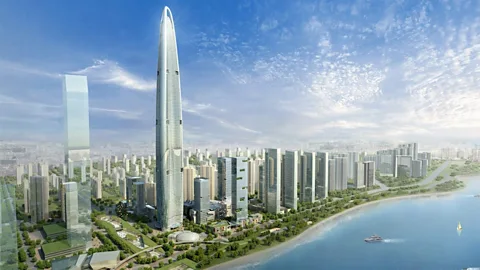
Wuhan – 530 miles (850 km) west of Shanghai - is often referred to as the “Chicago of China”, its US-style skyscrapers rising above a waterfront defined by the confluence of the Yangtze and Han rivers.
The latest addition to Wuhan’s skyline is the 2,087 ft (636 m), 120-storey Wuhan Greenland Center, designed by Chicago architects Adrian Smith and Gordon Gill. Smith’s credits include the Burj Khalifa in Dubai, the world’s tallest building.
The $4.5 bn Greenland Center, seven years in the making, is an adventure in skyscraper aerodynamics, its soft, rounded and tapered form designed to minimise wind loads on the structure and to maximise the flow of fresh air within the tower to keep energy consumption as low as possible. Its sleek structure will house offices, apartments, a hotel and, at the top, a club with a bar set under a spectacular elongated steel and glass dome.
 Kengo Kuma & Associates
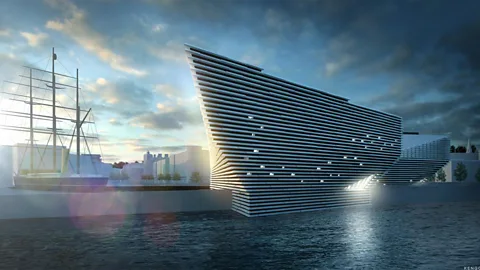
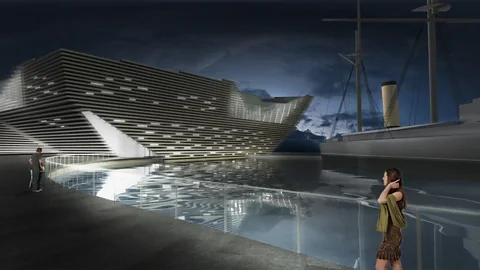
Looking like a cross between a surreal ocean liner and a serrated cliff face, Scotland’s first design museum faces the River Tay along the newly redeveloped Dundee waterfront.
When it opens in the summer of 2018, it will be the first British building by Kengo Kuma, the Japanese architect whose work includes the exquisite Bato Hiroshige Museum of Art in Nakagawa, dedicated to the popular work of the woodblock print artist Andō Hiroshige, whose imagery captured the imagination of Frank Lloyd Wright.
Where the Nakagawa museum has the appearance of a filigree timber structure, the Dundee V&A is a muscular concrete design containing 1,650 sq m of gallery space within its three floors. One permanent exhibit will be the Oak Room from Miss Cranston’s Ingram Street Tearooms, a 1908 design for Glasgow by Charles Rennie Mackintosh, Scotland’s best-known architect who was hugely influenced by Japanese design.
 Royal Botanical Gardens Kew
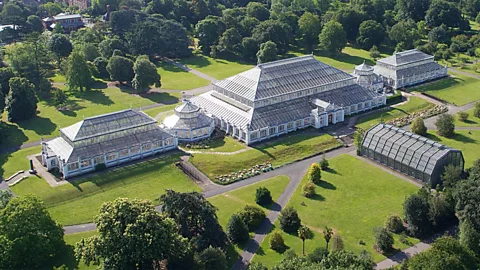
Closed for five years while undergoing a thorough restoration, the gloriously ambitious Victorian iron and glass Temperate House at London's Kew Gardens re-opens on May 5.
Created by Decimus Burton, and first opened in 1863, its design, along with Burton’s earlier Palm House at Kew, was an important source of architectural and engineering inspiration for new forms and types of 20th Century buildings, among them railway stations, air terminals and even shopping malls. The Grade 1 listed building has been taken apart and re-assembled, with new heating and drainage systems, some re-organisation of its floor space and other improvements difficult or even impossible to see.
The Temperate House, with its collection of 10,000 plants from around the world promises to be better than new. This painstaking and meticulous work has been carried out by Donald Insall Associates, a firm with 60 years of experience in bringing fresh life to historic buildings.
 Crossrail
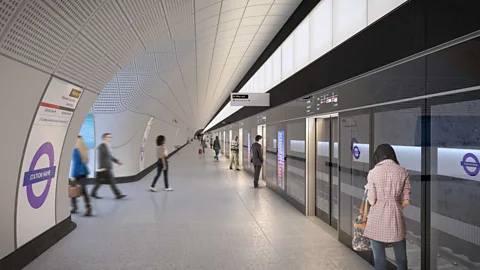
Operating, at first, in three linked sections between Reading and Abbey Wood in southeast London and Shenfield in the city’s northeast via Heathrow Airport, Paddington, Liverpool Street and 21 kms of new tunnels, the long-awaited Elizabeth Line opens in December.
A year later, it will be fully operational with passengers travelling its length without having to change trains. Whatever the initial complications, this cross-London railway – still best known as Crossrail – is a considerable engineering achievement.
It will also boast ten brand new stations, above and below ground, each crowned by one or more ambitious, light-filled concourses designed by seasoned British architects. Among them: Weston Williamson (Paddington), John McAslan (Bond Street), Hawkins Brown (Tottenham Court Road), Aedas (Farringdon) and Wilkinson Eyre (Liverpool Street). Each station is generously planned for maximum passenger flow, and all lead down to smoothly curved subways and platforms designed throughout by Grimshaw Architects.
 Foster and Partners
Narbonne, in southern France, was founded as a Roman colony in 118BC. Ships sailed from here to Rome, while overland traffic used the Via Domitia, the main road from Italy to Spain. Re-founded by Julius Caesar, the city’s importance grew.
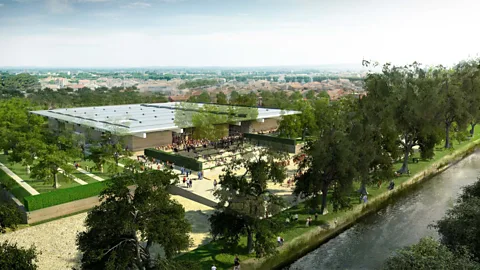
Not surprisingly, Narbonne is rich in Roman archaeology, so much so, that a new museum dedicated to the conservation, interpretation and display of thousands of artefacts opens in 2018 on the site of a former Roman fort. It will be known as MuRéNa. Exhibits take pride of place in this building by Foster and Partners, while a long, low structure sits under a precast concrete roof with deep eaves to fend off the Mediterranean sun.
The interior is divided by a long wall displaying a thousand funerary monuments, with gaps so visitors can see through to the conservation studios on the other side. Public galleries lead out to gardens complete with a new amphitheatre for open-air events.
 OMA
OMA“The design for BLOX”, says Rem Koolhaas, principal of the Dutch architectural practice OMA, “is a linear display of the tenets of Danish Modernism: monumentality, simplicity and politeness.” Lego bricks again? Not quite.
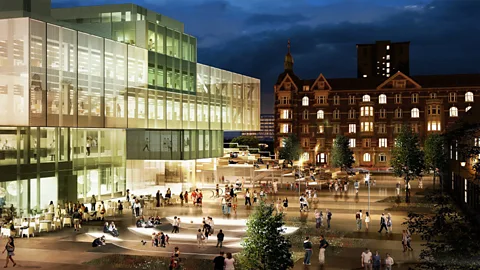
In response, perhaps, to the continuing tidal wave of buildings worldwide configured in wild and bizarre shapes, OMA has designed the new Danish Architecture Centre in the guise of an interlocking sequence of otherwise inexpressive steel and glass boxes. What the building lacks, deliberately, in aesthetic waywardness, it gains in the ways in which it will be used.
Set in the old port of Copenhagen, BLOX is home to offices, apartments, conference rooms and cafés all geared around the wider worlds of architecture and design. The building is a public meeting place, a fact reinforced by the covered alley that slices through it at pavement level creating a weather-proof walkway between the city centre and the port.
