TV review: Good Omens

The apocalyptic fantasy series based on the comic novel by Terry Pratchett and Neil Gaiman has been eagerly awaited. But does it live up to expectations? Nicholas Barber gives his verdict.
After 30 years and almost as many near misses, Terry Pratchett and Neil Gaiman’s apocalyptic comic fantasy novel, Good Omens, has finally made it to the screen – and, for its legions of fans, it will have been worth the wait. Scripted by Neil himself (to use his Twitter handle) and directed by Douglas Mackinnon, the ambitious six-part Amazon series has a ridiculous number of big names in front of the camera (including Michael Sheen, David Tennant and Jon Hamm) as well as behind it (David Arnold composes the programme’s devilishly catchy melodies, and Tori Amos sings the final song). The novel’s aficionados will feel as if their prayers have been answered. But anyone who was a doubting Thomas where the book was concerned will have problems with the adaptation, too.
More like this:
- The horrors of the near future
- Game of Thrones finale review
- Israel’s unexpected hit TV show
The story begins 6000 years ago: Biblical scholars once calculated that that was when God created the Earth – and Good Omens takes that calculation as gospel. Adam and Eve are cast out of Eden thanks to the wiles of a demon named Crowley (Tennant), but they’re given some help, and a flaming sword, by an angel named Aziraphale (Sheen). From then on, Crowley has the job of tempting humanity to perdition, and Aziraphale has the job of nudging us in the other direction. But they soon realise that they quite enjoy each other’s company, as well as enjoying life on Earth in general, and so they’re shocked to learn, in present-day London, that the world is about to end. The Antichrist – an 11-year-old boy – has been prophesied to trigger an all-consuming war between Heaven and Hell, but the angel and the demon agree that if they can track him down, they might be able to persuade him to delay the End of Days. They just have to make sure that no one from Heaven or Hell notices what they’re doing.
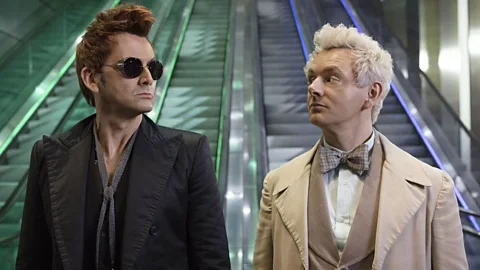
Gaiman has made some shrewd changes to his and Pratchett’s original narrative. (Pratchett himself died in 2015.) He develops the unlikely bromance between Aziraphale and Crowley, so that these celestial beings’ friendship is more touching and, well, human, than it is on paper. Sheen is especially lovable as the anxious, bow-tied angel who would love to stick to God’s ineffable plan, but who can’t bear the thought of an eternity without Stephen Sondheim musicals and tea at the Ritz. Tennant’s louche, rock’n’roll demon may sometimes come across as a Bill Nighy impersonator, but anyone who warmed to his swaggering Doctor Who persona will relish seeing what that same persona would be like with the addition of a bottle of bourbon. Gaiman also bumps up the number of other angels and demons (most notably the archangel Gabriel, played by Hamm as a bumptious corporate boss) who pop into Aziraphale’s vintage bookshop and Crowley’s bachelor pad to keep them on their toes. They fill the first episode with an air of spy-movie jeopardy that the novel doesn’t have.
Unfortunately, it’s an air that dissipates as the series goes on. The issue is that there is a huge number of sequences in Good Omens that doesn’t involve Aziraphale and Crowley, and while all of that peripheral material boasts lavish costumes, decent digital effects and lively performances, none of it is anywhere near as tense or as funny as the central duo’s mission. There is a dishevelled witchfinder (Michael McKean, with an amusingly mangled Scottish accent) who hires a drippy new assistant (Jack Whitehall), and lives next door to a kindly sex-worker (Miranda Richardson). There is a 17th-Century witch (Josie Lawrence) who can see the future, and there is the witch’s beautiful American descendent (Adria Arjona), who tries to figure out what her ancestor’s prophecies might mean. And then there are the Four Horsemen of the Apocalypse – or the Four Bikers of the Apocalypse, as they’ve become – as well as the mop-topped Antichrist and his friends, who romp around an Oxfordshire village in blissful ignorance of their earth-shattering importance.
If that weren’t enough, we drop in on Christ’s crucifixion, the French Revolution, Shakespeare’s Globe and World War Two. We visit the shiny white headquarters of Heaven and the shadowy bustling corridors of Hell. And we hear God’s own narration, as voiced by Frances McDormand. All of these scenes are entertaining, in a self-congratulatory sort of way. But how much do they have to do with whether an angel and a demon can prevent the destruction of mankind? For most of the series, the answer is very little.
The tangential structure won’t put off the book’s devotees, who adore it not for its plot but for its studenty jokes, its mischievous commentary on Christianity, and its leaps from continent to continent, and from century to century. But everybody else will be asking if it was strictly necessary for the series to ramble on like this for six hours.
To give you some idea of how leisurely it all is, the fate of humanity is resolved near the beginning of the last episode, which leaves about 40 minutes of loose-end tying: whenever you think you’ve watched the final scene, Gaiman adds another final scene and then another. That would be frustrating enough with any story, but it is particularly problematic when the story is about the ultimate race against time: the countdown to Armageddon. Let’s face it, if a TV series can’t imbue the imminent obliteration of everything and everyone on the planet with a sense of urgency, then it has to be doing something wrong. Animated signposts keep swinging onto the screen to tell us how many days and hours are left until doomsday, and yet Good Omens meanders along as if it had all the time in the world.
★★★☆☆
Love TV? Join BBC Culture’s TV fans on Facebook, a community for television fanatics all over the world.
If you would like to comment on this story or anything else you have seen on BBC Culture, head over to our Facebook page or message us on Twitter.
And if you liked this story, sign up for the weekly bbc.com features newsletter, called The Essential List. A handpicked selection of stories from BBC Future, Culture, Capital and Travel, delivered to your inbox every Friday.
