Eleven Days: When Agatha Christie went missing


In an exclusive short story for BBC Culture and BBC Britain, Kate Mosse writes a fictional account of the 11 mysterious days when the popular crime writer vanished.
Eleven Days
A sharp slip of cold air as she winds down the window. A laundered handkerchief to clean the inside of the windscreen. Black trees, the glitter of frost and sentinel silhouettes of houses thrown up by the pale headlamps of her Morris Cowley. White board road signs. Milford and Guildford and Hurtmore.
Silence.
The woman in a fur coat and velour hat, driving through the Surrey Hills on a late Friday evening in midwinter. Past the Silent Pool, Albury Mill Pond, circling back again to Newlands Corner, then stopping. Engine off, handbrake on. Her eyes closing, and sleep.
Did the woman dream, then? Or perhaps, was there a wonderful absence of stories? Of other voices in her head. Peace and darkness, no reality to bear. No memories, no loss. That dark and muddy track marking the before and after of her different selves: Miss Miller, Mrs Christie, Agatha.
Is that what had happened?
Celia leans back in her chair by the window. A pool of yellow light from the floor lamp and a paperback book open face-down on her lap, even though she is not reading. Her eyes are tired and her legs ache after an afternoon of shopping and reminiscing. Thinking of the woman she once met, all those years ago.
December 1926. The Harrogate Hydropathic Spa.
Seventy years ago. Celia had been fourteen. Gauche, shy, wishing herself anywhere other than with her parents in a respectable Yorkshire hotel. She noticed Mrs Neele immediately when she arrived early that Saturday evening: reserved, elegant in her grey stockingette skirt, green jumper and grey cardigan, carrying only a small overnight case. Her luggage was coming on, she explained to the manageress, Mrs Taylor, as she signed the register.
Room Five on the first floor, Mrs Neele, at a cost of five guineas a week?
Perfectly acceptable, thank you.
Just back from South Africa, you say?
That's right. I shall look up my relatives as soon as I have… settled myself.
Quite so. Quite.

Another evening, Mrs Neele coming down to dinner in a pink georgette dress and matching shoes. She was private, seemed happy in her own company, but kind. Kind enough to talk to Celia – when most of the adults looked through her – in the Winter Garden Ballroom after dinner. Mrs Neele had been reading The Phantom Train, a mystery Celia too had borrowed from the WH Smith lending library and enjoyed.
The scent of lavender water and pale blue eyes, fair hair turning a little to grey, a thoughtful expression. Celia noticed Mrs Neele wore no wedding ring, that she settled down to The Times crossword as she took her after-dinner coffee. Celia confided she was missing her dog and Mrs Neele admitted she, too, had a terrier of whom she was very fond. And Mrs Neele liked her name so very much. Celia. From Shakespeare's As You Like It? A pretty name, like Rosalind…
It was a conversation that lasted only a few minutes, but held precious in Celia's memory ever since. Words like a string of pearls.
Did Celia know, then, who Mrs Neele really was? Everything seems clearer now with the benefit of hindsight. The colours are painted bright, our gaze direct and without prejudice. She understands now that memory is a shifting, perfidious thing, so she cannot be sure.
All Celia can say for certain, looking back to those 11 days in December 1926, is that the newspapers were increasingly full of the disappearance of the famous lady crime writer. How Mrs Agatha Christie, wife of Colonel Archie Christie of Sunningdale, had gone missing on the evening of Friday 3rd December.
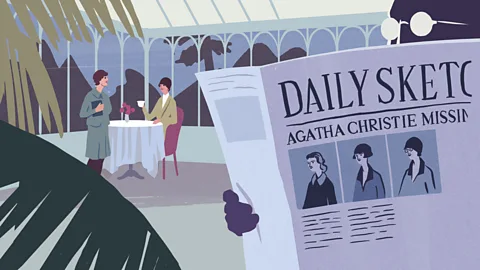
How although her Morris Cowley motor car had been found the following morning, Mrs Christie had not.
Missing. Presumed dead?
Monday 6th, Tuesday 7th, Wednesday 8th, Thursday 9th December. Red letter days all.
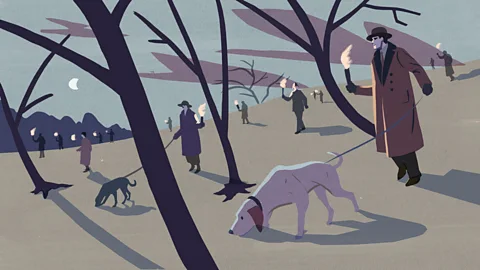
They were dredging the neighbouring ponds, so the dailies said. They were searching the North Surrey woods. A woman matching Mrs Christie's appearance had been seen here, or there, or elsewhere – in distress or in disguise, with or without a hat.
Each day the column inches grew longer and the numbers of people involved in the manhunt swelled. Five men, fifty, five hundred, a thousand. Police officers, well-wishes, naysayers, local women. Was any of it true, Celia wondered at the time. And how could anyone claim to know the mind of another? Mediums and psychics tried. Even the celebrated crime writer Mrs Dorothy Sayers was to help, or so the scribblers claimed.
The Daily Mail, The Daily Express, The Mirror, The Sketch and The News published photographs old and new, composites of how Mrs Christie might look if she had altered her hair or put on a pair of spectacles. There was a studio portrait with her young daughter, Rosalind.
Articles brim-full of speculation and insinuation and motivation. Could it actually have been an accident? A bout of amnesia? Or a publicity stunt?
Or murder ....
Really, it could have been one of Mrs Christie's own plots.
One night, to Celia's mortification, her mother made a vulgar attempt to engage Mrs Neele in conversation. What a beautiful shawl… and have you seen today's headlines? It's obvious, is it not, that her husband killed her? A lovers' quarrel, or so I heard. The servants have talked.
And Celia's father had remarked on how much Mrs Neele resembled the missing authoress. Why, you could quite be sisters, he said.
Thursday tipped into Friday, into Saturday. The temperature held. No snow. Mild for December. Visitors departed, others arrived to take their place. Christmas shopping and the Roman Baths. Carafes of the health-giving water on every table and brown paper packages delivered to reception. Lights along Promenade Crescent and, in the West Park, the doors of St Peter's, candlelit, open to those seeking refuge.
But there was a muttering beneath the surface. A sense that the Harrogate Hydropathic was about to play its part in some larger drama. A sense of a secret about to be told. The mirror cracking from side to side.
The chambermaids gossiped and, though Celia heard them being scolded by Mrs Taylor, they did not stop. In the dining room, beneath the blowsy stained-glass ceiling, guests exchanged glances. While the bridge players cut for the first rubber of the evening, and Mrs Neele sang in her beautiful soprano to Miss Corbett's accompaniment, and some danced and danced to the tunes of the Happy Hydro Band, eyes fell greedily upon the final newspaper editions.
Whispers carried all the way from Yorkshire to the Fleet Street news desks. The respectable anonymity of the hotel was slipping away.
Then, the end.
On Tuesday 14th December, Celia looked down from the first-floor landing to see a man, worn out with fuss and bother, sitting in an armchair in reception: Colonel Christie, newly arrived on the London train to claim his wife.
Their reconciliation was quiet, not at all romantic to Celia's young expectations. It spoke of relief rather than love. And although speculation spiralled like smoke, obscuring as much as enlightening, the official line remained the same as the awkward words Celia had heard spoken by Archie Christie on that evening in December – that his wife had lost her memory, that she was suffering from nervous exhaustion, that she did not know who she was.
Two years later, the Christies were divorced and Archie married his 'friend', a Miss Nancy Neele. Two years after that again, Celia read in her father's newspaper that Mrs Christie was on honeymoon with her new husband, the archaeologist Max Mallowan.
Now, in the darkening room, Celia pulls her cardigan tight around her thin shoulders, and thinks how odd it is that those 11 days should continue to so vex writers and biographers and commentators. That fans and critics alike, even now, feel cheated by Mrs Christie's refusal to talk about it, save that one interview given to the Daily Mail. Thinking they have a right to know.
Celia turns over her book and returns to a sentence underlined in one of her favourite Marple stories: 'What I do realise is that women must stick together – one should, in an emergency, stand by one's own sex.'
Is that what Celia has been doing all of these years? She supposed so, though she had no secret to keep. Mrs Neele – Agatha Christie – had not confided in her, of course she hadn't. They had exchanged a few, pleasant words, little else. And yet it still mattered a great deal to Celia that she had held her tongue. Had shared nothing of what she'd heard or seen or understood during those 11 days.
It seems extraordinary to Celia that they all fail to realise that the clues to that period are there for all to see. For where else should one witness the workings of a writer's heart, her head, but in the pages of her books? Was it possible they had not read Endless Night or Sad Cypress, The Man in the Brown Suit, Harlequin's Lane, The Lie?
So many shards of evidence, fragments of human nature, the ways in which a person's life might fall to pieces. Stories where a wife loses her husband to a younger woman or where the desire to flee, to escape, dwarfs everything. Darkness across the face of the sun. Distress and loss, the ways in which ordinary women and men pick themselves up and brush themselves down.
A story within stories. Hidden in plain sight.
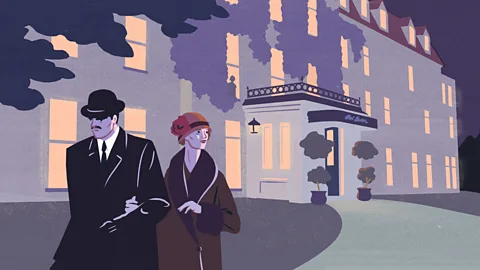
Celia gets out of her chair, glances at her travelling clock; soon it will be time for her to go down to dinner. Through the window, the Montpellier Quarter glitters confidently in the distance, beyond the driveway. It is The Swan Hotel now, but it's not so very different from the old days. The Christmas lights are gaudier, the families noisier and less well behaved. But the grey walls of the Victorian facade are still covered in ivy and the frost still sparkles in the lights from the long hotel windows. Another old lady, aging well.
Celia applies a little powder and lipstick. Changes her comfortable cardigan for a blouse and shawl, blue shot through with green. An anniversary ritual, a nod to the past. She turns off the light and walks down to dinner. Along the first-floor corridor, where the boards still squeak beneath the carpet. Down the stairs to the reception area, where Colonel Christie once waited for his lost wife.
A glass of sherry tonight, Celia decides, to raise a toast to an extraordinary woman whom she once met. A pleasant supper. The Times crossword.
Or, perhaps, a new detective story.
If you would like to comment on this story or anything else you have seen on BBC Culture, head over to our Facebook page or message us onTwitter. This story is a part of BBC Britain – a new series focused on exploring this extraordinary island, one story at a time. Readers outside of the UK can see every BBC Britain story by heading to the Britain homepage; you also can see our latest stories by following us on Facebook and Twitter.
