The new tech that detects deadly slides on rubbish mountains

 Getty Images
Australian researchers are developing software to anticipate landslides on rubbish mountains – potentially helping the millions who live and work on them
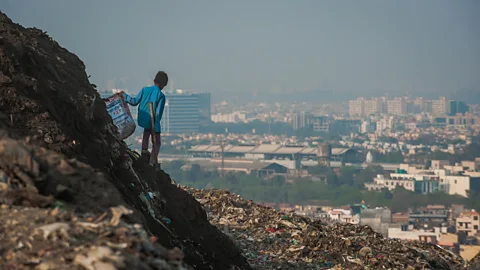
Nearly 15 million people live and work within sprawling municipal rubbish heaps around the globe, scavenging through trash each day for discarded scraps they might sell. These “garbage cities” are made up of shanty houses built from wood and sheets of corrugated metal and plastic. Families live among piles of medical and electronic waste, household rubbish and broken glass, even toxic waste. These rubbish piles are naturally more prone to landslides, as unsteady mountains of trash can suddenly come tumbling down without warning.
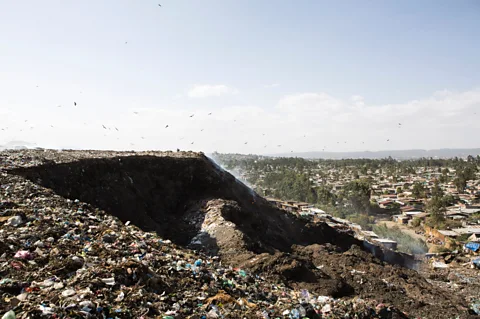
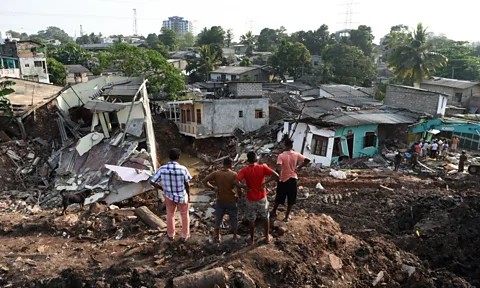
Manila’s Payatas dump, one of the largest garbage cities in the Philippines and home to nearly 10,000 residents, collapsed in 2000, triggering a landslide 30m high and 100m wide that left more than 200 people dead. In 2015, a landslide swept through a massive rubbish dump on the outskirts of Ethiopia’s capital, killing over 100 people and destroying makeshift homes.
The survival rate for those engulfed in such disasters is low, given the nature of the material and the potential for methane gas to build up inside pockets created within the mass - poisoning those trapped within. And the future holds much more garbage: according to the World Bank’s “What a Waste” report, the global population is expected to generate 3.40 billion tonnes of waste annually by 2050, increasing drastically from today’s 2.01 billion tonnes.
 Getty Images
A group of Australian researchers have recently developed software that may be able to detect landslides as far as two weeks in advance, giving rubbish heap residents time to evacuate and engineers the opportunity to secure terrain. The AI system makes use of applied mathematics to help identify signs of an impending slide: miniscule cracks and subtle movements that presage a violent downward cascade. The hope is that artificially intelligent systems like this one might someday help monitor garbage city slopes and prevent disasters from reoccurring.
“We have been studying data on movements in granular materials to understand their ‘rhythm of failure’,” explains Professor Antoinette Tordesillas, of the faculty of science at the University of Melbourne and one of the lead authors of the study. Her laboratory experiments involved various types of granular material (i.e. sand, concrete, ceramics, rocks) which were loaded to failure - that is, until the solid disintegrated into pieces and collapsed. “What we discovered is a distinct rhythm in the stages preceding the collapse,” says Tordesillas.
Her technology uses the laws of physics to “steer AI to identify the right pattern efficiently”: that is, algorithms take into account ground motion, the dynamics of failure and known triggers of landslides such as rainfall (which weakens the grip between rubbish items and particles) in order to produce reliable data. Eventually, this data could be used to provide early, real-time prediction of slides in places like garbage cities, underground mines and steep mountain slopes.
A natural slope is made up of earth particles such as rocks or clay which have been bonded together over thousands of years. A rubbish dump, by contrast, is made up of solid waste particles like plastics, glass, metals, organic matter, paper and the like, which loosely hold their shape until a disturbance weakens them. Instability of dumpsites can happen for several reasons: improper compaction of waste, inadequate provision for drainage systems, decomposition of organic waste and potential slip surfaces within heaps of trash, moisture, methane-build-up explosions and dumping waste in excess of design capacity.
“Some of these factors make early waste slides’ prediction more difficult than earth slides,” says Isaac Akinwumi, a lecturer in Geotechnical Engineering at Nigeria’s Covenant University. The need for robust predictive technology is thus critical, particularly where developing countries are concerned: rubbish heap slopes there are often steeper than regulations allow in the US or the UK, material isn’t compacted in the same way and waste management companies don’t make site stability a priority, all of which can contribute to the propensity for slides. “If Professor Tordesillas’ tool can provide early warning before waste slides occur, then it will be a vital tool for preventing landslide disaster,” says Akinwumi.
 Getty Images
Indeed, such technology might be able to turn data into actionable intelligence - the coordinates of an impending slide, for example, or information that helps workers make the call between reinforcement or an evacuation. In order for the proposed AI system to work, however, researchers and the waste management organisations they partner with will have to overcome financial, political and regulatory hurdles.
For instance, industry experts will need proof that the technology works. It will cost money to assess risks and install the technology —costs that local operators might not be willing to take on — and displacing local residents during either the reinforcement or evacuation phases would be logistically difficult. Finally, the technology won’t eradicate long term environmental problems of the dump itself, such as air emissions, disease outbreak and toxic run-off.
Hazards associated with dump slides are one of the reasons leading waste associations are now urging that these garbage cities be closed and replaced with more modern facilities or controlled landfills. “Testing this technology to see whether it provides a solution to the growing problem of rubbish slides is certainly worthwhile,” says David Biderman, CEO of Solid Waste Association of North America (SWANA). “In fact, it may be a good interim improvement on the path to closing the dumpsite.” Biderman is all too familiar with the growing problem of garbage cities, and has worked to make SWANA a more internationally-facing company.
Solid waste is a growing problem that affects not just those who live in the direct shadow of its squalor, but those who are many thousands of miles away; as nations and cities become more populated and prosperous, offer more products and services to citizens, and participate in global trade and exchange, they face corresponding amounts of waste to manage through treatment and disposal. While not a panacea and still very much in its formative stages, this technology has the potential to transform waste disaster relief efforts, allowing for a geo-targeted approach to landslide event prediction, international aid and prevention.
--
To comment on this story or anything else you have seen on BBC Capital, please head over to ourFacebook page or message us on Twitter.
If you liked this story, sign up for the weekly bbc.com features newsletter called "If You Only Read 6 Things This Week". A handpicked selection of stories from BBC Future, Culture, Capital and Travel, delivered to your inbox every Friday.
{"image":{"pid":""}}
