The people making bags out of worthless money

 Dylan Baddour
Hyperinflation has ravaged Venezuela’s economy, and its old bolivar notes are worth next to nothing. But for some enterprising artists, these useless notes are an economic opportunity.
 Dylan Baddour
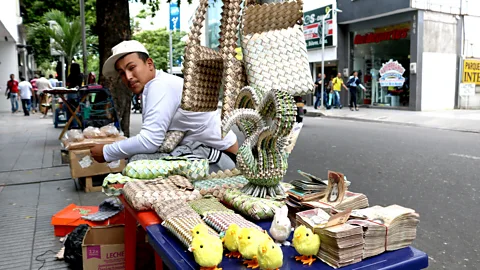
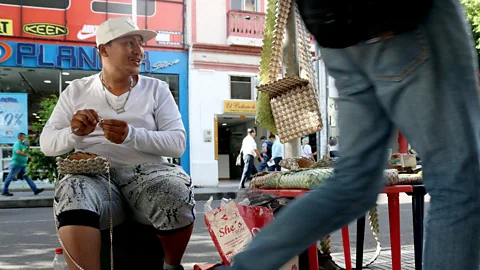
The collapse of Venezuela’s currency has wrecked its economy, driving millions of its people to hunger and extreme poverty. Artists like Edison Infante, 23, have turned the country’s worthless money into an asset, weaving banknotes into purses and bags.
Like millions of others, they have left their country. Now they work in the Colombian border city of Cúcuta to support their families back home.
Their art has attracted buyers from across Colombia – and the world – for its surreal symbolism of a failed economy.
 Dylan Baddour
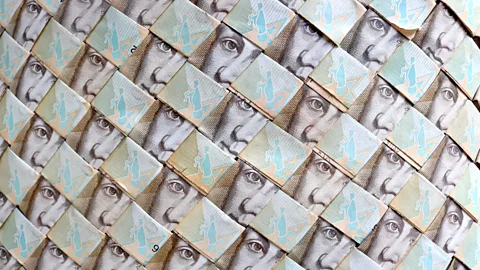
The bags can include more than a thousand bills, worth just a handful of US cents.
These creations sell for between $7 and $15 – enough money, Infante says, to feed a family for at least two weeks in Venezuela.
 Dylan Baddour
Hyperinflation has evaporated the savings accounts and destroyed the wages of the Venezuelan people.
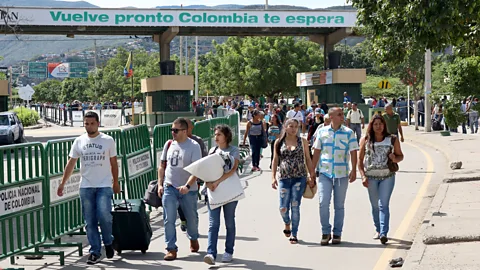
Every day, tens of thousands of Venezuelans cross the border to Cúcuta, a city on Venezuela’s western border about 680km south west of Caracas.
They cross to work, to buy food that’s scarce at home, or to migrate throughout South America.
 Dylan Baddour
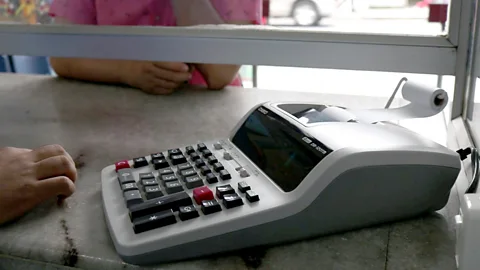
The IMF has predicted Venezuela’s annual inflation rate will hit 1,000,000% by the end of the year.
In an attempt to curb runaway inflation, the government recently created a new currency – the sovereign bolívar – worth 100,000 old bolívars. But there’s no sign of the crisis abating, and critics say it could make the situation worse.
 Dylan Baddour
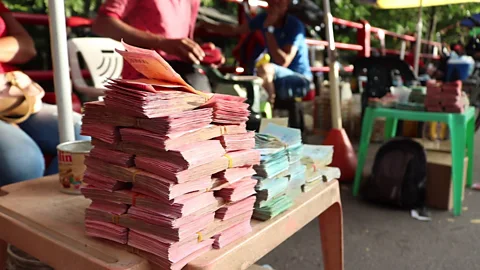
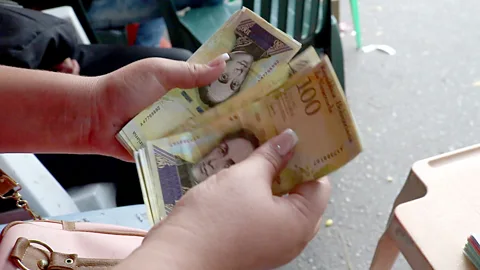
At the Venezuelan border, unofficial money changers sit watch over plastic tables heaped with bundled 20,000, 50,000 and 100,000 bolívar bills – the new sovereign bolívar hadn’t yet arrived to Cúcuta at the time of writing.
Every day, thousands of Venezuelans return home from a day of work in Colombia, changing a handful of coins for a stack of bills on their way back.
 Dylan Baddour
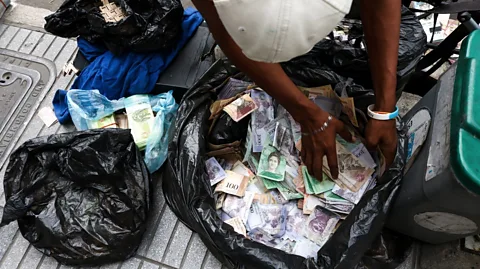
Older bills in lower denominations are treated like rubbish, like 10 bolívar banknotes printed in 2011, 100 bolívar banknotes printed in 2015 or 1,000 bolívar banknotes printed in 2016.
The artists buy bills in bulk, paying $1 or more per sack of cash, more than the notes are actually worth. Here, Jorge Corderos sifts through his art supply, noting that he started out making bags from two and five bolívar bills.
“We never imagined we would be using a 5,000 bill,” he says.
 Dylan Baddour
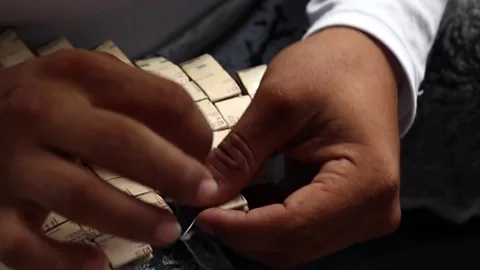
Cordero learned the technique – folding paper into chains that are stitched together – in prison in Venezuela. There it was done with any discarded materials like magazines, sweet wrappers or food packaging.
The banknote is a far superior material, he says: waterproof, smooth and strong.
 Dylan Baddour
For Infante, the bolívar bags have been a blessing at a dark time. The novelty of apparel made from money and its link to current events means he can live relatively well while many Venezuelans scrape by selling candies or labouring.
With just one sale a day, Infante can get by. Twice, people from Bogota have bought in bulk to resell in the Colombian capital. Americans and Italians have also loaded up on Infante’s bolívar bags to take home.
Infante hopes his craft can get him out of the depressed border zone and into other big cities where he could make more money, like Bogota in Colombia or Lima in Peru. But his real hope, he says, is to someday return to a peaceful Venezuela.
