One surprising idea to help solve a water crisis

 Amanda Ruggeri
Arid Jordan faces refugee and water challenges, but these women are here to help
 Amanda Ruggeri
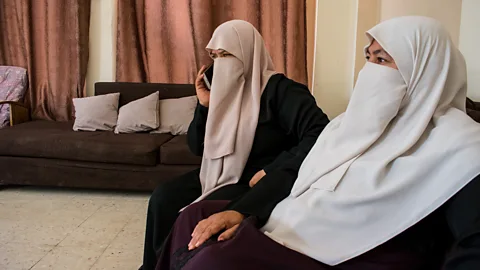
When I meet Tahani Shatti and her cousin Khawla Shatti, they pull me in for a warm greeting: a squeeze and three kisses, one on the left cheek, two on the right. They are confident and composed. Over biscuits and cardamom coffee, Tahani in particular punctuates her answers with easy laughs.
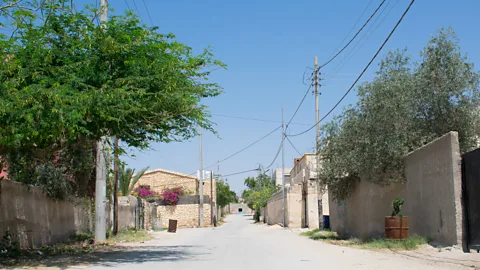
The women weren’t always this self-assured, they tell me. Several years ago, Khawla had never entered a foreigner’s house. And Tahani hardly ever went beyond a five-minute drive from her home in Jofa, shown here, a small village in Jordan just a few kilometres from the Dead Sea. For errands, she would take a taxi from her house to the grocery store, then return home.
That’s no longer true. “Now I can go all around Jordan, from one governorate to the other, and I’m not afraid. I don’t lose my self-confidence,” Tahani tells me through an interpreter. “I’ve totally changed. I have the most important things: money to do what I want, and the self-confidence to do it.”
The reason? The women started a new career… a particularly surprising one.
 Amanda Ruggeri
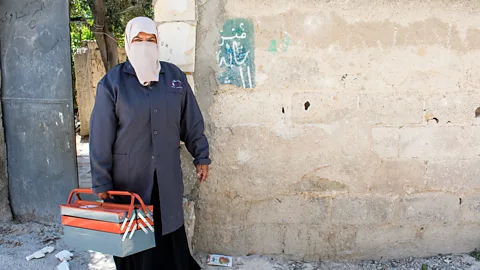
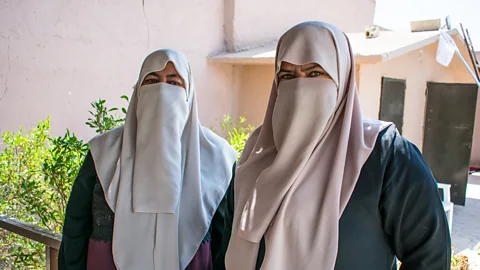
When we leave the house, both women pull their niqabs, the face veils frequently worn in parts of Jordan and around the Arabian Peninsula, up to their eyes. (Niqabs tend to be worn whenever men who aren’t family members might see them; for that reason, the women also wore them for these photographs).
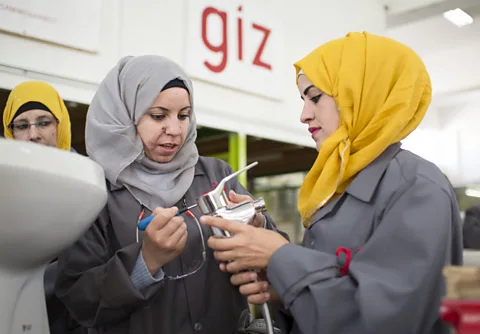
Over her modest clothing, Tahani adds something else: a plumber’s uniform.
 GIZ/Thomas Imo
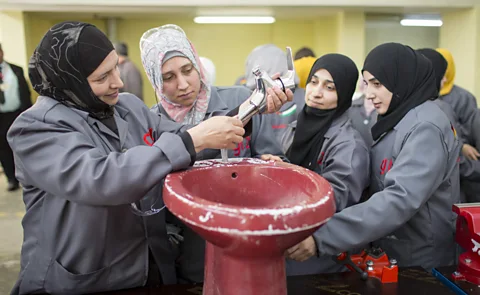
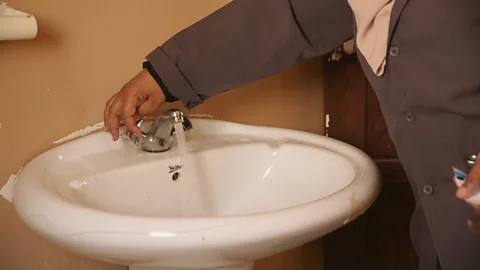
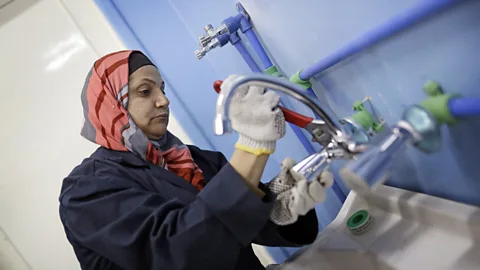
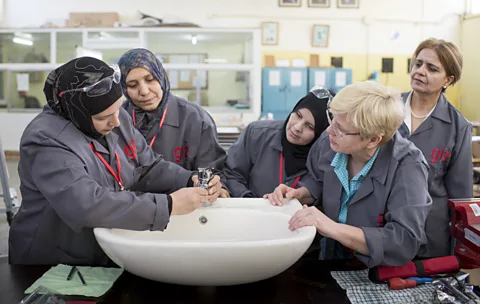
Tahani and Khawla are two of Jordan’s first female plumbers. Back in 2011, they were in the original pilot group of 17 in Water Wise Women: a programme organised by Jordan’s Ministry of Water and Irrigation and partly funded by Germany’s Agency for International Cooperation (GIZ). Now, more than 300 women in 15 locations across the country have been trained, about 10% of whom are Syrian refugees. And demand for the programme is growing. It is opening up to a new city in the spring – Mafraq, one of the places hardest-hit by the refugee crisis – where it will train another 75 women.
 Amanda Ruggeri
The catalyst behind the programme was simple: Jordan is running out of water.
 Amanda Ruggeri
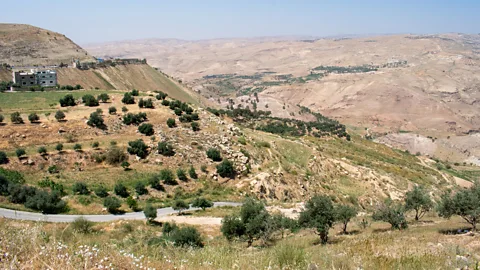
Jordan is a small, dry country made up of 75% desert.
The kingdom currently has about 150 cubic metres of water available per person, per year. Less than half the volume of an average swimming pool, that’s one-sixtieth of the amount of water available to US residents – and a quarter of the global average.
 Getty Images
But the reasons for Jordan’s water crisis go beyond mere geography.
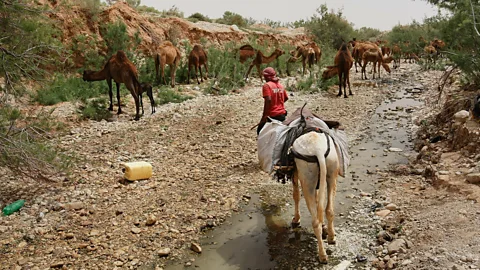
For decades, one major problem has been political (and military) conflict. This both has made for lack of cooperation over water resources and sometimes has directly been caused by water access itself. Many regional disagreements centre on the Jordan River, which is fed by tributaries from Lebanon, Syria, Jordan, Israel and the Palestinian territories. This has hindered attempts to not only share water but to protect the river – where both water quality and amount have plummeted in the last few decades, as shown in this photograph of a nearly dry river bed in the West Bank after a recent drought.
A more recent, extra pressure has been the Syrian conflict. As of March this year, there are 665,000 Syrian refugees registered with the UN in Jordan. But Jordan’s minister of state for media affairs Mohammad Momani says the actual number is around 1.3 million. That’s a substantial number for a country with just under 10 million inhabitants total. And it’s squeezing every resource Jordan has to offer, including water.
 Getty Images
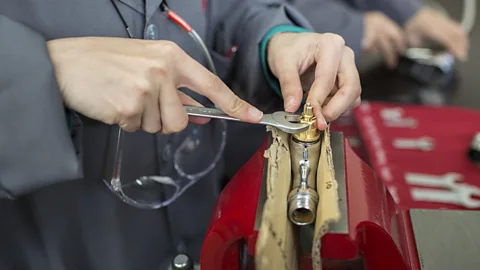
But one major – and perhaps more immediately solvable – part of the problem is water leakage. In some areas, up to 76% of water is leaked before it comes through a tap, toilet or shower. One estimate holds that if all of that wasted water could be saved, it would provide the basic needs for 2.6 million people, a quarter of Jordan’s population.
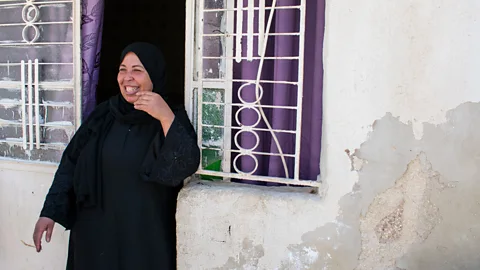
Some of these leaks are practically invisible; only someone who is trained would know what to look for. Others are visible, but have been difficult to fix thanks to a logistical, and cultural, issue. In many communities, a man who isn’t a relative can’t enter someone’s house if only women are there. But many of the women’s husbands work, which means only women are home during the day. And until recently, all the plumbers were men.
 Amanda Ruggeri
Not only that, but because the woman is frequently the one doing the washing, cooking and other chores that require water, she’d usually have a better idea of what was wrong than the man.
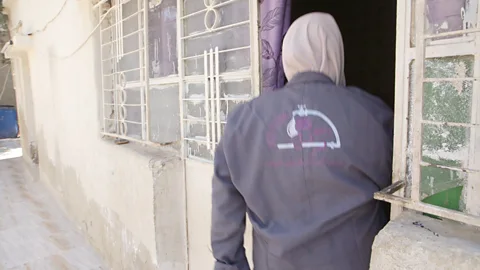
“The man would take the lead and tell the plumber, the faucet isn’t working. But no. Maybe the faucet isn’t working, but also the bathroom isn’t working,” says Hind Al-Shdaifat, GIZ’s component manager. “And the woman would know, and the man wouldn’t know. He would keep asking her what is the situation here and to the plumber and it’s a long chain.”
 Amanda Ruggeri
Before, if a woman wanted to call a plumber, she would wait until her husband comes back. And how much water would she lose in the meantime? – GIZ’s Hind Al-Shdaifat
 GIZ/Thomas Imo
The solution, officials at Jordan’s Ministry of Water and Irrigation realised, was to train female plumbers. If you think that sounds like rather a progressive solution for a problem caused, in part, by conservative traditions, you’re right. In many of communities like Jofa, few women work outside the home; if they do, they’re for more traditionally ‘female’ jobs, like sewing.
This isn’t unique to Jordan. In the UK, for examples, fewer than 6% of all trade workers including plumbers and plasterers are women. But in conservative areas like this one, the cultural barriers can be even greater.
When the women went out to do their first tasks in the community, they were laughed at. Men told them it was impossible. “They would point to them, like, ‘These are the plumbers! The women plumbers!’”, says Al-Shdaifat.
Even other women were astonished, Shawla says. When they went to a school to fix something, the female director couldn’t believe it. “She was like, ‘How does your husband allow you to go work in this profession?’ I said ‘Well, hallas – we work.’”
 Amanda Ruggeri
The women’s own families weren’t always in favour of the idea, either. Shawla’s husband and relatives didn’t mind. But Tahani had a harder time. “My family – my parents and brothers – rejected the idea,” she says. “But for me, because my husband was okay with it, I said, I’ll do it.” Even so, when she was going on a training course, she’d change her clothes at a friend’s house after leaving her home so that if she ran into relatives, they wouldn’t recognise her.
Tahani later told the programme directors, “If this succeeds here, where people are still so strict, it can work anywhere.”
 GIZ/Thomas Imo
Like many of the other women who took the initial two-week training, Tahani and Khawla didn’t start out planning to become plumbers. But what they learned fascinated them.
“We didn’t know anything about the water crisis in Jordan,” Tahani says. “We used to know that water would come just two days per week, but we never knew that there was a water shortage. We used to call it the ‘water wedding day’: on this day, we’d celebrate, cleaning everything and washing everything, because the water is running.”
As soon as they did the course, both women went back and checked their own houses to see if there were leaks. Tahani, especially, was shocked at what she found. She’d always noticed that, even if she filled up her water tanks on the ‘water wedding day’, her family would run out of water before the next time. They’d have to go buy water, every week. After the training, she found out that her toilet tank was leaking – something that wasn’t visible or audible to the untrained eye. The tank’s capacity was 14 litres. It had been draining her home of water for years.
How many years?
“Since before I got married, gave birth, everything,” she says, laughing. “So – 15 years!”
 Amanda Ruggeri
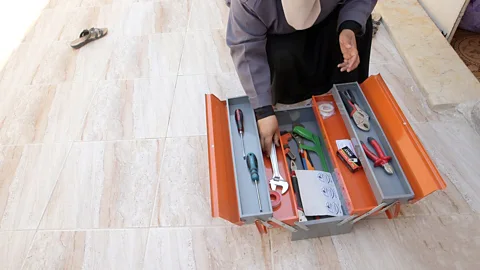
After that, Tahani and Khawla were hooked. Along with other women, they took a more technical, two-month training with Water Wise Women, part of which involved them going out into the community to do plumbing tasks. They received their own tool boxes from the programme.
And, here and there, they started helping friends and relatives. Word of the women’s work spread. It was helped by media campaigns by Water Wise Women, such as an initiative to convince imams to allow the women to work in the mosques. This helped to get the imams, and therefore their worshippers, on the plumbers’ side, and quell any naysaying.
 Amanda Ruggeri
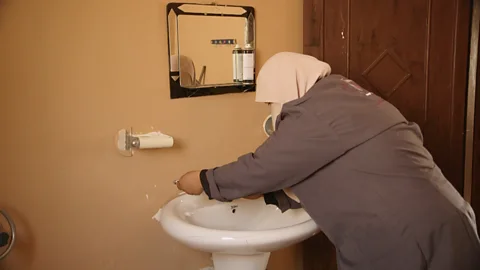
When I ask Khawla what getting paid for the first time as a plumber felt like, she beams. “I was extremely happy,” she says. “When you have your own money, it’s really nice. It’s your own effort, so you can spend it the way you want.” She and Tahani celebrated their first payday by going out to buy fruit and clothing for their children. Had she ever made her own money before? “No,” she says quickly. She was 41 at the time. Tahani, who also never had had a paying job either, was 31.
 Amanda Ruggeri
The income has changed the women’s lives in tangible ways, too. Khawla’s husband is retired; with the extra income, she was able to pay for her daughter in high school to get extra tutoring.
Tahani’s husband doesn’t have regular work either. When I ask how important the income is for them, she laughs: “It’s the main source of income!”. She makes about 350 Jordanian dinar ($500) per month, which is significantly above the 268 dinar minimum wage and considered to be a good salary for the area.
It also opened up new avenues for her. Families sometimes rent farmhouses in the area for a weekend getaway from the capital city of Amman, less than an hour away. The women who stayed there often didn’t like the idea of a male plumber, so would take Tahani’s number. Those connections led to Tahani helping the owners advertise the houses for other renters, as well as cleaning and preparing the rentals… and taking care of any plumbing issues. It’s a new income stream for her. “So it’s really opening new doors for me. Alhamdulillah, alhamdulillah [praise be to God],” she says, smiling.
 GIZ/Thomas Imo
The Ministry for Water and Irrigation reports that the programme also has been effective for its main purpose: reducing leaks. There has been a 30% to 40% reduction in water consumption in households wherever the female plumbers are active. That isn’t just because the plumbers can go to the houses of women like this one, one of Tahani’s clients, to fix leaks quickly. It’s also because their very existence – and the fact that they can have relaxed, open conversations with other locals who run everyday household tasks (in other words, women). It raises awareness of potential leaks and of the water crisis in general.
But their presence as women who work is powerful, too. Tahani has three daughters and a son. What lesson, I ask, does she hope that her career gives her daughters? She doesn’t hesitate.
Amanda Ruggeri“The biggest lesson I want to give to my daughters is that they should have confidence,” Tahani says. “They should be really proud of themselves and do what they like.” Her 14-year-old daughter already has announced what she wants to be: a plumber.
