What income around the world looks like


 Luc Forsyth/Dollar Street
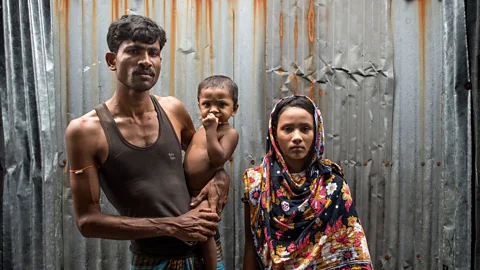
What do 30,000 photos of 300 families from 50 countries – organised by income – look like? This website will show you.
 Moa Karlberg/Dollar Street
What’s your monthly income? What kind of house do you live in? You may think you know where you fall on the grand global scale of wealth – but an online, open-source gallery of 30,000 intimate photos of families in their homes across the world may change that view of yourself.
Anna Rosling Rönnlund is a former Google UX designer and a co-founder of Gapminder, a Swedish non-profit eductation organisation. Last year, she created a tool called Dollar Street – an online collection of photos that places more than 300 families from 50 countries on a figurative “street”. Lower income families are placed at one end, wealthier families are at the other.
The goal? To give readers a sense of how other people from other cultures live, beyond how their countries are typically represented in news media images – as well as a sense as how you fit into the spectrum of wealth.
 Luc Forsyth/Dollar Street
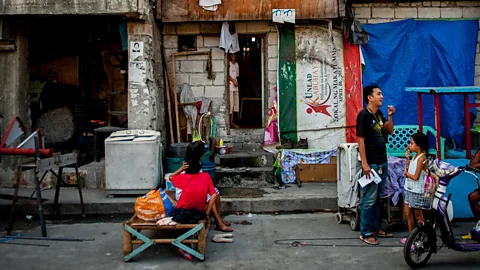
The Dollar Street platform allows to search by country, income level, and specific objects. “It’s such a concrete thing,” Rönnlund says of the photo database. “If you’re in a classroom, looking at different kids’ toys will give a clue into their lives.”
Rönnlund hopes these intimate portraits into everyday household life will correct preconceived notions of how people in different countries live. One of the main aims for the project is to show that big challenges for families worldwide, like access to clean water, boil down to individual income, not nationality.
 Zoriah Miller/Dollar Street
“We asked families for their most valuable things. On the poor ends of the street, it’s usually a plastic bucket or something because that is the difference between life and death. In the middle, it’s a sewing machine, or phone, or bike – something that improves speed or makes your life more productive. On the rich end, it’s a wedding photo or bottle of rum or toy. Our basic needs are fulfilled, so we start thinking about special things.”
- Anna Rosling Rönnlund
 Zoriah Miller/Dollar Street
The way Dollar Street classifies objects can provide a fascinating insight into how different families live. In poor families, single objects are more likely to have multiple uses – a single plastic chair could be tagged as “sofa” and “armchair”, for example, whereas a wealthy family would have one of each.
A striking example of this is “toothpaste”. In the village of Akaniaka in Malawi, Nampedi Wizilamu scrapes mud off the sides of her wall and mixes it with water to brush her teeth. Dollar Street, in this instance, groups both “toothpaste” and “wall” under the same label.
 Zoriah Miller/Dollar Street
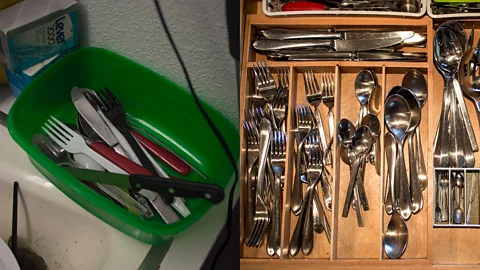
A common theme among the photos is that wealth can vary widely in the same country. Rönnlund compares two American families, and finds a surprising wealth indicator: cutlery drawers. The family that makes nearly $5,000 a month has a compartmentalised tray in the drawer that separates steel utensils by type, but a family making around $600 a month in the US, stores a mix of utensils (some plastic) in a plastic tub.
 Steve Hester and Ron Peacock/Dollar Street
Items that many might consider mundane household objects, such as bookcases or books, are surprising signifiers of wealth in this context. Reading for pleasure for instance, requires plentiful free time and a certain education level. Other examples highlighted by the project include beverages like fizzy drinks and alcohol; and integrated door locks that require a key, as opposed to a padlock or a chain link that ties a swinging door to a wooden pole.
 Zoriah Miller and Jonathan Taylor/Dollar Street
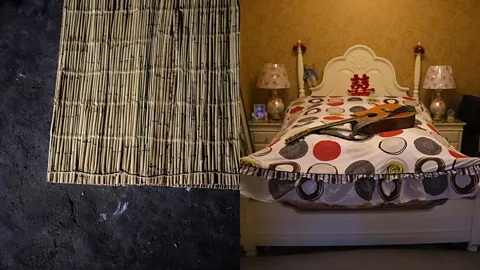
In poorer homes, shelter that shields from the elements is prioritised over a bed to sleep on. Whereas rich families own bedframes that cradle mattresses covered in pillows, sheets and duvets often made from synthetic materials in factories and are colourful and pleasant to look at. Poorer families might sleep on the floor, resulting in a rough night’s sleep – studies show that poverty is often linked to a lack of sleep.
 Dollar Street
Food provides a key view into a family’s income, regardless of the country they live in. Poorer families, which can spend 80% of their income on food, rely on cheap staples that they can buy locally and don’t have to refrigerate, like cornmeal.
But richer families can afford expensive perishables like meat. They also buy produce imported from around the world that can be eaten at any time regardless of season. They prepare so much, and can be so particular about what they eat, that they end up with leftovers.
 Zoriah Miller/Dollar Street
“I’ve always been fascinated by everyday life. When people are selling [and showing] their homes, and they happen to have forgotten to hide something personal – I’m obsessed with that.”
- Anna Rosling Rönnlund
