The crumbling mansions of India’s ‘City of Joy’

 Sreya Chatterjee
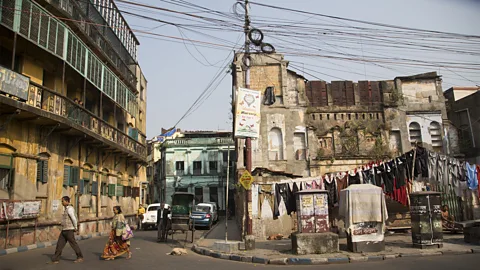
Kolkata’s grand old family homes used to house entire generations. But as households shrink and new buildings appear, the future of these ageing cultural artefacts is uncertain.
 Sreya Chatterjee
Leaving behind this house once and for all is like severing a precious part of your existence. One doesn’t do this willingly – Kalyan Kumar Chatterjee
 Sreya Chatterjee
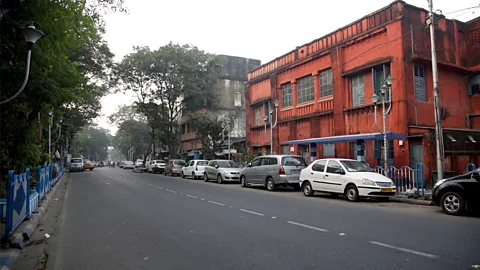
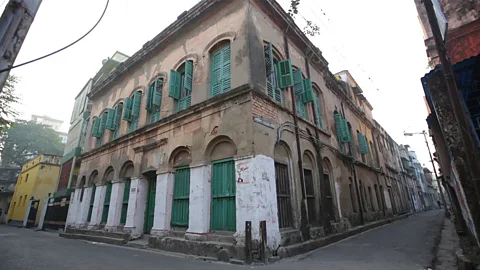
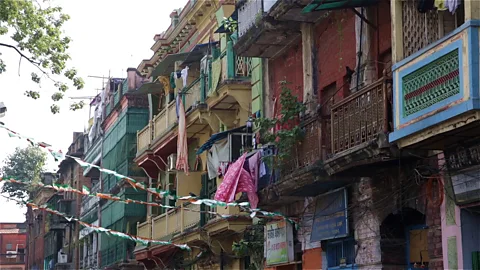
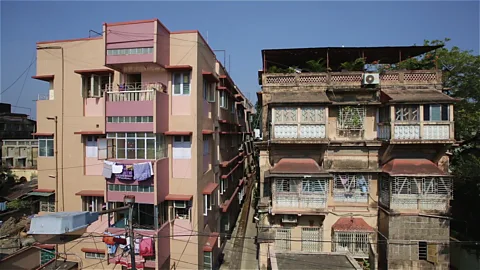
Along the densely-packed streets of Bhowanipore, no two buildings are the same.
Central courtyards, oxide-red floors, green Venetian, or French-style, windows, intricate motifs and patterned openings are the striking, salient features of the houses in this neighbourhood of south Kolkata, India.
An intrinsic part of this city’s character, these grand old family homes are scattered throughout the streets and date back to the late 18th and early 19th Centuries, when Kolkata was the hub of British colonial rule.
The mansions are spacious, designed with enough space for multiple generations to live together and gatherings of extended families, but many are under threat.
 Sreya Chatterjee
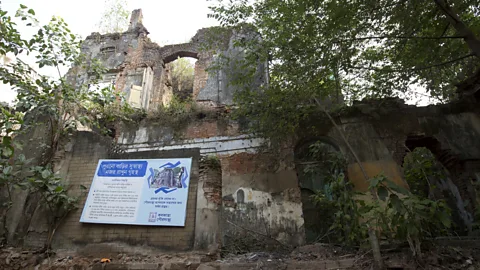
Such old properties need regular maintenance and without it they can quickly become overrun by Banyan trees, whose thick roots cause irreparable cracks. Eventually, the walls start falling apart. In the older localities of north and south Kolkata, many of these crumbling mansions are still occupied.
Derelict buildings are a particular problem during the monsoon season when heavy rains can wash away the remaining structures. In July, last year, a dilapidated 150-year-old building collapsed and killed two people. In 2016, more than 20 people were injured after portions of old buildings collapsed.
Thousands of these old houses in Kolkata are in desperate need of repair – by one 2016 estimate, there were roughly 3,000 unsafe buildings in Kolkata, with 50,000 people living in them.
Though the Kolkata Municipal Corporation sends notices to owners of 'highly dangerous' buildings in the city and puts up public signs, tenants are often unwilling to move.
The reason? They cannot afford to rent elsewhere.
 Sreya Chatterjee
Rents in unsafe buildings in Kolkata can be as low as 100 rupees ($1.57) a month and finding somewhere else to live in the city for such a low price is almost impossible. But low rental income means landlords are unlikely to undertake repairs because they know they won't recover their costs. The owners would rather sell their properties on to developers for a hefty sum.
Residential property prices in Kolkata are much lower than in India’s boom cities - Mumbai, Delhi and Bangalore. Residential sales in the city were down 20% in 2017 compared to the year before, and 39,252 properties were left unsold at the end of last year, according to estate agents Knight Frank, a 5% increase on 2016. The Indian property market as a whole is weak and prices have sunk over the last year or two. Kolkata is no exception.
Sometimes, instead of being sold outright, these homes are passed on to developers, who usually house the previous owners while their old mansion is torn down and a new property built in its place. Once the new building is complete, the old owners are given a flat in the reconstructed building. Then the owners are free to decide whether they want to sell it or live there.
 Sreya Chatterjee
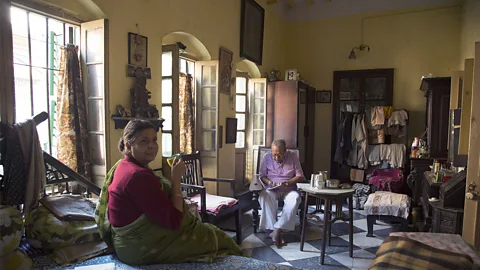
My father, Kalyan Kumar Chatterjee, has lived all his life in one of these homes, a 3,000 sq ft, three-storied house in Bhowanipore.
He calls this place, where five generations of his family have lived, a ‘second-hand’ house. His ancestor, Chandra Kumar Chatterjee bought it in 1905. And as per the family legend, the house was already at least 40 years old when it was bought, making it no less than 150 years old today.
In line with the melange of Kolkata’s architectural styles, it has about 22 rooms with myriad names, indicating their various functionalities.
There is boithhok khana, the meeting room; nacch ghor, the dance room; and finally, the grand pathorer ghor, the room with mosaic flooring.
 Sreya Chatterjee
When I was born in 1985, there were almost 40 extended family members living in the house. But gradually the number reduced as my grandparent’s generation passed away.
From 2006 onwards, the children started moving to other cities for higher education or work. And as the parents gradually became older it was difficult for them to maintain the place. So, they moved to modern buildings with better amenities.
Financial constraints meant my parents weren’t able to move. Our sole family property is that house, and my parents still live there, with my father’s 83-year-old aunt and two house-helps. Other family members visit occasionally.
Since the other family members had alternative accommodation, they pushed for the redevelopment of the house. They no longer wanted the liability of maintenance and needed the money from selling their share - a hefty sum due to its prime location. Initially, we objected, as it was our ‘only’ home. This led to disputes and bitterness within the family before my parents relented and agreed to hand it over to developers to rebuild.
 Siddhartha Hajra
All I can hope is that the houses that can be maintained will be preserved – Kalyan Kumar Chatterjee
 Siddhartha Hajra
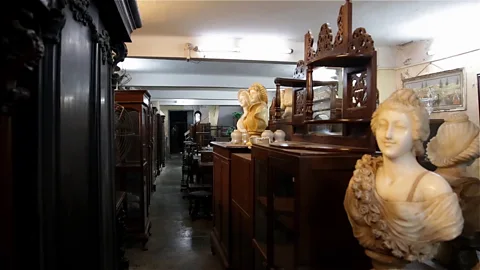
As family members move and the old mansions of Kolkata crumble, antiques that are remnants of the city’s aristocratic past go under the hammer at auction sale rooms.
In the past, Kolkata was known for its auctions and had at one time at least 20 auction houses. Now, the last one standing is Russell Exchange, India’s oldest surviving auction house. It was bought from the British in 1940 and is now run by brothers Anwar Saleem and Arshad Salim.
Housed on the ground floor, the grand hall of Russell Exchange comes alive every Sunday for the weekly auction. Arshad Salim, who has been conducting the auctions here since he was 18, boasts that he has sold everything under the sun in his auction house, from "a pin to an aeroplane”. Apart from auctioning, Russell Exchange also sells these old pieces of furniture directly to interested customers. Some are rented out as props for film and television shoots.
In many ways, the stock of Russell Exchange illustrates the changing tide of Kolkata’s fortunes.
 Sreya Chatterjee
Families and households are changing in India, and the average number of people living under one roof is shrinking.
Between the 2001 and 2011 censuses, the mean household size fell from 5.3 to 4.8.
The proportion of Indian households with 15 or more members fell by 25% during that time, and one-member households grew by 35%.
Those with between one and four people grew from 43% to 51%, while the proportion with five people or more fell over the same period, from 57% to 49%.
The same patterns are evident in West Bengal, the state in which Kolkata is located.
Sreya ChatterjeeThe decline of the old houses of the city can be attributed to the city’s ambiguous definition of ‘heritage’.
In Kolkata, a heritage building is one which is either a notable institutional building or one which was lived in or frequented by a renowned personality. The architectural value of the house is of less significance.
There are scant guidelines regarding demolition and The West Bengal Heritage Commission, an advisory body, was disbanded in 2014.
In some instances, the heritage tag has been redefined by boutiques, cafes, exhibition spaces which have all popped up in several old buildings. City walking tours, such as Calcutta Walks and Heritage Walk Calcutta, are also including these old homes in their itineraries to help tourists and residents see them in a new light.
 Siddhartha Hajra
But Kolkata’s residents broadly perceive the destruction of their ancestral houses as an inevitability.
Property developers and land owners see them not as cultural artefacts but as prime real estate that could be used more efficiently. Many of the city’s young people feel this way too, who are happy to trade expensive painstaking maintenance of the old houses for smaller, more modern flats.
But there are some emergent voices fighting this onward march of modernity. Concerned homeowners, civic bodies other citizens are starting forums, drafting petitions and fighting legal battles to protect whatever is remaining.
 Siddhartha Hajra
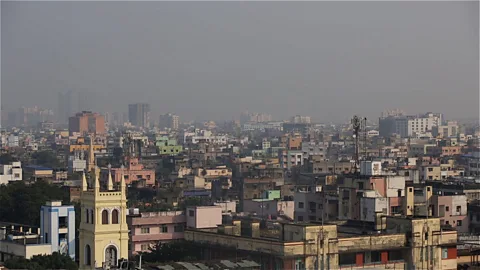
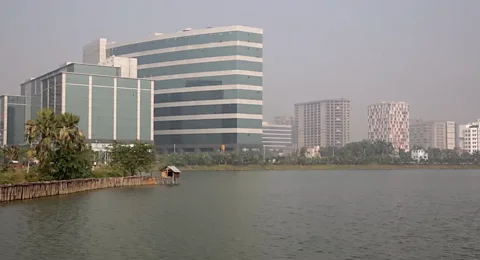
Despite a stagnant property market, the trend towards modern developments is likely to continue. A growing population and IT sector has caused a noticeable expansion and development of the suburban areas of the city.
This has left some concerned that functional but homogenous modern buildings will rob the city of its rich architectural history and character.
Economist and Nobel laureate Amartya Sen is one such concerned observer. “We do owe to the future generations a preserved and unmutilated heritage of Kolkata's eccentric but exciting old buildings.”
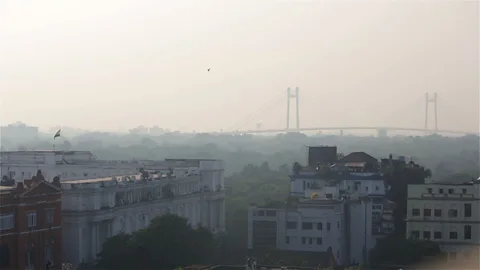
The question now for Kolkata’s citizens and authorities: how to grow as a modern city, while still preserving these crumbling artefacts of this deeply cultural city.
