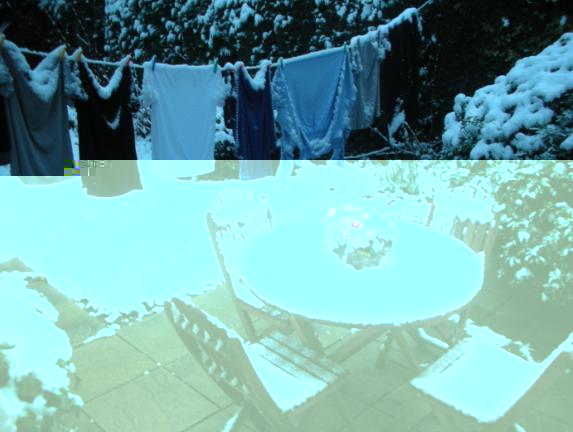
January 2007Sorry I'm Late!Me in Paris, 1 January 2007 (the snow is fake!) Imagine me, Soyoung, rushing into a classroom where the students are all sitting politely waiting for me. I am out of breath, flustered, dropping my books and papers all down the corridor. I tumble into the room, dump my books on the desk, grab a whiteboard pen, look up and contemplate the serene faces sitting waiting for me. “Good morning, class, and welcome to the lesson.”
[That was a difficult first paragraph, Soyoung. I know that. Don’t panic. You can do this and it will be a lot of fun for both of us.]That’s how I feel right now. You arrived on time. You have completed your ‘homework’ and it is sitting on my desk waiting for me. You have prepared your ‘lesson’. I am the one who is late, disorganised and unprepared. Well, that’s not quite true, but I feel a little ashamed that you were already blogging while I was still in Paris having a good time (and spending far too much money).
I am actually very organised, and I am very prepared. And now I’m even here. So “Hi!” and congratulations on winning the BBC Learning English monthly blogging competition. Thank you for posting your first two blogs and for sending such lovely, artistic photographs.
You probably know that I was in Paris to celebrate the New Year. I too made a few New Year resolutions, Soyoung, but I’m afraid I broke most of them before half-past midnight (drink less, eat less, be a nicer person – all broken before the celebrations had ended, I’m afraid). Never mind. I can always try again next year.
Yes, cautious is a good word to use about someone’s character. You could also describe someone as careful, too. So are you someone who never takes risks? It will be interesting for me – and all our readers – to get to know you a little better during this month. Yes, Soyoung, we have readers. Lots and lots and lots of them! They are usually very generous and kind and I think you will soon find that you have an international fan club. Right now, however, you and I need to get to know a little more about each other. I will ask you more about your music and what sort of yoga you do, later. Also, it would be interesting to hear about some of your favourite books (most of our readers are very interested in books).
INTERVIEW MEYou probably read the blogs between me and Federico, from Peru, last month. I told him quite a lot about myself. I could repeat all that, or you could ‘interview’ me to find out exactly what you want to know. Why not post a blog which is a series of (fairly simple) questions you would like me to answer? You could write it like a questionnaire or a list. Then I will try to give simple, direct answers. You can ask me anything you like and I will do my best to answer everything you ask. I’m looking forward to your list.
Meanwhile, I have added some language notes for you, below, and some photos (which I’m afraid are not as good as yours) to make the blog look a little less ‘heavy’.
Take it easy, Soyoung. I’m looking forward to hearing from you soon.
Best wishes,
STEPHEN SOME USEFUL WORDS AND EXPRESSIONSout of breathIf you are out of breath you are breathing quickly and deeply because you have been running or rushing. If you run for a bus, for example, you may be a little out of breath when you get on it.
flusteredfeeling a little nervous or confused
tumbleto fall or roll forward
dumpdrop or slam down grabget hold of (roughly)
contemplatelook at and think about
serenecalm; relaxed
congratulations on winningNotice the structure with the preposition on and the –ing form of the verb. It is probably easiest to remember this as a fixed expression. Some examples: Congratulations on passing your driving test. Congratulations on becoming a father. Congratulations on scoring the winning goal.Even if you use a noun instead of a verb, you should remember the preposition on with the word congratulations. More examples: Congratulations on your 18th birthday. Congratulations on your degree. Congratulations on your success. SOME GRAMMAR TO THINK ABOUTRead this sentence again and think about the grammar: You were already blogging while I was still in Paris having a good time.We can make it a little simpler: You were blogging while I was having a good time.Think about: You were blogging…This structure helps us to describe something in the past ( were) which was happening [but has finished happening now] at the same time ( while) as something else was happening ( I was having a good time).
So this is a structure we can use when we want to talk about two things happening at the same time, but which have both finished happening now. Here are some more example sentences:
I was reading the paper while Jane was making breakfast.
They were talking to their teacher while the other students were working in the library.HOW WE USE ENGLISH – some punctuationBoth the words homework and lesson are printed in single inverted commas [‘…. .’] in my blog to show that I am using them in a special way. Of course, Soyoung, you have not actually done any homework. And this, of course, is not a lesson. But I am using the words homework and lesson to paint a picture, to give an impression. I am comparing our situation with an English lesson and so I am using homework and lesson in a creative way. When you do that, in English, you need to show your reader that you are using the words in a special way, so we use single inverted commas. …AND DON’T FORGET THE ARTICLERead the following list then look again at your excellent blog. You don’t have a problem with the article, but just look again at these examples. Compare your version with items in the list to see where there are some missing articles. [We’ll focus on the article again during the month, so take it easy.]
…the blog competition
…the BBC
…the City Hall
…the New Year bell
The temperature is around 9 degrees.
…the UK
…in a library
…to learn the guitar
I’m looking for a music institute…SOME RE-WRITTEN SENTENCESFind the original sentences in your first and second blogs and then compare them with the following, corrected versions:
1. I never imagined I could win the blog competition this month.2. I have been working in this field for almost ten years.3. I could say that I like this sort of work but that sometimes my workload is too heavy to handle.4. Do you know anything about freight forwarders?5. It was nice for me because I haven’t had time (not a time) to think about myself properly.6. There’s a chilly wind.7. I have to lose (not loose) weight (not my weight).
By the way, Soyoung, I’m pretty sure from looking at your photo that you don’t need to lose weight! Don’t overdo it.
Just before leaving for home. posted on Wednesday, 03 January 2007 | comment on this postFood and drinkDear Soyoung,
Today’s blog was all about food. That didn’t help me because, like you, I am trying to lose weight. I ate far too much over the Christmas and New Year holidays. There is one big difference between you and me, however, Soyoung: I am fat and you are not! Anyway, sorry to torture you with this photograph but I thought you might be interested in this beautiful chocolate tree I brought back from Paris, for my daughter, Lucy. She’s is definitely not on a diet – although, between you and me, I think she could lose a kilo or so, but PLEASE don’t tell anyone I said so. Actually, she’s just joined a gym – like almost everyone else in Britain in January – so I guess she’ll soon lose that little bit of extra weight she put on (like all of us) over Christmas.
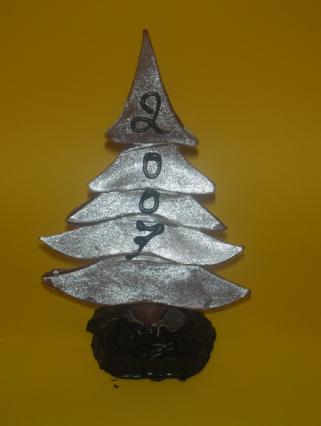 This New Year tree is made from two of the finest types of chocolate in the world. I struggled home from France with it taking great care not to break it. It looks so lovely, covered in fine silver dust, that Lucy can’t bear to spoil it by eating it. How long do you think she can keep it without taking the first bite? You’re right, I do have a car. It’s a beautiful little open-top sports car with a super-charger – which means it goes ridiculously fast and I am too immature to drive it sensibly. You see, Soyoung, I am not cautious like you. When I was a young man I could never afford a good car. I still can’t afford one! But that didn’t seem to stop me buying it. In English we have an expression, ‘big boys’ toys’ to describe these kinds of things that only old men can afford but which most young men would like to have. You know, Harley-Davidson motorbikes, designer suits, hand-made shoes, all that kind of stuff. I’m afraid I have to admit that I do like lots of these ‘big boys’ toys’.
Even though I have a car I use public transport a lot. I never drive into the centre of London, for example, and I usually use the bus service even when I travel locally. So of course I understand how irritating your daily journey to work must be and how wonderful it is when the school holidays begin so that the buses are practically empty.
Back to food then. Thanks for the photographs. They remind me a little of the two years when I lived in Xi’an, in central China. I know that Korean food and Chinese food are sometimes very different but they are much more similar than European and Korean food, I think. Where I live, in west London, there is a very large Korean community. There are lots of Korean restaurants, therefore, and supermarkets, too. When I lived in Sweden (1973-1977) I taught a small number of students from North Korea. They were diplomats from the North Korean embassy in Stockholm. In those days it was very difficult to get Korean food in Europe or to find Korean restaurants here. But today, especially in our larger cities, it is much easier.
Tell me more, please, about soju. You wrote that it “is very traditional Korean alcohol”. What is it made from? Rice? Is it anything like Japanese sake or Chinese rice wine? Is it served hot or cold? Do you have laws about alcohol (and tobacco) in Korea? My daughter, Lucy, was 18 last November. To celebrate her birthday she took me to a local bar and bought me a drink because at 18 she was, at last, legally allowed to buy alcohol in a bar.
One more thing intrigued me in your blog. You talked about your friend and her boyfriend who are going to get married in March. They have only been going out together for three or four months. It’s not long, is it? You said that both their parents are very keen for them to get married as soon as possible because of their age. How old are they? Why is their age important to their parents? I think Lucy might be almost old enough to get married when she’s thirty, thirty-five, forty. I am exaggerating a little, of course, but why rush? What are the cultural norms and pressures in Korea? It could be very interesting to hear what you think. Incidentally, you didn’t say whether or not you are married. Perhaps you feel as though you are married to your job?
We can talk more about your job in future blogs. Meanwhile, here are some words and expressions to help expand your vocabulary, and then a little bit of grammar work. Don’t work too hard, and, of course, if I’ve written anything you don’t understand please don’t hesitate to ask me to explain it better.
Take care.
Looking forward to reading your next blog.
Best wishes,
STEPHEN
SOME USEFUL WORDS AND EXPRESSIONS
to tortureto punish someone by causing him or her pain
between you and meYou can use this expression when you are about to tell someone a secret. It means ‘I’m only telling this secret to you, and no one else knows about it.’
she could lose a kilo or soThis is an idiomatic way of saying that a person is a little overweight.
gymShort for ‘gymnasium’ – a hall or large room where you can do physical exercise.
put ongain (the opposite of ‘lose’)
can’t beardoesn’t want
ridiculouslyfoolishly
immaturenot very sensible; not very adult
affordhave enough money
have to admitam unwilling to agree (but it is true)
irritatingannoying
remindmake me (or help me to) remember
intriguedvery interested [It is useful to learn prepositions together with particular words. ‘Intrigued’ always takes the preposition ‘by’. EXAMPLE: I was intrigued by her comments at the meeting. ‘Interested’ usually takes ‘in’. EXAMPLE: I was interested in her comments at the meeting.]
exaggeratingIf you exaggerate, you make some thing seem bigger, more important, better or worse, for effect. Here, I am exaggerating: I don’t really think Lucy should wait until she’s forty before she gets married. But by exaggerating I am trying to express my opinion that I think she shouldn’t get married too soon or too young.
SOME MORE GRAMMARLet’s look at your first sentence today.
1. You are writing about something (the winter vacation) which is happening right now. It could be useful, therefore, to indicate that, by starting with, Right now…2. We use ‘it is’ (not ‘there is’) to indicate events, situations or states (it is winter; it is five o’clock; it is raining). So you could continue your sentence like this: Right now it is…3. Remember that ‘vacation’ (or ‘holiday’ as we might say in British English) is a noun. It is also singular. Singular nouns usually need an article. So, let’s go on: Right now it is the students’ winter holiday in Korea…4. Don’t forget that the apostrophe (’) comes after the ‘s’ in students because students is plural (it is the winter holiday for all students, not just for one).
5. There is a second idea in your sentence – the holiday continues until the beginning of February. You can join ideas in sentences with a simple conjunction such as ‘and’ or ‘but’. Sometimes it is easier simply to write two separate sentences. So your sentence could finish like this: Right now it is the students’ winter holiday in Korea until the beginning of next month. Or, you could have written two sentences, like this: Right now it is the students’ winter holiday in Korea. It will last until the beginning of next month.6. There are two more things to remember (it’s tough, Soyoung, isn’t it?!). Firstly, don’t forget that ‘Korea’ must have a capital ‘K’, and that names, for example the names of department stores, also start with a capital letter. Secondly, ‘early’ is an adjective, not a noun. You could have written …until early next month and that would have been correct. You don’t need a preposition (‘of’) because ‘early’ is not a noun. However, if you wanted to use a noun (because you used a preposition) the correct noun would be ‘beginning’ or ‘start’ and, of course, you would also need an article: ‘the beginning of…’ or ‘the start of…’. 7. There is no number 7. I think you’ve probably had enough grammar for one day.
FINALLYDon’t forget the interview questions. Ask me anything about myself. I will try to answer all your questions.
posted on Thursday, 04 January 2007 | comment on this postHello, Soyoung!Dear Soyoung,
I hope you read the Teacher Blog every day, and find it useful. Don’t forget that there are teaching notes especially for you, at the end of every blog from me. Sometimes there are also questions and suggestions for your next blog. For example, Soyoung, how about that list of questions to ask me? It could be a nice, simple way of exchanging basic information about ourselves.
Today you told me about going to the movies. You mentioned Casino Royale. Yes, Soyoung, I saw it on the day it opened in London, last November, and I think it is the best Bond film since Goldfinger – maybe even better. I have a soft spot for Bond movies. When I was a boy I was a reluctant reader. The first books I read voluntarily were Casino Royale and From Russia With Love, which had just been published at that time (1966-69, I think). I was lucky to have a very good English teacher at school. He inspired me to read great literature, so I feel a bit ashamed to say that I still like some of the James Bond books.
I can certainly understand why all the women I know think that Daniel Craig is the best-ever James Bond. I’ll share a little secret with you, Soyoung, but please don’t tell anyone else: when I was a boy I used to look in the mirror and practise saying, “My name’s Bond, James Bond.” Is that sad or what? At that time I could almost believe that one day I might look something like Sean Connery. Well, now that he’s old and bald and probably a bit overweight, I do. But that’s not what I meant. I’m afraid I will never look like Daniel Craig. Perhaps I should start going to horror movies instead.
You mentioned that your sister lives in Beijing. Why? Does she work there or is she a student? How easy or difficult is it for Koreans to communicate with the Chinese? How similar are your two languages? Have you ever been there to visit your sister?
You said that you live with your parents. While your mum is away you have to do all the housework. Does that include cleaning and cooking? How about your dad? Does he help? It could be interesting to hear from you about what men do in the family in Korea.
Well, the weekend has started. It is incredibly mild here – about 14 degrees today (it should be about 2 or 3 degrees in early January) – and tonight I’m going out with Lucy, my daughter, to one of our favourite local restaurants. However, the bad news is that I can’t have a beer, or any other kind of alcoholic drink. Why? Because in 5 weeks I’m going to Tanzania to climb Mount Kilimanjaro, the highest mountain in Africa. It is part of my training to give up everything enjoyable before I go! No more champagne, no more coffee, no more chocolate, until I come back at the end of February. I have to run 10 kilometres per day and I should walk another 10 kilometres. Now it is coming closer I am beginning to ask myself how I ever thought I could do it. Do you have any advice?
I will stop now. I will write some teaching notes for you, below. Then I will post a list of recommended books. Some of our blog readers have asked for reading suggestions. It is a general list, Soyoung. It is not specifically for you. Please don’t try to read all these books yourself!
Meanwhile, I am very much looking forward to hearing about family life in Korea and maybe a bit more about your working life.
Have a great weekend, Soyoung, and don’t drink too much soju!
With best wishes,
STEPHEN
SOME USEFUL WORDS AND EXPRESSIONS
have a soft spot for
If you have a soft spot for something it means that you like it, uncritically.
a reluctant reader
someone who is not very motivated to read
voluntarily
by choice, not because I was told to or forced to
inspired
made me want to read by making me excited about reading
ashamed
embarrassed; guilty
mild
less cold than usual
to give up
to stop doing or having something
SOME WORDS TO CHECK AGAIN
Use of good dictionary to check the meanings and spellings of these words from your blog:
sauce and source: only once of these words is a kind of food. Which one? What does the other word mean?
chilly and chilli: only one of these words is a kind of food. Which one? What does the other word mean?
SOME CORRECTIONS
Find the original sentences in your blog then look at how I have re-written (corrected) them:
1. …it is interesting that he wrote something about his life…
2. It’s almost 18% alcohol and colourless, like water.
3. It has happened occasionally because I have had enough to drink.
4. Do you ever go to see new movies?
5. What are the newly-released movies in your country?
6. It’s about a Korean-style casino, called Hwatu, where a young boy wants to become the best player, like the legendary Tazza (played by Younsik Baek). The boy learns from Tazza all the technical skills and card tricks necessary to become a great player.
7. I always buy popcorn and a cola at the cinema before I take my seat.
8. …to have dinner (not ‘a’ dinner) with my colleagues.
…AND DON’T FORGET THE ARTICLE!
the teacher’s blog
I had to close the records
…she’s out of the office for three hours
I checked the time
I have to do the laundry…
OK, Soyoung, I’m sure that’s more than enough for one day. Find some time during the weekend to look again at this week’s notes and corrections. Try to listen to some English on the radio for about 30 minutes. Choose one short newspaper or magazine article in English and read it carefully. Try having a telephone conversation in English with a friend – someone whose English is quite good. These are some good ways to help develop your English. Good luck. Have a great weekend. I’m looking forward to hearing from you again very soon.
-----------------------------
 A PERSONAL SELECTION OF EXCELLENT READING Many of you who have been reading these blogs, and posting comments, over the last few weeks have asked about books. There seem to be two main queries: which authors are currently popular in the UK and which books have I read and enjoyed? So here are some recommendations. Remember, though, that other English teachers would almost certainly disagree with some of my choices and that you yourself might find some of them strange, boring, difficult or even offensive. This is very much a personal selection, not a BBC selection. Personally, I hope you get them all, read them all and enjoy every word of every book.
A quick note about my selection criteria. I have chosen mostly British authors. That’s not because I am prejudiced against non-British authors. Most of my favourite writers of fiction are, in fact, North American – Raymond Chandler, Carl Hiassen, Elmore Leonard, John Updike, Garrison Keillor, and lots more. I also read huge amounts of fiction in translation. However, here I have mostly chosen authors who have something to say about modern Britain. These books may not become classics. But they are all well written. Several have already won major international literary prizes. Some fiction authors who are popular in the UK at the momentMonica ALI Recommended title: Brick Lane, Black Swan 2003, ISBN 0 552 77115 5
Modern, multi-racial Britain.Giles FODEN Recommended title: The Last King of Scotland, Faber and Faber 1998, ISBN 0 571 19564 4
Thriller set in Uganda about Idi Amin’s Scottish doctor. Sounds weird, doesn’t it? It’s a great book and has just been made into a film (which I hope to see next week).Mark HADDON
Recommended title: The Curious Incident of the Dog in the Night-Time , Vintage 2004, ISBN 0 099 45025 9
Autistic child’s insights into the non-autistic world around him. Humorous thriller.Andrea LEVY Recommended title: Small Island, Headline 2004, ISBN 0 7553 0750 X
Inter-racial issues around Jamaicans who fought for the British armed forces during the Second World War. A fascinating insight into cultural change in Britain in the middle of the 20th century.Zadie SMITH Recommended title: White Teeth, Penguin 2000, ISBN 0 140 27633 5
More multi-cultural modern Britain.I would also recommend:
Anything by William BOYD (start with Brazzaville Beach, perhaps).
Anything by Jane GARDAM (start with Bilgewater, perhaps).
Anything by Nick HORNBY (start with About A Boy, perhaps).
Anything by David LODGE (start with Therapy, perhaps).
Anything by Ian McEWAN (start with , Saturday, perhaps).
For poetry lovers, here are two popular British poets:
Roger McGOUGH, Collected Poems, Penguin Books 2004, ISBN 0 141 01455 5
and
Benjamin ZEPHANIAH, Talking Turkeys, Puffin 1995, ISBN 0 14 036330 0 (This is a book of poems written for teenagers, but don’t let that put you off. Reading children’s books is a great way to study a language. My best foreign language is Swedish and I learned it almost totally from talking to the children of a Swedish family I lived with, and from reading their books and comics.)Ten of my favourite books(but ask me again tomorrow and I’m sure I’d list ten others!)Mother Tongues – Travels Through Tribal EuropeHelena DRYSDALE
Picador (London) 2001
ISBN 0 330 37280 7
Non-fiction. A travel book about the disappearing tribes (and, therefore, their languages) of Western Europe. Beautifully written, knowledgeable and full of fascinating insights into a Europe which is rapidly disappearing. If you are interested in European culture, history, minority languages and change, this could be a little gem of a book for you.SpiesMichael FRAYN
Faber and Faber 2002
ISBN 0 571 21296 4
Fiction: A gentle but disturbing novel about boys growing up in wartime Britain.Old FilthJane GARDAM
Chatto and Windus (London) 2004
ISBN 0 7011 7756 X
Fiction. Sir Edward Feathers, ‘Filth’, was an English international lawyer practising in the Far East. This is his story from childhood to old age. It is also a story of England and Englishness, of the days of the British Empire and the Second World War. It is a story of the past, the present and even the future. It is sad yet funny, compassionate but provocative, delicate and gentle. Like all Jane Gardam’s novels it is also beautifully written.England – Travels Through an Unwrecked LandscapeCandida LYCETT GREEN
Pavilion Books (London) 1996
ISBN 1 85793 681 7
Non-fiction. The author (who is the daughter of one of England’s best-loved poets, John Betjeman) travels around England looking for the beautiful, the unusual, the eccentric and the hidden. This is ‘England off the motorway’ – she even travels by horse. There are 60 short pieces about places she has visited and four suggested short tours. If you ever visit England you should visit a handful of these forgotten places – before they disappear altogether.A House by the Shore – Twelve Years in the HebridesAlison JOHNSON
Futura (London) 1986
ISBN 0 7088 3404 3
Non-fiction. The story of a young couple who met at university, in Oxford, and decided not to live the conventional life that might have been expected of them. They moved to a remote island off the coast of north-west Scotland, bought a derelict house, rebuilt it themselves and turned it into one of the loveliest small hotels anywhere. A book about hard work, setbacks and successes, about wildlife and exquisite landscapes, about food and sustainable lifestyles.Lake Wobegon DaysGarrison KEILLOR [US]
Faber and Faber (London) 1986
ISBN 0 571 13846 2
Fiction. Lake Wobegon is a small town somewhere in the mid-US. Its citizens are of mainly northern European origin, catholics and protestants, old and, of course, a younger generation, too. An affectionate portrait of small-town American life in the middle of the last century. An elegy of a by-gone time. Keillor’s writing style is gentle, his humour sharp but never unkind. It is one of very few books I have read several times. Where There’s A WillJohn MORTIMER
Viking (London) 2003
ISBN 0 670 91365 0
Non-fiction. A delightful collection of 32 short pieces about life’s simple pleasures by one of Britain’s best-known playwrights and novelists. They include discussions on ‘Listening’, ‘The Companionship of Women’, ‘Being Vulgar’, ‘Making a Fuss’ and ‘Inventions and the Decline of Language’. The Assassin’s Cloak – an anthology of the world’s greatest diaristsEdited by Irene and Alan TAYLOR
Canongate Books (Edinburgh) 2000
ISBN 1 84195 172 2
Non-fiction. Before bloggers we had diarists. They wrote on real paper with real pens and ink. Much of the good stuff survived. This is a collection of entries from 170 contributors and claims to be the most wide-ranging and comprehensive anthology of its kind ever completed. There are 686 pages. A great book to keep beside your bed – and to inspire you to write.PoemsR S THOMAS
Phoenix (London) 2002
ISBN 0 75381 653 9
Poetry. A small, relatively cheap and rather lovely hardback book of a selection of poems by one of Britain’s best-known and most accomplished poets. Thomas, who was Welsh, died in September 2000. There are poems about isolation, the people and landscapes of Wales, faith and belief and, of course, love and loss. These are deceptively gentle poems, poems to live with, poems to return to, poems – some of them – even to learn by heart.TerroristJohn UPDIKE [US]
Hamish Hamilton (London) 2006
ISBN 0 241 14351 9
Fiction. Set in New Jersey, USA, the novel follows 18 year-old Ahmad Mulloy’s struggle to find meaning in the materialistic world around him. A penetrating and topical critique of the human condition in the 21st century. posted on Friday, 05 January 2007 | comment on this postTwelfth NightDear Soyoung,
I hope you are spending a little bit of your weekend preparing a list of questions for me. I’m looking forward to reading them.
Here, it is Twelfth Night, the twelfth night after Christmas, when all the Christmas decorations must be taken down and put away. There are some ancient traditions for Twelfth Night. One of them is burning holly and ivy. Another – one which I like more – is eating Twelfth Night cake.
Twelfth Night cake is made to a Medievalrecipe using sultanas, dried fruit, fruit peel, almonds, marzipan, sugar, butter, eggs and wheat flour. I am quite a good cook (well, not bad, anyway), but I don’t bake. So Lucy and I bought a small Twelfth Night cake, which we opened and ate with strong coffee this morning.
The tradition is that a small bean was hidden inside the Twelfth Night Cake mixture. Whoever found the bean when the cake was baked and served became The Bean King for a day of dancing, singing, eating and drinking. The cake Lucy and I bought had a small chocolate bean wrapped in silver paper, and a cardboard crown around the cake. She got the chocolate bean, of course. I got the cardboard crown. Great, eh?. I’m afraid there was no singing or dancing in our house this morning either, but Lucy is going to a party tonight so I’m sure she’ll do all the dancing and singing and eating and drinking she needs.
Have a good day!
With very best wishes,
STEPHEN
SOME USEFUL WORDS
holly
a small evergreen tree, with prickly leaves and red berries, which is used as decoration in Britain at Christmas
ivy
a plant which grows up walls and trees
Medieval
from a time, in European history, between the end of the Roman Empire (476 AD) and the beginning of the Renaissance (1500 AD)
recipe
a list of ingredients and a set of instructions telling you how to cook something
 This is our little Twelfth Night Cake.
Lucy has already eaten the chocolate
‘bean’, and I refuse to be photographed
wearing a cardboard crown! Find translations in a good dictionary for each of these ingredients: sultanas
dried fruit
fruit peel
almonds
marzipan
wheat flourIf you have time, use a good dictionary to help you understand the differences between these verbs:to bake
to boil
to cook
to fry
to grill
to poach
to simmer
to steam posted on Saturday, 06 January 2007 | comment on this postGorgeous photosDear Soyoung,
What GORGEOUS photographs! Your cousins are so cute! ‘Cute’, by the way, is a word I never use. But I honestly can’t think of a better one here. You asked, “Are they adorable enough?”, and I think everyone who sees them will agree that they are absolutely gorgeous.
So, it’s freezing in Korea, is it? Well, here it is unbelievably mild. I read in this morning’s newspaper that it was 21 degrees in New York this weekend (normally, it could be below freezing). Who can doubt that global warming is real and happening right now?
Hey, thank you! That’s the first time I’ve ever been invited to Korea. Be careful, I might come one day. Actually, I was offered a job with The British Council in Korea about 25 years ago. It’s the only time I’ve been offered a job and didn’t take it. And now I can’t even remember why. Just think, I might have taught your parents (grand-parents?).
It’s also the first time in my entire life anyone has asked me for religious advice. If you knew me better, Soyoung, you would realise that almost anyone else in the world would give you better advice.
So let’s move on to the questions. The kind of thing I had in mind was fairly basic, simple, direct questions which I could answer in one or two sentences. Things like:
What’s your full name? (Do you like your name? Do you like your middle name?)
Where were you born?
What do your parents do?
Have you got any brothers or sisters? (Are they older or younger than you?)
Where did you go to college/university?
What did you study?
What was your first job?
What do you do now?
What sort of music do you like?
What’s your favourite place? (Why do you like it?)
Have you ever been to Korea? (When? Why not?)
What three things do you strongly dislike?
What three things do you love passionately?
What single thing would you most like to do in your life?
It would be very interesting to hear your answers to some or all of these.
How about telling me a bit more about your two other sisters and your brother? Do you all live together? Are they married? What are their jobs?
It would be good to hear from you a little bit more about your time in Manchester. Why did you choose Manchester? Did you study at a language school there? Where did you live while you were there? Did you live with a British family? What was that like? What were the best things and the worst things about living in Manchester? You said you had some ‘unforgettable experiences’ there: can you tell me more (or is it a secret?)? Perhaps that’s enough questions for today.
Here, the Christmas holidays are not quite over. Lucy starts school again on Thursday. So, today we were in central London to have breakfast with good friends from the US. Can you believe they don’t have a computer? After breakfast I took them to an internet café to show them your blogs (and mine) and to read some of the comments posted by our amazing readers. How does it feel, now, Soyoung, to have a little fan club? (By the way, our American friends loved the photos of your cousins, too.)
After that we bought tickets for a jazz concert. I’m going to see the famous guitarist, John Williams, playing with the John Etheridge trio, in central London tonight. Do you know them? Do you listen to jazz? Is jazz popular in Korea? To be honest, I’m not a huge fan myself, but it’s not every day that you get the chance to see John Williams live in a small jazz club.
Later, I got a programme for this weekend’s Russian Winter Festival, in Trafalgar Square (London). We go every year and usually meet up with Russian friends, drink too much vodka, get sentimental then go home. Actually, it is usually quite good. There’s fake snow everywhere (will we ever see real snow in London again?), lots of Russian handicrafts to buy, authentic Russian food to taste and some great young Russian bands to listen to. The only problem is that it is always too crowded. Anyway, if we go and if Lucy lets me take her camera (I don’t have a digital camera myself) I’ll try to get a couple of good photos to post with my blog. Expect out-of-focus pictures of sad old people trying to have a good time.
OK, it’s time to take a shower and get changed into the kind of clothes you have to wear to go to a jazz club: my old black leather jacket, a black shirt, black jeans, black shoes and guess what colour socks?
Have a good evening, Soyoung. I’m looking forward to hearing from you tomorrow.
With best wishes,
STEPHEN
SOME USEFUL WORDS AND EXPRESSIONS
cute
pretty, attractive
gorgeous
extremely pleasant, extremely attractive, extremely beautiful
unbelievably
incredibly, difficult to believe
global warming
the problem of the gradual rise in temperature in the Earth’s atmosphere
…I had in mind
I was thinking of
it’s not every day that…
An idiomatic expression meaning something doesn’t happen very often.
get sentimental
become emotional (tender, romantic, sad)
handicrafts
objects made by hand to culturally traditional designs
authentic
real, genuine
GRAMMAR – correct use of the different forms of the present tense
The present tense has two forms and can be used:
1) to describe something happening at this moment [I am writing to you, Soyoung, right now] and
2) to describe something that happens regularly or is fixed [I write to you every day].
Now, look again at the third paragraph in you blog for today. Compare your original with my re-written and corrected version. First, focus on the use of the present tense, then look at the other changes I’ve made (for example to prepositions).
I’ll tell you about my family now. My parents have one son and four daughters. My sister, who is called Young Eun, is my parents’ eldest daughter. She lives in China, as I told you in a previous blog. She’s been in Beijing for almost three years. My brother-in-law works for an accountancy company in Beijing. My sister doesn’t work. She takes care of their three kids. They are adorable, cute and lovely. Sometimes, however, they can be naughty but that’s not a problem because my sister knows how to handle them. She’s very good at bringing up her children, and they take notice of her. She strongly believes that children should always be polite around other people.
Now, look again at these two sentences from your blog and compare each one with the re-written and corrected sentence below it:
‘I’m cooking any Korean foods.’
I cook all kinds of Korean food.‘Now we’re sometimes talking on MSN.’
Now we sometimes talk on MSN.
TIP FOR SUCCESS!
It’s often better to write two or three short sentences rather than one long and complex one. The longer your sentences are the more chance there is for making an error. Keep your sentences relatively short and always check that you have chosen the correct tense and written the verb in the correct form
DON’T FORGET…
…the definite article before ‘weather’ [How’s the weather in your country?]
…the indefinite article before ‘previous blog’ [as I told you in a previous blog]
…the indefinite article before ‘accountancy company’ [My brother-in-law works for an accountancy company in Beijing.]
…the definite article before ‘boy’ and ‘girls’ (photo caption) [The boy is Hosun and the girls are Jiwon and Hyewon.]
…the definite article before ‘UK’ [She liked working in the UK.]
…the definite article before ‘international school’ [My older sister’s kids are studying in English at the international school in Beijing.]
posted on Monday, 08 January 2007 | comment on this postOh, dear SoyoungOh, dear Soyoung,
Sorry, sorry, sorry! Don’t panic. Don’t be sad. Don’t be dissatisfied with your English. Yes! You should enjoy writing the blog, so if you’re not it’s my fault, and I’m sorry. What can I say? What can I do? You’ll just have to imagine the bottle of champagne I should really send you as an apology.
I’m sure you understand, however, that I want to help you improve some parts of your English. (It also helps our keen readers all over the world.) When I correct or re-write some of your blog it is not a criticism of your English, or of you. You have some real strengths. For example, you make very few errors with prepositions (and that is unusual), you use capital letters correctly and you have a good range of fixed expressions which you use well. Your sentences are quite sophisticated and very ambitious and you have a good understanding of paragraph structure. Well done! European languages are not easy for speakers of non-European languages. When I lived in China I tried to learn Chinese and was extremely bad at it. I absolutely understand how hard it is for you, and I also appreciate how much you have achieved with your English already. Don’t be downhearted. You have every reason to be very proud of yourself.
You asked me about Kilimanjaro. Yes, I am trying to regulate my daily life a little more than usual right now. I go for a 6-10 kilometre run each day (well, most days), I am trying to cut down on alcohol and I am supposed to stop drinking coffee altogether. That’s the hardest one for me. I am completely addicted to coffee. I love good coffee. I start each day with good friends in a local coffee shop. Nothing tastes quite so good. Nothing helps me start the day so well. What can I do?
You mentioned your friend who climbed Anapurna and Jiri. That’s real mountaineering. You need real skills (and courage) to climb like that. Kilimanjaro is 6,000 metres above sea-level but it is a relatively gentle climb (until the last day). I am no mountaineer, believe me. And my courage is shrinking with every passing day. Actually, Soyoung, I’m even scared of the vaccination against yellow fever.
You said that your friend met her husband on a mountain. Now, there’s an interesting idea. Do you think I might meet someone – a nice Kenyan girl (woman) maybe – and come back with a new wife? You never know. Anything’s possible, I suppose. I wonder what Lucy would think of that? But, no, Soyoung, I don’t think I believe in love at first sight.
You made me laugh when you wrote that you had never climbed a mountain because you thought that you would be “another heavy load for others”. That could be me, too! You have much more experience than I have. I have been to Chamonix but I preferred to look at Mont Blanc from the bottom rather than the top. I have also been to Interlaken, in Switzerland, but it was 40 years ago, before it became quite so popular with tourists, and I didn’t even ski then. Here’s something I remember from Interlaken in 1967. You could buy beautiful, full-colour postcards of the town, about 20 centimetres x 16 centimetres. Pressed into the photo on the front of the card was a transparent 45 rpm record of Swiss folk music. It was part of the card – you couldn’t remove it. There was a hole in the middle of the card and you could play the card on a record player (turntable). I had two of these postcards. But I haven’t seen them for years. They were probably thrown out when my mother died 20 years ago. What a pity. It would be good to look at them again. Unfortunately, I no longer have a turntable so I wouldn’t be able to play them.
Another evening, another jazz club – and I don’t even really like jazz, as I told you. But I have a good friend who is an amateur jazz singer and tonight she’s singing in a small club in Pimlico, near Victoria, in central London. It’s a good job that I’ve got more than one black shirt.
I won’t give you too much ‘homework’ tonight. Take it easy. How about writing me a nice blog tomorrow about a favourite object you own – an ornament, a souvenir from a holiday, an old toy, something like that? And then on Thursday you can tell me all about your mum’s return from Beijing.
I’m looking forward to hearing from you again very soon.
Have fun!
Very best wishes,
STEPHEN
(the nasty English teacher who is far too tough on you!)
SOME USEFUL WORDS AND EXPRESSIONS
it’s my fault
I caused the situation; I am to blame for it; I am responsible
keen
If you are keen to do something you want to do it very much.
range
number of different things of the same kind; variety
sophisticated
advanced; complex
ambitious
Ambitious sentences are complex and try to achieve a lot.
downhearted
sad and discouraged
to cut down on
to reduce the amount of something you use
I am supposed to…
I should
(to be) addicted to
to like something a lot; be unable to stop using something, even if it’s harmful
courage
If you have courage you are able to do something dangerous even if you are afraid.
shrinking
getting smaller
vaccination against
injection of a drug to help prevent a disease (note the preposition, ‘against’)
You never know.
An idiomatic expression which means ‘life is unpredictable, you can never be sure what will happen’.
(to) believe in love at first sight
to believe that it is possible to fall in love with someone the very first moment you see them
20 centimetres x 16 centimetres
The ‘x’ here stands for the word ‘by’ which you must say if you read this aloud.
transparent
If something is transparent you can see through it clearly. Here you could see the photograph through the record.
rpm
an abbreviation which stands for ‘revolutions per minute’ to indicate the speed of the turntable
What a pity.
an idiomatic way of expressing disappointment
amateur
the opposite of ‘professional’
It’s a good job that…an idiomatic way of saying something is fortunate or lucky
posted on Tuesday, 09 January 2007 | comment on this postFeelingsDear Soyoung,
Thank you for your blog. I’m sorry you’ve had a couple of difficult days. It’s good when you have friends and colleagues who will listen – even if they don’t say anything. I’m very glad you’re feeling a bit happier now. Below, I have written a list of sentences and expressions you can use when you want to talk about how you feel. I hope they’re useful.
Yes, I have read the comments posted on your blog by Diema. I loved the questions. Shall I answer them? OK, I’ll do my best:
QUESTION 1: Are you satisfied with your job, and if you had the chance to change it would you?
I work freelance. Therefore, I don’t really have a job. I do little bit of teaching, which I love. I have written a few school books – mostly about other countries – and years ago I wrote a best-selling self-study listening book (which is now out of print). I work as a consultant for some language schools, and, best of all, I have a little bit of freelance work from the BBC. And I really mean ‘best of all’. The two months I have had blogging with you, Soyoung, and with Federico last month, have been more enjoyable than any work I have had for a very long time. Thank you (and thanks, too, to all the readers who write comments on the blogs).
QUESTION 2: What is the most important skill or characteristic which is required to be a good teacher?
You need to like teaching, and I suppose that means you need to like people, too. I love working with people (adults, anyway) from other countries. I love working with my language and my culture. I am fascinated by other cultures and I used to enjoy travelling a lot. I am not at all sure I’m a good teacher, but I do really enjoy it immensely. Diema suggests that patience is a quality which good teachers need. Oh, dear. I’m afraid that means I am not a good teacher. I have none, and perhaps that’s why I don’t enjoy teaching children very much.
QUESTION 3: Do you think you are a good parent?
Of course! I’m brilliant! Lucy has just read this, and fallen off her chair. I can’t understand that.
I don’t think I’m allowed to let Lucy write anything here but she would definitely be the best person to answer that question. I do take being a parent very seriously, though. My wife – Lucy’s mother – died of cancer just over three years ago. But from the moment she was born Lucy and I always had a very good, close relationship (which is interesting because I never wanted children). Yvonne, my late wife, was a head teacher. She was hard-working and always very busy. When Lucy was born – eighteen years ago – I gave up my job in central London and became freelance so that I could take care of ‘the baby’. That ‘baby’ is now a delightful young woman. She is great company and I think we have a really wonderful relationship. I am very lucky. Oh, Lucy has just told me she will permit me to write that I’m not bad as a dad, and could be a lot worse. Mmm!
QUESTION 4: What should one do in order to become your friend? How can one lose you as a friend?
What a fantastic question! No one has ever asked me that before. I like people who are honest, funny and clever. I am attracted to people who don’t take themselves too seriously, who are irreverent and enjoy irony. I am drawn to people who read very widely and who are interested in ideas.
If someone really is a good friend, I can’t imagine losing him or her as a friend. A couple of years ago, though, I had a ‘good friend’ who told me he needed money for a life-saving operation his mother needed in another European country. He seemed extremely upset and had no idea how to raise enough money. I lent him quite a lot of money – and I haven’t seen or heard of him since. I suppose that’s a good way to lose me as a friend.
Now to your questions, Soyoung (and thank you for them, they are good, too). Your first was about the number of countries I have visited. Actually, I have no precise idea but I guess it must be about thirty. I have probably worked in about 10-15 countries.
Yes, I am still in touch with quite a lot of ‘old’ students of mine. Some of them, in Sweden, for example, have become some of my very best friends. I am glad, too, that I am still in touch with students from Xi’an Foreign Languages University, in China, where I worked during 1980-82. I am very fortunate to have friends, former colleagues and ex-students in the Czech Republic, Finland, France, Germany, Holland, Italy, Norway, Poland, Russia, Serbia and Slovenia (sorry if I have left any out by mistake).
It wouldn’t be right to say, here, which countries I have enjoyed most or been most impressed by. In different ways, they have all been positive experiences.
While you are at the cinema watching the Chinese movie, Battle of Wits, we are having a tremendous storm, here. The wind is very strong and the rain is extremely heavy. But it is incredibly mild. You asked about how much history we know about other countries. Well, right now Lucy is studying modern Chinese history. History is one of the three subjects she is studying for her university entrance exams. She wants to study History of Art at university.
This weekend she will go to yet another 18th birthday party. This time it is in a smart restaurant in central London, and after that they are all staying in a nice hotel near Trafalgar Square. That means I don’t have to stay awake till one in the morning just to be a taxi. Instead, I’ll have a (rare) quiet Friday night in the house with a good book (I’m reading some stories recommended to me by Federico, last month), some soft music and a glass or two…oh, no, I can’t do that can I? I’m supposed to have given up all alcohol until after I return from Kilimanjaro. OK, then, it’ll just have to be orange juice (it’s just not the same, though, is it?).
I’m very much looking forward to hearing about your mum’s trip to China.
Take care, and have a great weekend. Don’t worry about work. Don’t worry about your English. Don’t worry about anything. Have fun.
With warm good wishes,
STEPHEN
SOME USEFUL WORDS AND EXPRESSIONS
colleagues
the people you work with
immensely
enormously, a lot (Remember that most adverbs in English end in –ly. Use that information to help you decide on the grammatical function of a word.)
irreverent
If you are irreverent, you don’t show respect for people or institutions only because of their status.
irony
a way of using (sometimes bad) jokes to make a serious point
(This is a difficult word to define very clearly in English. Remember what I said about using dictionaries in yesterday’s blog? Well, this is an example of a word which you may need to look up in a good dictionary.)
am drawn to
another way of saying ‘am attracted to’
SOME WAYS OF WRITING ABOUT FEELINGS AND EMOTIONS
Here are some sentences and expressions you can use when writing about how you feel. Some of these example sentences are based on some of your sentences, Soyoung, in paragraphs 1 and 3 of today’s blog:
I’m feeling a bit emotional at the moment.
I’m feeling a bit depressed. But I don’t want to talk about it because it’s very personal.
I don’t want to let my personal problems affect my work.
I have mood swings, from time-to-time.
I feel much better now because I’ve decided to stop thinking about it.
I felt much better after talking about it with a friend.
I feel more and more tired as the week goes on.
I feel more and more tired as it gets towards the end of the week.
I don’t get angry quickly.
I don’t lose my temper easily.
I get depressed quite easily, especially in unfamiliar situations.
I sometimes just need a breath of fresh air to help my feelings improve.
AND REMEMBER…
…try to use words you already know rather than risk choosing the wrong word from a dictionary
…the difference between to get in touch with and to keep in touch with
(‘to get in touch with’ means to make contact; ‘to keep in touch with’ means to have continuous contact)
…in English we always say the internet (EXAMPLE: We can’t live without the internet.)
posted on Wednesday, 10 January 2007 | comment on this postFeelingsDear Soyoung,
Thank you for your blog. I’m sorry you’ve had a couple of difficult days. It’s good when you have friends and colleagues who will listen – even if they don’t say anything. I’m very glad you’re feeling a bit happier now. Below, I have written a list of sentences and expressions you can use when you want to talk about how you feel. I hope they’re useful.
Yes, I have read the comments posted on your blog by Diema. I loved the questions. Shall I answer them? OK, I’ll do my best:
QUESTION 1: Are you satisfied with your job, and if you had the chance to change it would you?
I work freelance. Therefore, I don’t really have a job. I do little bit of teaching, which I love. I have written a few school books – mostly about other countries – and years ago I wrote a best-selling self-study listening book (which is now out of print). I work as a consultant for some language schools, and, best of all, I have a little bit of freelance work from the BBC. And I really mean ‘best of all’. The two months I have had blogging with you, Soyoung, and with Federico last month, have been more enjoyable than any work I have had for a very long time. Thank you (and thanks, too, to all the readers who write comments on the blogs).
QUESTION 2: What is the most important skill or characteristic which is required to be a good teacher?
You need to like teaching, and I suppose that means you need to like people, too. I love working with people (adults, anyway) from other countries. I love working with my language and my culture. I am fascinated by other cultures and I used to enjoy travelling a lot. I am not at all sure I’m a good teacher, but I do really enjoy it immensely. Diema suggests that patience is a quality which good teachers need. Oh, dear. I’m afraid that means I am not a good teacher. I have none, and perhaps that’s why I don’t enjoy teaching children very much.
QUESTION 3: Do you think you are a good parent?
Of course! I’m brilliant! Lucy has just read this, and fallen off her chair. I can’t understand that.
I don’t think I’m allowed to let Lucy write anything here but she would definitely be the best person to answer that question. I do take being a parent very seriously, though. My wife – Lucy’s mother – died of cancer just over three years ago. But from the moment she was born Lucy and I always had a very good, close relationship (which is interesting because I never wanted children). Yvonne, my late wife, was a head teacher. She was hard-working and always very busy. When Lucy was born – eighteen years ago – I gave up my job in central London and became freelance so that I could take care of ‘the baby’. That ‘baby’ is now a delightful young woman. She is great company and I think we have a really wonderful relationship. I am very lucky. Oh, Lucy has just told me she will permit me to write that I’m not bad as a dad, and could be a lot worse. Mmm!
QUESTION 4: What should one do in order to become your friend? How can one lose you as a friend?
What a fantastic question! No one has ever asked me that before. I like people who are honest, funny and clever. I am attracted to people who don’t take themselves too seriously, who are irreverent and enjoy irony. I am drawn to people who read very widely and who are interested in ideas.
If someone really is a good friend, I can’t imagine losing him or her as a friend. A couple of years ago, though, I had a ‘good friend’ who told me he needed money for a life-saving operation his mother needed in another European country. He seemed extremely upset and had no idea how to raise enough money. I lent him quite a lot of money – and I haven’t seen or heard of him since. I suppose that’s a good way to lose me as a friend.
Now to your questions, Soyoung (and thank you for them, they are good, too). Your first was about the number of countries I have visited. Actually, I have no precise idea but I guess it must be about thirty. I have probably worked in about 10-15 countries.
Yes, I am still in touch with quite a lot of ‘old’ students of mine. Some of them, in Sweden, for example, have become some of my very best friends. I am glad, too, that I am still in touch with students from Xi’an Foreign Languages University, in China, where I worked during 1980-82. I am very fortunate to have friends, former colleagues and ex-students in the Czech Republic, Finland, France, Germany, Holland, Italy, Norway, Poland, Russia, Serbia and Slovenia (sorry if I have left any out by mistake).
It wouldn’t be right to say, here, which countries I have enjoyed most or been most impressed by. In different ways, they have all been positive experiences.
While you are at the cinema watching the Chinese movie, Battle of Wits, we are having a tremendous storm, here. The wind is very strong and the rain is extremely heavy. But it is incredibly mild. You asked about how much history we know about other countries. Well, right now Lucy is studying modern Chinese history. History is one of the three subjects she is studying for her university entrance exams. She wants to study History of Art at university.
This weekend she will go to yet another 18th birthday party. This time it is in a smart restaurant in central London, and after that they are all staying in a nice hotel near Trafalgar Square. That means I don’t have to stay awake till one in the morning just to be a taxi. Instead, I’ll have a (rare) quiet Friday night in the house with a good book (I’m reading some stories recommended to me by Federico, last month), some soft music and a glass or two…oh, no, I can’t do that can I? I’m supposed to have given up all alcohol until after I return from Kilimanjaro. OK, then, it’ll just have to be orange juice (it’s just not the same, though, is it?).
I’m very much looking forward to hearing about your mum’s trip to China.
Take care, and have a great weekend. Don’t worry about work. Don’t worry about your English. Don’t worry about anything. Have fun.
With warm good wishes,
STEPHEN
SOME USEFUL WORDS AND EXPRESSIONS
colleagues
the people you work with
immensely
enormously, a lot (Remember that most adverbs in English end in –ly. Use that information to help you decide on the grammatical function of a word.)
irreverent
If you are irreverent, you don’t show respect for people or institutions only because of their status.
irony
a way of using (sometimes bad) jokes to make a serious point
(This is a difficult word to define very clearly in English. Remember what I said about using dictionaries in yesterday’s blog? Well, this is an example of a word which you may need to look up in a good dictionary.)
am drawn to
another way of saying ‘am attracted to’
SOME WAYS OF WRITING ABOUT FEELINGS AND EMOTIONS
Here are some sentences and expressions you can use when writing about how you feel. Some of these example sentences are based on some of your sentences, Soyoung, in paragraphs 1 and 3 of today’s blog:
I’m feeling a bit emotional at the moment.
I’m feeling a bit depressed. But I don’t want to talk about it because it’s very personal.
I don’t want to let my personal problems affect my work.
I have mood swings, from time-to-time.
I feel much better now because I’ve decided to stop thinking about it.
I felt much better after talking about it with a friend.
I feel more and more tired as the week goes on.
I feel more and more tired as it gets towards the end of the week.
I don’t get angry quickly.
I don’t lose my temper easily.
I get depressed quite easily, especially in unfamiliar situations.
I sometimes just need a breath of fresh air to help my feelings improve.
AND REMEMBER…
…try to use words you already know rather than risk choosing the wrong word from a dictionary
…the difference between to get in touch with and to keep in touch with
(‘to get in touch with’ means to make contact; ‘to keep in touch with’ means to have continuous contact)
…in English we always say the internet (EXAMPLE: We can’t live without the internet.)
posted on Thursday, 11 January 2007 | comment on this post A Russian Winter WeekendHello Soyoung,
I hope you had a good weekend. I’m looking forward to hearing all about it. Can you believe that we’re already starting our third week?
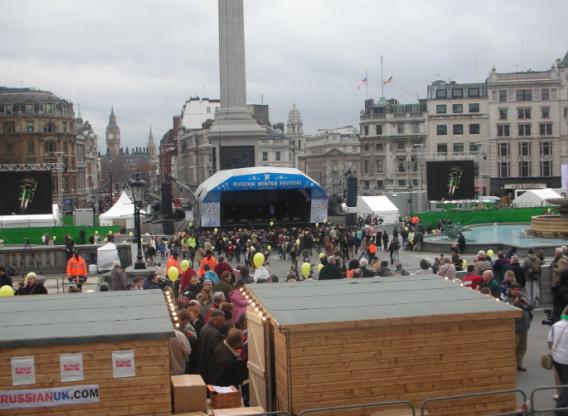
Here the weather continues to be unusually mild. We went to the Russian Winter Festival in Trafalgar Square (central London) on Saturday. It was very busy. There was Russian singing and dancing on the big stage, and a line of wooden kiosks selling Russian handicrafts and food. There were acrobats and jugglers and folk musicians, and it seemed as though every Russian living in London was there. I got a chance to practise the few words of Russian I speak (that’s about seven!). But it didn’t feel like winter. It was 12 degrees!
Then we went to see the movie, Perfume – the story of a murderer. Have you heard of it? Have you seen it? It is based on the novel, Perfume, by Patrick Suskind. I read the novel about 15 years ago and thought it was very powerful. The movie was excellent, but perhaps about 20 minutes too long for me. If you like beautiful photography and a dramatic story you will probably like this. It’s a bit scary, though, in places.
I read your blog about Korean music. Thank you. First, you talked a little bit about the weather. You are quite right. It is often possible to experience every kind of weather in one day here, especially in places like Manchester.
Then you talked about feelings, and I loved your question at the end of that paragraph: How about your daughter, Lucy? Is she complicated? (By the way, that was perfect grammar and sentence construction, and very good use of vocabulary. Well done.)
Of course, everyone is complicated. But Lucy has never been particularly difficult, not even when her mum died. She and I have (I think) a very nice relationship. I tell her what to do, and she does it! Well, of course, it’s not quite like that. But she is a very easy person to have as a daughter. She has a warm personality. It’s a bit like having a cat – except more expensive to feed and she doesn’t (yet) stay out all night!
Do you have a cat or any other animals?
OK. Korean music. You’re right about Korean music not being very popular in Europe. I am ashamed to say I don’t know any non-classical Korean musicians. I have certainly never heard of the bands you mentioned – and neither has Lucy. So we have decided that when I’ve finished this blog (and when I’ve done the housework, been shopping for the week’s food, cooked lunch and been for a run) we will try to find some of the bands you mentioned, on the internet.
Did I say lunch? Yes, it’s lunch-time already. Lucy is at the gym. When she gets back she’ll be ravenous. Sunday is now the only day of the week when we can have a relaxed family meal together so I always make something a bit special for Sunday lunch. Today I’m going to make beef patties with herbs and a sauce made from the juices from the beef, a little olive oil, a little red wine, some herbs, a little butter and a little tomato purée. We’ll have ‘Dad’s special’ mashed potato (the recipe’s a family secret, I’m afraid), some carrots baked in a little olive oil, and perhaps some French beans. For dessert? I haven’t decided yet. But just typing this list has made me hungry to I’ll stop now and head for the kitchen.
I’m still looking forward to hearing about your mum’s visit to Beijing – it is 25 years since I was there.
I’m also looking forward to reading what you write about Korean architecture.
I hope you like the photos we took at the Russian Winter Festival.
Take care.
Best wishes,
STEPHEN
SOME USEFUL WORDS AND EXPRESSIONS
kiosks
A small building, similar to a hut, where newspapers, sweets or street food are sold
acrobats
entertainers, often from a circus, who perform difficult movements and jumps
jugglers
entertainers, also often from a circus, who throw several objects (such as balls) into the air and catch them in rotation (so that there are several objects in the air at the same time). The verb is ‘to juggle’. NB: There is no verb form of the word ‘acrobat’.
ravenous
extremely hungry
patties
small ‘cakes’ of meat, like small beefburgers
herbs
dried plants, such as thyme, rosemary and oregano, which are used in cooking (use a good bi-lingual dictionary to check the names of herbs)
purée
a food which has been mashed or blended into a thick, smooth paste (‘paste’ is a synonym here, so you can say, ‘tomato paste’)
SOME VOCABULARY TO THINK ABOUT
Some notes about some words you used in Friday’s (12 January) blog:
heavy
It is normally used about things which weigh a lot. A large book, for example, can be heavy. A piece of furniture may be difficult to move because it is heavy. We don’t usually use the word about a wind or a difficult situation. So your first sentence could be re-written like this: It was cold and there was a strong wind this morning.
In your next paragraph, your last sentence could be re-written lie this: I know it’s very difficult to manage a family as a single parent.
criticism
Many words in English have different grammatical forms. For example, the verb ‘to criticise’ can be made into a noun, ‘a critic’ or ‘a criticism’, an adverb, ‘critically’ and an adjective ‘critical’.
It is important to remember what form of the word you need to use. For example, in your sentence, ‘Am I quite criticism?’ you are asking a question about what sort of person you are. When we describe things and people we usually need to use adjectives. So your sentence should be re-written like this: Am I quite critical? (or ‘Am I too critical?’).
during
We use this word when we talk about something which happened over a period of time, while something else was happening. For example, ‘I fell asleep during the movie.’
When you explained why you didn’t talk to your mum, you should have used another word, like this: She was asleep because she was tired from her journey.
hand over/ to fit
When children grow out of their clothes, parents sometimes pass them on or pass them down to other, younger children in the family. Your sentences about your sister, therefore, could be re-written like this: My older sister packed a lot of clothes for my youngest sister’s baby. She has two girls, in China, and some clothes no longer fit them. It saves money to pass on clothes as the children grow up.
architecture/buildings
This is one of those so-called uncountable nouns in English. Therefore, it doesn’t normally have a plural form. Your final paragraph would be improved if it were re-written like this: I’m going to talk about traditional Korean architecture tomorrow because I want to show you some gorgeous buildings.
SOME FIXED EXPRESSIONS TO LEARN AND USE
Have you heard of it/them? (about books, movies, bands etc)
Am I too critical? (asking for someone’s opinion about you)
She was having a lie-in. (This means that she was still asleep much later than usual because she had chosen not to get up early or at the usual time. You can say, for example: ‘Don’t wake me up in the morning, I’m going to have a lie-in.’ NB: in ‘lie-in’, both parts of the word are stressed equally.)
What traditional customs does your country have?
ORDER OF ADJECTIVES
If you make a sentence with a string of more than one adjectives in it, there is a general rule for the correct order of adjectives. Read the rules below, then look again at your sentence: ‘She gave me a small, beautiful pearl earring.’ Would you correct it?
The general rules:
1. Determiners (articles) and numbers come first.
EXAMPLE: ‘All those people…’
2. Then:
quality (lovely, beautiful, strange)
size (large, tiny, enormous)
age/heat (old, young, hot, cold)
shape (round, square)
colour/shade (red, blue, light, dark)
origin/source (Korean, Medieval)
material ( wooden, silk, woollen)
NB: Remember, however, that language rules, especially in English, have lots of exceptions. These are general rules and can be used as a rough guide.
So, Soyoung, your sentence would have been a bit better like this: ‘She gave me a beautiful [QUALITY], small [SIZE] pearl [MATERIAL] earring.’
The Russian Winter Festival, Trafalgar Square, London
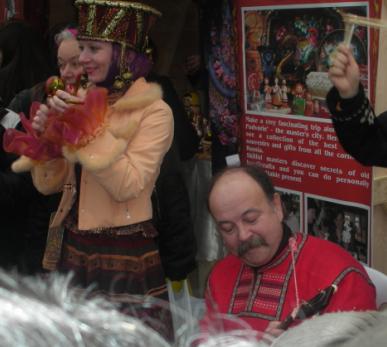
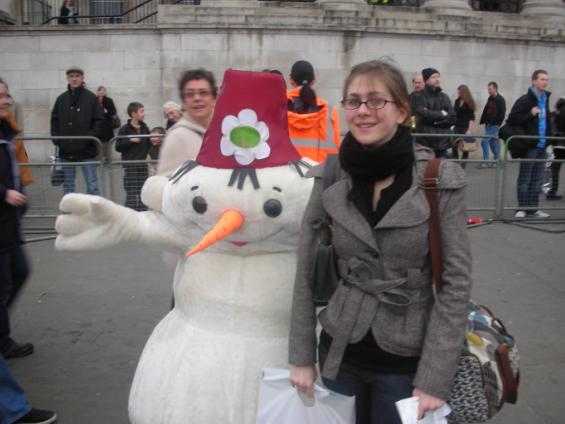
Saturday 13 January 2007 Trafalgar Square with Nelson’s Column in the background, the big stage in front of it and the wooden kiosks in the foreground. Folk musicians in traditional costumes. Folk-singing and dancing. Lucy posing, very reluctantly, with Russian ‘snowman’
[LUCY: “The things I do for the BBC!”] posted on Sunday, 14 January 2007 | comment on this postOur Third Week
Dear Soyoung,
It sounds like you had a fairly relaxed weekend. So, it was too cold to go out, was it? Never mind, you can post a couple of the photographs of Korean buildings you took two years ago, if you like.
Your colleague sounds like she had a good weekend. Is that why she didn’t want to go to work this morning? Personally, I never suffer from Monday syndrome. That’s because I sometimes work at weekends, and because practically every day is different for me. This morning, for example, I was in central London by 08.30 having breakfast in a quiet café. Then I went to the Tanzanian embassy to apply for a visa for my trip to Kilimanjaro. Kilimanjaro is, of course, in Kenya, but we have to travel across Tanzania to get to Kenya.
Applying for a visa is usually tedious and bureaucratic. So I was very surprised to find that there was no queue at the embassy and that I was dealt with extremely efficiently by a very warm and friendly young man. I have to collect my visa on Friday.
How is your mum, Soyoung? Has she recovered from her tiring journey? Is she in the kitchen already, cooking for you and your dad? Does she ever rest? Did you celebrate her return home – by taking her out to a Chinese restaurant, maybe? Actually, it sounds like she relaxed when she visited the spa near your sister’s house. I, too, love to take a sauna. I used to have a sauna every week, for about twenty years, but I don’t get the chance so often now.
Once again, Soyoung, your photographs are great, and so artistically arranged on the page. But the one I found most interesting is the photo of your sister on her wedding day. She looks very pretty – like a porcelain doll. I was intrigued by your mum’s advice to your sister. Have I understood this correctly? Your mother thinks that your sister should not demonstrate her love for her husband to him. Is that right? But she thinks that your sister’s husband should demonstrate his love for his wife. Then you said that “it’s a man’s duty” to show his love. But not a woman’s? I’m confused. Anyway, do you think that we should have to think consciously about whether or not to show our love? I wonder what our readers (women and men) think about that.
Once again I have to apologise. Last month Federico recommended stories by the writer, G K Chesterton, and I hadn’t read any. Now, Soyoung, you are recommending Zorba the Greek, and I haven’t read that, either. Life is just too short, don’t you think? I have seen the movie, though. But I didn’t like it. I’m sure the book is very much better.
This afternoon I went to see The Last King of Scotland which is a film about a young Scottish doctor who goes to live in Uganda, in the 1970s, and becomes the personal physician of the president, Idi Amin. It was a great movie, with good photography, fantastic music and only one or two very unpleasant scenes of extreme violence (you can close your eyes – I did). Actually, I bought six books while I was out today. Three of them are about Kenya and Mount Kilimanjaro, one was about one of my favourite British painters, Mary Fedden, another was a travel book about Siberia (a part of the world I have travelled in and know reasonably well), and the final book was a novel by William Boyd. Now I need a few quiet nights with nothing else to do but read. No chance! As soon as I finish this I have to go out training, again!
So I’ll just make a few language notes and then I’ll get my track suit on and go for a long run in the dark.
Have a good day tomorrow.
Best wishes,
STEPHEN
SOME USEFUL WORDS AND EXPRESSIONS
tedious
very boring
bureaucratic
with a lot of administrative paperwork
dealt with by
served by
spa
The word originally meant a place where drinkable mineral water came up out of the ground, naturally. However, we now use the word to mean a building where you can swim, bathe and take different kinds of water-based health treatments.
porcelain
fragile or fine pottery; China (not the country!)
intrigued
very interested; fascinated
track suit
sports clothes comprising a sweatshirt top and loose-fitting trousers of the same material; sometimes called a jogging suit or jogsuit
VOCABULARY FOCUS
Look again at how you have used some of these words.
journey (not ‘travel’)
The word ‘travel’ can be a noun, but it is more usually used as a verb. A better title for today’s blog would have been ‘My mum’s journey’
colleague (not ‘co-worker’)
outside (is all one word, not two)
In the same way, the word ‘inside’ is also all one word.
convenient/convenience
You probably need to check the ways this word can be used, in a very good English learner’s dictionary, and perhaps in a bi-lingual dictionary, too. ‘Convenient’ is generally used about something that is suitable or useful for a particular purpose and may save you time or effort.
old, older (elder), oldest
You don’t make any mistakes with these words, so don’t panic. You can, however, use the word ‘elder’ if you want to, only about the brother or sister who is older than you (EXAMPLE: ‘She is my elder sister’). ‘Elder’ cannot be used instead of ‘older’ in comparative sentences like this: ‘She is older than me’.
cousin/nephew/niece
Your cousin is your aunt’s or uncle’s child. Your sister’s (or brother’s) children are your ‘nephews’ (boys) or ‘nieces’ (girls).
SPELLING
It is, perhaps, not very important whether you use British English or American English spelling – except in examinations. So I have not usually corrected words like ‘favorite’ (below) or ‘color’. Sometimes ‘spelling mistakes’ are actually typing mistakes. Use your computer’s spellcheck facility for important documents or business letters. Look again at the following, from your blog today, to make sure you know the correct spellings:
irritated
planned
beautiful
favourite [UK English] favorite [US English]
SOME RE-WRITTEN SENTENCES
Compare your original sentences with the following re-written (and corrected) versions:
I had planned to go out to take pictures of traditional Korean buildings but it was really cold outside.
I like to read listening to soft music. I think it’s also Stephen’s favourite way of relaxing.
As I told you before, my mum didn’t go sightseeing while she was in Beijing.
My mum went to many Chinese restaurants, in fact most of her visits were to beautiful expensive restaurants.
You know, Koreans like to relax in the sauna but I don’t because I can’t breathe properly in the heat and humidity.
I love the photos you took at The Russian Winter Festival.
I’m going to a bookshop after work.
SOME IDIOMATIC EXPRESSIONS
By using some of the following common expressions you can make your English sound more natural. Don’t overuse them, though.
Never mind.
[It doesn’t matter.]
…if you like.
[If you want to; if you would like to]
No chance!
[There is no possibility]
Don’t worry.
[Not ‘Don’t be worry’]
posted on Monday, 15 January 2007 | comment on this postBeautiful buildings
Hi Soyoung,
How are you today? Better than your sister, I hope. Here, too, it is cold, grey and miserable today. Lucy is off school with a heavy cold. It’s the first time she’s missed a day of school for almost four years. I’ve spent the morning making her a tasty breakfast (poached eggs with ‘soldiers’), a hot toddy and, now, some tomato soup for lunch. She’s feeling much better now and I hope she’ll be at school tomorrow.
I’m sorry to hear your sister isn’t well. I guess she’s happy now that your mum’s back home and can look after her. Your mum sounds full of energy. I liked the way you described her personality as outgoing (a good word) and cheerful.
You are probably right when you say that most of us in the west think that the cultures of the Far East are very similar or the same. Of course it’s not true, and I think your photographs illustrate the different architectural styles very well.
I remember when I lived in China, between 1980 and 1982, I used to travel from Xi’an (where I lived and worked) to Beijing, about once a month for meetings. I always tried to visit The Forbidden City and The Temple of Heaven (my favourite building in China) on every trip. The rich dark red and deep yellow colours were so beautiful, and I love the dark blue roof tiles of The Temple of Heaven.
To my eyes Osaka Castle looks very stylish. I like its austere, more minimal decorative style. It looks very Japanese, to me.
I am sorry to say that I know very little about Korean architectural styles – or even about the dynastic history of your country. So, there’s something else for me to learn; another little project for me when I get back from Kenya at the end of next month.
You didn’t say what you plan to write about tomorrow. How about a bit more family history? You seem to have a large family. Do you have any old photos of your parents and grand-parents, or your aunts and uncles, which you could scan and upload? It could be fascinating.
Whatever you choose to write about, I’m looking forward, as ever, to hearing from you.
Take care.
Very best wishes,
STEPHEN
PS: A little note to our readers
We read and enjoy all your comments, so don’t be shy – write to us at the end of our daily blogs. We soon begin to feel lonely if we don’t hear from you.
SOME USEFUL WORDS AND EXPRESSIONS
miserable
Miserable weather is rainy, dull and grey.
off school
If you are off school you are not at school, usually because you are unwell. We use the same structure about not being at work (EXAMPLE: My colleague, Susan, was off work today with a terrible headache.).
poached
cooked gently in boiling water
The difference between a ‘poached’ egg and a ‘boiled’ egg is that when you poach an egg you break open the shell and pour the egg carefully onto the surface of the boiling water. A boiled egg is cooked inside its shell.
‘soldiers’This use of the word means long, thin strips of toast which are only usually cut like this to be eaten with poached or soft-boiled eggs.
hot toddy
a winter drink made by pouring lemon juice, honey and a little whisky (or cognac) into a mug of hot water
outgoing
An outgoing person is friendly and likes meeting people
stylish
smart, elegant, (perhaps ‘fashionable’)
austere
plain, not decorated
SENTENCE STRUCTURE
Look again, Soyoung, at the sentences you wrote about your sister, at the beginning of your blog, today, and then compare them with the re-written and corrected version, below. Look carefully at the use of a relative pronoun, at the past tense form of the verb ‘to catch’ and at the structure ‘too weak to go…’:
My younger sister, who lives with me, caught a cold last week. Maybe it’s flu because she is too weak to go to work today.
Now look again at the sentences you wrote about your mum. Compare them with the re-written and corrected version below. Look at the use of idiomatic expressions, such as ‘take it easy’.
She understands her health better than I do so I don’t need to tell her to take it easy.
Finally, look again at the passage you wrote about Korean dynastic history. Compare it with the following and focus on (a) the use of articles, (b) prepositions with dates, (c) vocabulary, and (d) the use of passive structures:
I like to go to palaces such as Kyung Bok Kung and Chang Kyung Kung, in Seoul. Seoul has been the capital of Korea since the Joseon Dynasty (1392-1910). Kyung Bok Kung Palace was built in 1394 when the Joseon Dynasty was founded. It was burned down several times during various battles, but was rebuilt. There are several palaces where the kings of the Joseon Dynasty lived. The dynastic period ended when the Joseon Dynasty ended. Now we don’t have a king any more.
Soyoung, you perhaps think that there are a lot of corrections here. Actually, there are not many, but they are important ones. Remember my advice last week: it is better for you to write more, shorter sentences than fewer long ones.
posted on Tuesday, 16 January 2007 | comment on this postLove Is In The AirDear Soyoung,
I have often wondered what women talk about when they get together. Now I know – other people’s love affairs. Can that be a more interesting subject than cars and football?
One of our Chinese readers wrote a long and interesting comment about love, on Monday 15 January. Both she and you ask me some big questions. She asked me what I think about showing feelings and emotions, and you asked me what I think about married couples who have affairs. This blog is becoming an agony column! And I think I am one of the least-qualified people to answer your questions. Firstly, I am a man. Secondly, I am a (relatively) old man. Thirdly, there are people who read this blog who know me, so I have to be careful what I say!!!
Personally, I don’t think I have any problem showing my feelings. When Arsenal (a London football club) win a match I jump and shout and kiss everyone in sight (whether they like it or not). When they lose, I cry all night. See? No problem with emotions.
As for love affairs, well, I think I had better remain silent on that intriguing subject.
It’s not even Valentine’s Day!
I’m teasing you a little, and that’s not really fair is it? OK, I’ll try to be serious for a moment. The other day I read a questionnaire about expressing one’s emotions, in a newspaper. One question was, ‘What makes you cry?’ Would you like a little list?
1) My own happiness, sometimes
2) The joy of just being alive
3) Certain pieces of western classical music (by, for example,
Beethoven, Elgar, Puccini, Sibelius, Tchaikovsky, Peter Warlock), especially when played live
4) Certain pieces of popular music from the 1960s
5) Profound evil
6) Sadness for others in tragic circumstances
7) Thinking about my late wife, sometimes
Another question was, ‘What makes you laugh?’, and although I think I laugh quite a lot I found it much more difficult to write a list of things that make me laugh. I think that’s because it’s not things but people who make me laugh.
There were other questions, too, about when, for example, you would try to hide your feelings, and how you try to hide your feelings. (One way, for me, is to say nothing rather than say something upsetting.)
As for ‘true love’, I am not sure I really understand it. Isn’t all love true love? Or are there lots of different kinds of love? I’m not even sure I understand what it means to ‘open your heart’ to someone. I don’t think I could stop my heart opening, by itself, if I was with the ‘right’ person. But I don’t believe there is only ever one ‘right’ person.
Oh, dear, Soyoung, I am completely out of my depth here. I should stick to safer subjects – like pork wrapped in lettuce with sesame seeds. It sounds good, but just a little too spicy for my taste. Here, it is time for dinner and, as usual, I have to cook. I’m going to be lazy tonight and just make pasta with a tomato and olive sauce.
Have a good day at the office.
Best wishes,
STEPHEN
SOME USEFUL WORDS AND EXPRESSIONS
agony column
page or article in a newspaper or magazine where readers ask for, and get, personal advice
teasing
embarrassing or making fun of someone for one’s own amusement
fair
reasonable, right, just
out of my depth
If you are out of your depth you are trying to deal with something that is too difficult or too advanced for you.
stick to
stay with, not move to something else
SENTENCE STRUCTURE
Here are some re-written (and corrected) versions of some sentences from your blog. Read them carefully and identify the differences.
I went to a butcher’s to buy it, in Manchester, but he didn’t know what Sam Gyup Sal was.
We then moved to a café for coffee. I prefer it to tea.
We talked a little about married couples’ affairs and real love after marriage.
The main subject of prime time Korean TV is love affairs.
A friend of mine, who wants to be a script writer, said that TV stations only want stories about love and betrayal.
But audience ratings are lower than for programmes about love affairs.
I think we have to take responsibility for the family after marriage.
However, one of us said that she could accept falling in love with another man after marriage so long as it was true love.
DON’T FORGET
All parts of sentences have to ‘agree’. Look again at your original versions of these re-writes and focus on where the different parts of each sentence agree
…I couldn’t upload many beautiful photos…
They soak pork in red wine for a week or even a month before roasting it.
When it’s fully-cooked I start eating it.
No one is married in my circle of friends and we chatted about other people’s affairs which we have heard about on the grapevine.
The main subject of prime time Korean TV is love affairs, and housewives like to watch those shows after dinner.
A few TV dramas are about hospitals, lawyers and university students.
But if I realised that someone loved me from deep in his heart, I think I would love in return.
A quick note to 'Rita' from Germany
Yes, Rita, even if it is irritating, I’m afraid it is not only correct to write ‘…it is 25 years since I was there…’, but it is probably more commonly used than the present perfect (which is, of course, perfectly correct, too). Thanks for the question.
posted on Wednesday, 17 January 2007 | comment on this postHappiness is...Dear Soyoung,
Thanks for your blog. Like you, I am looking forward to the weekend. Today is exceptionally stormy, really unpleasant and a bit frightening. The weather forecast is for better weather tomorrow. I hope so.
I’ve been writing all morning, and trying to ignore the wind. I’m glad your blog has arrived. Now I can focus on something else for a while: the things that make us happy. For you, it’s ice-cream, movies, e-mail, wine, clothes and blogging. What makes me happy? Let me think…
1) Lucy. She’s a good daughter. She’s clever, helpful, funny, loving and I think she has good values.
2) Running. When the weather is good – dry, not too hot, not too windy – and I am running (jogging) in the park, I find it easy to forget problems and enjoy the open space. I live near an enormous royal deer park so it is easy to run away from the traffic. I see herds of deer, very close up, every day.
3) Friends. I love sitting around a table with friends, and a bottle or two of good French wine, talking about nothing special late into the night. If there’s good music to listen to and good food to eat, that can make it even better. It is good to know that there are people who like you.
4) Home. I love travelling. I have travelled very widely around the world. I enjoy being a foreigner. I like visiting new places and meeting new people. But it’s always very nice to come home. I have a very small house, but I like it and find it very comfortable. I am always happy to be home.
5) Money. We say that money can’t buy happiness. But if you have no money – or not enough to be comfortable – it isn’t easy to be happy, I think. I buy lots of books and CDs. I like to buy good food. Good wine is not cheap. I go to the cinema and the theatre as often as I can. I like live music, too. Like you, I rather like expensive clothes, even though I can’t really afford them. Most of this isn’t really necessary, but it makes life better in so many ways. None of it is free.
6) Independence. I work freelance. That can be a problem when there is no work. However, when I have work I can usually decide when to do it. In my life there are very few times when I am obliged to do something I don’t want to do. I’m lucky, I know, but it’s also how I’ve tried to arrange my life.
Well, Soyoung, the wind is getting worse. So something which would make me happy right now would be if the weather improved. I hope it’s not too bad where you are.
There are a few language notes, below, as usual, Then, maybe, you can relax, in a new sweater, with a tub of ice-cream and a good movie with a couple of friends, followed by a bottle of good wine. No? Well the weekend’s almost here.
Have fun!
Best wishes,
STEPHEN
PS: I like your use of the word ‘Mancunian’. For people who don’t know, it means someone who comes from Manchester. Well done, Soyoung.
SOME USEFUL WORDS AND EXPRESSIONS
weather forecast
a radio or TV programme, or feature in a newspaper, saying what the weather will be like the following day or for the next few days
ignore
If you ignore someone or something, you take no notice of them.
values
moral principles and beliefs
deer
large wild animal (the male usually has large, branching horns or antlers); check the word in a good bi-lingual dictionary
herds
family groups (of deer)
FOCUS ON TENSES
I have selected some sentences from your blog. Let’s focus on the correct tense forms. Look at your original sentences and then compare them with the re-written (and corrected) versions below. I have typed in bold the parts of each sentence which need to agree:
I have appreciated your kind comments on my blog since we started.
I’m facing a difficult situation at work where my manager wants me to do more work.
I will feel better soon.
I ate ice-cream after work last week.
I call them sometimes and frequently write e-mails to them.
I rarely drink with my mum because she doesn’t like to drink alcohol.
I make a shopping list and a budget before going shopping.
I have never had ‘global’ friends I’ve never seen before.
You have no idea what a nice surprise it is.
If you need more help with tenses, you should check the forms and functions of the different tenses, in a good grammar book. Then, it could be a good idea to buy a good, self-study grammar practice book (with answers) which focuses on tense forms.
posted on Thursday, 18 January 2007 | comment on this postA Typical SaturdayDear Soyoung,
Many thanks for your blog. I bet you’re relieved that it’s the weekend and that you don’t have to go to work.
Here the storms have passed but a lot of damage was done all across the country. One of our readers, a Korean who lives in Lincoln, wrote about the bad weather up there (Lincoln is in the east of England, towards the north). The newspapers say that over £1bn worth of damage was done. Seven people were killed in the storms. Some airports and ports were closed, and many train services were cancelled. There are thousands of households across the country still without electrical power. We are lucky, here, not to have been too badly affected.
Another of our readers, however, thought that my mood was affected by the storms, and I think she’s right. I am easily affected by changes in the weather. How about you? What most easily affects your mood?
Isn’t it great that so many readers write such wonderful comments? It’s like having a whole new set of friends all across the world. Or am I being too poetic?
Here, it’s a typical Saturday morning. I woke around 07.30, took a quick shower and went to the coffee shop, which opens at 08.00. I’ve tried to give up coffee completely. In fact, I’ve been quite successful. I had no coffee between last Sunday and yesterday. So I allowed myself a little treat this morning – one small but very strong cappuccino. I met a couple of friends there, briefly, read the Saturday papers, bought some food for the weekend and then came home to do some D-I-Y in my bathroom. I had a small leak which I hope I have fixed – otherwise I’ll have to get a plumber to come and fix it, and that will be expensive.
I’m not especially good at D-I-Y. Well, I’m not so bad at it, but I don’t like doing it. The leak will probably return. I should have phoned the plumber.
Anyway, my typical Saturday continues. The mail has just arrived and I’ve got a postcard from a very old friend, and former colleague, in Serbia. About twenty-five years ago I went to Belgrade (in what was then Yugoslavia) and gave a couple of lectures at The British Council there. (Soyoung, is there a British Council office in Seoul? If there is, it will be a good place to find books in English and useful information about Britain.) I also ran a workshop for university teachers in the town of Kragujevac and I visited a few schools in and around Belgrade. One of these schools was in a little town called Sabac. The head of English there was a very impressive and hard-working woman whose pupils were, I think, exceptionally lucky to have her. We have kept contact over the years. She is now rather old and she retired a long time ago, but we still keep in touch. Her postcard, this morning, is to give me her new address. After I finish this, I’ll probably write her a long letter.
Then it will be lunch-time. It would be nice if I had a ticket for the Arsenal (football) match this afternoon, but I haven’t (and, to our reader in Scotland, I was exaggerating a bit about crying all night if Arsenal lose – but just a bit!) so Lucy and I have decided to take a long country walk. I need the practice for Mount Kilimanjaro, and Lucy tells me she just can’t face any more school work this weekend. She had some bad news yesterday: her first choice of university has not offered her a place. I feel so sorry for her. She’s exceptionally bright and very hard-working. She has chosen extremely difficult subjects to study and has applied to the most difficult universities to get into. This is quite a disappointment for her and, as a parent, I, of course, want to make everything right for her – and in this case I am completely powerless. She’ll get over it, I suppose.
Aaaggh! I have just looked out of the window. It looks like the storms have returned. A quick change of plan, then. We’ll spend the rest of the afternoon curled up on the sofa with good books and warm soup. I’m reading Restless by William Boyd at the moment. Lucy’s re-reading White Teeth by Zadie Smith.
Soyoung, I hope you manage to see lots of good friends over the weekend and that when Monday morning comes you’re feeling refreshed and ready for another week at the office. Say ‘Hi!’ to you mum and dad, and to all your friends, from me and Lucy – and from all your many fans around the world.
Best wishes,
STEPHEN
SOME USEFUL WORDS AND EXPRESSIONS
I bet
I’m sure
relieved
glad (because something unpleasant has stopped)
£1bn worth of…
You should read this as, “one billion pounds’ worth of”. A billion is a thousand million.
mood
state of one’s emotions
a little treat
something special; a reward
cappuccino
espresso coffee with steamed, frothy milk
D-I-Y
This stands for ‘do it yourself’ and is used to refer to household jobs such as decorating and small repairs which you do yourself.
leak
If a container or pipe has a leak it means it is cracked or has a hole in it and liquid (or gas) is escaping.
plumber
person who connects and repairs water pipes
ran a workshop
directed a workshop
retired
stopped working because (she) reached 60
can’t face
don’t feel able to deal with
bright
intelligent
get over
recover from
SOME GRAMMAR
Look again at the sentences in my second paragraph. Can you find five examples of passive structures? The passive form is used when you want to focus on a person or thing affected by an action. The person or thing then becomes the subject of a passive form of the verb.
[Soyoung, as I write this explanation I am uncomfortable that I am perhaps making it more difficult for you. I am sure you have studied the passive form (sometimes called the passive voice) in your grammar books. It is probably more helpful if you refer to those books again and then look at my second paragraph to find five examples of verbs in the passive form.]
The sentences with passive forms in them are:
Here the storms have passed but a lot of damage was done all across the country.
The newspapers say that over £1bn worth of damage was done.
Seven people were killed in the storms.
Some airports and ports were closed, and many train services were cancelled.
Those sentences could have been written in the active voice (with verbs in the simple past tense), like this:
Here the storms, which have passed, did a lot of damage all across the country.
The newspapers say that the storms did over £1bn worth of damage,
The storms killed seven people.
The storms closed some airports and ports.
Many railway companies cancelled their train services.
LOOK AGAIN
I have selected a few sentences from your blog to correct and re-write. Look again at your original sentences and compare them with my corrected and re-written versions.
I called a friend, Haeng-ja, who has been living in the US since she got married.
I was glad to hear from her but I felt quite sad because I felt I had lost a good friend.
I met two friends called Kyung and Eun-mi. We were at the same elementary school.
We became friends when we met again at our church.
We worked as Sunday School teachers.
Now look again at your original paragraph about Tiradentes and compare the re-written paragraph. Look especially closely at verb forms (including phrasal verbs), sentence links and idiomatic use:
Then we moved on [PHRASAL VERB] to Tiradentes, a Brazilian café at the airport terminal station. I had [TENSE] never been there [WORD ORDER] before. It’s the first branch in Korea. We usually go for [IDIOMATIC USE] coffee at [PREPOSITION] Starbucks, Coffee Bean, Pascucci or [LINK WORD] Dunkin Donuts. The international coffee shops are very popular places [GRAMMAR AGREEMENT] to meet. Tiradentes is quite small but [WORD SELECTION: CONRAST] it has a pleasant [WORD SELECTION] smell and the quality is good [PHRASE STRUCTURE]. Like other places [SENTENCE STRUCTURE], it is usually [PRECISE MEANING: REGULAR EVENT] quite packed inside. The café’s interior [WORD ORDER] is decorated [WORD SELECTION] in [PREPOSITION] orange which [SENTENCE LINK] is one of my favourite colours. Maybe that’s why I feel comfortable there [PHRASE STRUCTURE].
Soyoung, I know that the re-written paragraph will be difficult to read with all my comments in it. So here it is again without them:
Then we moved onto Tiradentes, a Brazilian café at the airport terminal station. I had never been there before. It’s the first branch in Korea. We usually go for coffee at Starbucks, Coffee Bean, Pascucci or Dunkin Donuts. The international coffee shops are very popular places to meet. Tiradentes is quite small but it has a pleasant smell and the quality is good. Like other places, it is usually quite packed inside. The café’s interior is decorated in orange which is one of my favourite colours. Maybe that’s why I feel comfortable there.
posted on Saturday, 20 January 2007 | comment on this postA Typical SundayDear Soyoung,
Suddenly it’s winter. Like you, we have no snow but the temperature fell during the night, and this morning it was freezing when Lucy and I set off for the coffee shop.
I bought the papers and spent an hour or so reading them while Lucy went off to the pool for her weekly exercise. Friends came and went. I had another coffee (I promise I won’t have even one cup during the week – maybe). The rain stopped and the sun came out. By the time I left the coffee shop it felt like spring. I drove home with the top down on the car (I’ll probably be in bed all week with flu) and the radio on loud. There was a terrific recording of La Traviata on BBC Radio 3 so I took a short drive into the countryside just to listen to it (the sound system in my car is so good it’s actually better than the system I have in the house).
The Sunday papers here are enormous. I usually get The Observer. It has about eight different sections (sport, travel, culture, news, business, music, fashion, a magazine and so on). I read something today which you might find interesting. According to The Observer, the average British person will spend 12 years of his/her life on the sofa, spends around £800 [about US $1475] a year on gambling, has 14 very close friends, will live to be 75 (if they’re men) or 79 (if they’re women), will eat 35,000 biscuits during his/her lifetime, watches TV for two-and-a-half hours a day and is online for just a little bit longer. We are 160 cm (women) or 178 cm (men) tall, have an IQ of 100, spend 45 hours a year on hold on the phone, and we are each kept awake by our partners’ annoying behaviour for 51 minutes every night (that means we miss a total of 38 nights’ sleep a year). A final statistic: the average British person spends £1,134 (about US $ 2,000) every year on holidays.
Well, Soyoung, is there anything there that surprises you? Do you think the statistics would be about the same or very different for the average Korean? Do you think you are an average Korean?
I’m not sure I’m an average Briton, if these statistics are right. I rarely sit on my sofa – it’s so uncomfortable!). I don’t gamble – I never even buy a lottery ticket. I don’t have 14 very close friends – perhaps 6 or 7 very close friends, but around twenty or so people I think of as good friends, and maybe another thirty or so I would call friends. I wish I could deny it, but yes, I’m sure I will eat a lot more than 35,000 biscuits during my lifetime (per year might be closer). I’m 180 cm tall and have no idea what I weigh (but I know it’s too much). I am too modest to tell you what my IQ is (but not so modest that I can resist telling you it’s a lot higher than 100). I never hold on the phone (would that make me a difficult customer for you?). I spend far more than I can afford on holidays. And I have nothing to say, in public, about being kept awake by other people’s annoying behaviour (which I assume means things like snoring) in bed!
Well, it’s almost time for lunch. We usually have a late lunch on Sundays. Today, I have promised Lucy I will make a small beef pie with beer. We’ll have winter vegetables (carrots, potatoes and broccoli) with it, and I don’t think we’ll need a dessert after that. I’ve just opened a bottle of excellent French wine so that it can ‘breathe’ for a while. Unfortunately, I can’t resist having a glass while I cook. So I’d better get started.
I hope you’re having a relaxing Sunday. Don’t forget to read Saturday’s blog, too, because that’s where I have answered your Friday blog, and included quite a lot of language notes for you. It’s a lot of work, I know. But by this time next week your month (and my time) with the BBC will have ended. So, let’s make the most of this week, and have some fun (send me a joke, mine are rubbish – even if Alex, from Russia, was kind enough to say he liked them: thank you, Alex).
Say ‘Hi!’ to the family from me.
Very best wishes,
STEPHEN
SOME USEFUL WORDS AND EXPRESSIONS
There are far too many words here to learn. However, they are all words and expressions you need to recognise when you read. Select five or six which you think will be most useful to you, and try to memorise them. It will be much easier to learn them if you try to use them as much as possible.
weekly
something which happens every week (other, related, words include: ‘hourly’, ‘daily’, ‘monthly’, ‘yearly’ and ‘annually’)
La Traviata
an opera by Verdi
BBC Radio 3
There are four main BBC national radio channels in Britain. Radio 1 plays mostly pop music; Radio 2 plays mostly ‘easy listening’ popular music; Radio 3 plays mostly classical music, with some drama and documentaries, and Radio 4 is a talk radio station with news, politics, drama, science and technology programmes, comedy and current affairs.
the countryside
Some students, especially those with European mother tongue backgrounds, under-use this word. The countryside is land that is not towns and cities. It is never correct to use the word ‘nature’ here instead.
According to
If something is true according to a newspaper (for example, The Observer) it means that that newspaper says it is true.
gambling
an activity where you take a risk or make a decision hoping to win or make money. Card games, roulette, betting on sports events, are all forms of gambling. The verb is ‘to gamble’.
close
intimate; friends you know very well
will live to be
Notice the use of the future form with ‘will’ and to ‘to be’.
biscuits
a small, flat, baked ‘cake’ which is crisp and usually sweet (although there are unsweetened biscuits for cheese and salads, for example). The nearest US English is ‘cookie’.
a day
per day
have an IQ of
Notice the structure of this expression, with the verb ‘to have’ and the preposition ‘of’ before the number.
on hold
If you are on hold on the telephone you are waiting to talk to someone (who may have asked you to wait)
kept awake by
If something keeps you awake it stops you from sleeping.
Briton
A British person.
rarely
If you do something rarely, you don’t do it very often.
deny
If you deny something, you say that it is not true.
weigh
The sentence, ‘I have no idea what I weigh’ means I don’t know how heavy I am. Notice the structure, and these useful sentences:
What do you weigh?
How much do you weigh?
What did she weigh when she was born?
modest
Someone who is modest doesn’t talk very much about his/her abilities, skills, achievements or material possessions.
assume
If you assume that something is true, you suppose it is true.
snoring
The verb is ‘to snore’. Someone who snores while asleep makes a loud noise in his/her throat.
I can’t resist having
Notice the structure of this expression, and these useful sentences:
I can’t resist having a chocolate biscuit with my coffee.
She can’t resist phoning her old boyfriend even though he’s got another girlfriend.
‘Resist’ means not to do something, especially when you are tempted to do it. Oscar Wilde, an English writer, wrote, “I can resist everything except temptation.”
make the most of
take advantage of (in a positive way)
GRAMMAR – USE OF TENSES
Look again, Soyoung, at my third and fifth paragraphs. Focus on the verb forms (tenses) I have used. Make sure you understand why some sentences use future tense forms (EXAMPLE: The average British person will spend 12 years of his/her life on the sofa.) and why other sentences use present simple forms (EXAMPLE: The average British person spends around £800 a year on gambling.). If you are unsure, think carefully about the exact meaning of each sentence.
posted on Sunday, 21 January 2007 | comment on this postOur Final WeekDear Soyoung,
I’m glad you had a relaxing weekend – and I wish I had someone to do my housework and washing and cooking for me. That would be just perfect. If your mum ever fancies a holiday in the UK for a few months…
This morning I have been doing really exciting things, such as changing the bedding, cleaning the bathroom, washing Lucy’s filthy clothes, ironing, shopping and paying a few bills. What a glamorous life, eh? It has been too cold and too wet all morning to wash the car. So, I’ve got something else exciting to look forward to later in the week. Great!
Actually, I’m now beginning to concentrate on my Kilimanjaro adventure. I still need to buy a new sleeping bag, a padded jacket and some waterproof trousers. If it ever stops raining I’ll go out and get them this week. I have a bigger problem: vaccinations. Soyoung, I have to admit that (like a lot of men, I think) I hate injections. All right, I admit it, I’m scared of injections. I’ve been putting it off for weeks but if I don’t get my yellow fever vaccination soon, it will be too late. I’ll keep you informed.
Meanwhile, I still have to collect some money from the people who have agreed to sponsor my trip. It’s for a British charity, called Scope, which helps people with cerebral palsy to live more comfortable lives, and, in many cases, to have ‘normal’ jobs. There will be 40 of us, trekking for seven days, and together we expect to raise about £200,000 for Scope’ work.
I’m taking a couple of cameras and I hope to write one or two short articles about the trip when I get back.
Yes, I saw Little Miss Sunshine last year and I quite enjoyed it. I saw no movies this weekend, but I have tickets for the theatre for next week, and Lucy and I hope to visit a couple of art exhibitions before I leave for Tanzania. Talking of Tanzania, what do you think, Soyoung, about Lucy being on her own while I’m away? Is it too tempting for her to have wild parties every night while I’m away? Did you ever do that when you were her age? Did your parents discover what you’d done? Or were you very good at cleaning up afterwards? Maybe you were just too well-behaved to have wild parties?
Only four more blogs left, if I have calculated correctly. Have you got any plans for them? How about a bit more about your colleagues? And what about special celebrations in Korea? When is your New Year? Do you celebrated Valentine’s Day? At the end of the week it would be good to know what plans you have for the rest of the year. Will you take a foreign holiday, for example? I’ll stop now and focus on some language notes. But before the end of the week I’ll post some more photographs, and, like I said, I’ll let you know what happens about the yellow fever jab.
I’m looking forward to hearing from you again soon.
Best wishes,
STEPHEN
PS. Since I wrote this, I've fixed up an appointment for my jab for tomorrow morning. Expect me to be pathetic!
SOME USEFUL WORDS AND EXPRESSIONS
fancies
wants; feels like
bedding
bed clothes; sheets, pillow cases, duvet covers, blankets, etc
filthy
extremely dirty
sleeping bag
a large, warm bag for sleeping in (especially when you are camping)
padded
filled with soft, insulating material, such as feathers or cotton
vaccinations
medical treatment, with a vaccine (liquid medicine), to prevent certain diseases
injections
Vaccines are usually given by injections. An injection is given with a syringe which has a sharp needle which is put into the body and through which the vaccine is deposited into your body.
scared of
frightened of
putting it off
delaying it
I’ll keep you informed.
I’ll make sure you find out what happens.
to sponsor
If you sponsor someone you promise to pay them. People who sponsor this trip, for example, agree to pay me, say £50, for climbing the mountain. The money, of course, is for the charity (in this case, Scope).
charity
A charity is an organisation which raises money to help people who are sick, disabled or very poor.
cerebral palsy
a kind of brain damage
trekking
walking long distances under difficult geographical conditions
to raise
to collect
jab
informal (slang) word for ‘injection’
SENTENCE AND PARAGRAPH STRUCTURE
Look again at your first paragraph. It is rather long. It could be divided into several shorter ones. Below, I have re-written (and corrected) the paragraph. First, read both paragraphs together. Check every change I have made. Then read the corrected paragraph once more. Finally, you can use it as a reference source of correct grammar and useful expressions. Soyoung, please remember that I have re-written this to give you a set of model paragraphs to refer to. Don’t think of this as criticism, but as help. Also, don’t think that this means your English it is not good. That’s not true.
I had a great weekend. I relaxed at home with my mum on Saturday. But she made a noise which woke me up in the morning. She was doing the housework, as usual. But there was more work to do because I hadn’t washed my bedclothes while she was away.
I woke up in the morning because the washing machine was so loud. My room is next to the washing room. Our washing machine is rather old. My mum bought it seven years ago, and about three months ago it started to make a noise. However, my mum doesn’t want to spend money on a new one until this one breaks down. So she will probably have it fixed again, even if it’s soon going to break down completely.
My mum is staying at my youngest sister’s house for the next five days because my sister needs a baby-sitter. My niece is almost four months old and she is too young to send to a nursery. One of our social problems is that we don’t have a well-developed social welfare system, especially for married women who work. Most companies don’t have their own nurseries – even those with over a hundred employees – because they are not required to by law. So my mum takes on a lot of extra work by helping to care for her grand-daughter. How about in the UK? Are there enough nurseries for young children?
At the moment I seem to have lost my appetite. I don’t know why I don’t want to eat anything. I had a light brunch with my sister on Saturday morning. Then I didn’t eat anything else until the evening. My mum suggested I have boiled lettuce with rice, but I didn’t want it. Suddenly, though, I fancied some fried chicken, and my mum called for a takeaway. But when it came I just ate two pieces of chicken with a beer. Then I fell asleep almost immediately. I woke up at 11 pm and thought that maybe there had been a sleeping drug in it.
I watched the second series of the American TV show ‘24’ on the internet. I’m excited by it. My mum is sad that I am so absorbed in it. She thinks I am only interested in TV shows. Maybe she’s right but it’s really interesting and Kiefer Sutherland is a fantastic actor. posted on Monday, 22 January 2007 | comment on this postI Didn't Feel A ThingDear Soyoung,
First, an apology. I made a typing error in yesterday’s blog. I hope it didn’t confuse you (or anyone else). Towards the end of my blog I asked about celebrations in Korea. I asked about Korean New Year and also about Valentine’s Day. I should have typed Do you celebrate Valentine’s Day? (not “Do you celebrated Valentine’s Day?”). I’m very sorry about the error.
Next, a big thank-you. Thanks to all the readers who reassured me about injections. You were right. It must be about 10 years (probably more) since I last had any injections. In those days you could actually feel the needle going in. This morning I had to ask the nurse if she was really sure she’d given me the injection: I felt absolutely nothing at all. It’s amazing. I think I might go back and have a few more!
Soyoung, in your blog today you didn’t refer to anything from my blog yesterday. Did you have a problem accessing it? Or was it just too boring to respond to? (Don’t answer the second question!)
Yours today was full of great photographs. You seem to have had a good time when you were here in Britain. You’re right about phrasal verbs – there are so many of them, and they are so important. Of course, it’s a good idea to have some sort of reference book – perhaps a dictionary of phrasal verbs – but they can’t easily be learned from a book or from lists. I wonder whether our readers have any tips for you.
Phrasal verbs are probably best learned by reading a lot, especially modern, idiomatic texts such as magazine articles and popular novels, and by listening to conversation or dialogue in, for example, movies, TV programmes and radio plays. (Are foreign movies and TV programmes dubbed in Korea, or are they subtitled?) It is a good idea to keep a small notebook just for phrasal verbs. When you discover a new one write it in your notebook, with an example sentence. Organise the phrasal verbs alphabetically, in groups. For example, keep all the phrasal verbs you learn with ‘catch’ together under ‘c’ (EXAMPLES: to ‘catch on’, ‘to catch up’).
Well, here it’s been a rather nice day: very cold, but very sunny. I was able to go for a run. I ran for two hours in Bushy Park which is a large royal deer park next to Hampton Court Palace (very near where I live). I got home just before it began to get dark. Lucy came home from school – hungry, as usual – with piles of homework to do. She has a music lesson tonight (she plays the alto and soprano saxophones and four different sizes of recorder) and since there’s nothing to watch on TV I guess we’ll both have an early night.
I’m looking forward to reading your blog tomorrow, as ever.
With best wishes,
STEPHEN
SOME USEFUL WORDS AND EXPRESSIONS
made
Remember to use the verb ‘to make’ with ‘error’ and ‘mistake’ (EXAMPLE: I made a mistake.)
dubbed
Foreign movies and TV programmes which are dubbed have the original foreign language dialogue removed and replaced by dialogue in your language.
subtitled
Foreign movies and TV programmes which are subtitled keep the original dialogue, in the foreign language, but have lines of text in your language, at the bottom of the screen.
piles of
lots of
recorder
a hollow musical instrument you play by blowing down one end and covering a series of holes with your fingers
have an early night
go to bed earlier than usual
MORE PRACTICE WITH TENSES AND VERB FORMS
Remember that when you describe something you did in the past you should usually use the Simple Past Tense (EXAMPLE: I went to Wales with Maggie. The weather wasn’t very good but occasionally the sun came out. She and I had a great time. While we walked along the shore we talked about our futures. She wanted to be a magazine editor. Now she works as a correspondent for the Daily Telegraph, in Beijing.).
Sometimes you will need to mix tenses and verb forms (EXAMPLE: I studied phrasal verbs on the course. There are a huge number of them. We couldn’t get a good score when we were examined on them. A friend, who is from Switzerland, decided to buy a book of phrasal verbs. We were almost exhausted studying phrasal verbs because they are difficult to memorise. But the class was fun. The teacher, Catherine, was very nice and funny. She was energetic, cheerful and charming. She always taught us very well. Her lessons were exciting and her classroom was always full of laughter.)
posted on Tuesday, 23 January 2007 | comment on this postSnowDear Soyoung,
Take it easy. I can feel the stress in your blog. You haven’t responded to Monday’s blog, or Tuesday’s, so it’s difficult to know what to say to you today. I hope you wake up feeling fresh and relaxed, and that you have time to look very carefully at all the material I sent you on Monday and Tuesday – and today!
I woke around three o’clock in the morning. My darkened bedroom was softly tinted (I never sleep with the curtains closed). The sky was the colour of fresh mushrooms, a little pink at the edges. It was snowing. It had been snowing for some time. Everything was outlined with thick, white shadows. As I stood, looking down the road where I live, a large male fox, normally well-hidden in the dark, patrolled the garden walls, his thick, bushy tail leaving light brush-strokes in the freshly-fallen snow.
I woke Lucy (it’s not every day we get the chance to see such dramatic natural beauty right outside our house) and we stood, just looking out of the window at the untouched loveliness in front of us.
Snow does that to me. Evidently, the first snowfall of the year is supposed to be very depressing. I think if it were October or November now I’d be depressed. But it is the end of January. Spring is practically here. So I don’t mind a little snow, which will be gone by tea-time anyway. And the kids love it, too. My next door neighbours have a 3 year-old son, Alexander. I watched this morning as he and his dad, Richard, cleared the snow off their car. This was probably Alexander’s first real snow. He was wrapped up in a thick coat and scarf and a colourful woolly hat with a pom-pom on it, and he was wearing tough little boots. They were clearly having fun.
It must be the snow; I’m feeling somewhat poetic this morning. (Don’t worry, it’ll soon wear off.) I sat down to write a long poem about the snow, but a long poem didn’t seem to want to come. This haiku came, instead. I’ve dedicated it to a friend, but, Soyoung, if I hadn’t been blogging to you this week I probably wouldn’t have written it at all. So, in a very real sense, it is for you, too.
SNOW
for Alison
Snow came in the night,
like a secret lover, and
stayed beyond the dawn.
© Stephen Keeler OK, enough of this nonsense. It has just occurred to me that some of our readers may not know what a haiku is. So, here’s a quick literature lesson, for anyone who needs or wants it.
Haiku [pronounced hy-koo] is a Japanese literary form. A classical haiku is supposed to present an impression of a single natural object or scene, in a particular season, and should be written in three non-rhyming lines of five, seven and five syllables.
There is a fuller definition, with a little historical background information, in The Concise Oxford Dictionary of Literary Terms (ISBN 0 19 282893 2), or just type haiku into whatever search engine you use and see what comes up. Then, why not write some haikus yourself, in English, of course. It would be a great way to end our month, don’t you think? And let’s invite all our readers to write haikus and post them as comments before we go.
There are, of course, other favourite literary forms. A lot of my students used to like to write Limericks. How about this one?
There was a young girl from Korea
Who waited for blogs to appear
On her screen every day
So that she could then say
“Phrasal verbs are remarkably queer!” If you’re not sure about the ‘rules’ of Limericks, try the same dictionary of literary terms or, of course, the internet.
All that, Soyoung (two pages in this Microsoft Word document) is just because it snowed last night. Oh yes, and some ‘arty’ photographs at the end of the blog, too. Hope you like them. Uh-oh, I feel another Limerick coming on:
There was a young woman from Seoul;
Learning English her principal goal.
Some people go jogging,
Soyoung prefers blogging
And Stephen? He plays teacher’s role. I promise that’s it. No more. The trouble is, once you start it becomes a bit addictive. Anyway, I’ll stop now.
There once was a girl called Soyoung No! I said I’ll stop, so I will. Perhaps some of your readers would like to finish that one? Like I said, take it easy. Try to make sure you have enough time to read my blogs from Monday, Tuesday and today. You only have two more chances to write before your month with the BBC ends. Let’s end in style, shall we?
Best wishes,
STEPHEN
WORDS AND EXPRESSIONSToday, make a note of the words and expressions (in my blog) which you haven’t seen before or don’t understand. Then, try to guess the meaning of each word and expression in your list. You should be able to guess around half of them. Now, use a good (bi-lingual) dictionary to find the meanings of the rest. I will post a full list of useful words and expressions from today’s blog, tomorrow.
A NOTE ABOUT FUND-RAISING EVENTSA couple of readers have asked about how fund-raising events, like my trip to Tanzania, work. The trip is a fund-raising event for the British charity, Scope – a charity which helps cerebral palsy sufferers. (But I have done others, such as running in the London Marathon and, once, cycling from London to Paris, for other charities.) It works like this. If you decide to take part, you agree to raise a certain sum of money through personal sponsorship. I had to agree to raise a minimum of £2,800. In addition, I had to pay around £200 to register, and there are other costs, too. For example, I have to buy all the equipment I need and I must pay for a Tanzanian visa (£38), transit taxes through Kenya (£40, I think), airport taxes (£65) and additional personal costs. My air fare, accommodation and food costs are included in the £200 registration fee and also come out of the £2,800 I raise from my sponsors.
People raise money in different ways. If you work in a school or hospital or other large institution, you can organise events such as raffles, fancy dress parties, auctions, and so on, to raise money. I work mostly alone. So I decided that £2,800 divided by 100 was £28 so I would ask one hundred people for a cheque for £28. It more or less worked (I had to put in about £300 extra).
There will be around 40 of us climbing the mountain between 15th and 24th February, and we will raise around £120,000 for Scope. Around £100,000 goes direct to the charity’s work with cerebral palsy sufferers. I may have got some of the figures wrong, but that should give you a rough idea of how it works. PHOTOGRAPHS FROM A SNOWY LONDONSoyoung, my photographs are not as good as yours. However, this might give you some idea of what things looked like in my back garden around eight o’clock this morning.
It’s difficult to believe we’ll be sitting here in shorts and T-shirts a few weeks from now.
Maybe I should have listened to the weather forecast before putting the washing out last night. posted on Wednesday, 24 January 2007 | comment on this postDon't Stop Now!Dear Soyoung,
It’s Thursday, it’s one o’clock and I’ve just had lunch. It is a gorgeous day here, with bright sunshine even though it’s a little cold.
How are you today? Have you recovered from yesterday? Did you sleep well and wake refreshed and full of energy for another working day? I hope so. As you know, this is my penultimate (second from last) blog. So let’s get the ‘business’ over, first. Here’s the list I promised you yesterday. How many of these words and expressions were new to you? Did you manage to find them all in your dictionary?
USEFUL WORDS AND EXPRESSIONS FROM YESTERDAY’S (24 JANUARY) BLOG
tinted
slightly coloured
edges
the places or lines where one thing stops and another begins
outlined
If something is ‘outlined’ it has a line around it which makes it easier to see.
fox
a wild, dog-like animal with reddish-brown fur
brush-strokes
the marks left by a paint-brush
it’s not every day we get the chance
This expression means ‘it doesn’t happen very often’.
right
exactly
practically
almost
I don’t mind
I have no objection to; I don’t dislike
pom-pom
a decorative ball, usually made of wool, on the top of a hat
somewhat
rather (‘somewhat’ is a fairly formal word)
wear off
go away
dedicated
(written) for
It has just occurred to me that
I have only just thought about this
I feel another limerick coming on
You can use ‘I feel another…coming on’ to mean that you are going to repeat an action.
Don’t Stop Now!
If you’ve got the time and the energy, why not make a hard copy of each blog from this month and put them all together in a booklet or file. Add a blank page between each blog and make new notes each time you re-read a blog. Make notes of new words, grammar points which you understand better, pronunciation notes (from your dictionary or from listening) and any new words or expressions you have learned since we blogged but which are related in some way to material in the blogs.
This could become a very useful reference project for you. You could even add short newspaper or magazine articles you find, and hard copies of other material from the internet. The BBC World Service Learning English website is terrific – as you know – and you will always be able to find something useful and accessible there.
The important thing now is to keep your English fresh by continuing to study it as well as use it.
I’m looking forward to getting your blog, later today.
Take care (and don’t work too hard).
With best wishes,
STEPHEN
posted on Thursday, 25 January 2007 | comment on this postHOORAY! I Made A Mistake!!!Guess what? I got it wrong! Today is not our last day, Soyoung, we’ve got another week. How good is that? I can’t believe my luck! Excuse me for a minute or two while I open a bottle of wine to celebrate (well, it is the weekend, after all).
Before I go any further I just want to say a very serious thank you to all the readers who’ve been so generous in their comments about these blogs. It is great to know you’re all out there and finding at least some of this useful. It’s a shame you can’t post photos of yourselves so I can see what you all look like. Anyway, we’ll have a proper chance to say goodbye at the end of NEXT week.
Meanwhile, back in Korea, Soyoung’s been back to her favourite café, started a yoga class and remembered an old flame. . .
Dear Soyoung,
Many thanks for your blog. I know exactly how it feels to wake up and not to want to get out of bed. It happens to me every morning, in the winter. In the summer, however, I’m sometimes up at 4.30 or 5.00. It’s the best time of day for jogging in the park, with only the birds (especially woodpeckers, herons and jays) and the animals (deer, rabbits and squirrels) for company.
The weather here is very much improved. It’s so mild again that as soon as I’ve finished this I’m going out for a two-hour run (Kilimanjaro training).
You said nothing about my haiku. Maybe you didn’t like it very much? How about the Limericks I wrote for you? (They’re unique, you know. OK, so they’re not exactly works of genius, but they are unique.) Soyoung, have you read the poems and rhymes that our readers have been writing this week? Not bad, eh? Maybe I should just say a bit more about Limericks.
Limerick: an English verse form with five rhyming lines [a, a, b, b, a]. The third and fourth lines have two stresses each, and the others have three. It is usually humorous and features the names of people and/or places (EXAMPLE – the words or syllables in bold text are to be stressed: There was a young girl called Soyoung,).
Try reading this one aloud. Stress the words or syllables in bold text. You should now discover the characteristic rhythm of the Limerick.
There once was a teacher called Stephen
Whose nose was too long and uneven.
His head, it was bald
And his face, it looked mauled…
Oh my god, here he comes, now I’m leavin’
I think Limericks may be culturally alien to you, Soyoung, but how about haiku? Do you Korean writers use this form? Or just the Japanese?
You mentioned your friend who works for Design-Jungle, and then you asked about my house. It gave me an idea. I will take some photos of the inside of some of the rooms in my house (rooms which have been cleaned and are tidy!) and I’ll post them on the blog sometime over the weekend. Would that be of any interest to you?
Now, your love story. Oh, Soyoung. It is so sad. So beautiful and so sad. Do you write? In Korean, I mean? If you can write, I think you should write it as a simple love story and try to get it published. It is so lovely.
I have re-written that part of your blog, below, with a few corrections. Read the two versions – yours and mine – side-by-side to check the corrections and small changes I’ve made. I have tried to keep the lovely simplicity of your original version. Sorry, if I’ve failed.
I have a feeling that there may be quite a few of our readers – men as well as women – who have love stories they might want to share. If we were a little bit nearer 14th February (Valentine’s Day) we could have done a ‘love story special’ blog. But I suppose that would mean I’d have to share a love story with you. Mmm? Maybe it’s not such a good idea, after all.
The weekend starts (for me) just about now. After my long run, I’ll take a long, hot shower, shave and put something smart on. Lucy’s had a hard week at school – she had to complete a mini-thesis by today – so we’re going out for a meal tonight. Tomorrow, I’ll go up to town (i.e. central London) to see friends, do some shopping – there’s a new novel by one of my favourite US writers, Carl Hiassen, published this weekend and I want to buy a copy – maybe go to a movie (what do you recommend, Soyoung?) and see the exhibition of Indian sculpture at the Royal Academy of Arts, in Piccadilly (a street in central London).
I’ll blog again sometime during the weekend – with those photographs I promised you – and fill you in on all the fun I’ve had.
Have a great weekend yourself.
Bye for now,
STEPHEN
SOME USEFUL WORDS AND EXPRESSIONS
an old flame
an idiomatic term for a former boyfriend (or girlfriend)
woodpeckers
A woodpecker is a bird with a long sharp beak which it uses to make holes in tree trunks so as to remove insects to eat.
herons
A heron is a large grey water bird with long legs.
jays
A jay is a bird from the crow family. In Britain, jays have black-and-white wings and a pink body.
deer
Note: the plural of ‘deer’ is ‘deer’ (like ‘sheep’ for example). See earlier blog for definition.
rabbits
A rabbit is a small furry animal with long ears.
squirrels
A squirrel is a small furry animal with a long bushy tail. Squirrels are expert tree-climbers.
bald
without any hair
mauled
badly damaged (scratched and cut) by a wild animal, especially a lion or tiger
alien
foreign; unknown; strange
mini-thesis
an academic project, shorter than a thesis but longer than an essay
fill you in on…If you ‘fill (someone) in on’ something, it means you give them all the details.
A LOVE STORY
by Lee Soyoung
I started a yoga class this week. Wow! When the class was almost finished, the teacher switched the light off and we closed our eyes. She told us to keep silent and think of nothing, just to keep breathing. Suddenly, I remembered my first love.
It’s silly. I don’t know why he appeared in my thoughts just then…
I met him at the riverside when I was 19. He was alone. I was sitting down near the riverbank and he was not far from me. I looked at him and then turned my face back towards the river. He watched me for a while and then came and sat next to me. He said he came here to feel refreshed. Me, too.
We started to talk about our lives. We were very young and it was easy to open our hearts to each other. We became friends, not lovers.
We phoned each other every day and met once a week. He was a student and I had a part-time job. I hadn’t gone to university after high-school. He was surprised but understood: he wasn’t enjoying studying physics. He was clever and bright. I liked his good nature. He was tall and good-looking.
I began to love him as time went by but I couldn’t show my feelings for him because I didn’t want to lose his friendship. I never really found out whether he loved me. A friend advised me to hide my feelings for him.
We did our two years of National Service in the army. I visited his camp to see him whenever he wanted to see me. Then, after he graduated he went on to do a master’s degree. We were still good friends.
Almost seven years later I didn’t exactly love him but I wanted to meet him again, as a friend. I wanted to keep in touch with him forever. I think, he had begun to love me, but I didn’t know how to deal with that. So I did nothing.
Eventually, he stopped calling. We didn’t see each other for almost two years. Maybe the relationship was over. One day I left a message for him to meet me at work but he didn’t receive the call. He had left for Vancouver to study at the theological academy there (he had sometimes told me that he might study theology). When I decided to study abroad a friend suggested I go to Vancouver, nowhere else. But I believed that if we were fated to meet again we would.
But we didn’t. He married another woman. It’s fate that he didn’t come back to me. It’s over. I sometimes wonder whether he’s all right and happy.
The past is sometimes very beautiful in my mind like this.
posted on Friday, 26 January 2007 | comment on this postOur HouseI don’t have the software you’ve got, Soyoung, and I think my camera (or my photographic skills) may not be as good as yours. However, here are a few photographs I took at home this morning (28th January 2007). Is this what you imagine a British house is like inside? I have no idea whether our house is typically British or not. Let me know what you think? What surprised you? What did you expect and not expect to see? What do you think are the main differences between my house and yours?
The kitchen.A shelf of some of my little treasures from various parts of the world.More treasures. There are wood carvings from Russia and Sweden and the Czech Republic, a bear from Berlin, a knife from France and bottles of ink from Italy.The living-room.Part of the dining-room, with pictures from China.The hall stairs. I bought the poster in Paris three or four years ago.The bathroom.Lucy, pretending to be hard at work in her room.A shelf of Lucy's little treasures, including a small steamboat from Stockholm and some matrioska dolls from Russia. posted on Sunday, 28 January 2007 | comment on this postAnother Shot in the ArmDear Soyoung,
It sounds like you’ve had another exhausting day. Why do you get home so late? Do you work late every night? I hope they pay you very well.
I don’t think you read my blog last Friday. Even if you haven’t got time to respond to it you should try to find time to look at the language points.
Well, I had another shot in the arm today. Actually, another two shots – one in each arm. And I still felt nothing. So, I think I’m protected against everything now except actually climbing the mountain itself.
The nurse said I should sit down for five minutes after the injections. I know nothing about these things, so I asked why. She told me it was in case I had an allergic reaction. Evidently, some people become extremely dizzy after they’ve just had an armful of shots. I asked her what she would do if I reacted in that way. She said she’d give me adrenalin. I didn’t sit and wait. The way I drive my car, my system is pumped full of adrenalin by the time I’m halfway down the road!
So I came home and had breakfast with a neighbour and then I went out for a run. It is incredibly mild again – about 11 degrees this morning – and it was possible to go out without track suit bottoms on. Imagine running in just shorts (and a track suit top, of course) in January!
You asked about job interviews here. I’m not sure they’re so very different from interviews anywhere else. You have to make a good impression as soon as you walk through the door. Personally, I think you should always shake hands with your interviewers, both at the beginning and at the end of your interview. You should smile at and make eye contact with them throughout the interview. You should listen carefully to their questions and then answer them as concisely and confidently as possible. You should appear to be relaxed, knowledgeable and friendly.
Of course, it helps enormously if you prepare thoroughly for your interview in advance. Find out about the company and its products or services, even its history. Make sure you completely understand what you will have to do if you get the job. Be prepared to ask questions and to ask your interviewers to explain anything you didn’t understand during the interview. Is that how you got your job, Soyoung?
OK, no more from me right now because I want you to have time to look at all the language points below – and to read last Friday’s blog, too. Remember, we only have four more days (and this time I haven’t made a mistake!), so you should try to make the most of these last few blogs.
Have a good day at work. Try to get home early (am I beginning to sound like your mum?).
Best wishes,
STEPHEN
SOME USEFUL WORDS AND EXPRESSIONS
shot in the arm
‘A shot in the arm’ is an idiomatic expression which means ‘motivation’, ‘encouragement’ or ‘extra energy’. But the expression also has a literal meaning: ‘shot’ is an idiomatic word for ‘injection’.
protected against (notice the preposition, ‘against’)
allergic reaction
A response to something you are allergic to (see below).
(to be) allergic to
If you are ‘allergic to’ something you become ill when in contact with it [EXAMPLE: Edward is allergic to eggs. He always get a bad headache if he eats them.]
allergy
An illness you get when you are in contact with something you are allergic to.
dizzy
a feeling of losing your balance; about to fall over
adrenalin (look it up in a good bi-lingual dictionary))
A substance produced by your body in response to stress. It increases the speed of your heart and gives you more energy.
track suit bottoms (plural, like trousers)
loose trousers worn when you do sport
make a good impression
have a positive effect. If you make a good impression on someone they react positively towards you.
concisely
with all the necessary information and as briefly (or directly) as possible
A LITTLE BIT OF GRAMMAR
Read the following sentence and focus on the word ‘should’.
The nurse said I should sit down for five minutes after the injections.
We use the word should, in this context, when we talk about giving advice. In this sentence, the nurse is giving advice to the patient. She is advising him to sit down for five minutes.
‘Should’ is also used, in English, to express moral obligation. Read the following and decide whether it is giving advice or expressing moral obligation.
You shouldn’t play loud music so late at night. Think about the neighbours.
This expresses a moral obligation to play music quietly so you don’t disturb your neighbours.
‘Should’ can also be used like ‘must’, when talking about rules and regulations. It is less strong than ‘must’ but is intended to have a similar effect. Some teachers call this use of ‘should’ a ‘soft imperative’. Read the following sentence from a sign in a restaurant kitchen:
You should wash your hands before preparing food.
The meaning is clear. You have to wash your hands before you handle food. (In a restaurant kitchen it would probably be better if the sign had read: ‘Wash your hands before preparing food’.)
Now look at the following twelve sentences and decide which give advice (A), which express moral obligation (O) and which are ‘soft imperatives’ (I). The answers are at the end of today’s blog.
1. You should visit your grandmother more often. You know how much she looks forward to seeing you.
2. You should take an umbrella. It’s going to rain.
3. You should report to reception when you arrive.
4. You shouldn’t drive so fast. It’s dangerous.
5. You should phone her to say thank you for the present she sent you.
6. You shouldn’t smoke. It’s bad for your health.
7. You should give up your seat on a crowded bus if an old person is standing.
8. You shouldn’t use your mobile phone in a hospital.
9. You shouldn’t push in. Join the queue and wait your turn.
10. You should never drink alcohol and then drive your car.
11. You should try to spend 20 minutes a day studying English.
12. You should hand in the money you found in the street.
A FEW CORRECTIONS AND RE-WRITES
I’ve chosen several short extracts from your blog to re-write and correct. Make sure you focus on the verb forms (tenses) when you compare my versions with your originals:
How was your weekend?
What a beautiful house!
That house was very similar to yours.
It was furnished with white furniture.
I think the English like white things. Do you?
They are unique and a good way of keeping memories.
I didn’t buy souvenirs but I took photographs of places I visited instead.
The US government is very strict about issuing tourist visas.
A friend has just come back to Seoul. He’s been in Vancouver learning how to make guitars. He’s played the guitar with a band for several years and has given concerts at downtown music clubs. Unfortunately, I’ve never been to one but I have listened to unpublished recordings. He studied at the music academy and now wants to work in New York. I hope he manages it.
DON’T FORGET: ARTICLES ARE IMPORTANT!
…the weekend
Maybe I’ll go to the USA.
I first have to get a visa.
It’s not easy to get a tourist visa for the USA.
The US government is very strict…
I’ve finished washing the dishes.
ANSWERS: 1.(O), 2.(A), 3.(I), 4.(A), 5.(O), 6.(A), 7.(O), 8.(I), 9.(I), 10.(A), 11.(A), 12.(O).
posted on Monday, 29 January 2007 | comment on this postA Little House in West LondonDear Soyoung,
I don’t know whether or not you read the comments posted by readers on the Teacher’s Blog each day (I always read yours – they’re fascinating, aren’t they?), but if you do you’ll have read how kind people have been about my little house here in west London. By the way, the pink stuff is by no means all Lucy’s, and pink is probably her least favourite colour. (You should see my pink shoes sometime!)
The Europeans are, as always, fixated on why we have separate taps in our bathrooms. I don’t think I have ever had a European student who hasn’t asked that question but please keep asking it, this is not a criticism. I am privileged that you read the blog and post questions. I love it. Thank you. Oh yes, and I have at least five friends who don’t have separate taps in their bathrooms. You’re right, of course. I know, I know, it’s so much easier – and probably safer – when it comes to getting the temperature right. We do have a mixer tap in the kitchen, however.
There was a nice comment, too, from a reader in Krasnoyarsk in Siberia, Russia. I was there for a few days about 20 years ago, and right now I am reading Dervla Murphy’s new book about travelling on the BAM (Baikal-Amur Mainline) railway, called Silverland (John Murray 2006, ISBN 0 7195 6828 5). Her 2005 book, Through Siberia By Accident (John Murray, 0 7195 6663 0) is a wonderful piece of travel writing. It’s now 27 years, I think, since I travelled from Beijing to Moscow on the (Chinese) Trans-Siberian Express (also passing through Krasnoyarsk). But one of my warmest memories from the later trip is of putting my face into Lake Baikal and drinking – and then not becoming ill! The water was as cold and as sweet as the perfect chilled beer on a hot summer’s day. And then there was that time, about 30 years ago, I was in Nizhny Novgorod, Alex – what a beautiful kremlin it’s got. I’ve still got a small wooden box I bought there. It’s decorated with a hand-painted picture of that fairy-tale kremlin… Sorry, I’m day-dreaming a bit here…
Back to you, Soyoung. I got a bit carried away there. I wasn’t ignoring you. It’s just that it’s a bit frustrating not to be able to answer every single reader’s comments, don’t you agree? Here’s a little fantasy: wouldn’t it be good if you and I could meet up, together with all our readers who’ve posted comments during the month, and have an international party? Just think about it. What would we eat? What sort of music would we choose? Where would be a good place to have such a party? Who else (if anyone) would we invite? How formal would it be? What would you wear?
OK, I said it was just a fantasy. It’s never going to happen, is it? But we can dream. If I won the lottery… Well, that’s never going to happen, either. (Mainly because I never buy a ticket!)
That’s all for today, Soyoung. I’ve got to get my running gear on. It’s now just two weeks before I leave for Tanzania, and I’m not fit enough (it would help if I stopped eating too often and too much).
Have a good day at the office.
Best wishes,
STEPHEN
SOME QUESTIONS
(the answers are at the end of today’s blog)
1. In my first paragraph how should you pronounce the two words in bold text? Are they both pronounced the same? Why/why not?
2. Which word in my first paragraph means ‘very interesting’?
3. Which expression in my first paragraph means ‘not at all’?
4. Which of the following is the best synonym for ‘fixated on’? (a) obsessed with, (b) interested in, (c) stuck to, (d) critical of
5. Which of these is the best definition of mixer tap (second paragraph)? (a) food processor, (b) hot water tap, (c) single tap providing both hot and cold water, (d) cold water tap, (e) shower
6. Can you complete the sentence below with the correct preposition from the list?
I have happy memories ________ my visit to Manchester.
(a) with (b) to (c) by (d) of (e) through
7. Can you find a word in my third paragraph which means ‘cooled’?
8. Which expression in my fourth paragraph means ‘became over-enthusiastic’?
9. Which word in my fourth paragraph means ‘paying no attention to’?
A LITTLE BIT OF GRAMMAR
In English, if you want to ask about something that might or could be possible, you have to use certain kinds of conditional structures. Look again at my fourth paragraph and identify the sentences which ask about what would happen if we were able to meet.
Each of those questions can be extended, like this:
What would we eat if we were to have a party?
What sort of music would we choose if we wanted everyone to enjoy it?
Where would be a good place to have such a party if we were able to do it?
Who else would we invite if we wanted more guests?
How formal would it be (if we had this party)?
What would you wear if you went to this party?
Practise writing more conditional questions like these. For example, you could ask me about the kinds of things I would like to do if I visited Korea. Use the following question words: ‘what’, ‘where, ‘who’, ‘when’, ‘how’.
LOOK AGAIN
Look again at your original version of the passages I have corrected and re-written below. Make sure you focus on the differences between the two versions and that you understand the errors I’ve corrected. Check any new words in a good dictionary and any grammatical queries in a good bi-lingual grammar reference book.
I’m going to see the movie, Borat: Cultural Learnings of America for Make Benefit Glorious Nation of Kazakhstan, tomorrow. Have you seen it? Tomorrow is the last day it will be on. Do you read the reviews before you decide to see a film?
The weather has changed and become very cold – around minus 5 – during the evening. It will be much colder tomorrow. I guess I should wear lots of clothes to keep warm.
It’s the last day of January and I remember my New Year’s resolution to learn the guitar. I’m starting in a fortnight and I’m very excited about it.
NOTE: The title of the Borat movie is in deliberately incorrect English. That is part of the irony of the movie. Please don’t worry if you think the title is in ungrammatical English. It is. It’s meant to be.
THE PRESIDENTIAL ELECTION
There are quite a few grammatical and structural errors in your third and fourth paragraphs. Tomorrow, Syoung, could you give us a list of the official names of the main political parties? If you have time, could you look again at your third and fourth paragraphs and perhaps include a little bit more information about the election tomorrow?
For the benefit of your many, many readers, I’ve summarised your third and fourth paragraphs, below. I am not absolutely sure I’ve included all the information you wanted to include. Perhaps you could say a little more about all of this tomorrow. And do you have any photographs of political posters or leaflets, badges or logos from the different parties? Any chance you could post one or two so we can see what Korean political material looks like?
We will have a Presidential Election at the end of the year. A few candidates have already started campaigning. The governing (?) party has almost been destroyed by differences between the President and the government (members of the party). The main Korean political parties are reinventing themselves for the election. However, most people believe that the parties only change so they will be elected, not because their policies have changed.
It is not clear which candidate will emerge as the winner. Candidates have to win their party’s nomination first. Then they will be the Presidential candidate from that party.
CHECK THESE ERRORS
fine (not ‘find’), about the weather
nonsense (not ‘non-sense’)
readers’ (not ‘reader’s’)
Korea (not ‘Korean’, second paragraph)
reviews (not ‘critical columns’)
excited (not ‘exciting’)
ANSWERS: 1. /reed/ and /red/. The first is in the present tense and the second is in the (future) present perfect. 2. ‘fascinating’ 3. ‘by no means’ 4. (a) 5. (c) 6. (d) 7. ‘chilled’ 8. ‘got a bit carried away’ 9. ‘ignoring’
posted on Tuesday, 30 January 2007 | comment on this postI Should Have Done This BeforeI just went online to see whether Soyoung has blogged yet – she hasn’t, so I’ve got a bit of time on my hands. I checked the readers’ comments, as usual, and I thought it was about time I spoke direct to some of you. I should have done this earlier, especially to people like Hyoshil and Paulraj and Farida and lots more of you who have posted comments so regularly.
The first was from Monica in Brazil. Monica, my favourite drink is caipirinha (and I just love saying the word). Here, in London, it is extremely popular. Purely in the interests of social science, you understand, I have discovered that the best caipirinha in London is made by the bar staff at the ICA (Institute of Contemporary Arts), in The Mall (very near Trafalgar Square and The British Council’s headquarters). They have a Brazilian barman and a Polish barmaid both of whom make excellent caipirinhas. However, they are not cheap. £6 is a lot of money for such a small drink, even if it does taste like something the gods have made especially for you.
Then Diego, also from Brazil, asks about eating out in London. Personally, I don’t think it’s expensive. I am by no means a rich man but I guess we can afford to eat out once or twice a week. I also have breakfast out, at a local coffee shop, most days. That costs around £5. If Lucy and I, for example, go out for lunch we can expect to pay between £30-£45 for the two of us. Of course, if we went somewhere very special it would be a lot more expensive. Lucy and I are both members of the ICA and we often eat at their excellent restaurant, and go to movies and exhibitions there, for a little bit less than it would cost if we were not members.
Diego also asked a bit about Lucy’s future. She will read History of Art at university and then she wants to become either an art detective (finding fakes, I guess) or a museum curator. Last week I was in Bond Street, in central London, where there is a (private) gallery which has two paintings by Marc Chagall (one of my favourite painters) and one by Picasso, for sale. I went in and asked how much. There was a slim, elegant, young woman sitting behind an enormous, expensive-looking desk. She was wearing quietly expensive clothes, discreet jewellery, gorgeous shoes and practically no make-up. She spoke with a soft mid-Atlantic accent (although I’m pretty sure she was British) and she told me, almost in a whisper, that if I was interested in the Chagall I would need about two-and-a-half million pounds (about five million US dollars). I thanked her very much, took one final longing look at the painting, and quietly left the gallery. That is the kind of young woman I think Lucy would like to be. And then, of course, there’s her crazy, wild side – but I don’t think she’d thank me for telling you about that!
Hyoshil will pay for our big party if she wins the lottery. How generous! Wouldn’t it be good? I don’t suppose you’d fancy buying a Chagall, too, would you, Hyoshil?
Jill Huang is another faithful regular, and I liked her questions about Beijing. Jill, I’d love to find that old vegetarian restaurant I last visited almost 30 years ago, where everything is made to look like meat. My first visit, if I returned, would have to be to The Forbidden City, at dawn on an autumn morning, before it is opened to the public. I don’t have any close friends in Beijing, but I have a dear old friend, Professor Rao Dujun, in Xi’an. He was fantastically supportive of me when I first arrived there and has remained a wonderful friend – even if we don’t have much contact nowadays. Another good friend, Jiang Dengzhen, still teaches at the Foreign Languages University, in Xi’an. He was an excellent teacher, a good friend and had a nice sense of humour. Other Chinese friends now live in the United States.
Adriana, with your question you expose my complete mathematical stupidity. Yes! Please! Post the answer with your next comment (I think I’ll try to get hold of the book, though. Thanks for that.). Is it three-and-a-half bottles to one friend, two full and three half-bottles to another, and two full and three half-bottles for me? Or am I too stupid even to see that that is wrong? Don’t answer that last question. Can’t I just drink some of it first?
Farida made some lovely comments about my house. I don’t know why I didn’t include a photo of my bedroom. It’s quite a nice room, I think. I’m not sure I’ve got the time now. I tried moving the plants, Farida, but I’m afraid I prefer it the way it was. Anyway, a huge ‘thank you’ to you and everyone else who has posted comments (and not just today).
OK, I’ve got to go. I’ll check out Soyoung’s blog later this afternoon and will reply tonight (before going to the movies, to see Venus).
posted on Wednesday, 31 January 2007 | comment on this post | |