


A Russian Winter Weekend
Hello Soyoung,
I hope you had a good weekend. I’m looking forward to hearing all about it. Can you believe that we’re already starting our third week?
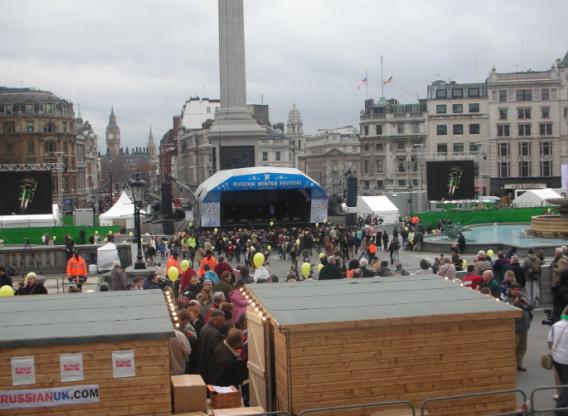
Here the weather continues to be unusually mild. We went to the Russian Winter Festival in Trafalgar Square (central London) on Saturday. It was very busy. There was Russian singing and dancing on the big stage, and a line of wooden kiosks selling Russian handicrafts and food. There were acrobats and jugglers and folk musicians, and it seemed as though every Russian living in London was there. I got a chance to practise the few words of Russian I speak (that’s about seven!). But it didn’t feel like winter. It was 12 degrees!
Then we went to see the movie, Perfume – the story of a murderer. Have you heard of it? Have you seen it? It is based on the novel, Perfume, by Patrick Suskind. I read the novel about 15 years ago and thought it was very powerful. The movie was excellent, but perhaps about 20 minutes too long for me. If you like beautiful photography and a dramatic story you will probably like this. It’s a bit scary, though, in places.
I read your blog about Korean music. Thank you. First, you talked a little bit about the weather. You are quite right. It is often possible to experience every kind of weather in one day here, especially in places like Manchester.
Then you talked about feelings, and I loved your question at the end of that paragraph: How about your daughter, Lucy? Is she complicated? (By the way, that was perfect grammar and sentence construction, and very good use of vocabulary. Well done.)
Of course, everyone is complicated. But Lucy has never been particularly difficult, not even when her mum died. She and I have (I think) a very nice relationship. I tell her what to do, and she does it! Well, of course, it’s not quite like that. But she is a very easy person to have as a daughter. She has a warm personality. It’s a bit like having a cat – except more expensive to feed and she doesn’t (yet) stay out all night!
Do you have a cat or any other animals?
OK. Korean music. You’re right about Korean music not being very popular in Europe. I am ashamed to say I don’t know any non-classical Korean musicians. I have certainly never heard of the bands you mentioned – and neither has Lucy. So we have decided that when I’ve finished this blog (and when I’ve done the housework, been shopping for the week’s food, cooked lunch and been for a run) we will try to find some of the bands you mentioned, on the internet.
Did I say lunch? Yes, it’s lunch-time already. Lucy is at the gym. When she gets back she’ll be ravenous. Sunday is now the only day of the week when we can have a relaxed family meal together so I always make something a bit special for Sunday lunch. Today I’m going to make beef patties with herbs and a sauce made from the juices from the beef, a little olive oil, a little red wine, some herbs, a little butter and a little tomato purée. We’ll have ‘Dad’s special’ mashed potato (the recipe’s a family secret, I’m afraid), some carrots baked in a little olive oil, and perhaps some French beans. For dessert? I haven’t decided yet. But just typing this list has made me hungry to I’ll stop now and head for the kitchen.
I’m still looking forward to hearing about your mum’s visit to Beijing – it is 25 years since I was there.
I’m also looking forward to reading what you write about Korean architecture.
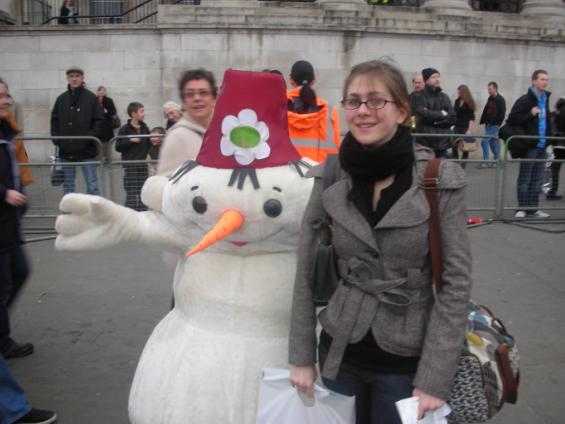
I hope you like the photos we took at the Russian Winter Festival.
Take care.
Best wishes,
STEPHEN
SOME USEFUL WORDS AND EXPRESSIONS
kiosks
A small building, similar to a hut, where newspapers, sweets or street food are sold
acrobats
entertainers, often from a circus, who perform difficult movements and jumps
jugglers
entertainers, also often from a circus, who throw several objects (such as balls) into the air and catch them in rotation (so that there are several objects in the air at the same time). The verb is ‘to juggle’. NB: There is no verb form of the word ‘acrobat’.
ravenous
extremely hungry
patties
small ‘cakes’ of meat, like small beefburgers
herbs
dried plants, such as thyme, rosemary and oregano, which are used in cooking (use a good bi-lingual dictionary to check the names of herbs)
purée
a food which has been mashed or blended into a thick, smooth paste (‘paste’ is a synonym here, so you can say, ‘tomato paste’)
SOME VOCABULARY TO THINK ABOUT
Some notes about some words you used in Friday’s (12 January) blog:
heavy
It is normally used about things which weigh a lot. A large book, for example, can be heavy. A piece of furniture may be difficult to move because it is heavy. We don’t usually use the word about a wind or a difficult situation. So your first sentence could be re-written like this: It was cold and there was a strong wind this morning.
In your next paragraph, your last sentence could be re-written lie this: I know it’s very difficult to manage a family as a single parent.
criticism
Many words in English have different grammatical forms. For example, the verb ‘to criticise’ can be made into a noun, ‘a critic’ or ‘a criticism’, an adverb, ‘critically’ and an adjective ‘critical’.
It is important to remember what form of the word you need to use. For example, in your sentence, ‘Am I quite criticism?’ you are asking a question about what sort of person you are. When we describe things and people we usually need to use adjectives. So your sentence should be re-written like this: Am I quite critical? (or ‘Am I too critical?’).
during
We use this word when we talk about something which happened over a period of time, while something else was happening. For example, ‘I fell asleep during the movie.’
When you explained why you didn’t talk to your mum, you should have used another word, like this: She was asleep because she was tired from her journey.
hand over/ to fit
When children grow out of their clothes, parents sometimes pass them on or pass them down to other, younger children in the family. Your sentences about your sister, therefore, could be re-written like this: My older sister packed a lot of clothes for my youngest sister’s baby. She has two girls, in China, and some clothes no longer fit them. It saves money to pass on clothes as the children grow up.
architecture/buildings
This is one of those so-called uncountable nouns in English. Therefore, it doesn’t normally have a plural form. Your final paragraph would be improved if it were re-written like this: I’m going to talk about traditional Korean architecture tomorrow because I want to show you some gorgeous buildings.
SOME FIXED EXPRESSIONS TO LEARN AND USE
Have you heard of it/them? (about books, movies, bands etc)
Am I too critical? (asking for someone’s opinion about you)
She was having a lie-in. (This means that she was still asleep much later than usual because she had chosen not to get up early or at the usual time. You can say, for example: ‘Don’t wake me up in the morning, I’m going to have a lie-in.’ NB: in ‘lie-in’, both parts of the word are stressed equally.)
What traditional customs does your country have?
ORDER OF ADJECTIVES
If you make a sentence with a string of more than one adjectives in it, there is a general rule for the correct order of adjectives. Read the rules below, then look again at your sentence: ‘She gave me a small, beautiful pearl earring.’ Would you correct it?
The general rules:
1. Determiners (articles) and numbers come first.
EXAMPLE: ‘All those people…’
2. Then:
quality (lovely, beautiful, strange)
size (large, tiny, enormous)
age/heat (old, young, hot, cold)
shape (round, square)
colour/shade (red, blue, light, dark)
origin/source (Korean, Medieval)
material ( wooden, silk, woollen)
NB: Remember, however, that language rules, especially in English, have lots of exceptions. These are general rules and can be used as a rough guide.
So, Soyoung, your sentence would have been a bit better like this: ‘She gave me a beautiful [QUALITY], small [SIZE] pearl [MATERIAL] earring.’
Saturday 13 January 2007


[LUCY: “The things I do for the BBC!”]
Comments
Hello Stephen, This blog of yours is highly appreciated by me, a German teacher of English as a foreign language. Thanks a million! I'll recommend it to my English-teaching colleagues. I'm irritated by your use of present tense in the sentence about the visit to Beijing. We teach our students to use the present perfect here: '... it has been 25 years since ...'. Would this be grammatically incorrect in the given context? Thank you very much in advance for answering. Best wishes for a happy and successful New Year Rita
Thanks lucy. Viewing your pose i fall in love, really..........
Hi, Stephen.Ireally liked the blog.I travelled to Russia virtually and felt the cold .Thanks.
Thanks for all your contributions. This blog has now closed and can no longer accept new comments.


