February 2009Hello, Goodbye!“And so, the time has come and I must face the final curtain…… “(no prizes for guessing which song that line comes from :))
Well, it seems we have already said goodbye to Marcos. It is a shame we didn’t get a final exchange together but never mind.
It has been an incredible month and I have loved interacting with all of you. I am sad to say goodbye but you never know we may get another opportunity to talk.
I thought I would leave you with some final language learning tips to help you on your way. I will divide the tips into skill areas. First of all, as we are blogging, let’s look at writing. Here are my top tips for improving your writing:
1. Write without editing initially and do not let your fingers off the key board or your pen off the page until you have run out of things to say. While your thoughts are flowing, let your pen flow too.
2. Review 3 times. In the first review, go back and look at the words which convey meaning – the nouns, verbs and adjectives in your sentences. Ask yourself if you could have used a more vivid verb or a more precise noun or adjective. Use a thesaurus if you are stuck. Look for repetition of verbs, nouns and adjectives. If you have used the adjective nice 3 times – try to find a substitute. If you have repeated a noun, replace it with a pronoun.
3. In the second review, if you are working on the computer, make use of Microsoft software and pay attention to all the green and red lines. Don’t edit blindly though. Ask yourself whether you want to use British or American English and stick to your decision.
4. in the final review, if there is no body to take a look for you, go over your writing with a fine tooth comb and look for your common errors (which you should already be aware of) and double check for your common typos. For example, I know my common typos are ‘fro/form/studnet/adn’. Notice that Microsoft won’t help me with fro and form as they are words anyway – but they are not the words I want – I want for and from.
Now let’s look at speaking. Here are my top tips for improving your speaking:
1. Number one: do NOT and I mean NEVER be afraid of making mistakes or making a fool of yourself. Speak at every given opportunity. Talk to everyone – do not discriminate – whether you know them or not, whether you need to or not. Tell them you are learning and most people will be empathetic.
2. Carry a notebook with you for when you have an opportunity to speak to someone who will comment on your fluency/accuracy and who will suggest more suitable words to use.
3. Repetition, repetition, repetition. Remember to become fluent and to sound more natural you need to practise regularly and improve upon your pronunciation of individual sounds and your intonation.
Now let’s look at listening – closely linked to speaking. This is what I recommend:
1. Again for this, it is useful to carry a notebook to jot down words and phrases you hear but are not sure of the meaning.
2. If you do not understand and you can ask, ask. Do not be afraid and nod and just pretend to understand. The speaker will know!
3. Listen to a wide variety of texts – language learning tapes initially. TV and films when you feel a little more confident. And most important of all, real everyday speech.
4. Take part in the conversation – listen actively.
Last but certainly not least, reading. This is a skill close to my heart as you know and I do believe that there is nothing more satisfying than being able to read in a foreign language. So, here are my top tips for reading.
1. Read widely but start with texts that you can manage to build your confidence, like graded readers and abridged versions of stories.
2. Don’t stop to look up every unknown word in a dictionary – this will take away the enjoyment.
3. Start a reading group so you can discuss what you are reading and get feedback on phrases you don’t understand.
4. Do not try to read every word. You would not do this in your mother tongue so don’t do it when you read in a foreign language.
Well, that’s all from me. Stay keen and keep blogging. I wish you well with the next teacher and student blogger. It has been a pleasure.
Best wishes for the future.
Helen x
posted on Monday, 02 February 2009 | comment on this postHello from New Teacher Sarah!Hello Everyone!
Firstly, farewell to teacher Helen and student Marcos, and thank you for all your great posts. I’m really honoured to be writing here in this blog, and I’m looking forward to interacting with you all over the web. As Lily the student blogger says: “That’s the magic of English” - we can all talk about our own experiences and share things even though we’re in different countries.
Let me introduce myself: my name is Sarah, I live in a village in the countryside near London, and I teach English to adults and teenagers. I love languages and meeting people from other cultures. I speak French and Italian, and I also teach Music when time allows! I love playing the piano, but I’m not sure my neighbours love it quite so much… ;-)
Today it has snowed. It really has snowed. You know how everything is muffled and still when there’s snow on the ground? It’s like a fairytale: there are small, excited children running about (some not so small!), and no-one has gone to work.
I’m really looking forward to the next month or so, and am especially excited to see that student Lily has already written her first post. I’ll publish some corrections for Lily later on today.
Bye for now.
Sarah
posted on Monday, 02 February 2009 | comment on this postRe: Hello from Peru (student Lily's first entry) & COLON CHALLENGE!!!Hello to Lily & all the bloggers out there!
It’s really nice to ‘meet’ you all, my fellow netizens! Thank you to Lily for her post, it was really interesting to discover that she’s good at languages AND has a mathematical brain - I’m so jealous! It’s great news that you’re teaching English, and I know that everyone on this blog will want to help you get ready for the FCE exam.
The following phrases in Lily’s entry stood out as being particularly good, because they convey strong feeling within a good sentence structure.
1. Good use of English
‘I finished studying Intermediate level but I couldn’t continue with it because I couldn’t afford it’
‘Those people were with me the whole time’
‘I [got to know] amazing people and countries through them, even though I didn’t travel abroad: that’s the magic of English’
‘After that I realized that I feel useful through this language’
‘because inside of me there was a strong feeling for being an English teacher’
‘God won’t ask you how many things you have done, but how much love have you put in everything that you have done’
In the spirit of putting a lot of love into this, here are some corrections, followed by a challenge for everyone to try:
2. Things to Improve
• EXCLAMATION MARKS
The exclamation mark is the other way up in English, just like this! Maybe the keyboard in Peru does it the other way up?
• COLONS
Colons are used not only before you write a list, but also in the middle of sentences when you want to then go on and identify or explain things in the 2nd half of the sentence. I found 5 places in Lily’s post where she could have used a colon. Here are the first 2 places; can you find the other 3?
‘When I was finishing my High School I was wondering to myself: what am I going to do with my life?’
[Explains what you were wondering]
‘There are so many things to remember from when you are at university: the teachers, the time that you spend studying with your friends..’
[Identifies the memories you have]
• IDIOMS
Idioms are tricky: you just have to learn them off by heart.
- (Thanks God/I’m thankful God) = Thank God/thank goodness
- (At least, my dreams came true) = At last, my dreams came true
So, just one challenge for today:
- Find 3 place where Lily could have used a colon
Bye for now!
Sarah
posted on Monday, 02 February 2009 | comment on this postSunshine & snowHello everyone!
I was pleasantly surprised to see that so many people had written, and I’m sorry for not replying sooner; free time has been spent skidding down Surrey hills. My friend made a video of my first attempt at dinner tray sledging, but I don’t look particularly dignified ;-) However, the light was golden and the hills were blanketed in white, so at least the view was good. It is so important to be able to glimpse a nice view now and then in your daily life.
I’ll try to respond to all your messages, but there are a lot of them! However, I hope to answer as many as possible, not least because it’s a completely new & very exciting experience for me opening up a page with missives from Bangladesh, Brazil, Spain and many more countries. I wonder what life’s like where you are...
DREAMS
James Wu from China – I like the enquiring spirit of your post! It’s more usual to say
‘All my dreams have come true’
or something similar, without collocating it with either ‘at last’ or ‘at least’. This is because ‘At last!’ is an exclamation which shows you’ve been waiting a while for something, but also indicates that you might be annoyed through having to wait too long & are slightly exasperated. I believe ‘At least…’ is usually followed by
At least + subj + verb
but is also slightly unsuitable because ‘at least’ means that the bare minimum of positive things have recently happened. Not suitable if you’re talking about ‘all your dreams’.
______________________________________
COLON CHALLENGE
Everyone found at least 1 or 2 good places for a colon. Sometimes, the sentence needed altering, too, but the focus of the exercise was on the colons. I’ve added syntax corrections in here and there in italics.
_______________________________________
Halima from Bangladesh – hello there.
1. An interesting choice of sentence.. This sentence from Lily's blog actually needed a semicolon & a bit of rejigging. The original meaning in Lily’s post was clear, but it would more grammatically correct to write:
I’m from Peru; I’d like to show you what a rich country it is
2. Well, there was the time when I started to work at the Travel agency in the accounts area: it was nice, but too much work.
> CORRECT use of colon, well done.
3. > CORRECT well done
___________________________
Paulraj – hi, have you been blogging here for long? Whereabouts in India are you from?
Yes, you could use a colon in all of the places you listed. I’ll have to look back at Lily’s original post to understand exactly what Lily meant by the first sentence you quote.
___________________________
Hi Monica – nice to hear from you.
-----------------------------------------------
You know, I’d love to post some photos to show what I’ve been up to. As they say: ‘a picture’s worth a thousand words’, however I’ve been stalled in my efforts by the mysterious disappearance of the appropriate cables. Do any of you ever lose things?!
I’d love to hear something about your daily routines. They say that understanding the culture or the history of a people isn’t all about knowing about the grand events, or wars fought in the name of a famous cause, but rather that we also need to know about people’s ‘microhistory’ (i.e. the minutiae of their daily life) in order to arrive at a more complete understanding of their daily reality. What do you think?
Look how many times I’ve put ‘They say’ for provincial tidbits of hand-me-down wisdom: how lax of me. I’ll look up the sourcing for those quotes and post them later for all you eagle-eyed students!
I haven't yet read Lily's post; I'm saving that for tonight's reading, so I'll be on the blog again soon. In the meantime, have a great weekend everyone.
Sarah
_________________________________
p.s. Here’s a little glossary of some of the more unusual vocabulary, although I’m sure many of you were able to guess the meaning from the context:
Blanketed- covered as by a blanket
To skid down something e.g. the stairs – to descend a sloped surface at medium velocity with minimum balance & poise
Missives – written communication e.g. in military term, could be used for a letter instructing a general to do something. Also used in business to describe rapid-fire emails.
enquiring (adj) - questioning, explorative, investigative (also spelt inquiring)
Syntax – You could say that this word describes ‘the proper structure & order of words in a sentence’. Can anyone add to this definition?
Here-and-there – at a couple of points, say in paragraphs 2 and 4 in e.g. an essay
To rejig something – to tweak information into an improved format
to stall in one's efforts – unusual verb formation; ‘to stall’ is usually used when a car engine cuts out because the revs are too low
Tidbits of information – small bits; small choice pickings
Hand-me-down – 2nd hand clothes you get handed by close relatives, esp. brothers & sisters
lax - neglectful, lazy
Eagle-eyed – watchful, picking up on things visually
_____________________________
TODAY'S CHALLENGE: If you can, use 2/3 of the words & phrases above to write a few sentences about your own daily lives. I look forward to hearing from you!
posted on Saturday, 07 February 2009 | comment on this postTHE ISLE OF WIGHT - PHRASAL VERBSHi guys!
Doesn't Huaraz from Lily's post sound a wonderful place to visit? I wish I could share a mate de coca with Lily and her husband, but I don't think my arms are long enough to reach Peru from England ;-)
Lily - your English is really descriptive; I look forward to correcting a few grammar points later on. I'll also reply to as many of the comments everyone else made on my last blog as I can!
I’m sorry for not writing sooner; this week has been a bit heavy at work, so I wasn’t my usual chirpy self. I recently got involved in planning and running new English courses, and I feel like the added responsibilities have all hit me at once!
However, life seems much better today. This weekend I’ve come away with my parents to the Isle of Wight, which is a beautiful, sleepy little island in the English Channel (or ‘The Sleeve’, as the French call it) just to the south of Portsmouth and Southampton. I’d like to tell you all a little bit about my day today.
______________________________________
This morning we woke up to radiant sunshine, and decided to go on a mini tour of the island. First, I had a few errands to run, so I popped out to the shops to pick up a few bits & bobs, then nipped back across the road to the hotel.

A thatched cottage. This type of roof is made with lots of small bundles of sticks - do you have anything similar in your country?
Then we set off in the car, and headed towards Ventnor, a quaint Victorian seaside town. When we got there, we strolled along the esplanade and climbed up the cliff path, from where we had a fantastic view of the Channel. By the time we got back down again, we were a little out of breath, so we stopped for a beer and a bowl of chips. Tucking into a big bowl of chips after a nice long walk probably wasn’t the healthiest thing to do, but I felt we’d earned it!

A typical English village church
After wandering back to the car, we carried on with the tour, stopping only to fill up with petrol, and drop something off at a friend’s house. They had been expecting us, but unfortunately, we turned up a bit late so they weren’t at home.
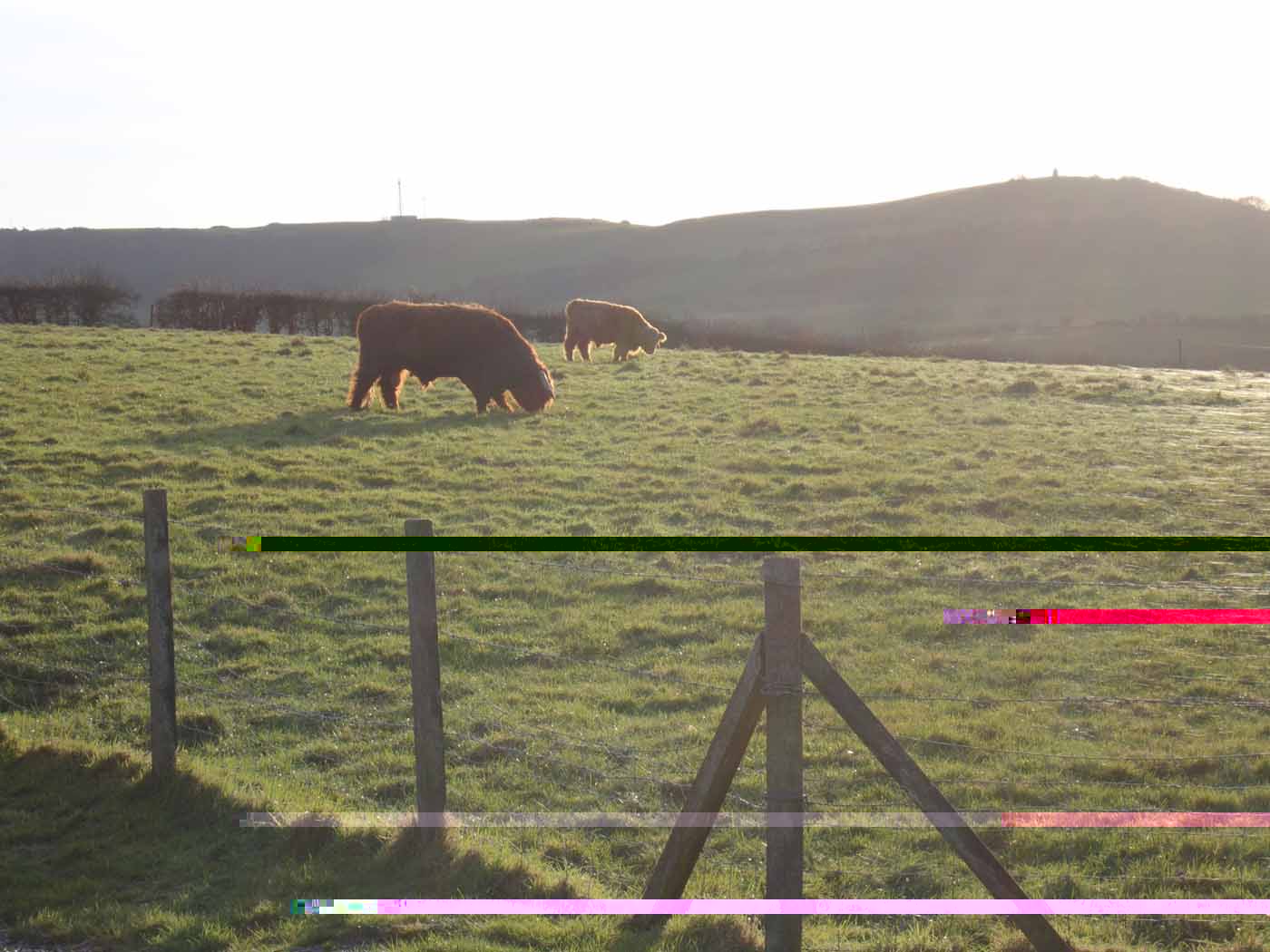
A couple of shaggy Highland cows in a field
I hope you’ll all forgive me this fairly anodyne account, but sometimes the most relaxing days are the ones where nothing exceptional happens...
__________________________________________
VOCABULARY
Adjectives:
chirpy = happy, talkative
radiant = bright, shining
quaint = old-fashioned, usually used to describe small English villages
out of breath = breathing heavily after exercise
shaggy = an adjective used to desribe an animal (especially a dog) with a long coat
anodyne = bland, harmless; perhaps unexciting
Nouns:
errands = places to go, people to see in town (e.g. collecting things, dropping things off)
bits & bobs = small items you need to get from the shops
esplanade = the stretch of pavement beside the sea in a town
Verbs:
to stroll = to walk at a leisurely pace
to tuck into = to start eating a large portion of food with great enthusiasm
You’ve earned it! = You deserve the reward for your hard work or efforts
to wander = to walk slowly, without a real sense of purpose
__________________________________
PHRASAL VERBS
- movement; describing your daily routine
to pop out
to nip across (the road)
to set off
to head towards
to stroll along
to drop off
to turn up
Learning English Challenges:
1. Can you explain the meaning of the phrasal verbs above? Two of them are quite informal, and wouldn’t normally be used in an academic essay. Which two are they?
2. Without changing their meaning as they are used in the context of this blog, can you identify which one of the phrasal verbs above can be used with an object or pronoun between the verb and the preposition that follows it?
3. Can you write a few sentences using the 7 phrasal verbs above?
________________________________________
If you’re interested in finding out more about phrasal verbs, you might like to look at the ‘Face up to Phrasals’ page on the Learning English website.
posted on Sunday, 15 February 2009 | comment on this postMESSAGE FOR LILYHi Lily!
I hope you’re well. It’s great to read all your posts; I can barely keep up! I visited Peru in 2004 with my boyfriend (as he was at the time), so I occasionally feel quite nostalgic hearing about all the places you write about. I’ll try to dig out some photos from that time, as maybe you’ll recognise a few of the locations! It was such an amazing trip; everything in Peru is so striking when you come from grey old England.
Having said that, I’m sure it’s just a case of ‘the grass is always greener (on the other side of the fence)’. Or as Aesop said in his fable about a fox jumping up to bite some juicy looking grapes, you always covet what you can’t have.
Re. your post ‘Under Stress’:
Wind, nature, flowers, animals… it sounds like the perfect antidote to the frantic pace of modern life. I read something in a magazine today which particularly struck me, as it was written by a nun who had spent 50 years in a closed order before taking a one year sabbatical from the convent to do an art course in east London (‘The Abbess’s Tale’, intelligent life, Winter 2008). She bravely tackled the tube and the crowds to get to life drawing classes, but she said that she was surprised and saddened to see so many people dressed in black, talking into a mobile with tight, pained faces, clutching a coffee and rushing along the street as if time were their worst enemy.
OK, now for some grammar notes… I hope you find them useful!
___________________________
RELATIVE CLAUSES
When you think a sentence is made up of too many clauses, and you need a way of connecting them, try using a relative pronoun such as ‘which’.
For example, your sentence
‘This is another place to visit in Peru is Huaraz is 7 hours from Lima’
is incorrect, because it contains too many clauses without anything to join them together. Start with the thing you want to describe:
Another place to visit in Peru is Huaraz
Then add the extra information after a comma and the relative pronoun ‘which’:
Another place to visit in Peru is Huaraz, which is 7 hours from Peru.
And voilà: you’ve just created your first non-defining relative clause! Easy when you know how, huh?
____________________
THE PRONOUN ‘IT’
You need to use this more often, as the verb ‘is’ nearly always takes a subject:
It is very interesting (not ‘Is very interesting’)
_____________________
EMBEDDED QUESTIONS
In questions where you don’t use a question mark, you don’t need to invert the verb & subject, nor use an auxiliary like ‘do’:
Please tell me how you celebrate carnivals in your country
(not ‘Please tell me how do you celebrate carnivals’)
These types of questions are usually introduced by a question frame:
I can’t remember…
I don’t know…
Please explain…
I wonder….
and are followed by a question word:
a) I can’t remember how…
b) I don’t know when…
c) Please explain what…
d) I wonder why….
TODAY’S CHALLENGE:
Complete sentences a) to d) above, taking care not to invert the subject and the verb after the question frame.
___________________
FESTIVALS
Since you ask, the main one near me is the annual Notting Hill Carnival. This festival, which started in the 1960s as a celebration of Caribbean culture in London, takes the form of a massive street party, with different streets devoted to different types of music, beat out on steelpans or pumped out through sound systems. It’s fantastic - people parade down the streets and it feels like a proper holiday. In some areas, however, the streets are swarming with police: cops on trikes, cops on bikes, cops on spikes, cops on the rooftops, cops in the street…*
For the most part, however, the Notting Hill Carnival makes for a relaxing day, punctuated only by buttery barbequed corn-on-the-cob, jerk chicken and millions of people dancing in the streets.
OK, here’s some of the vocabulary I’ve used in this post. Please tell me, do you like any of the words? Which ones do you like, and why? Which ones don’t you like, if any?
________________________
VOCABULARY
•Verbs
to covet = to want something that’s not yours
to tackle = to face something with great determination (e.g. to tackle a problem)
to clutch = to hold tightly
to parade = to walk down the middle of the street in a display
•Nouns
an antidote = a liquid you drink after a poisonous snake has bitten you
a closed order = a set of buildings where nuns live in strict
isolation from the outside world
steelpans = tuned drums made out of beaten oil barrels
corn-on-the-cob = sweetcorn cooked on the cob on which it grows
jerk chicken = Jamaican-style spicy chicken, cooked over hot coals
a swarm = a group of thousands of insects moving together as one organism
cops = informal/slang word for ‘police’
•Adjectives
nostalgic = affected by a bittersweet desire to return to the past
striking = having a strong, positive visual impact
________________________
*I once heard the political activist and comedian Mark Thomas use a similar run of words in his show ‘Seriously Organised Criminal’. It sounded funnier when he said it, but you get the spirit!
posted on Wednesday, 18 February 2009 | comment on this postHello fellow bloggers!Hello everyone!
It’s so exciting getting all your messages! It's amazing to open up my computer and hear from you all, so thank you for your posts. Here are a few replies and English corrections from the last week or so.
_______________
Lily - I was sorry to hear that you have been ill; I hope you feel better soon. Best wishes from across the pond.
_______________
Adek from Poland - re. your ‘Colon Challenge’ comment
Hi to a fellow keen grammarian! To answer your query, you don’t need to use ‘to’ in front of ‘post’ in ‘What I plan to do is (to) post a list of definitions every two weeks’. You can use the extra ‘to’, but the repetition of ‘to’ makes it stylistically clunky.
re. your ‘Sunshine & Snow’ comment
There was just one small error in your blog entry: ‘lax’ is an adjective, not a noun (‘How lax of me’, not 'What a lax of me’). It was a great little story that you wrote, well done. What age are your students? Are they all native Polish speakers?
____________
James Wu Zhih Cheng from CHINA – I’m SO sorry for the confusion; I have a business English student from Taiwan who speaks Chinese as her first language, so I think I had China on the brain when I replied to your comment! Please forgive me.
____________
Toni – re. your ‘Colon Challenge comment’
There was a small mistake in your blog entry: ‘I haven’t found any more places’ is the correct version, because we use NOT + ANY (not ‘not…none’ or ‘not…no more’).
You’re right about the use of paragraphs though: they really help structure a piece of writing, and help convey the writer’s thoughts more clearly to the reader.
_____________
Hyoshil from the UK – re. your ‘Colon Challenge’ comment
You used some great adjectives in your post, which gave it a good descriptive edge, and made it quite strong in sensory imagery. Just one correction:
‘Weather’ is an uncountable noun, so we say ‘some wintry & arctic weather’, not ‘a wintry & arctic weather’.
Re. your ‘Sunshine & Snow’ comment:
This was another nice blog note; thank you for your contribution. Your son sounds so sweet! How old is he?
Here are a few of corrections which I think might be useful for you:
After having + past participle
e.g. After having played badminton
ACTIVE VERB
To skid down something = an active (not passive) verb, as in ‘the car had skidded down the hill’ (not ‘been skidded down the hill’).
PASSIVE VERB
To get damaged = a passive (not active) verb, as in ‘the car didn’t get damaged at all’ (not ‘didn’t damage at all’)
nb: ‘Lax’ is a negative adjective meaning something like ‘lazy/negligent’, but it sounds like you had a wonderful Sunday afternoon doing lots of things in town, so maybe ‘relaxed’ would have been more appropriate.
____________
Rose from Poland – re. your ‘Colon Challenge’ comment
Q1. Correct
Q2. Correct
Q3. Incorrect – colon not needed
I’m glad you like English villages! Here’s the view from the bottom of my lane last week:

The view from the bottom of Church Lane
Monica from Brazil – hello there.
I’m very interested to hear firsthand what life’s like in Rio. People say that it’s a really vibrant, fascinating & cultural city, but that it can be a tad dangerous if you go out at night by yourself in the wrong area, especially as a lone woman. I’m glad to hear that things aren’t as bad as they seem in the newspapers! You know what newspapers can be like; they tend to over-sensationalise events to make the story more dramatic.
Re. your ‘Sunshine & Snow’ comment:
‘Dinner tray sledging’ is not a formalised pastime, and has yet to be recognised by any major sporting body, however since you asked, it involves (temporarily) appropriating dinner trays from any institutional or office canteen and using the aforementioned trays as toboggans to slide down snowy hills. ;-)
I love those moments when it’s drizzling, then the sun comes out and a rainbow appears. Why do you call it ‘a widow’s wedding day’? Is it because the rain is sad like a widow, then the sun appears, which represents her cheering up again because she’s getting remarried? I’d love to know!
___________
Rodrigo – hi. ‘Wrong’ is an adjective, not a verb:
‘I hope I didn’t get too many questions wrong!’ (not ‘I hope I didn’t wrong so much’). There is no direct English equivalent for ‘sbagliare’ in its common sense.
__________
Diana from Sweden – hi there, thanks for your kind message. In response to your query, it’s ‘You have a clear structure, which I admire’. This is because it’s a non-defining relative clause.
__________
Richard Yang – thanks for your sweet message. Whereabouts in China are you from? The college where I work are sending me to do some teacher training in China tomorrow! I’m so excited; I’ve never been to China before. I’m a little bit nervous, too. Do you have any advice on how to behave when you first meet people?
___________
Felicitas – you write beautifully! It’s a bit warmer here now, but I bet you’re still glad that you’re not coming to London until June! (nb check out the word order here)
___________
Guzin from Turkey – nice to meet you. I’m envious of your 20°C weather… I went to Istanbul last autumn, but it rained the whole weekend!
____________
Concetta, Simone, Karoun –hi there, nice to ‘meet’ you. I hope that we will be able to communicate more over the next few weeks.
_____________
Vijay – re. your comment on ‘Sunshine & Snow’
Thanks for your post. You used the new vocabulary well! Just one point: ‘stuff’ is an uncountable noun with a plural meaning, used to describe a group of objects or belongings. You can’t put an ‘s’ on the end of ‘stuff’.
I quite agree – 24 hours in a day never seems long enough to do everything you want to do! With regards to your English learning, how do you record new vocabulary and phrases while you’re at work? Do you keep a notebook or a folder on your PC? How do you divide the new information? Do you put it into thematic categories, divided by topic & subdivided into parts of speech, or is it ordered alphabetically? Do let me know!
______________
Ana Paula from Brazil – hello.
I like the expressions you used; they sounded very natural, especially ‘dash to the bus’ and ‘hit the sack’ – great! What a long day you have though. You must be worn out by the end of the week. You mentioned that you attend evening classes at the university - what are you studying?
______________
Alice from Malaysia – I loved reading your comment. You sound like a real perfectionist!
______________
Paulraj from India – hello there.
Re. your ‘Sunshine & Snow’ comment: I don’t know many Indian women called ‘Lily’, do you? This could be because it is a name which comes from Western mythology: ‘The white lily is linked to Juno (the queen of the gods in Roman mythology) by the story that while nursing her son Hercules, some excess milk fell from the sky creating the group of stars we call the Milky Way, and lilies were created from what milk fell to the earth’. I think it’s a very beautiful name. Apparently it signifies beauty or purity, depending on the colour of the flower. I found the information in inverted commas on a florist’s website at http://marriage.about.com/od/flowers/a/flowermean_2.htm
I wonder what Freud would have had to say about your anxiety dream of losing your car… Have you ever read ‘The Interpretation of Dreams’?
_____________
Doris from Haslemere – hello!!!
A perfect definition, thank you. Here it is again for those of you who might have missed it:
‘In linguistics, syntax (syn-, "together",táxis, "arrangement") is the study of the principles and rules for constructing sentences in natural languages’.
Where did you find that definition?
_____________
Halima from Bangladesh – you used the new vocabulary correctly. Just one sentence which needed tweaking:
Word order: to give someone a hand with something
Can you correct ‘I gave a hand with my mother on arranging the things scattered here and there’?
______________
Mahjaheen – hiya. Perfect use of the new vocabulary, well done.
______________
Here's some of the vocabulary from today's post. I'll publish the definitions tomorrow!
VOCABULARY
drizzle
vibrant
clunky
a tad
appropriate
over-sensationalise events
toboggans
Learning English Challenge:
1. Can you identify which of the words above are
a) Adjectives
b) Verbs
c) Nouns?
2. Which of the words above can be used as an adjective and a noun without changing the spelling? Which of them can be used as both a noun and a verb?
Good luck!
_________________
That’s all for now. I look forward to hearing from you all soon, and I’ll post some pictures from China!
Best wishes,
Sarah
posted on Friday, 20 February 2009 | comment on this postJET-LAG SPECIALHello campers, what’s new? I can’t believe I’m in China! I hope that I will be able to learn as much here as I’ve learnt from reading all your comments about your different countries, customs and lives.
Can I tell you a bit about my day? I had such a nice plane journey over here. I was seated next to a lovely Chinese girl called Chen Yi, who had run onto the plane about 2 minutes before the doors closed. She was full of bubbling energy, and kept knocking things over and spilling her food, which made me laugh! At one point she even managed to sit down in my tea. Then she fell asleep and snored gently, only to wake up beaming beatifically every time I accidently brushed past her to get to the loo. She had been studying English in London, and wants to do a Masters at Kings College London. She taught me a little bit of Chinese, and helped me invent a Chinese name for myself, as ‘Sarah’ apparently sounds a bit like the Mandarin for ‘salad’, which might make people giggle. My new Chinese name is ‘Mai Su Lan’, which I think means something like ‘Wise Orchid’, although I’m not 100% sure. I hope I meet Chen Yi again, although we are all like bits of flotsam and jetsam in the slipstream of life on this Earth: you can never say exactly what’s going to happen, where life's going to take you, or when you will cross paths with people again.
I can’t believe I’m still awake; I’ve had 6 hours’ sleep in 3 days. My veins run with coffee, not blood, and I keep seeing things out of the corner of my eye that aren’t there! As you can see from the photo, I wear quite thick glasses. My eyesight’s not great at the best of times, so you can imagine what it’s like now!
Anyway, tomorrow I’m going to look around this amazing city. I can’t wait!
See you soon.
Sarah
VOCAB
to beam beatifically = to smile like a saint
flotsam and jetsam = bits of driftwood that float on the sea
the slipstream = the fast-moving, turbulent current of air that comes off the wing of a plane
cross paths with someone = to meet someone you know again through chance/events usually out of your control
...and here are some definitions from yesterday's post:
•Verbs
to drizzle = to rain lightly
over-sensationalise events = to exaggerate what’s happening (usually in tabloid newspapers)
to appropriate = to take possession of something that’s not yours
•Noun(s)
toboggans = a flat sledge (thing you use to slide down mountains in the snow)
•Adjectives
vibrant = lively
clunky = unwieldy; awkward; inelegant
a tad = a little
Well done to everyone who got the homework correct.
_________________________
Today’s Question is…
Why does the spellchecker on my laptop not like words such as ‘accidently’, ‘sensationalise’, ‘prioritise’ and 'loo'?!
posted on Sunday, 22 February 2009 | comment on this postUpdate from ChinaHi guys!
I hope that you are all in tip-top form, and that your week is going well.
I’m sorry for not writing sooner; there is limited internet access here. So what’s new? Well, everything is new to me! I can’t quite find the words to describe everything. Maybe I’ll be able to reflect on my China experience when I’m back in the UK, with a bit of distance between me and this new reality. For the moment, however, I’m living it, and experiencing loads of new things first-hand! Here are some photos:

The view from my hotel in Shanghai
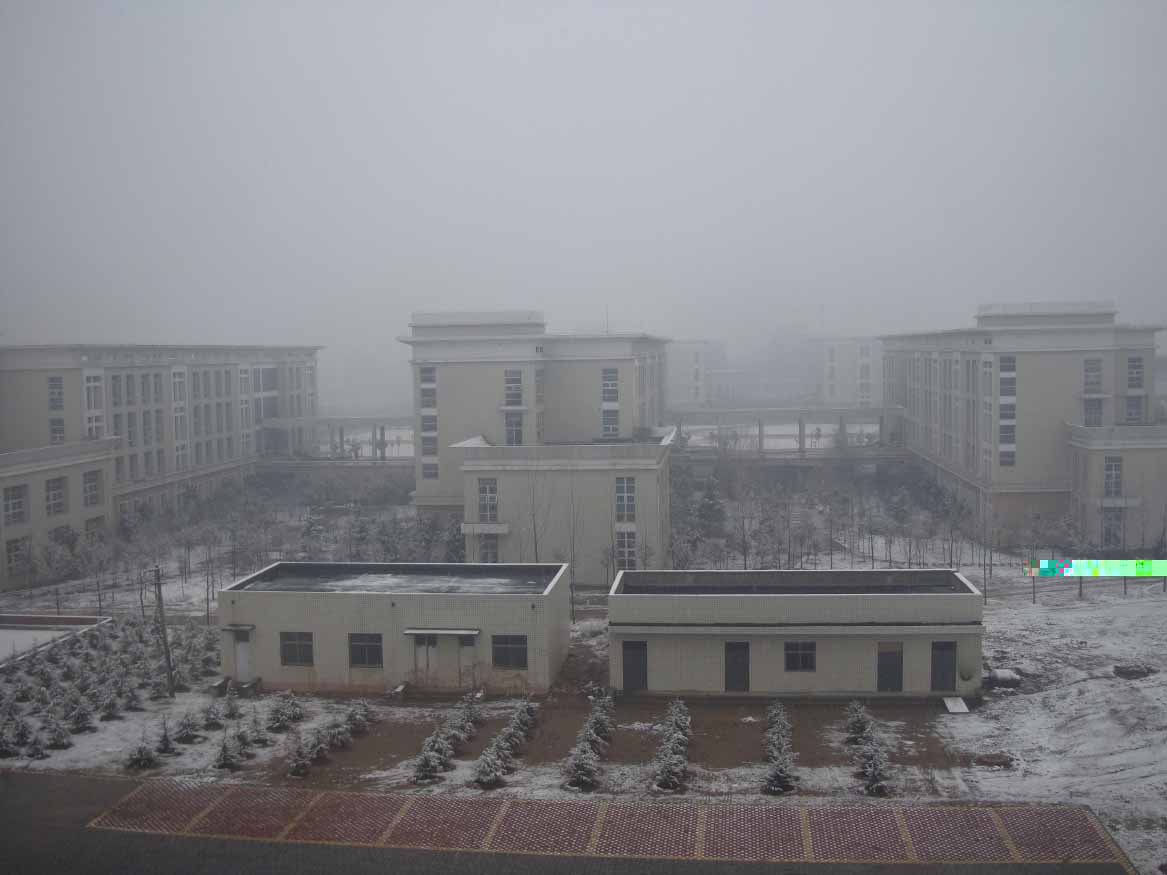
The nursing college in Zhengzhou where I'm teaching
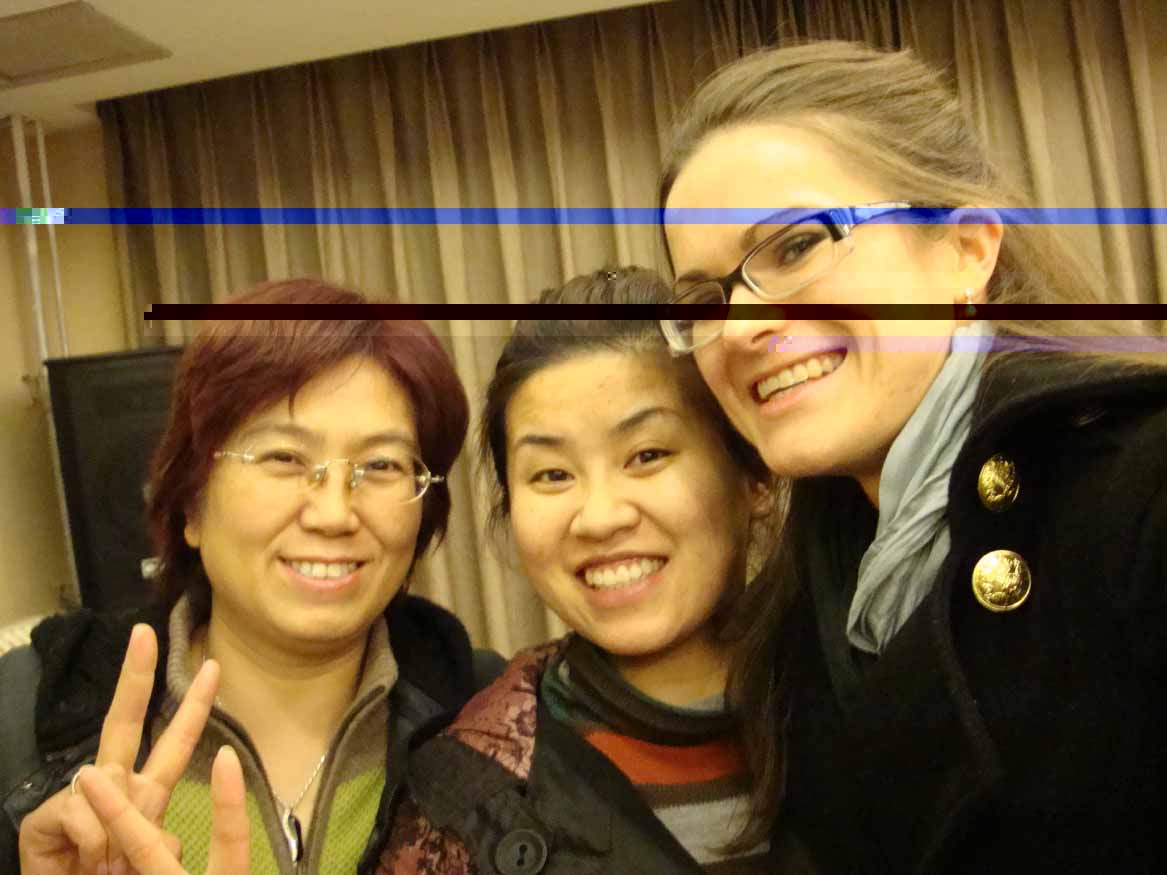
Here come the girls... These guys are keeping me organised!
I’m a little bit tired right now, because I’ve been training nursing and English teachers for 8 hours per day, and trying to learn some Chinese when I can! This with limited success I hasten to add, although I have learnt a few words, and can write the Chinese characters for numbers 1 to 5, ‘man’, ‘big’, ‘money’ and ‘small’: a unique selection of words, I think you’ll agree! The most useful words I’ve learnt so far are ‘water’ and ‘thank you’. ;-) I learnt ‘water’ from a lady through miming and drawing pictures at 3 am. I was kinda thirsty… I won’t forget that particular word in a hurry!
It must be a long time ago now for you all, but can you remember the first words that you learnt in English? What were they? How did you learn them?
OK, a gentleman is trying to lock the room so I’d better go now. Be in touch soon.
Best wishes to you all
Sarah
VOCABULARY
in tip-top form = feeling good (informal)
to experience first-hand = not through books, television or the internet (i.e. to observe something in real life)
I hasten to add = I must say
miming = saying something without words, using gestures
posted on Thursday, 26 February 2009 | comment on this post | February 2009
| Sun | Mon | Tue | Wed | Thu | Fri | Sat |
|---|
| 1 | 2 | 3 | 4 | 5 | 6 | 7 | | 8 | 9 | 10 | 11 | 12 | 13 | 14 | | 15 | 16 | 17 | 18 | 19 | 20 | 21 | | 22 | 23 | 24 | 25 | 26 | 27 | 28 | | | | | | | | |
|


