October 2008Hello Linda and all!Hi Linda!
Sorry that it has taken me so long to write but as you may know I have been on holiday this week. More about the holiday later! Well it seems that we both have something very important in common, we are both expats! It is something very different isn’t it to live, work and study in a country that is not your native country. It can be very challenging but also very rewarding. Not least rewarding of course is the opportunity to learn about another culture very closely! I can see that you have grabbed that opportunity with both hands! You seem very much at home in your new country and proud of it too! You now also have the benefit of knowing at least three languages (or more – do you know German too?). Where did you learn your English, it’s fantastic!! Well done! I have never been to Vietnam but I have been close, last year I went on holiday to Koh Chang which, as you probably know, is an island belonging to Thailand close to the border with Vietnam. I’m sure there are many differences however between Vietnam and Thai culture… I have been to Prague though not to Pilsen. Pilsen has of course played a very important role in my life!!!! (I’m wondering if any of our readers can guess why? ;)
I would be interested to hear any observations you have regarding the similarities and differences between your two cultures and especially a little about your experiences as a language student in Vietnam and Czech republic. Also as you are such a successful language learner, could you reflect a little on your method of studying. We would all be very interested to get some tips to help us improve as language learners from someone who has successfully learned two foreign languages!! For example, how do you go about remembering new words?
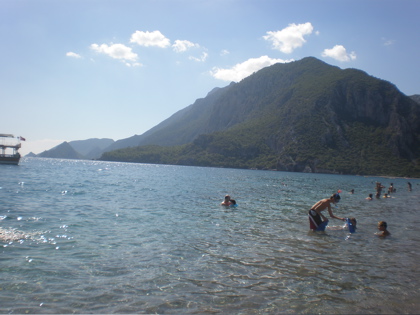
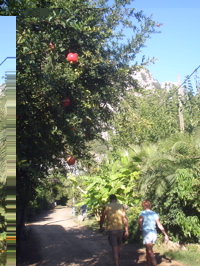
So as I mentioned before, we have all been on holiday in the south coast of Turkey in a beautiful place called Cirali near Olympos in the Antalya region on the Mediterranean coast. It is a truly beautiful and natural place. Though it is a popular tourist destination, it is protected from being over developed and spoiled as it has been designated as a national park. There are many special things about this place. It is abundant with fruit most notably oranges and at the moment pomegranates.
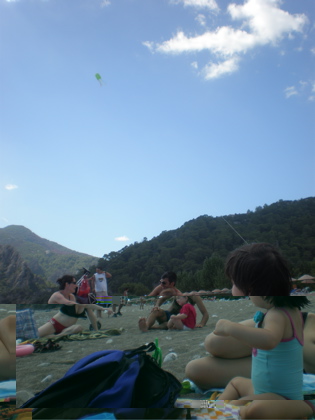
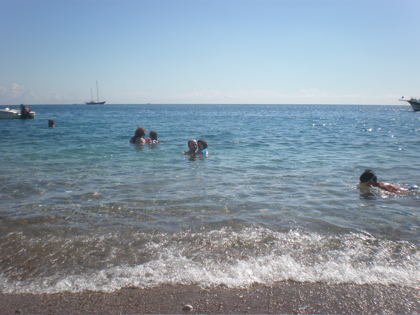
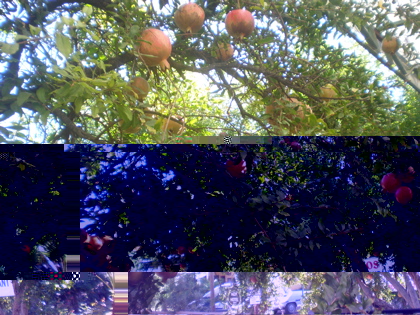 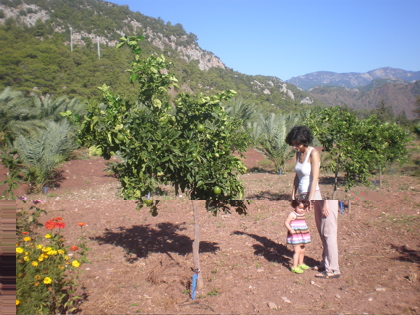 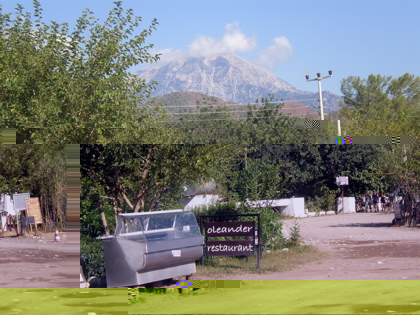 Look closely at the next photo and you will see me and Nehir swimming in the sea! Turtles come to lay there eggs on this beach too!!! Nehir's first time flying a kite!
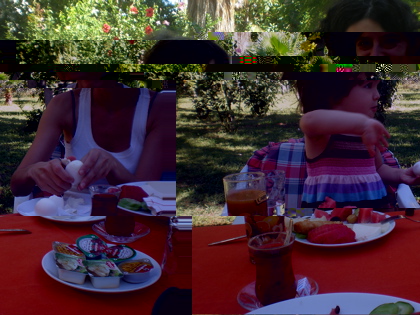
A lovely Turkish breakfast! There is also something very special to see in the mountains, something that you may not be able to see anywhere else in the world and there is a very important connection with Greek mythology. It is a magical and mystical place!
Linda, I look forward to hearing your observations on the comparisons between your two cultures and about your language learning tips!
Everyone else here is some homework: find out what is special in the mountains near Cirali that you may not see anywhere else in the world and then choose 3 things that you find interesting about the place. The following link may be of help:
http://www.singlix.com/antalya/atlas_olympos_p2.html posted on Saturday, 04 October 2008 | comment on this postComputers, Places, Stories, Connections, Creativity and Collocations“Get well Soon!” to your computer Linda! Poor old Marvin had a similar problem too. I wonder how he is… I hope this is not some kind of bad luck curse I have put on my blog students…! (Seems Ana Paula has a lucky charm to protect her though!) Anyhow, good luck with that Linda and know that we are waiting for your next post with bated breath.
Thanks and well done to all of you dedicated students who read the article I linked to and identified the special feature in the mountains of Cirali – the eternal flame! The article and the photos seem to have excited and captured your imaginations as much as the place has captured my imagination and, I should say, my heart and soul! I cannot explain how much I appreciate your comments. Josette, I must say that your comment itself was inspiring enough to spark off a myriad of thoughts regarding the interconnectedness of places, creativity, stories, histories and travel in my mind... Go on! Throw those clothes in the bag!!!
I have seen the eternal fire. It really does just come out of the side of the mountain!! The flames are not huge and when you see them they look just like little camp fires but nonetheless, it is a unique sight! I walked up the mountain to see the flames at night many years ago as a young and foolish man wearing only flip flops and when I came down I was much wiser (I knew that flip flops were no good for walking down mountains!)
I haven’t seen any turtles there though (and I have been there many times) I’m not sure when they come to lay there eggs… It is probably a good thing that I haven’t seen them, it means the turtles are being careful (which they really need to be amongst such harmful creatures as humans!!) It is also nice that so many of you shared my excitement about the pomegranate trees. Truly amazing aren’t they? I can’t remember ever having seen pomegranate trees in fruit before… Our Sweet Mamma Earth gives us such wonderful presents doesn’t she? We should take care of her more… By the way does anybody know the Greek myth about Persephone and the pomegranate seeds? If you don’t then check it out here.
Now, to change the subject to a more "teacherly" one, I want to say something about collocations. Alongside noticing and recording phrases, noticing and recording collocations is another helpful and important way to develop accuracy and natural sounding fluency.
Some of you probably know what collocations are I’m sure. For those who don’t here is an explanation:
Collocations are “word partners” or words that are used together. For example, think of the word “hair”. There are many collocations or words you use with hair. Look at the list below and find which word we do not use with hair:
black
curly
long hair
yellow
short
Answer: we do not use “yellow” with hair (we use blonde!). So yellow does not collocate with “hair”. It is easy to understand what you mean by “yellow hair” but it does not sound natural!
“blonde hair” is an adjective + noun collocation (blonde is an adjective, hair is a noun)
There are other types of collocations like: verb + noun
verb + adverb
The Challenge
1. What is the adjective that I used with student in this post? Name 3 other adjectives can you think of to use with student?
2. What verb did I use in this post with “imagination”?
3. What verb did I use with “blog” what other verbs do we use with blog?
posted on Wednesday, 08 October 2008 | comment on this postWays of recording collocationsHi everyone!
Once again, thanks again for your comments – reading them is like travelling itself: continually bumping into such interesting people and getting refreshing new ideas and perspectives!!!
Regarding the homework:
1) The adjective I used with “student” was “dedicated” examples of other positive adjectives commonly used with or to “student” are:
hardworking
keen
bright student
conscientious
outstanding
Examples of use: John’s a really outstanding student.
The students are very keen!
Negative adjectives commonly used with student would be
poor
a weak student
lazy
bad
2) The verb I used with “imagination” was “capture”. Other commonly used verbs are:
catch
let your/my(etc)imagination fly
fire up
appeal to
use
leave it up to
Examples of use: What you said really caught my imagination…
The story I told helped to fire up my student’s imagination…
I’ll leave the rest up to your imagination!
3) The verb I used with “blog” was “put on”. Other commonly used verbs are:
post a new entry on
comment on
publish a new post on the/ my/your (etc)blog
update
Examples of use: How often is the blog updated?
I’ve just published a new post on my blog
The aim of this homework was to encourage you to develop your skills of noticing language in use. This will help you learn how to use a new or important word and become more fluent more easily. Again if you think and remember in chunks and collocations, you will ease the amount of work your brain and memory has to do! My purpose here in this post is to give you an example of ways in which you can record words in your vocabulary books which will also help your memory! (If you don’t have a vocab book, I suggest you get one!). The way I have written the collocations and examples of use above is an example of a way you could record collocations in your vocabulary books! This is particularly useful if your are often using a certain word at work or in your studies.
Challenge
A word that is being used a lot in the news is “crisis”. I would like you to look at some recent news articles (could be BBC articles of course!) and to find at least three verbs and two adjectives that collocate with “crisis”. I would also like to write down the sentences that you found them in. Put them all in your comment!
Ok folks! See ya later!
posted on Friday, 10 October 2008 | comment on this postWar, What is it Good For?Thank-you for your homework and comments! Apologies for letting in the somewhat depressing real world into blogland!! People do write and talk about these things though don’t they! What is interesting me at the moment is how they talk about them. Here are some of the verbs that you have “noticed” and some extra ones:
to fight
to head off
to tackle
to stand up to a/the crisis
to face
to survive
to overcome
the crisis hit - the crisis destroyed - the crisis is getting tougher
Now look again at these verbs. Do you notice anything about the style of the language? In what other situations would you use these words?
Yes, these are all verbs that we use in English to talk about conflict, about wars and fighting.
This is an example of how we use metaphors in everyday speech (not just in novels and poetry). We are talking about a financial problem as if it was our enemy that we must kill! A lot of language used in business is the language of war. You hear phrases like:
aggressive marketing
marketing campaigns
the cut-throat world of business or advertising (etc)
the company dominates…
Do you do the same in your own language? Do you think that we use this language in English because the world of business is a battlefield and can’t be another way? Or do we use these metaphors because that is how we want it to be? Could the way we think about and then the way we conduct business change if we used different metaphors?
Another example of an important metaphor that we use to think is that of TIME IS MONEY. In English we use the same language to talk about money that we do for time. Look at these phrases:
You're wasting my time.
He's living on borrowed time.
Is that worth your while?
You don't use your time, profitably.
The types of commonly used metaphors (in everyday speech) can tell us a lot about a culture can’t they. Do you use these types of words to talk about time in your language?
Metaphors are a very important part of the English language. People communicate everyday using metaphors and these can be one of the things that you can look out for to develop your fluency and also to understand Anglo/American culture. It can be one way in which you organize and record your vocabulary too. More importantly, remember that the language that you use may shape the way you are understood or the actual situation that you are in…
In a book called "Metaphors We Live By", George Lakoff and Mark Johnson have this to say:
In all aspects of life, ... we define our reality in terms of metaphors and then proceed to act on the basis of the metaphors. We draw inferences, set goals, make commitments, and execute plans, all on the basis of how we in part structure our experience, consciously and unconsciously, by means of metaphor.
Homework ChallengeFind at least 3 examples of how people use language of WATER metaphorically!
Good Luck!
posted on Tuesday, 14 October 2008 | comment on this postFree Flow - Please!!!Thanks everyone for your responses to my questions about metaphors in your language and metaphors about water in English! Welcome to Rosa Maria from El Salvador! Adrianna, I totally agree with you, I think business should also be done by associations and partnerships!! I especially would like to thank Thienloifrom Vietnam for sharing the metaphor from that “Mother's love is water of river”. Did you know that my daughter is called Nehir which means River? ☺
I was interested to learn the expression “spends money like water”! Do you know, I have never heard this before. You see, I am learning just as much as I hope you guys are!
So anyway, I was thinking about this expression and then with help from Marisela from Venezuela, I realized that lots and lots of metaphors and phrases you came up with (from the depths of your rich language knowledge) connect money and water and many more sprang to my mind, so much so that I am now sure that even the word “bank” (the place that people used to put money in!) comes from the word river bank!!
Look: in English we talk about cash flow and how funds are drained! Money also flows and many notes around the world have watermarks. The different types of money are called currencies and in the current financial climate it’s sink or swim! People try to keep their heads above water, companies go into liquidation, they liquidate their assets or freeze them! Illegal money is laundered. People dive headlong into projects, and sometimes end up in deep water, companies go under with too much dept and banks may need to throw them a life line (from the safety of the river bank??!).
So it seems that as long as you understand that business is war and time is money and money is water, then you should understand quite a lot of English. Wow, is that depressing or what?
Right, I think I need to listen to some music!
posted on Saturday, 18 October 2008 | comment on this postBack to Life! The universe speaks...So yesterday I gave a presentation at a teacher’s conference in Istanbul. The conference is organized every year with the goal of getting teachers teaching teachers! Many schools aim to help students develop into being caring and principled members of society . Relating to this, the goal of my presentation was to highlight the importance of setting authentic tasks for students that engage them ethically and socially. An example that I gave was an activity we did with our third grade primary school pupils last year. The children were asked to design a public park that was “environmentally friendly”. Having designed their park, they had to present their plans at a city planning meeting (a pretend one) to persuade the councilors to develop their park. Now, I had planned this presentation back in June this year and I chose the title “Back to Life, Back to Reality” which is (some of you probably know) the title of a famous track by Soul to Soul (from way back in the 80’s). Lo and behold, you would never guess what I discovered last week. I read an article in a magazine telling me that the leader of Soul to Soul, Jazzie B, was going to DJ at a party in Istanbul on the same day that I was giving my presentation that used his song title!!! Now what do you think were the chances of that happening? I mean, this is Istanbul, twenty years after the song was made famous and the guy turns up in town to DJ on the same day!!!! Well you could have knocked me down with a feather when I read that article! Is that the universe talking to me or what? What do you think about these kinds of coincidences? Do think that they are some kind of sign…? Anyway, it gave me a good little story to tell at the beginning of my presentation and two ladies (Turkish) even sang a few lines of the song for everybody (Turkish people use any excuse to get up and strut their stuff!). I was also able to invite everyone at my seminar to the party – now if that is not an ethical, authentic task then I don’t know what is!
The challenge(s)
1) Read the post before this one (I posted it yesterday!)
2) Find as many phrases or sentences that you can in this post that I use to express “surprise”.
3) What words collocate with “present” and “presentation” in this post. What useful phrases relating to presentations can you find in this post?
4) Share a time that you felt the universe was speaking to you!
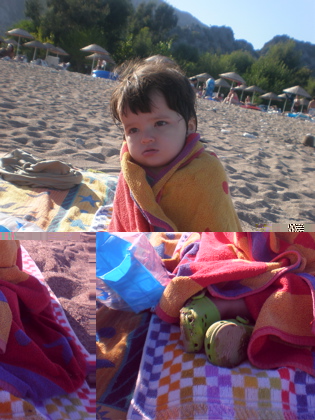
5) Look at the pretty pictures below.
Bye 4 now amigos!
  posted on Sunday, 19 October 2008 | comment on this postWelcome back Linda!Hi Linda!
Glad you could make it back. What have you been up to? How are the studies going? I really liked the joke your teacher told you about the “classes” ;)…! So I think you were going to share with us your tips for language learning weren’t you? That would be really cool!
I’m feeling a little run down and overworked at the moment (or did I just party too much on Saturday night! ;). Now I think about it, I remember partying a great deal one Christmas and New Year in Prague many moons ago…in fact I’m sure there are two of those lovely clocks (like the one you posted) in that square (which spins actually…or at least I saw it spin!!!). Man that beer is good and cheap (forgive me, but I am a British guy after all!) What do you do for fun where you live? Or are you studying too much to party?
This week I’m preparing for another conference though this one will be an international one at my school. I will give a presentation again similar to the one I mentioned in my last post. Doing presentations are really good for your own development as they force you to reflect on what your own ideas about a topic are, why you think the way you do and how best you can communicate them. If ever you get the chance, I really recommend doing them, even if they are just for your friends or at school. Making a presentation is an excellent study aid and way of practicing (as is this blog – extremely authentic and natural way of learning isn’t it?). I have seen some interesting presentations posted on You Tube perhaps some of you guys could do that as a form of practicing and post them on the BBC Learning facebook page or something? Hey that’s not a bad idea Joe… wow I'm amazing sometimes...the ideas just keep flowing!
Just wanted to check in really and say hi to you Linda as I hadn’t read your post until after I posted mine last night. Wouldn't want you to think I was a rude guy!
Take Care y’all and adios!
Simon
Your homework tonight? Sit back with a nice cuppa, chocolate biscuits and your favourite book or film. Goodnight!
posted on Monday, 20 October 2008 | comment on this postReplies...
Dear Ana Paula,
If anyone is going to jump in feet first with a presentation, it would be you! You could do one on of your favorite directors or films perhaps. Video it on your webcam and post it up at BBC LE! I hope the FCE class is going well! By the way, I thought of you in my DVD shop the other day and bought a copy of “City of Men”!
Dear Leila,
I completely agree with you about how it is people that are evil not business. What I’m thinking a lot about these days is whether the language we use in life effects the way we think and therefore the way we act. Do the people start behaving as if business is a battlefield because of the vocabulary they use… George Lakoff, a famous linguistic psychologist seems to think so. Also just look at how language is being used in the US elections… the speech writers for these guys are very much aware of the metaphors and imagery they use. You are probably also aware of NLP (Neuro Linguistic Programming) and how that is used in business to oil the cogs as they say…
Dear Naheed,
You’re absolutely right about how important it is to really know the subject of your presentation. This helps planning a lot and also, of course, your delivery. You how they say you should structure a presentation? It’s a simple 3 step procedure: 1) Say what you are going to say 2) Say it 3) Say what you said!
Dear Fred and YPW,
Glad to hear you’re picking up lots of cool phrases! Good luck with the FCE!
Dear Mauricio,
Thank you for your kind words. I too am pleased that you are finding the blog to be a useful resource! What really pleases me is your appreciation of my method (to help turn you into your own teachers ie. To help you develop even more learner autonomy!!)
Dear Fatima,
Welcome! I’d really like to learn a little bit more about where you are from as I’m interested in the Caucasus region!
Dear Thienloi,
I just loved your creative definition!!! Keep the ideas flowing!!
Take care everyone!
posted on Wednesday, 22 October 2008 | comment on this postThe Right way is Your way!Hi there Linda and everyone!
Yes I’m still alive! So sorry for being so inactive recently but I’ve been really busy and I got kind of burnt out!
Last weekend we held an international conference at our school. Teachers came from all over the world to attend and give presentations and to share their ideas through discussions. The theme of the conference was “International Education: a Bridge to Intercultural Understanding”. It was wonderful as I was able to learn a lot about current practices and concerns of teachers around the world. Not only did I attend the conference, I also gave a presentation and I was on the core organising committee so as you can imagine, I was run off my feet! The conference began last Friday so it was really interesting to read your post on that day Linda about the education system in the Czech Republic – was this the universe talking again??? Thanks for that post Linda, it was very informative for me for example it was good to learn about Comenius, I have heard of him but I didn’t know why he was famous. As a teacher, I completely agree with the quote of his that you posted about the importance of awakening students’ interests! Being properly motivated and interested in what you are studying is the key to successful learning. Basically, if you don’t like it, don’t do it! That’s probably a good maxim for life actually! And that’s quite close to your maxim Linda “to have fun and enjoy life”. You certainly seem like someone who is full of the joys of spring. Of course, it’s good to know your limits as you do with your beer drinking – well done (good to see your doing your bit to help stop the population growth – unlike me!!;) I also didn’t realize that Skoda was from Czech Republic too. It looks like you have become the teacher! Actually that always happens, the best way to teach is by learning from your students!
Those Daruma dolls look so cool! By the way today is Republic Day in Turkey (the day after Czech Independent Day! The Turkish Republic is 85 years old (or we should say young as Turkey is still a very young country!!). We had a big ceremony to celebrate at school which was a lot of fun!
Thanks for sharing what you do to learn languages. I know exactly what you mean about taking bank notes to the shop, that was a strategy I used to use a lot here in Turkey. I too learned so much from going shopping! Authentic tasks like that are very rewarding!!! I think you made a very good point about how practicing using language helps you learn. The internet is (as we all know here in lovely blogland) a really excellent place to learn. Other than living in different countries, it’s hard to find a better place to learn actually. Here you can speak, listen, read and write…there’s boundless opportunities. Of course, perhaps the best way to learn a language is to get a boyfriend or girlfriend who only speaks that language (maybe pilsen can help you learn English then…!!) ☺ I think what probably makes you a very successful learner Linda is that you know your own learning style, you know for example that chatting with people and practicing “fits” you or “suits” you. This means that you have thought about how you learn best. Many people don’t do this. They think that there is a certain way to learn (usually from a teacher) they don’t think about how what is good for them as individual learners. Actually there is only one right way to learn something and that’s your way. My advice to others out there is to do what Linda has done and spend some time reflecting on how you best study. I also thoroughly advise that you take risks like Linda has by doing this blog and start using your language as much as possible. Just remember that your language doesn’t always have to be perfect to be understood! If you want to improve and become more accurate then listen to or read people who are better than you and notice the language they use to get the job done.
The Challenges
1. What words or phrases in this post collocate with the word “conference” (for an explanation of collocate see one of my previous posts)
2. Find the phrase “Not only did I …” Why did I use it?
3. What does “run off my feet” mean?
4. Why did I use the phrase “Just remember that…”?
5. Share something you do that helps you learn and say how or why you think it is good for you.
posted on Wednesday, 29 October 2008 | comment on this postLearning to Learn
Ok guys, so here are the answers to last night's homework.
1) The collocates with “conference” that I used in the post were:
to hold
to attend
the theme of the conference
the conference began
2) I used “Not only did I...” to make the point that I did other things “on top of” or extra to the first job
3) “run off my feet” means very busy!
4) I used the phrase “Just remember...” to emphasise a “key” or most important idea.
So far there is one comment on the blog by Nia Komalafuri from Jakarta. I recommend that you all read it as he shares some really useful study tips that he uses. First and foremost he talks about “goals”. I would like to add to what Nia says about this by emphasising that we should always try to set for ourselves clear learning goals. Without them (as adults anyway) we won’t get very far. The best way to set goals is through reflection on what you do well now and what you want to do better in the future. Any learners have difficulties because they are not really clear about what they want to learn! It is not enough to say “I want to improve my speaking” for example! You need to pinpoint why you want to speak English and with whom you want to speak it. There are many different reasons to speak and these effect how you speak right down to the actual words! When you have clarified this point, you need to look at your performance in this situation and ask yourself. What do I want to improve about how I speak (is it pronunciation, vocabulary,) and then seek out the materials or resources that can help you. As Linda has pointed out, there are plenty of resources on the web! You then need to be creative as Nia says and experiment to find what works for you. Nia’s example of how he organizes his notes is a really good one. I have seen many students benefit from this. I try to encourage students to organize there vocabulary around certain situationsor key words as I entioned in a previous blog. Also, what he says about summarizing is an excellent strategy that has long been known by academics as being a key to deeper learning (especially sumarizing things yo read). Summarizing aids memory and it also allows your brain to process and organize the things that you feel are important. You can then also use your summary with a study buddy (which is another great thing to have!) a study buddy being a study friend that you can talk things through with and share ideas etc.
I totally agree with Nia that it is a pity that he didn’t know how to learn at high school. This is the same for me too and I’m sure many of you guys feel that way too. Actually this is the fault of our teachers, schools and perhaps governments. What better to learn at school than how to learn! On top of that include the skill of being an independent student that can then learn whatever he wants. I wonder why that never seems to have been a priority in schools? Perhaps it was a priority i your school. If it was I’d love to hear about it!
Bye for now blogmates (I guess tomorrow is my last day here sob sob!)
posted on Thursday, 30 October 2008 | comment on this postFrom BBC Learning EnglishThank you Simon for keeping everyone here, on the blog, both entertained and guided through language mazes for the whole two months. We all missed you when you were at the conference and can only hope it was useful and worth your being 'run off your feet'!
In November we have a new teacher blogger, Helen Mehta. Welcome Helen and enjoy blogging!
BBC Learning English team posted on Friday, 31 October 2008 | comment on this postLots of Love!It's been a wonderful experience, a great pleasure and a privilege to have been part of this community! Thanks to all at the BBC Learning English Team for giving me the opportunity to be here. Of course special thanks to Marvin (where are you man?), Ana "Star Student Funky Stuff Strutting" Paula, Linda (have you ever thought of being a tour guide?) and to everyone who took the risk and time to write in comments. You all wrote such fascinating, sensitive and inspiring pieces (comments and posts). You should all be really proud of yourselves as learning different languages is one of the hardest and most important things in life. Learning a language increases our possibility to share our ideas and skills and to develop friendships - is there anything more important than these things?.
Peace, Love and Prosperity to you all and don't forget our Sweet Mama Earth, you have been a big part of my little family!
Simon, Nehir and Mehpare
posted on Friday, 31 October 2008 | comment on this post | October 2008
| Sun | Mon | Tue | Wed | Thu | Fri | Sat |
|---|
| | | | 1 | 2 | 3 | 4 | | 5 | 6 | 7 | 8 | 9 | 10 | 11 | | 12 | 13 | 14 | 15 | 16 | 17 | 18 | | 19 | 20 | 21 | 22 | 23 | 24 | 25 | | 26 | 27 | 28 | 29 | 30 | 31 | |
|