January 2009Back from the BeachHappy New Year to all!
Welcome Marcos Santos!
I can't wait to get aquainted with you. So, how did you spend your Christmas and new year? Were you partying on Copacabana beach with the thousands of others on new years eve?! I would have loved to have been there. It looked amazing on the TV. Whereabouts in Brazil do you live? What do you do? How long have you been blogging? Are you new to this? I have so many questions for you Marcos and I hope you for me. I don’t know how much of my November blog you followed but at the risk of repeating myself, I will give you a few basics now but would like it if you could come up with a list of questions for me which reflect what you would really like to know.
I live in Colombo, Sri Lanka with my husband, Pankaj and our daughter, Isabel Riya. She is 19 months now. Here is a picture of her on Christmas day eating a traditional Sri Lankan breakfast of kiribath (milk rice).
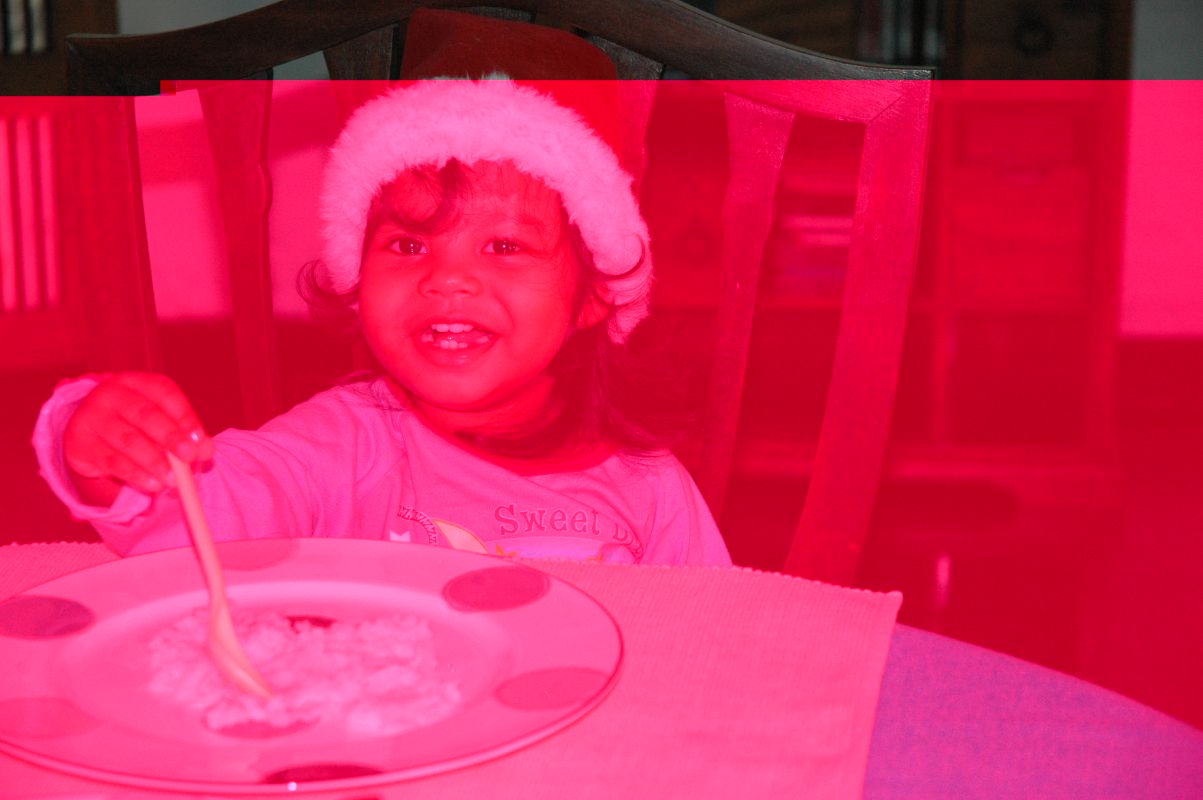
Our housekeeper, Vasantha made it for us. We have been here since August 2008 and will be here for at least 2 years, maybe more if we fancy it.
Well, first of all Christmas Day. We were at home in the morning and opened presents with Isabel. It was really exciting this year as she could actually tear open the presents with very little assistance from us. Last year, we had to open them all for her!
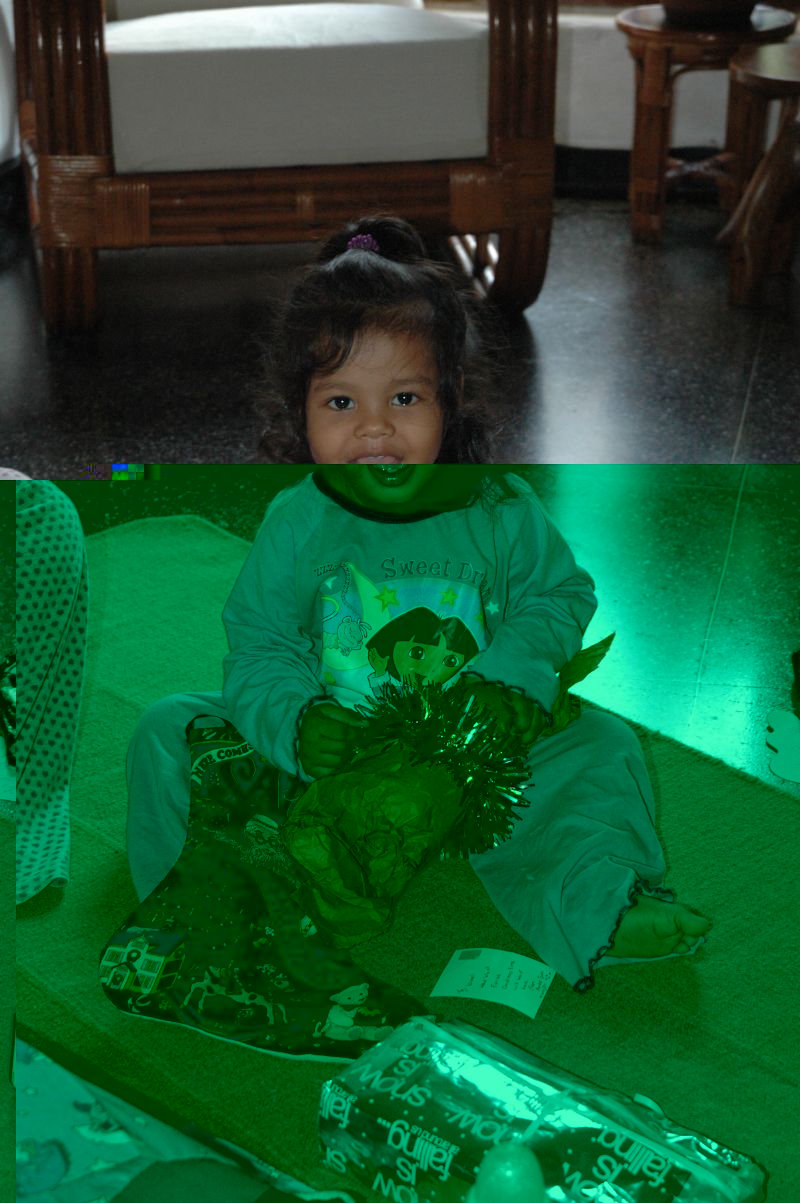
After the traditional Sri Lankan breakfast we all got ready and phoned our relatives and friends in India before heading off to the Mount Lavinia Hotel for their special buffet lunch. It was incredible. They had the whole works, from roast turkey and cranberry sauce to ham and pineapple and Brussels sprouts and roast potatoes. What did you eat for Christmas lunch?
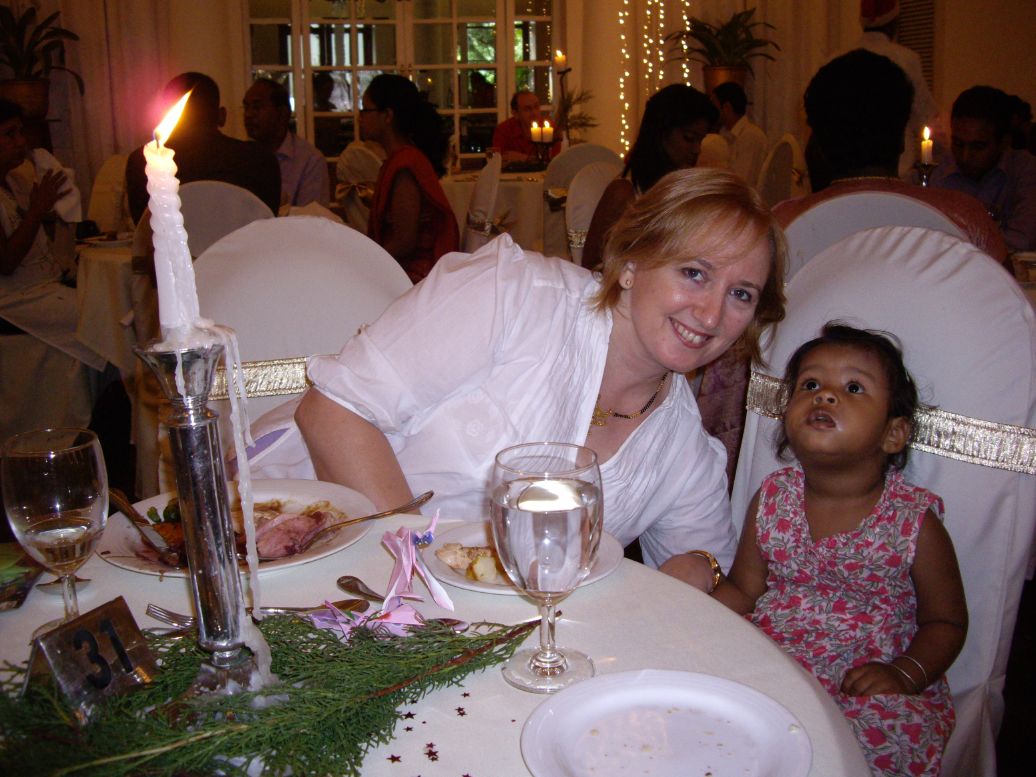
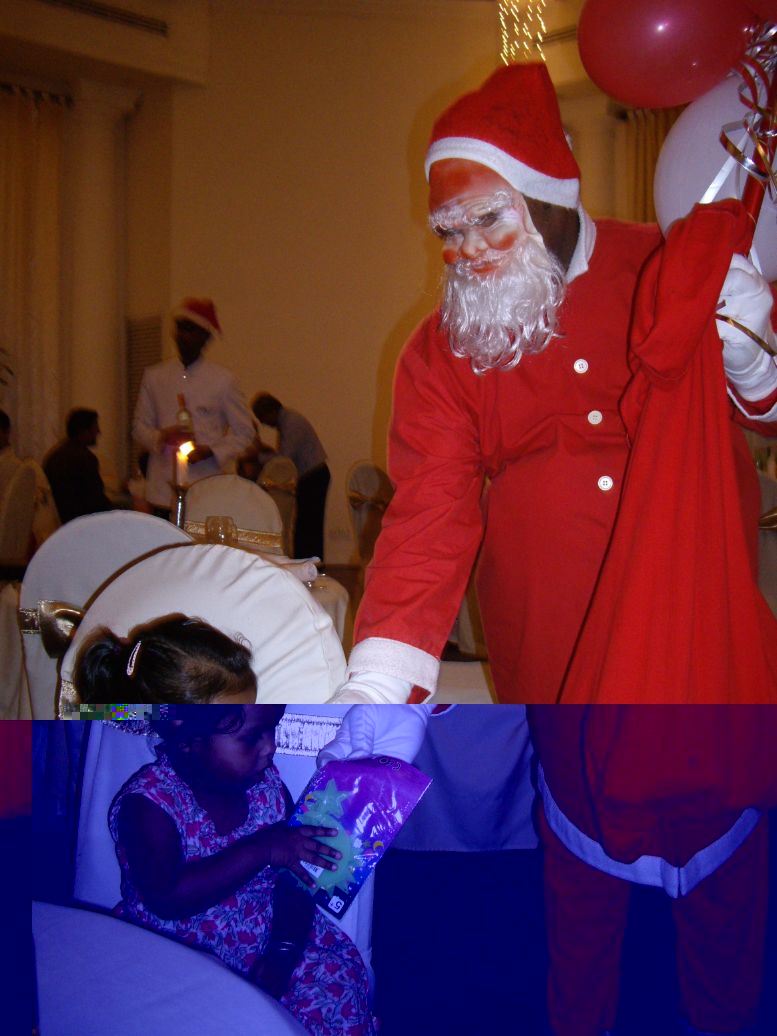
My mouth was constantly watering and I had to stop myself from gorging too much on the main course so I could taste the Christmas pudding and cake. I think the cake was quite alcoholic because after a small bite Isabel went on a sugar fixed rampage and it took all the energy we had between us (which wasn’t very much by this time ;)) to calm her down. Here she is with Santa Claus.
Now, New Years eve. We had a quiet one at home. Pankaj made chicken tikka rolls on our barbeque and we sat and watched them cook on our veranda and listened to music like Fat Boy Slim and Cold Play until we couldn’t eat any more. Then we strolled down to Mount Lavinia beach, which is about 2 minutes from our house and watched the new years’ revelers dancing, drinking and lighting fireworks. Unfortunately, I forgot to take my camera so I can’t show you any pictures of that but I am sure you can imagine the scene. There was also a line of ships on the horizon which came alight at midnight with their own firework displays. They were pretty neat though they could not compete with the various hotels which line Colombo’s coast. They were absolutely spectacular.
My father is coming to stay with us for 3 weeks and he arrives on the 6th morning so you will get to meet him too in the course of this month. I will bring him into our virtual classroom to chat with you.
Well, I look forward to hearing from you Marcos and all the other bloggers out there.
Bye for now,
Helen x
Words/expressions from my last blog
Cover versions - not the original version, an interpretation/copy
Squiffy - slang for drunk
Ordeal - a difficult experience
Jollity - happiness
A good dose of - plenty of
Maudlin - weakly sentimental
Today's challenge
How many different tenses did I use in this post and what were they? if you can, tell me the functions too (in the context here). posted on Friday, 02 January 2009 | comment on this postWhat Kind of Learner are you?Teacher Talk
Hello everyone, thanks for all your comments and well done to those who attempted the challenge. Thanks for your posts too Marcos. I am very happy to see that you are an enthusiastic blogger! Please do tell us more about your job.
I will post answers to the challenge at the end of this blog but for now, let’s get down to some serious business. I was sitting in our office the other day pondering this blog and one of the thoughts that crossed my mind was this:
What do all the student bloggers do with this blog? Do you download it? Save it? Record certain words/expressions from it? Try to imitate some of the stylistic features of it? Tell me, I am curious.
And following on from that question came this one: what do they want from it? From me? To be fully effective as a teacher blogger, I would really like answers to these questions. These are questions for you as well Marcos as you are this month’s student blogger and I notice you haven’t yet done your homework. :)
All this is related to the title of this blog. We all learn in different ways according to whether we are visual, auditory, kinesthetic learners, whether we like to learn with others or prefer to spend time studying alone, whether we are risk takers or not.
I would still like to have some questions from you Marcos as well regarding what you would like to know. I loved your recounting of your childhood memory of learning about Sri Lanka and its flag. It was well written and very evocative.
Let’s take a closer look at another of your paragraphs to help you (and the other bloggers) with your writing style:
“Well, let me start to answer your questions. (This is a good opening sentence to a paragraph. You use a good narrative technique and the tone is chatty and friendly) At Christmas I went to my parents' house in Pereiro. (Great but how did you get there? Tell us more. 340 km is quite a distance. It would have been interesting to know whether you went by train, bus, car) From Fortaleza (where I live) to Pereiro (where my parents live) is about 340 km. We had a great time there. (How was it great? This sentence teases us but we want more detail.) My parents, my two brothers, my sister, my nephew, my sister-in-law, my girlfriend... Everyone was at my parents' house at Christmas night. It was a special night.” (Again, we can imagine why it might have been special but tell us more – personalise it by telling us what it was that made you feel it was special- was it because you don’t get together very often? Was it because you have been busy lately and haven’t seen your family as often as you usually do?).
Marcos, your writing has a high degree of accuracy and is pretty fluent as well. I think you have a nice style but I would like you to take more risks and experiment more with your use of vocabulary. I hope you don’t mind me saying this but I feel a little as though you are playing it safe. Until recently I used to be an IELTS examiner and when evaluating a candidate's script we used to have to think about whether he/she was a risk taker or not. It is generally thought to be positive to take risks as a language learner. So, show us what you can do with the language and if you want to use a certain expression but are not sure of it, go ahead and use it anyway. You will receive feedback from me or the other bloggers. Basically, what I am saying is don’t be afraid.
Some replies
Mauricio – you bring up an interesting language point with your question. In the sentence “Here she is with Santa” as you correctly said is in the present tense yet the event took pace in the past. Well, the reason I have used the present simple tense is twofold: First of all, Isabel will be with Santa in that photo for as long as it exists as a photo. Therefore I am stating a fact – describing what is true about that photo. Secondly, it also serves the function of bringing the event closer to you and closer to real time chat as if we are talking in the here and now. This is partly because it is a blog and the communication is meant to be more informal and chatty and partly because I am playing the role of story teller and story tellers often use the present tense to narrate past events, for the same purpose – bringing the reader closer to what the characters are experiencing. I hope that makes sense.
James – I am glad you like the phrase ‘to be in awe of someone/something’. I find myself using it a lot about Isabel. People tend to be in awe of someone or something when they are experiencing something for the first time/when they see something wondrous/when they admire something/someone. Yes, you can say you are in awe of me if you like. It is a very flattering thing to say. :) But I am curious - why are you in awe of me?! Photos/pictures can be used interchangeably.
Guzin – Yes, Isabel has started talking but has a limited vocabulary at the moment. Yes, we are trying to raise her to be bilingual but the majority of her productive vocabulary at the moment is English.
Christine and Robert – sorry you are feeling the cold. Yes, we do have nice warm temperatures in Sri Lanka. It is about 28 degrees Celsius on average at the moment.
Dusan and everyone– yes, I have used a lot of tenses in this post. Is this usual? Let’s keep a regular track of tense variety in my posts and our own writing. It is important to use a variety of structures to make our writing more interesting - that is unless of course we are great literary giants who can get away with only using one or two tenses in a whole passage/chapter. Can you think of any writers who do this?
Naheed – I will bring my father to you just as soon as he arrives and gets over his jet lag. :) I am eagerly awaiting his arrival tomorrow morning.
Well, good night all. I am off to eat dinner now which will be a combination of the leftovers from the Thai lunch we had and some steamed rice and veggies.
Please keep up with the strong start you have all made to the new year with your blogging.
Speak to you soon,
Helen
Tenses used and functions in last post
Ewa did really well here so I am going to quote most of her examples:
1. Past Simple to show a completed action at a particular point in the past
E.g. How did you spend your New Year’s Eve?
2. Present Simple which we use when we talk about things which are factual, or happen repeatedly
E.g. What do you do? /Here she is with Santa Claus
3. Future Simple to indicate a decision made at the time of writing/speaking
E.g. I will give you...
4. Present Perfect simple – in this case to describe a state that began in the past but is still true. (unfinished past)
E.g. We have been here since August 2008
5. Present Perfect continuous to connect the past and present activity
E.g. How long have you been blogging?
6. Past Continuous which we use when we are in the middle of the action at the certain time
E.g. Were you partying...?
7. Present Continuous in this case for future arrangements:
E.g. My father is coming...
Today’s challenge
Try to suggest alternatives for these extracts from Marcos’ posts and explain your choice of structure/correction:
1. And I never forgot the flag of your country…
2. When I saw you are from Sri Lanka immediately came on my mind: "the country of the little lion".
3. I wish that you help me to write this blog during this month.
4. I am 31 years-old..
5. I am doing Master’s Degree
6. Since the first class I enjoy this language.
posted on Monday, 05 January 2009 | comment on this postThe Coffee Song and off to Una!Hello all! Great to hear from so many of you but more about that later…
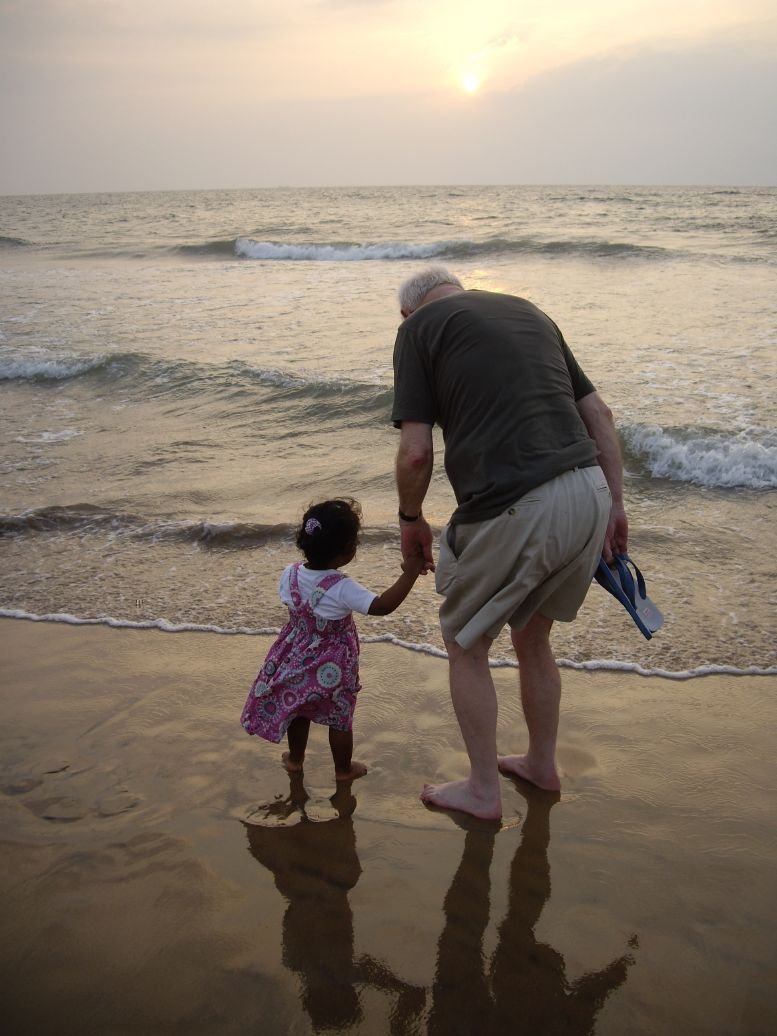
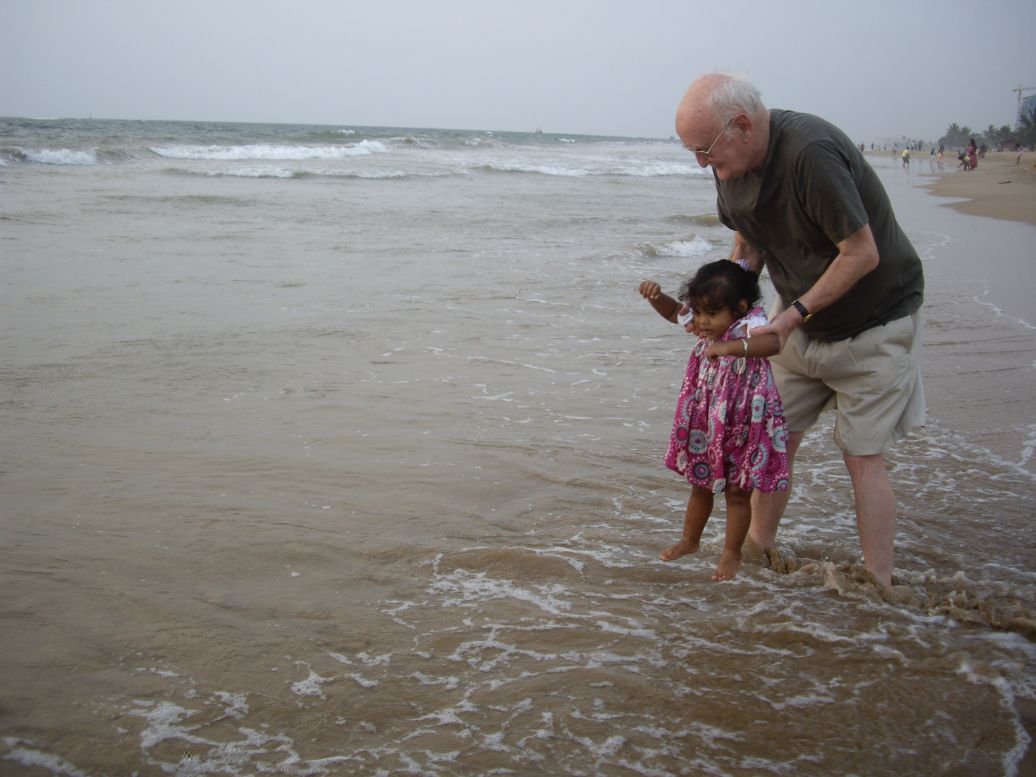
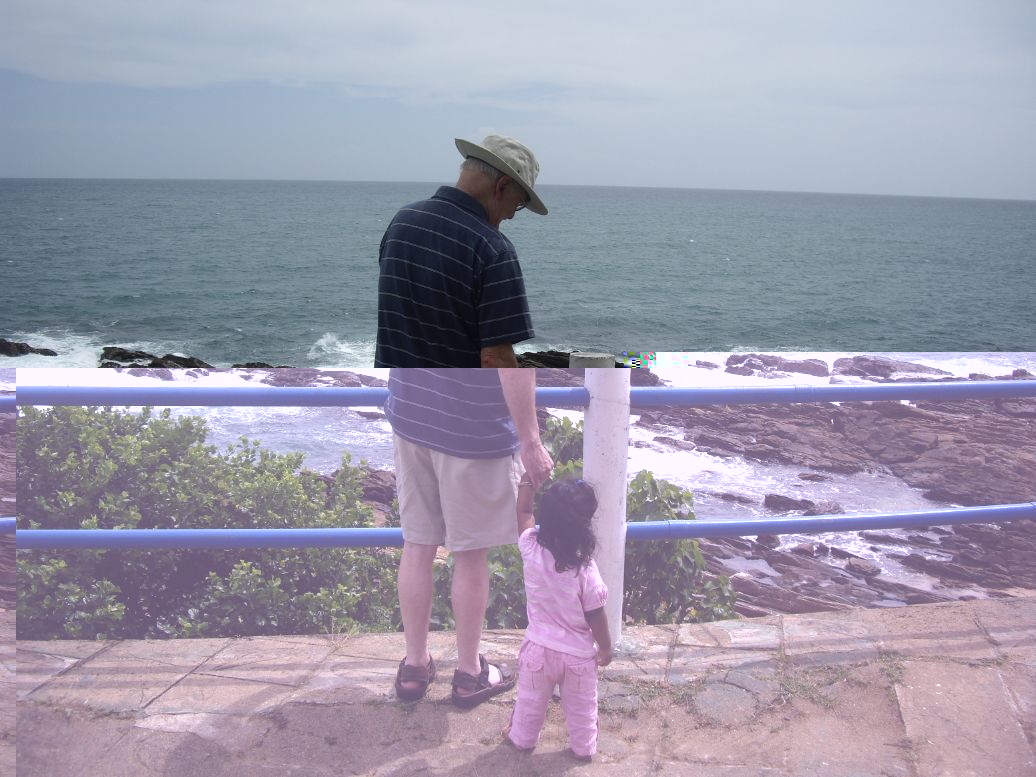
Well, Dad arrived safe and sound and brought with him lots of goodies for us all. It was like a second Christmas. Isabel took to him well and they were soon getting on like a house on fire. Dad has some great ways of breaking the ice with people, whatever the age. Here they are together on our local beach.
He also had a few nuggets of information about Brazil I thought were just fascinating so would like to share one of them with you. Marcos, I wonder if you know this song, it’s called The Coffee Song:
Here’s an excerpt from it:
“Way down among Brazilians
Coffee beans grow by the billions
So they’ve got to find those extra cups to fill
They’ve got an awful lot of coffee in brazil
………
No tea or tomato juice
You’ll see no potato juice
'cos the planters down in Santos all say no no no
A politician's daughter
Was accused of drinking water
And was fined a great big fifty dollar bill
They’ve got an awful lot of coffee in Brazil”…….
You can listen to it on you tube if you Google coffee song it will come up with a link. Apparently, it was written by Hiliard and Miles, made popular by Frank Sinatra in the 1940s or 50s and we are not sure but were speculating as to whether it was when there was a glut of coffee in Brazil or a downfall in demand. Do you know anything about this Marcos? This led us on to discussing the emergence of musicals and feel good factor songs in time of great distress such as war time and economic depression and in the present financial crisis we wondered whether the soaring popularity of the musical Mama Mia could be attributed to the same sentiment. Any thoughts on this? Have you seen this movie? We watched it this evening. It was quite enjoyable, if a bit cringe worthy at times.
Now I have to go finish packing as we are taking a trip down to Una (short for Unawatuna) on the South coast tomorrow morning and we plan to be off by 6.30 am at the latest. Don’t worry - I am taking my lap top and plan to use wi-fi to blog with you all when I am down there and if all else fails I can go to a cyber café. I promise to post pictures and info about this beach haven and more from Dad then too. :)
I will also do a special blog dedicated to answering your questions about language learning and commenting on the last blog and the issues it raised. I must just briefly say though how nice it was to read so many positive comments about the LE blog. I promise the LE team didn’t put me up to it!
Anyway, bye for now and wish me bon voyage – how do you say that in Portuguese – is there an equivalent Marcos?
Good night!
Helen
Answers to last challenge
1. And I have never forgotten the flag of your country… (Present perfect simple needed here as you are talking about a current state which began in the past)
2. When I saw you are from Sri Lanka immediately came on my mind: "the country of the little lion". (This whole sentence really needs to be rewritten and Ana Paula did it very well: “When I saw you were from Sri Lanka what immediately came to my mind was "the country of the little lion". Note it is ‘came to my mind’. Try to learn phrases like this as full phrases, not as separate words. It is difficult to find logic in prepositions, and often one verb can be used with many different prepositions depending on the context and meaning – so, I usually advise students to learn by noticing which prepositions are used in particular contexts and to record them as an entire phrase, rather than a simply verb+preposition).
3. I hope that you help me to write this blog during this month. (Common error to mix up usage of hope and wish)
4. I am 31 years old. (No hyphen needed here. We use a hyphen when we make the statement into a compound noun like this: I am a 31-year-old; of course you could just say, more simply: “I’m 31”).
5. I am doing a Master’s Degree. (Don’t forget those tricky articles, Marcos)
6. Since the first class I have enjoyed this language. (here again, we need the present perfect simple to express an ongoing state of enjoyment which started in your first English class).
posted on Wednesday, 07 January 2009 | comment on this postA Taste of UnaHi Everyone!
Great to hear from you all again. I write this evening from a temperate Una. It has been a lovely day today – warm but not too warm and as a result we have been able to sit in the sun without fear of getting burnt. The sea was also calmer today so Pankaj and Isabel had a dip. I took photos instead and Dad was firmly ensconced on a sun lounger by the hotel pool.

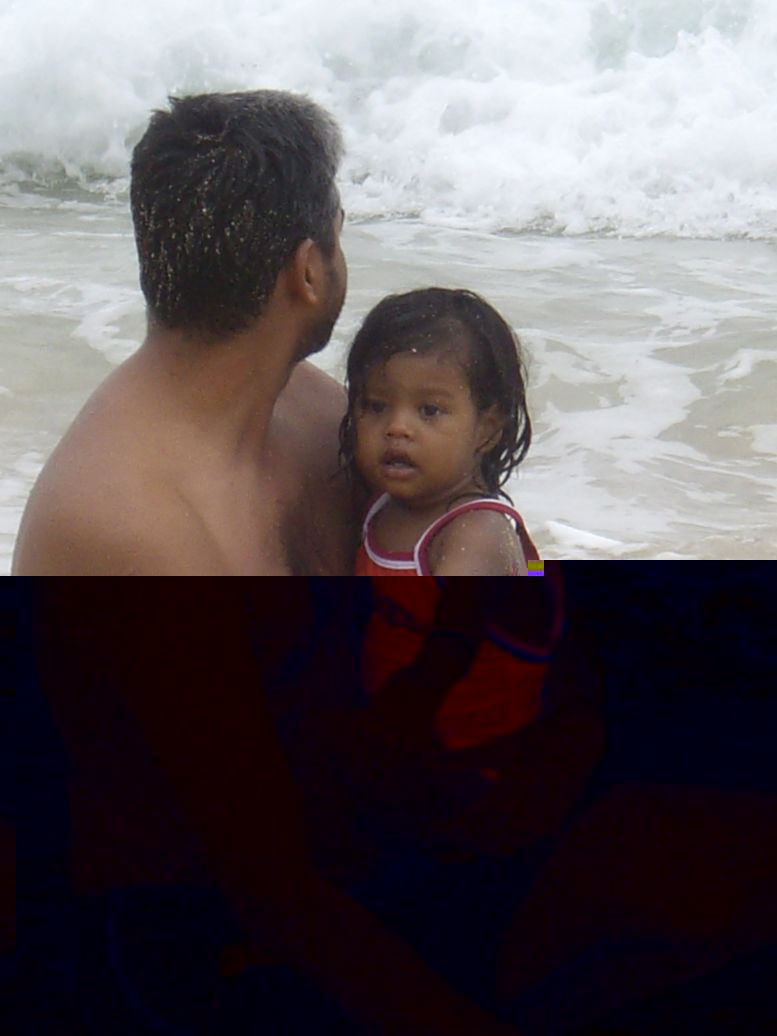
Sorry, I should have started at the beginning shouldn’t I? I’ll tell you what, I’ll retrace our steps to yesterday and the journey here.
Well, we had planned to set off early to beat the traffic – I told everyone I wanted us to leave at 6.30 a.m, knowing full well that if I said that we would probably be on the road by 7.30, but when I looked at my watch after having been on the road only a few minutes I got a pleasant surprise as it was only just gone 7! :) This boded well I thought for a hassle-free journey and I was more or less right as we'd anticipated it would take about 3 hours to Unawatuna and we were bang on target. Oh, I haven’t told you how we got there. We hired a car for the whole trip. It’s a white Nissan Bluebird and very roomy and comfortable it is too. So, where is Una? (I like calling it that) :) Well, it is about 115 km directly south from Mount Lavinia where we live. You hit Galle Road and head straight for Galle then Una is just a few kilometres beyond Galle around the next headland. I don’t know much about the town yet as we have not explored. In fact, we’ve not even left the hotel – can you believe that! How lazy is that?
So, what else can I tell you? Well, since we have eaten every single meal here so far I can tell you about the hotel food. In the evening there is a buffet with a wide selection of dishes, both Sri Lankan and continental. It is pretty decent for buffet food. I am usually not that keen on buffets, especially when it’s included in a half-board deal but I have to say, this one’s not bad at all. Breakfast is also a buffet – again, everything you’d expect to see, from croissants to rice, fresh juices and coffee. I’ll tell you something new I’ve tried here – a local fish they call Blue Marlin. Have any of you ever heard of it? I hadn’t but it’s quite tasty.
What next? Well, tomorrow we head off to Yala – a nature reserve where we are hoping to be lucky enough to see a leopard. Of course, it is very rare to see one but keep your fingers crossed for us. We will be gone two nights and then we come back to Una for some more nautical activity – we might go out on one of those glass-bottomed boats. Sorry, still haven’t been able to drag father to the keyboard yet. I am in our room on a wi-fi connection with Isabel sleeping beside me and Pankaj out having a massage; Dad’s asleep in the room next door. I promise you will hear from him soon.
Bye from Una and hope you like the pictures.
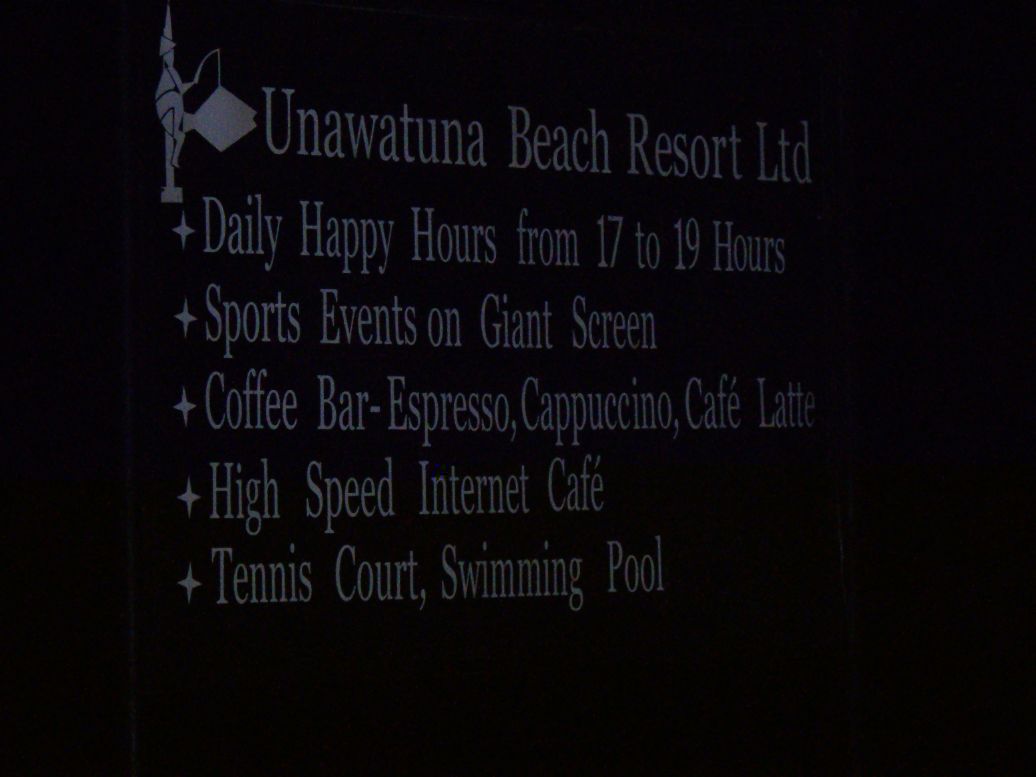
Looking forward to hearing from you again Marcos. Well done with the challenge you responded to. Now let’s see more of your writing.
Speak to you soon – maybe after I get back to Una – I don’t know if I’ll get wi-fi in Yala.
Helen x
Today’s challenge
Notice all the collocations in bold and try to use them in your next post. You could tell me about a journey/trip you have been on recently.
Can you also look at the use of journey and trip in this post and tell me what the difference is in usage.
posted on Friday, 09 January 2009 | comment on this postHello from Yala and DadHi everyone! How are you? Fine I hope. Sorry to all of you who keep writing and telling me how cold you are. Just close your eyes and imagine you are in Sri Lanka with us; though I have to say that if it were a month or two earlier or later, you would not want to be in my shoes, as the humidity increases it becomes less of a pleasant place to be.
Right, first things first, I am afraid I have had a few technical hitches so I will not be able to bring to you the full visual feast I had hoped. I will take you on a full safari, Yala style in a couple of days’ time, when I manage to rectify my lead problem. (Don’t ask!)
In the mean time I thought I would comment on a few of your comments and then I will hand you over to Dad.
First of all, I’ll return to the post where I invited you all to tell me what you wanted from this blog. Here’s what you said:
Vocabulary
Dialogue
A good balance
Fun
Analysis of language
The photos
Information about hobbies, culture and countries around the world
Some of you like the challenges; others just want to read and not necessarily contribute but the main thing that came across was that you are all interested in people and learning about how other people live, work, eat and play. This struck a chord with me as I feel exactly the same way which is probably why I am in this profession and why I have lived in a number of different countries.
Now some answers to a couple of specific questions:
Ana Paula – You asked about ‘but and though’, we do not usually put but and though in the same sentence. However, if we use a semi colon to separate two facts/ideas from each other it is possible to use both in the same sentence but not in the same clause. For example: I like cornflakes but my daughter does not; though my son will eat cornflakes and porridge. A lot of language learners make the mistake of putting but and though/but and although in the same clause/sentence without any semi colon. I wonder whether it is a direct translation issue for you or not? In a lot of languages it is possible but not in English, basically because the two words serve the same function.
Sunny – you wanted to know the difference between until and before and until and by. Well, I’ll do my best. These three words are all used to refer to a particular point in time, be it past, present or future. The difference is in usage. Until is used to refer to a point in time by which we ended/wish to end/circumstances bring an end to something. For example:
I waited until 9 o’clock but he never showed so I went home. (up to that point in time)
I will be in Sri Lanka until at least August 2010.
I always wait until everyone’s finished eating before I start to clear the plates.
Before I go to bed I brush my teeth. This refers to a time shortly preceding my going to bed. It is not that I am brushing my teeth right up to the point of getting into bed. We use before to refer to something that took place/will take place at a point preceding another event/activity/time. It can go at the beginning of a sentence or in the middle or even at the end. For example:
I met him before I came to Sri Lanka.
Before I came to Sri Lanka I had never eaten jackfruit.
I will use lifts now which I never would have done before.
By the time you read this I hope to be tucked up in bed.
I will have left Yala by this time tomorrow. (At some point before 9 p.m. tomorrow)
If we try to replace by with until it does not work. If we try to replace before with until or vice versa it will also not work because they have slightly different meanings and notice the difference in use. I hope these example sentences have helped clarify for you. I often find that examples are the best way of showing the difference.
Sergio - you asked about classifying new vocabulary. Well, these are a few of the ways I recommend to my students and ways I have also used myself.
By topic – all words associated with weather/sport/hobbies etc
By collocation – words which appear together. You could use the concept of a word spot/word web like so:
The main word is take. I record take in my notebook with a lot of other words which I can use with take:
Take a bath
Take a break
Take time
Take a breath
Take away
Take over (v)
Takeover (n)
Overtake (v)
It is also useful to record the part of speech as I have shown above.
Antonyms (Opposites)/synonyms (words with similar meanings)
Formal/informal
Functions – language for directions/letter of application/meeting for the first time etc
I am sure there are many more as well. You just have to decide which works best for you. Of course, there’s always the traditional alphabetical way as well. The main thing I think is that the methods you choose are clearly labeled so you can find what you are looking for quickly when you need to recycle/use that language again. It’s a bit like tidying up. If you are too tidy, you might find you can’t remember where you have put something because you have hidden it so well!
Right, that’s it for me. I will leave you with a couple of pics and Dad.
I bid you all good night. See you on safari very soon. :)
Helen x
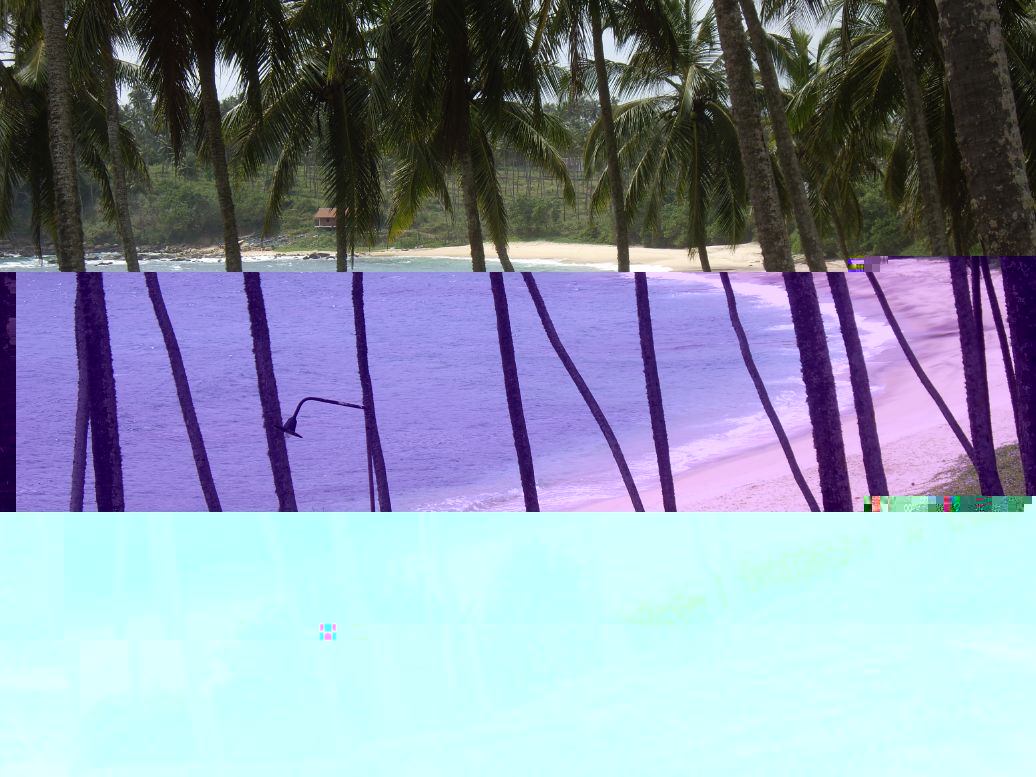
Here's the view of Tangalle bay from our lunch stop en route to Yala.
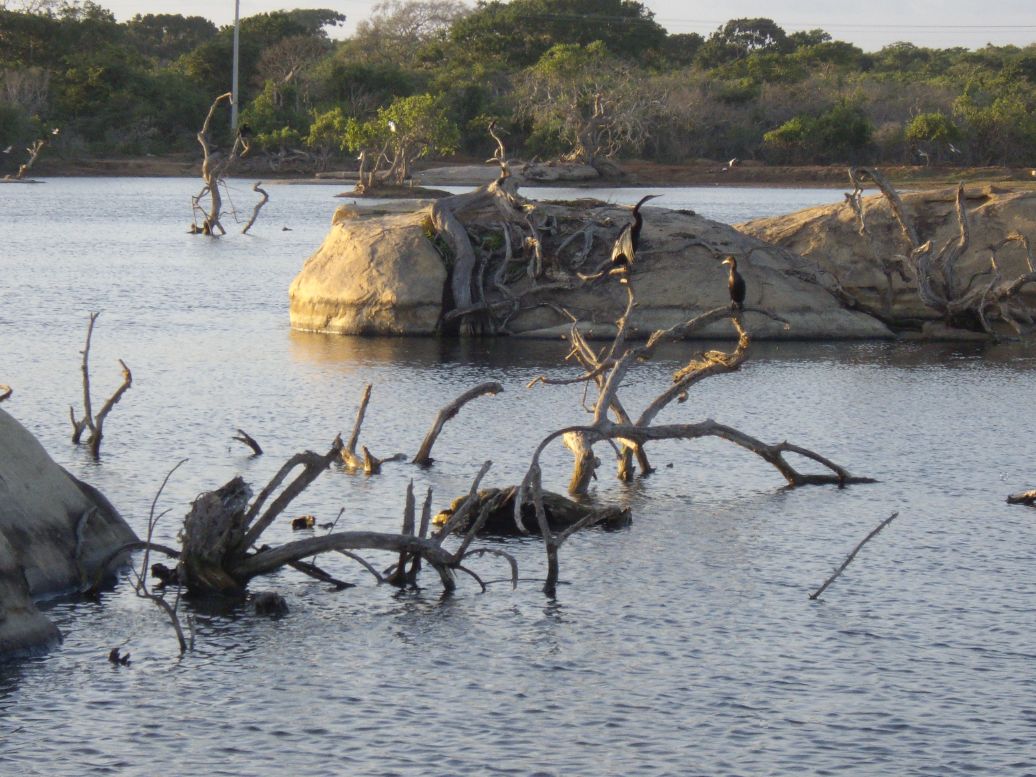
Good evening everybody. You are in the hands of an amateur blogger!
Allow me to introduce myself. My name is Roy. I live in the Lake District in northern England. I am Helen’s father and am spending a wonderful holiday with my family on the beautiful island of Sri Lanka. It is a complete contrast to having left England at -3 degrees, dropping into Sri Lanka the following day to a balmy 28 degrees in the shade!
We are staying in a resort called Yala Village.
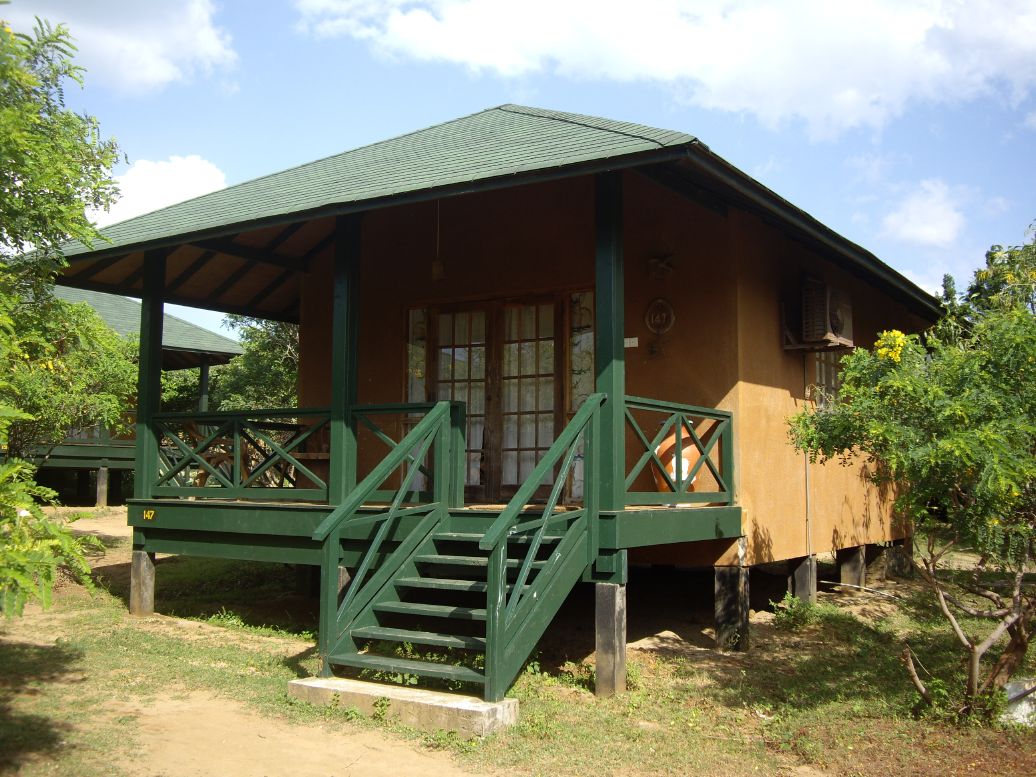
Facilities are really good. Here's a picture of my chalet. It's just opposite Helen's.
As usual with holidays we seem to be staggering from one meal time to another. When we return to our home in Colombo I have made a resolution to shed a few pounds by walking along the nearby beach; but as we all know the road to hell is paved with good intentions!
On our arrival we were advised to have a guide to take us to our chalet as there are wild boar roaming the grounds! Rather off-putting but up to now we are all safe and sound.
Thank you for the privilege of speaking to you all. It has been a great pleasure. I am very impressed with your language skills and really amazed at the comments that come in from all over the world. Good luck with your studies and thank you for your patience with me.
Best Wishes,
Roy
posted on Monday, 12 January 2009 | comment on this postYala SafariHello fellow bloggers all over the globe!
First of all, thanks from Dad for all your kind comments and appreciation of his efforts. Secondly, apologies to Marcos for not analysing your writing tonight. I promise in my next post I will. I read with interest your piece called Fortress.
Thirdly, apologies to all those I do not manage to have dialogue with today. I will try to respond to a few of you each post. Before I do that however, I’ll take you on a virtual tour of Yala National Park. I hope you like the pics. There were so many of them it was hard for me to make the selection but I have tried to give you as varied a tour as possible with some of the better, sharper pictures.
So, here goes: we set off in a jeep organised by the hotel at 5.45 in the morning. Our hotel was just a few minutes from the main entrance to Yala so we were inside the park in no time at all. We took with us a packed breakfast and two cameras. The best of the shots you will see in a minute were taken with our Nikon SLR with a Sigma zoom lens.
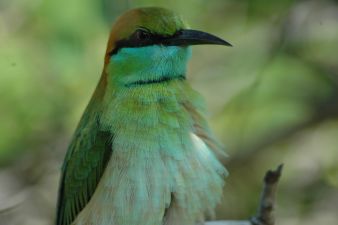
I’ll start with one of the more common sightings – the Green Bee Eater. They were ubiquitous in Yala but very attractive I thought and this one just wouldn’t stop posing for me. He was an absolute gift!
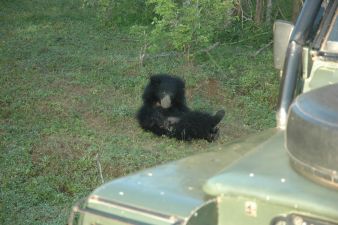
Next up is the Sloth bear - sloth by name, sloth by nature apparently. This is a cub but there were three of them who played near us for about 5 minutes before scattering into the bush. This was one of the rarer sightings according to our tracker.
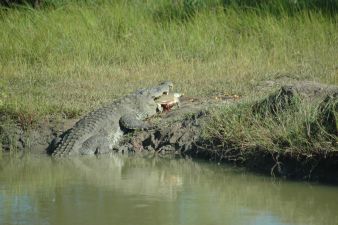
Now here’s one that’s not for the faint hearted among you - a crocodile with a turtle for its breakfast. Can you see the eggs that have been expelled from its stomach by the crocodile’s jaws?! I kept waiting for it to alter its position but it stayed absolutely still and would have done I think for an hour or so more. Busy digesting? :)
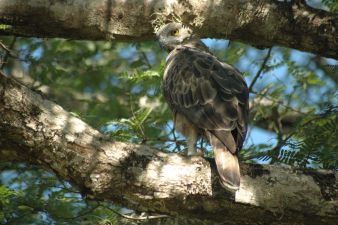
This is one I am proud of as I took it and it was a difficult shot to get. It’s an eagle. Which type, I am not sure but it is a fish-eating one. They are such dignified birds don’t you think?
After that we stopped for breakfast at a beach by which a memorial to the Tsunami victims killed in the park on that fateful day had been placed.
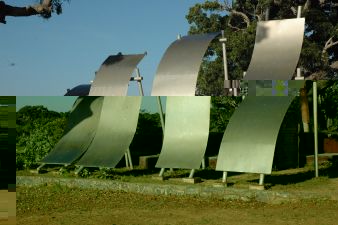
By this time I, although I was happy with what we had seen I was still anxious to see my favourite – the elephant. That most majestic of beasts, yet somehow melancholic. We set off back in the direction we had come and took a couple of in-roads off the main track to see if we couldn’t come across one or two at one of the many drinking holes but nothing until…..
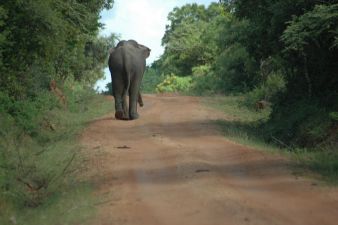
Back on the main road probably only a few kilometres into the park, there he came from the bush onto the track and walked right into my viewfinder. What a treat!

And in this one you can see that it is mating season as he has the musk glands weeping on his face. This is to attract the female of the species. Have I begun to sound a little like David Attenborough?:) My Dad kept saying that I did because I insisted on whispering in reverence the whole time!

And here he goes back off into the jungle…. With a trump, trump, trump. ;) After this, everything else paled. I was so happy to have had such close contact with this majestic male.
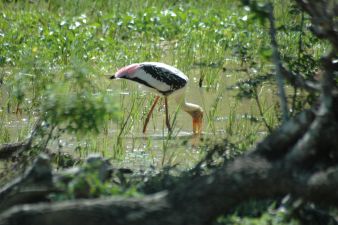
On the way out, we saw yet another painted crane but the light was right so I took a few shots and here’s one of the better ones.
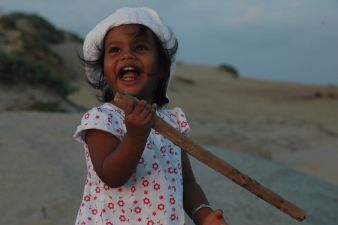
Well, as you can see, although it was a bumpy ride it was well worth the 4-hour trip and Isabel was amazingly well behaved through it all. Here she is on one of the most pristine, beautiful beaches I have been on – it is in the resort we stayed in.
Right, now for a few replies…..
Alessandro - I have been pondering what you said about bilingualism and I do think that one of the main reasons for Isabel not speaking in Hindi yet is due to the fact that Pankaj and I don't generally speak Hindi to each other at home. The fact that he speaks to her in Hindi is not enough. I think she needs to hear it being spoken aound her, which of course if we were in India she would do much more frequently. Do write more on the subject. It's very interesting and if anyone else has any light to shed on this matter, please do write in.
Paulraj -
Yes, I do think you are a risk taker as far as language learning is concerned but if you don't feel you push yourself enough, do try to use new words you are less familiar with the use of and see what happens. I do think that even at the basic level, students can take risks with the language they are learning. I will try to give you feedback whenever I can and don't lose heart that you were not chosen as the student blogger for this month. I am sure it will be an option for you in months to come. Make sure you get some feedback from the LE team.
Christine - no I don't know "Dinner for one" - is it a film? tell me about it. I like the title.
Toni - I agree, 'seeing and doing' is a good way to learn and I always have to write things down in order to remember them. I always say I can't think if I don't have a pen in my hand! :)
Rabail - absolutely no need to apologise. This blog is aimed at language learners from an intermediate to advanced level and yes, it is perfectly OK for you to comment on the teacher's blog as well as the student's. So, keep blogging if you like and I hope you pick up some more tips for your writing skills.
James - here's a correction for you: Your sentence from a comment on my Jan 5th blog :no matter it is long or short....' should read "no matter if/whether it is long or short...'.I do understand your frustration but please understand that it is not possible for me to correct every blogger's sentences.
Well, as they say, that's all folks. One more thing before I go. Thank you very much to all who told me of their trips and journeys. I will comment on those and the answers to recent challenges in my next post.
Good night and sweet dreams.
Helen x
posted on Thursday, 15 January 2009 | comment on this postBack Home and Back to WorkHello everyone! How are you on this fine Saturday? I am glad you liked the virtual safari of Yala. Now I’m afraid the holiday’s over and it’s back to work. My first day back is tomorrow. I mustn’t grumble though as I have had a month off – that’s probably about what most people get in a whole year, right? I do appreciate it, honestly. It’s going to be a busy but interesting week ahead as we have eleven new members of the teaching team to induct, most of whom have just arrived in Colombo. I like meeting people when they’ve just arrived and seeing their first reactions to things. They somehow manage to inject a fresh lease of life into the workplace and into my own life, as they help me see things from a fresh perspective again. I’ll let you know how it goes in a few days’ time.
Anyway, I thought that as I am going back to work, I would set you all back to work too so there are two challenges today! Don’t worry if you don’t have time to do both but if you could attempt one of them that would be great. It would help Marcos as well. Incidentally, Marcos, are you OK? I do hope to hear from you very soon, as I’m sure all the other bloggers do too. So, first of all have a look at this analysis of Marcos’ writing and see what you can learn from it and whether you can help him improve some of his sentences.
Marcos’ Fortress piece
My main focus here will be cohesion – looking at the ‘glue’ you use to ‘stick’ the pieces of text together to make it cohesive. First of all Marcos, look at the narrative techniques you use to take us from one place to another:“As I told you before...”
“A note before I continue”
“There are many places that I like to go here. One of these is…” (This is a good opening sentence to a paragraph. What we teachers like to call a ‘topic sentence’. It tells us exactly what the paragraph is going to be about. Your use of referencing in the second sentence is quite sophisticated too. You have avoided repeating the noun phrase from the first sentence by using the pronoun “these”).
“Today, this “bridge” is a touristic place where you can see the sunset.” (This is a nice closing/summary sentence to end the paragraph with too).
“Other place that I like to go is the” (this is a good follow on from the previous topic sentence but you will have to change the first word for it to work).
These introductions to your paragraphs help us to navigate your text and make it easier for us to absorb the information, which would otherwise be quite dense.
Now let’s see what other treats you had for us. This is a lovely, evocative image you have painted for us, Marcos. “…difficult for the sun to hide itself completely among the clouds”. The idea of the sun hiding and the fact that it found it difficult too is a powerful image. Well done.
This is perhaps your most cohesive paragraph and a great way to close your post: “So, we have many fantastic places to go, beaches and delicious food… But there is one thing that I really love in this city: the people. I have been lived here for 16 years and, everyday, the people here surprising me. They are friendly, funny, talkative and helpful. Here you are never be alone!”
First challenge:
Now see what you can do to improve these sentences:
1. I will talk about the city I live: Fortaleza. (This is a nice continuation of your initial sentence to this paragraph but see if you can spot the missing word).
2. They were interested in cultivate sugar cane in this region.
3. The French also tried to take the control of a part of the territory (Brazil).
4. estimated that lived in Fortaleza 2.473.614 inhabitants in 2008.
5. Additionally, there is the global warming. (This is not a good way to end a paragraph. You are introducing a new point and then you don’t elaborate on it. In the next paragraph you talk about the places you like to go to, which is completely unconnected to your mention of global warming. Apart from this however, there is a grammatical issue. See if you can spot it).
6. The best beaches of the Ceará is not in here in Fortaleza.
7. Unhappiness, I’ve never been in Jeri.
8. As Adriana remembered commenting the last post..
Second Challenge:
In the title to this post I have used two expressions with 'back' in. See how many other phrases you can find and use with 'back'. (This challenge comes fomr the fact that I got a Brewer's Phrase and Fable dicitonary for Christmas and I figured we could make use of it in these blogs).:)
Now over to some of the other bloggers…..
Gordana – I really enjoyed your post about your South Africa trip. You managed to use lots of the collocations I had introduced in my post appropriately and accurately. Well done. You included plenty of detail as well which added colour to your writing. I loved lines like:
“... so I got to see a cheeky monkey staring at me while I was having a bath”
“I must say that buffet meals are right up my street” (though here I have to say I differ from you. After my trip I am totally buffeted out! I don’t want to see another buffet for at least 6 months.:) Sorry to hear about your husband but glad that he recovered).
Toni, Guzin, YPW, Rene – thanks for your posts about your trips too. Rene, be careful about the form of the words you use though. Look at these examples of incorrect usage (not in terms of meaning, but form) of the collocations:
“Fortunately we are always banged on target”
“it bode well..”
Hyoshil – unfortunately, no we didn’t see any leopards but you know what, it didn’t matter. When I go to wildlife parks/nature reserves, I go with the philosophy that we may want to see lots of exotic animals but they generally don’t want to see us and the very fact that I know they are around somewhere fills me with anticipation and that high is enough for me.
Your use of vocabulary in this post is really rather good. Take these excerpts for example:
“The icing of the cake was when…”
“My son was ecstatic..” (Good use of the word ecstatic. How many other ways do you know to say ‘very happy’?)
I agree, 8 pounds does seem extortionate – nice use of this word by the way. How many other ways do you know to say ‘very expensive’? (This is not just a question for Hyoshil).
Right, finally before I sign off and get an early night in preparation for my first day back at work, here’s an explanation of the uses of trip and journey for you:
Here are a couple of examples to start you off:
Our trip to Yala was really exciting. (The whole experience – from start to finish)
The journey down to Una was uneventful. (The time we spent in the car getting there)
Definitions:
Trip – a pleasure excursion/specially arranged journey for a particular purpose
Journey – any travel from one place to another
Bye for now,
Sleep tight; don’t let the bed bugs bite :)
Helen
posted on Saturday, 17 January 2009 | comment on this postOut and About in ColomboHi Marcos. Hello everyone.
My apologies for not writing sooner. I guess returning to work hit me harder than I thought it would as I had to come home early with a migraine. I guess I had spent too long in front of a computer screen. However I didn’t want to leave it any longer before I communicated with you so I thought I’d let Dad fill you in with what he has been up to since our return to Colombo.
I promise to write as soon as the weekend starts. So without further ado have a read and a look at what Dad’s been up to.
Good night,
Helen.
Good evening everybody. This is Roy, Helen’s Dad – an amateur at the controls! Fasten your seat belts.
Thank you for your kind comments on my efforts.
I am half way through my holiday in Sri Lanka, the time has really flown-I have been here sixteen days already.
On Sunday morning I had a real treat. Pankaj took me to his barber and I had a haircut, shave and head massage. It was really relaxing and I think I went to sleep in the middle of it!
Today Pankaj and I have had a really mixed day. Shopping for groceries, stuff for Isabel, vegetables etc. The sort of day we all have wherever we are living.
Shopping can be difficult in Sri Lanka. With it being an island lots of things are imported and when stocks run out it is a case of waiting for the next shipment to arrive. Quite frustrating if you don’t shop in time-when you see it, buy it.
Since our return from holiday I am trying to eat less so last night I only had Lobster Thermidor at a restaurant on the beach.
Let me tell you about lunch today. I had my favourite South Indian meal –Masala Dosa. It is a huge pancake with a filling of potato and spices and comes with several dips. Beautiful!
I seem to remember saying to you that the road to hell is paved with good intentions!! I don’t care- I am on holiday.
Outside the restaurant we met a Sri Lankan guy, Shamil, who was having his wedding function there .He lives in England and had come for an arranged marriage and was due to fly back to the UK in two days. His new wife would have to wait for her visa to come through.
Here we are, forgive the shorts!
Our next visit was to Independence Hall, a modern building and quite impressive. It was built to commemorate independence in 1948.
We then picked Helen up at her office and returned home, played with Isabel for a while and finished off the evening with a delicious meal cooked by Pankaj.
That's it folks. Thank you all for your company and patience. Good luck to you all.
Roy posted on Wednesday, 21 January 2009 | comment on this postBrand NewHi Marcos, hi everyone!
I do hope the technical hitches are soon resolved and we can all have a more real time communication going. It feels strange writing when you’re not sure if any comments are going to come through. Anyway, here goes..
Thanks to those who wished me well in my new year at work. The first day was really quite disorienting. I had forgotten my password and could not remember which number I needed to dial on my phone to get an outside line. My boss said that these were positive signs that I had managed to leave work behind and switch off successfully during the break. I guess that’s true but it still felt weird. It was a gentle ease in though. I spent most of the morning checking my mail and catching up with how people had spent their holidays and then I went for a work lunch to welcome all the new teachers. We ate in an open-air café which had a live jazz band playing while we were eating. We swapped places during the meal so that we got chance to speak to as many people as possible. It was a pretty nice way to introduce us all.
The rest of the week was spent on induction and timetabling and by Wednesday night – as you saw from our post – I was completely exhausted and got a migraine. Never mind, I’m OK now. Some of you asked whether the new staff were local or not. Well, most of them were brand new to Sri Lanka and come from a range of countries, from England and Scotland to Canada and the USA.
Marcos, tell us what you’ve been up to – Your posts are very informative about your country and current issues and I enjoy reading them but what about you? You tell us you are busy but busy doing what? What’s going on in your life right now? Looking forward to hearing from you. I am off to a Swiss restaurant with my father and Pankaj now. We have booked a table for 8 pm so I’d better get a move on. We are planning to eat fondue – have you ever tried that?
Answers to last challenges:
Challenge 1
1. I will talk about the city where I live, Fortaleza.
2. They were interested in cultivating sugar cane in this region. (verb pattern- gerund)
3. The French also tried to take control of a part of the territory (Brazil). (no article needed here – take control of something is a set phrase and does not take an article)
4. It is estimated that 2.473.614 inhabitants lived in Fortaleza in 2008. (word order)
5. Additionally, there is global warming. ( no article)
6. The best beaches of Ceará are not here in Fortaleza. ( no article for Ceara and subject-verb agreement – plural)
7. I’ve never been unhappy in Jeri. (wrong word form – you need an adjective here not a noun; also word order issue)
8. As Adriana remembered commenting in the last post.. (preposition needed)Well I hope this has helped Marcos. I will analyse your last two pieces in my next blog.
Challenge 2
Backbone of (England), the – a name given to the Pennines – range of hills running north to south down the middle of the country
The backburner (put something on the backburner) – figuratively: put to one side for the time being
Back door, the (get in by the back door) – gain entrance to a job, position by ‘pulling strings’ and not through your own merit.
Backhanded (adj) – a backhanded compliment – a double-edged one.
Backhander, a (n) – a bribe
Back of beyond, the – in the middle of nowhere – away from civilization or dense residential areas/hard to find. It took me ages to find his place. He lives in the back of beyond. Apparently this phrase originated to describe the vast spaces of the outback in Australia.
Back to nature – return to a natural state
Back to basics – back to ‘ground rules’ and traditional values. It was used as a political slogan by the conservatives in the 1990s.
Back seat driver – someone who gives the driver instructions from the back seat.
Well done Hyoshil with your other expressions for very expensive: they were almost all right except for this one: ‘As much as that High’ (should be ‘as much as that’)
These were all good: Daylight robbery, A rip-off, Astronomical, To cost an arm and a leg, To cost a fortune, Pricey, Extortionate
Your expressions for very happy were correct too: Full of the joys of spring, On the top of the world, Overjoyed, Be made up, Over the moon, be on cloud nine, Ecstatic, Thrilled, Jubilant, Radiant, Delighted. Good work on Marcos’ sentences too. I hope you got that cup of coffee – you deserve it! I am glad you enjoyed that programme about elephants. I have seen some of that series myself. They did a whole ‘secret life of…’ series and I liked the approach they took.
YPW – I am glad you liked hearing about my work. I had hoped for more phrases with back though – aside from the ones I put in the text. See if you can use the ones listed in today’s blog.
Welcome Andrea and well done for attempting the challenges. Well done also to Adriana and Johnson for attempting the challenge. Adriana – I am glad you liked the parting expression. I like that one too. :)
Paulraj – You haven’t quite got the use of ‘back to back’. It does not mean simultaneously which is how I think you have tried to use it in your sentences in this post. It means following in close sequence. Well done with your attempts to improve Marcos’ sentences.
Well done Rene for your phrases with back. I will list them here again for those of you who didn’t read her post:
• to be back on track
• back to your roots
• to be back for good
• at the back of beyond
• to know sth. back to front
• back breaking work
• the backbone of the economy
• to stab somebody in the back
Sergio – yes. I know I am very lucky to have had a month off. I hope you get this opportunity at some point. Thanks for attempting the challenge.
Beatriz – yes, I actually do work on Sundays. We are open 7 days a week from 8 am to 8 pm so we all have different shift patterns. I have a Friday-Saturday weekend, which I have got used to and quite like now. Sundays are reasonably quiet in the office so I can kid myself into thinking that it is like doing a half day. I think it is all psychological.
Tiasha – welcome back and well done with the challenges. Your phrases used with back were appropriate. You still haven’t sent me that recipe for the chutney though! :)
hai van nguyen - well, if you are just starting out, I would recommend that you enrol yourself at a good language school. Where do you live? If you live in Hanoi there are lots of schools that are good. The second thing you need to do is what you have done here – be brave and take risks and use the language without worrying whether you make mistakes or not. The third thing you need to do is to find someone to practise with regularly. Finally, set yourself regular but achievable goals and read, read, read. Start with children’s books or abridged versions of classics, there are a lot of what they call ‘graded readers’ on the market nowadays and these can be really helpful. Good luck.
Today’s challenge
Find 5 phrases with ‘set’ in by reading a newspaper, novel or magazine and try to use them in a sentence. I will give you an example: the first time I set eyes on Pankaj I knew there was something special about him.
Right, that's all for now guys,
sleep well and have serene dreams.
Helen x
posted on Saturday, 24 January 2009 | comment on this postMixed Blessings and Verb PatternsHello everyone! I wish I knew how and where you were. It is a little disconcerting writing and not knowing whether you will get to read it in the next few days and worse still, whether you will have chance to comment and ask questions. Our time together is running out.
Anyway, mustn’t dwell on what we have no control over. I hope you are not feeling too despondent about the technical hitches Marcos.
So, what’s been mixed about the last couple of days? Well, I heard that a good friend of mine is getting married and another old friend of mine has had a baby and Pankaj baked oatmeal cookies today made with chocolate and treacle. doesn't that sound yummy? :) Treacle is very big here in Sri Lanka. A common dessert is curd and treacle, which incidentally I just love. Well, that’s all the good news; the not so good news is that Isabel is running a high temperature and we are a little worried about her. I think we may have to take her to the doctor’s tomorrow as this is the second day of the fever and her temperature is not going down, except temporarily after calpol. The other thing that’s not so great is that it is only two days before we must say goodbye to Dad :( and then to each other as this month’s blogging will come to a close. :( Finally, to top it all, the cookies didn’t turn out so great and Pankaj is a little grumpy about that. I will have to go and cheer him up after this. It was his first attempt so he should not be so hard on himself, don’t you agree? Anyway, we have all decided to order in Chinese food tonight as we cannot face cooking after our cookie disappointment and the kitchen smells so fantastic I couldn’t think of replacing that smell with something else.
Our weather has been very sultry today following a thunderstorm and heavy rain last night. High temperatures coupled with high humidity is not a very comfortable situation I can tell you. The pressure is building again and I think that we can expect more rain in the near future.
Right I shall turn my attention to you now Marcos and talk about your pieces on the Amazon and the Pink River Dolphin. What a great legend! Your piece on the Amazon was very passionate and I can only begin to understand how you feel, especially as your region depends on it for its vegetation, rainfall etc. You write convincingly and fluently. Well done.
Now, here’s where the verb patterns come in. I would like you to look at the following examples of different verb patterns. I would then like you to try correcting some of your sentences by focusing on the verb patterns. What do I mean by verb patterns? Well, a verb does not usually stand alone in a sentence. It tends to go with a preposition or adverb, be followed by a gerund or infinitive, and require an indirect object or not. This is what I mean by patterns. If you start to take notice of them, you will soon see patterns and start to be able to recognise when you are not using the correct form of the verb or preposition to go with it.
To extend in a particular direction
To extend across borders/boundaries
To extend over an area
To extend into a county/country/territory
To sum up
To destroy something
Without destroying something
To dislike something (dislike must have an object)
To be like +gerund/noun – It was like coming home. It was like seeing for the first time.
To dress in something/to wear something – she was dressed in red/she wore red/she was wearing red.
Some believe that to kill/killing ….. (here you can use the gerund or the infinitive form of the verb).
1. The forest extends itself for nine countries
2. If you sum the plant species of North America and Europe, this number is inferior of the diversity of plants in this forest.
3. The second defends its exploitation by community in a sustainable basis, without destroy the jungle.
4. The politicians here dislike when an important vehicle of the media (like BBC or New York Times) criticizes their inability to deal with the problems of devastation in Amazon Jungle or any other forest.
5. For us is like to go to another country.
6. he dresses white clothes
7. Some believe that kill an Amazon River Dolphin is sign of bad luck.
8. I was thinking to stop here, but I couldn’t.
Well folks, I am off to have an early night now as I am sure we will be woken up by Isabel half way through the night in need of some comfort and relief from her suffering.
I hope to have better news for you next time.
Godd night,
Helen x
posted on Tuesday, 27 January 2009 | comment on this postHurrah! – Back in BusinessGreat to be back everyone and I do hope you get chance to comment. I fear our time is coming to an end. Marcos – I hope you get chance to read my analysis of your writing. I shall write my final goodbye blog tomorrow but for now, let’s get an update on what’s been happening.
Well, Colombo’s not such a great place to be at the moment for a couple of reasons. The first being the fact that there are huge traffic jams caused by the government having closed roads. Why have they done this? To allow them space to do rehearsals for their military parade on February 4th. In case you don’t know, February 4th is Sri Lanka’s Independence Day. It’s great to celebrate but I don’t think that closing roads during peak commuting times is such a smart idea – and we have 3 more days to go!
The second reason I am not in such a good mood today is that we had a day-long power cut and I have been itching to get on the computer and write to you and had to wait until 6 in the evening. The power went off at 8.30 this morning. Why didn’t we go out you might ask? Well, the morning was OK. We managed to find cool spots in the house but by the time we had had lunch, I’m afraid lethargy set in and we collapsed on the bed and slept for a couple of hours.
Onto brighter things now, I heard from Dad today. He got back safe and sound. He is till adjusting to the freezing temperatures though and he said he can’t get used to wearing socks and shoes after being in sandals or barefoot for three weeks! When he spoke to me he had the heating on and was wearing a fleece as well!
Well, I’m afraid that’s all for now as I have to go help put Isabel to bed and start preparing dinner. I have an early start in the morning. I have to be in work by 7 am. I ma duty manager, which means I have to organise cover of any teachers are sick, take care of any customer issues, technical problems etc. The good thing about starting early though is that I also get to finish early. I finish my shift by 3 pm so I can enjoy the rest of the day with Pankaj and Isabel.
I’ll finish with some answers to the last challenge.
Until the next and final time,:(
Helen x
Corrections to verb patterns in Marcos’ sentences
1. The forest extends across/into nine countries.
2. If you add up all the plant species of North America and Europe, this number is less than the diversity of plants in this forest.
3. The second defends its exploitation by community on a sustainable basis, without destroying the jungle.
4. The politicians here dislike it when an important vehicle of the media (like BBC or New York Times) criticizes their inability to deal with the problems of devastation in the Amazon Jungle or any other forest.
5. For us it is like going to another country.
6. he wears white clothes.
7. Some believe that killing an Amazon River Dolphin brings bad luck.
8. I was thinking of stopping here, but I couldn’t.
posted on Saturday, 31 January 2009 | comment on this post | January 2009
| Sun | Mon | Tue | Wed | Thu | Fri | Sat |
|---|
| | | | | 1 | 2 | 3 | | 4 | 5 | 6 | 7 | 8 | 9 | 10 | | 11 | 12 | 13 | 14 | 15 | 16 | 17 | | 18 | 19 | 20 | 21 | 22 | 23 | 24 | | 25 | 26 | 27 | 28 | 29 | 30 | 31 | | | | | | | | |
|


