March 2008Greeting to Yanko!Hi there Yanko
Nice to hear from you and I hope we’ll have fun and of course, learn something through this month’s blog. I’m Trudi, your teacher and partner and this is my second blogging month. In case you haven’t read any posts from February, I’m British and living in Beijing, China.
So how are you today? How are you spending your weekend? I guess that you work as a system analyst from Monday to Friday and have the weekend free? It’s a shame that you lost a job opportunity because one of the requirements was to be fluent in English (please note the differences between my sentence and yours). Now that you are studying the language seriously, I hope that you can get a promotion or opportunity at work next time. I don’t know much about your profession (not professional because this is an adjective) so it would be useful if you explain more about what you do in later blogs.
You are right when you say that cultural differences exist not only between countries but also within them. As an example, there are many ethnic minority groups that live in China and their culture is different from the majority group which is Han Chinese. Also there are differences in accent, dialect and attitude between Chinese from the North and South of China. What cultural differences did you notice when you travelled to other countries?
Today, let’s look at an error in one of your sentences and correct it.’ I hope one day live abroad’ should read ‘I hope one day to live abroad. This is because of verb patterns; some verbs are followed by verb+–ing and some verbs are followed by to +infinitive. There is a short list of some common verb patterns for your reference:
Verb +ing
like
love
enjoy
prefer
hate
finish
look forward
Verb + to + infinitive
agree choose
decide expect
forget help
hope learn
need offer
refuse seem
want
I think I have a very stereotypical view of Brazilians’ personalities. When I think about people from Brazil (and considering the ones I’ve met), I imagine they are all very friendly, lively and passionate but hot-tempered too. Also, that they are extremely good dancers with great rhythm and lovers of music.To what extent does that stereotype apply to you Yanko?!
Hear from you soon
All the best
Trudi
Vocabulary
shame (n) pity
promotion (n) get a higher position at work
ethnic minority a group that has different national or cultural traditions from the majority of the population
dialect (n) regional variety of language
hot-tempered (adj) quick to get angry
stereotype (n) A conventional and oversimplified opinion or idea
posted on Sunday, 02 March 2008 | comment on this postThe Temple of HeavenHi Yanko
How was your day? Did you have a good day at work? Thanks for posting those great photos, they were beautiful. The colours and places shown in them looked so vibrant and enticing. Your blog was like a huge advert for tourism for your city and really made me wish that I could visit all the landmarks and sight seeing places you mentioned. After looking at the beach picture, I realised that I am yearning for the sea, sand and sunbathing. It’s been a long time since I had a ‘beach’ holiday; in fact the last time was January 2006 when I went to Kohl Lanta in Thailand. Teah (my one and a half year old daughter) has never see the sea or played on the beach and I’m sure she would love it (even though she’d probably eat the sand and try to swallow sea water!!) It’s a situation I’m hoping to rectify this summer.
I thought I would introduce you somewhere famous in Beijing but not the obvious places like the Great Wall and Tian An Men Square because I’m sure you know all about those two and have seen many pictures of them. One of my favourite places in Beijing is called the Temple of Heaven and I have posted a photo of one part of it below. There are so many temples all over China that some people say ‘if you have seen one, you have seen them all’ because they can appear to be very similar. The Temple of Heaven is architecturally quite distinctive, in my opinion, and the Ming and Qing dynasty emperors performed rites for the entire nation in this temple. Very precise attention was paid to all aspects of its design including colours and numbers (everything is in multiplesof three).
This picture shows the Hall of Good Harvests and I find it amazing as it was built without a single nail.
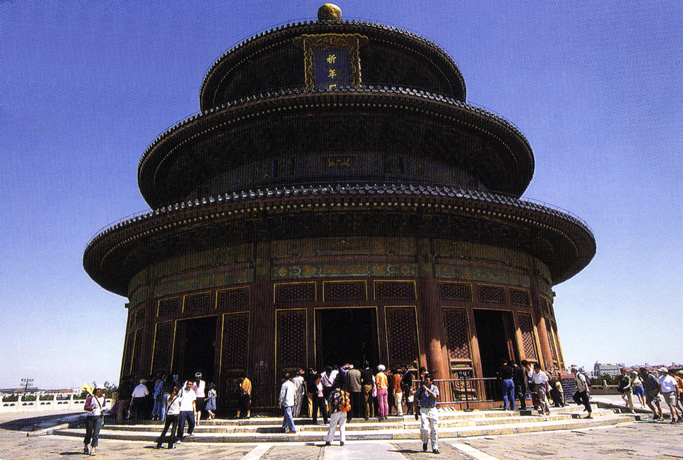 These days the temple is an all year round tourist attraction and the surrounding park comes alive around 6am with local residents(mainly senior citizens) who are doing their daily exercises and activities, everything from kite flying to tai-chi to practicing opera singing! The language point I want to highlight today is ‘ Thanks for the warmly reception’, you should use the adjective in this sentence which is ‘warm’. Warmly is an adverb and could be used in a sentence like this ‘I was warmly welcomed by the readers’
‘ I have some nice friends at this cities’ contains two mistakes. First the wrong preposition, change 'at' to ‘in’ and because you have used the plural word ‘cities’ , in order to make it agree, you must say ‘these’
I’m not feeling too good today as I got a bout of food-poisoning on Sunday night and haven’t fully recovered from it. So I’ll go now and curl up in bed with a hot-water bottle and try to sleep it off!
Best wishes
Trudi
Vocabularyvibrant (adj) lively and full of energy
enticing (adj) to attract because of hope or desire
yearn for a strong desire or wish
rectify(v) to correct a situation distinctive (adj) very different and distinguishing
dynasty (n) period of time in Chinese history
rites (n) religious or solemn ceremony
multiples of three (n) groups of three or numbers that cab be divided by three
senior citizens elderly people
bout (n) sudden attack of an illness
posted on Tuesday, 04 March 2008 | comment on this postA rainbow to brighten up your daySounds like you had a fantastic holiday in 2006 Yanko even though some parts of it were very tiring. Do you go on a holiday every year? Is it more common for Brazilians to travel around their own country or go abroad? With so much to see and do in your own country, I suppose there is no necessity to travel overseas unless you want to experience another culture or different climate. The hot springs sounded particularly appealing to me. I’ve been told of many similar springs in Japan and am waiting for the time and money to go! By the way, can you tell us about your family so we can put names and information to the faces we saw on the photos?
I must say thanks to all those readers who sent me ‘get well soon’ wishes, Merce, Kuldeep, Wisarut and many others. I’m partially recovered I have to say and now it seems it’s not food poisoning but some intestinal infection. Marianna, you are right that at this time of year with the weather and temperature changes, lots of viruses and infections are being passed around (and I hope the atmosphere at your workplace improves soon).
I’m taking Chinese herbal medicine as I’m a great believer in it. I have used different types of Chinese traditional medicine before and it has always worked. I sprained my ankle whilst doing aerobics a few years ago and I couldn’t put any body weight on it as it was so painful. I couldn’t walk so I hobbled to the pharmacist who gave me a huge band-aid and a small bottle of black, tar-like, evil-smelling liquid to put on the sprain. It took 1 day for the pain to go and 2 days for all the swelling to disappear.
I started taking the medicine for my current complaint yesterday so let’s see how long it takes to work…Hyoshil; I understand what you are saying about having to soldier on even when you feel ill or tired when you have kids. Even when Mum is ill, the children want to eat, play, and run riot all day and never give Mum a break.
Laetitia, thanks for you comments.
Tanya most of my students are international students (from Hong Kong, Korea, Japan) and I also teach some Japanese ladies. When I do work as an IELTS or AEAS examiner the students are all Chinese.
Eugeny sorry to disappoint you but I definitely am not amongst the people at the Temple of Heaven early in the morning. One reason is that I live far away from the temple and the other is that I have Teah to look after in the mornings and I’m comatose until the second she wakes up (about 7am) and I’m always dying for more sleep!
Eszter now I am used to life in China after 10 years but it was not easy to get over the culture shock. When I arrived in Beijing, it was not at all westernized and you had to speak Chinese in order to buy anything, go anywhere or get any service. No one spoke any English which made life difficult from the onsetbecause then I spoke no Chinese and everything was alien to me culturally and environmentally. The first year was interesting, the second year was frustrating, the third year I had had enough and wanted to leave. However, because my husband wanted to remain in China, I had to persevere. By the end of the fourth year, I felt that I had got used to the ups and downs of life here and could cope with it. Foreigners in China often say that their relationship with China is a ‘love-hate’ one; I’m no exception.
A few language points to note for you Yanko
1) Water slides (not ‘slides water’), this error is about word order and it should be adjective before noun.
2) ‘One week after, I go…’ this is a tense error. As your holiday is in the past and is finished now, you should write ‘One week after I went…’For the same reason (holiday finished action in the past), your sentence ‘I’ve stopped in more two cities in Minas Gerais’ should be in past simple tense like this ‘I stopped in two more cities’
3) In the last part of the same sentence ‘to buy a typical region food and souvenirs ‘,food’ is an uncountable noun so cannot be preceded by ‘a’ and the word ‘region’ is a noun so here you should use the adjective which is ‘regional’.The sentence should be 'to buy typical, regional food'.
I'll leave you now with a picture of a rainbow that was over my parent's house last summer when I visited. I love rainbows and although the end of the rainbow seemed to be in their back garden, I found no gold when I dug the whole garden up :-) Do you have any idioms or sayings about rainbows in your own language?

See you!
Trudi
Vocabulary
partially (adv) part, not totally
intestinal (adj) relating to the intestines(the long tubes that are part of the digestive tract)
sprained (v) A painful wrenching or twisting of the ligaments of a joint
hobbled (v) to limp
pharmasist (n) chemist, someone who prepares and sells medicine
complaint (n) illness
soldier on to continue to do something in a determined way even though its difficult
comatose (adj) in a very deep sleep and can't be woken easily
westernized (adj) become like the culture or things inwestern countries
onset (n) the beginning
persevere (v) to keep going/persist even though you face difficulties or obstacles
posted on Thursday, 06 March 2008 | comment on this postNewsflash - BBC blogs win an award!Sorry to 'interrupt' you Trudi, but I wanted to make a quick announcement.
The BBC student and teacher blogs have won an Elton award!
What's that? Well, it is a very special award given by the British Council for innovative English language resources. The British Council describes the awards as 'the Oscars of the English language teaching world'!
What's more, BBC Learning English has won a second Elton for our interactive soap opera, The Flatmates.
You can read more about the awards, and see some photos of the ceremony here.
I'm sure you'll join me in saying 'well done' to Paul and Carrie who work hard to look after these blogs. But we feel very strongly that the award really belongs to you - the student bloggers, the teacher bloggers and the whole learning community who have made these blogs so very special.
So, thank you... and congratulations! You are all winners!
William
BBC Learning English posted on Friday, 07 March 2008 | comment on this postThe most famous square in ChinaHello there Yanko
I’m not sure if you read any of my blogs as you never seem to answer any questions or respond to the language points I am raising. Nevertheless, I’ll continue to chat to you and ask you for more information about things that you write; I’m also hoping that you understand the corrections to some of your writing errors. Please let me know if you need any more explanations!
The carnival certainly is one of the most famous things about Rio and it springs to mind whenever the city is mentioned. I sometimes eat in a restaurant here called ‘Rio Brazilian BBQ’ and they show DVD’s of the carnival on big screens with very catchy music all night, every night. It looks amazing and the costumes are very decorative and elaborate. You said that the carnival’s history is an act of farewell to the pleasures of the flesh but, from what I’ve seen of the carnival from recordings, pleasures of the flesh are a primary focus!! There are many sexy and scantily dressed women and men in the carnival and a percentage of them are topless!! I bet it would be a really memorable experience to attend a carnival like that but I doubt I'd go topless ;-) What would you wear Yanko?
I’ll move on from that point to look at some of the errors in your posting;
1) ‘Many personalities, celebrities and foreign come from all of world participate…’ This sentence should read ‘Many personalities, celebrities and foreigners come from all over the world to participate…’
2) ‘Carnival is the most of popular festival in Brazil’ Did you want to write ‘The carnival is the most popular festival in Brazil’?
3) The carnival have, this is another error of agreement so note that it should be ‘The carnival has’
4) ‘The parade starts Sunday evening and go on into early morning Monday of the celebration’ the first half of the sentence is correct but the second half should read ‘and the celebration goes on into the early hours of Monday morning’. Here I have changed the word order, made the verb agree and added a phrase.
5) ‘There are a street carnival at famous place in Rio like Copacabana, Ipanema’ Sorry to point out another error in agreement of tense and plural noun but the mistakes in these areas are frequent so I’m hoping that you can recognize these reoccurring errors and try to correct them. The correct sentence is ‘There is a street carnival in famous places in Rio like…’ or ‘There are street carnivals in famous places in Rio.. .’
As some readers told me they know little about the most famous landmarks in China, I thought I’d write a bit about one today. I’m also following Yanko’s topic of ‘the most famous’ by talking about Tian’anmen Square which is the heart of Beijing.It is the central point and the rest of the city has been built and planned around it.
Tian’anmen Square is the world’s largest square-a good general knowledge fact that will help you in a game of Trivial Pursuit or a local pub quiz!. It is surely one of China’s most iconic spots and conjures up different attitudes and feelings in different people due to events that have occurred there. During the Qing dynasty, it was just a kind of corridor between ministry buildings and no where near the size it is today. Those structures were knocked down in 1911 and it wasn’t until some time in the late 1950’s that the square was enlarged to its present size and Soviet –style building were put up to flank it. The new style square was made because it was the 10th anniversary of the PRC at that time.
Nearly every time I have visited the square it is packed with tourists from all over China and overseas, I’ve never seen it without the photo-snapping, kite- flying hoards! If you can get up early enough (again, you have to be an early riser!), crowds of people gather at sunrise for the flag raising ceremony. The Chinese flag is raised daily at sunrise and set at sunset. On national holidays, the square is festooned with red flags and flowers and there are always many more troops of the Chinese army present at holiday times compared to ordinary days.
At one end of the square(north end I think!) is a building called the gate of Heavenly Peace and it has a huge portrait of the former Chinese Chairman, Mao on it so he can look out across the square. As I don't have a picture of the Square to hand, I have posted a picture of the gate with Mao's portrait which looks small in the photo but is, in fact, huge.
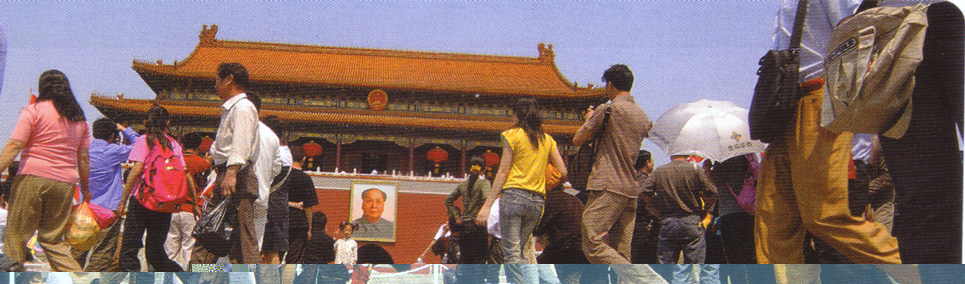 If you go through the gate, you will enter the Forbidden City. This ‘city’ is the place where the imperial families lived during the Ming and Qing dynasties and it’s vast. The other buildings around Tian’anmen square are Great Hall of the People, used for government meetings and other very special events, China National Museum and Chairman Mao Memorial Hall.
I'm sure Chinese people could give many more interesting facts and figures and even stories about the Square and the Forbidden city; all I've done is try to give you a taster here.
Well, that's my lot for today. I need some shut eye!
Bye Bye
Trudi
PS How much time do you spend studying English every week Yanko? Do you self-study or attend classes?Vocabularysprings to mind to appear suddenly or immediately in your thoughts
catchy (adj) attractive and appealing, easily remembered
scantily dressed wearing very few(not enough) clothes
iconic (adj) an important symbol
conjures up creates or brings into the mind
Soviet-style Russian- style
flank (v) placed on the sided of something
hoards (n) large gathering of people
festooned (adj) decorated with
taster (n) sample, tester
shut eye sleep
posted on Sunday, 09 March 2008 | comment on this postAnimal Farm and Fan dancersI’ve had a day at home today, writing an essay (got a deadline on Friday and I’m way behind!) and doing some work preparation. I’ve re-read ‘Animal Farm’ by George Orwell as I’m teaching it to my students. I’ve been preparing a vocabulary list so that their first read of the book will be helped along by their knowledge of some key words. I’m also creating worksheets about the characters, plot and use of language. Luckily, I really like George Orwell, I say luckily because I have to teach it and it’s sometimes hard to get motivated to teach things you don’t like much. I thought I’d give you a brief insight into the plot of ‘Animal Farm’; it’s quite a unique story.
An old, prize –winning boar gathers all the animals at Manor Farm together for a meeting in which he tells them of a dream he had. The dream was that all the animals lived together without humans around to oppress or control them. Even though this boar dies, three other pigs formulate his ideas into a philosophy called ‘Animalism’, they then take over the farm by defeating the farmer in a fight and then try to work together to achieve the old boar’s dream.
At first the newly named ‘Animal Farm’ prospers and the animals are taught to read and educated about the principles of Animalism however as time goes on the three pigs start quarrelling and struggling against each other for more power. After one particular incident, one of the pigs is chased off the farm and another takes control. The new pig leader says that there will be no more democratic meetings and all the decision making will be down to the pigs.
The farm and the animals suffer some setbacks and problems, which makes the human farmers who live nearby happy and smug that the animals can’t cope. The leader pig, who is called Napoleon starts getting rid of any animal who says a word against him or his ideas, his vicious dogs kill the animals. Napoleon also begins to act like a human by sleeping in a bed, drinking whisky and doing trade with the neighbouring farmers (all of which were forbidden according to Animalism.)
The other farm animals are cold, hungry and overworked because the farm is not functioning properly due to the poor leadership. As the years roll on, the pigs become more and more like humans, even to the stage of using whips on the other animals and wearing clothes. The original seven principles of Animalism are reduced to just one which is “all animals are equal, but some are more equal than others”. Finally Napoleon allies himself with the human farmers and the poor, farm animals find that they can no longer distinguish between pigs and human beings.
Orwell also wrote a book called ‘1984’ which is a favourite of mine, maybe some of you have read it or heard of it.But that’s enough about books, I need to return to my essay writing now and be a good student. My tutor will not be pleased if I don’t finish in time and Friday is only a few days away. You know, when I do my job as a teacher, it seems much easier and less stressful than being a student:-)
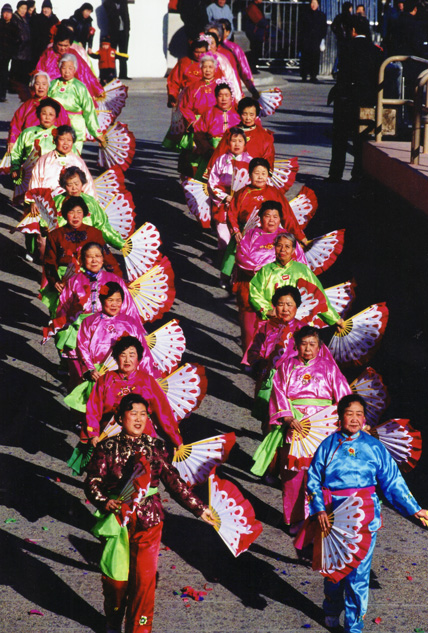
I know it's not related to the rest of my blog but I've attached a photo of Chinese ladies fan dancing. It's a very popular style of dancing for middle aged and elderly woman here. As you can see they wear bright costumes and dance with colourful fans while the men play instruments to accompany them. I love watching them dance and a few ladies practise every morning near the lake by my apartment. Teah and I watch them during our morning walk.
Vocabulary
motivated (adj) impelled, encouraged to do something
insight (n) understanding
boar (n) a male pig
oppress (v) to keep down people or things with severe and unjust use of force or authority
formulate (v) invent, devise
philosophy (n) a set of ideas or beliefs
prosper (v) be successful
principles (n) ideas or rules
democratic (adj) social equality
setbacks (n) unfortunate events that stop forward progress
smug (adj) self-satisfied
vicious (adj) evil and fierce
allies (v) to become friends with
distinguish (v) to recognise as different
posted on Tuesday, 11 March 2008 | comment on this postA 'passive' exercise for YankoHey Yanko,
How’s it going? I’m hoping that you read this blog because I’ve set you an exercise to do as a result of a grammar mistake in your last blog. Let’s take the bull by the horns and start with the language point for today.
‘Capoeira is a combination of dance, ritual and martial arts that developed by African slaves in Brazil the 16th century and nowadays represent a Afro-Brazilian culture and it’s teaching at Physical Education Class in the University’.
The first part of the sentence is a passive construction. Passive means the action of the verb is being done to the subject by someone or something else in the sentence so you need to use the correct form of the verb ‘to be’(is/was/have been etc) and the past participle so it should read ‘that was developed’.
Other corrections in the sentence are missing preposition ‘in the 16th century’, as ‘Afro’ begins with a vowel the article ‘an’ should precede it. Finally, ‘it’s teaching at...’ I’m not entirely sure what you mean but did you want to say ‘it is taught in the PE class at university’(another passive sentence Yanko)
As a short exercise in passive sentences, can you re-write the following active sentences in passive tense?
1) Bodyguards protect the rich and famous
2) Bad weather delayed our flight to Rome.
3) The cat chased the mouse
4) My brother organised the football game
5) The doctor examined my chest.
6) The gardener cut the lawn and trimmed the bushes.
7) Gloves protect your hands from the cold.
8) The child broke a glass vase.
Next a short reply to all the readers comments this week;
Pary from Iran, Raj, Leila, and Silwal Kishor thanks for your comments
Marcella, for a good summary of ‘1984’ by George Orwell, visit www.bookrags.com and search for the book, then click on book summary.
Tiasha, nice to see you are back blogging, I was wondering what happened to you!
Ana Paula. Very astute comments about the meaning and significance of Animal Farm
Hyoshil, great that you are reading ‘Fahrenheit 451’, do give ‘Animal Farm’ a try in English, you might like it
Kuldeep, thanks for sharing info about dancing in your country
Adek, it’s called “Animal Farm’, this is just the farm name (it was first called Manor Farm when humans owned it), in grammar we could refer to it as the animal’s farm but as a title it has to be Animal Farm
Mercè, The Sky’s Ashes sounds interesting-maybe I’ll seek it out and read it for myself Paulraj from India, what is it about the traditional dances in your country that you like? Thanks for the comments
Antonio from Lisbon-Portugal and Tanya and Merce the book is often used on English syllabuses and in English curriculums as it is considered a great modern classic by a famous author and is part of the English canon. It has surface and deep meaning, clever use of language, imagery, metaphor and serious underlying social comment. So it’s a text that student’s can really get their teeth into.Nastya, hi there! You hit the nail on the head about me trying to juggle too many balls...!! Pigs in the book are not only authoritative but also manipulating, deceitful and self-serving!! Hope you enjoyed your 10 days with Alex. What are you doing now you’re not blogging?
Today, I’m just making a fleeting visit to the blog because I’m dead beat, pooped and worn-out(all synonyms for 'tired'!). I was burning the midnight oil last night, sweating and pulling my hair out over that essay I had to do. Finally at 1.46am, I sent the essay to my tutor and crawled into bed...ah relief-NOT because I was woken up by a screaming Teah at 4am who wanted milk and cuddles. So now I’m feeling the worse for wear and need to catch up on some ZZZ’s(sleep). I’ve been teaching all morning and now, Teah is napping so I’m going to get my head down for an hour. I’m hoping I’ll wake up refreshed and then I’ll be able to go out and about and enjoy a Saturday afternoon with my family (and a large glass of red wine tonight to celebrate another essay completed!)
Bye for now, have a great weekend everyone
Trudi
Vocabularytake the bull by the horns face a difficulty and grapple with it
astute (adj) shrewd and intelligent
curriculum (n) courses of study offered at schools, universities etc
canon (n) a famous group of literary works
get your teeth into something to do something with energy and motivation
fleeting (adj) quick
burning the midnight oil staying up very late
pulling my hair out to be worried and anxious about something
the worse for wear tired from hard work
get my head down go to sleep
posted on Saturday, 15 March 2008 | comment on this postPicture an apartment in the middle of Beijing...Dear Coffee Addict
Finally you have realized I exist Yanko. Hurrah!
I write to you from a home with all its windows and doors sealed. The reason is that today there is a sand storm and the dust is flying everywhere outside. On days like this I really wish I was living in a country with a better environment, everyone is complaining and trying not to go outside unless absolutely necessary. I had to go to work this morning at the British Council so I had to venture out unfortunately but I rushed home after I finished and will not go out again until the air quality gets better.
So, I’m home now and thought I’d tell you about and show you a picture of exactly where I live in Beijing. The building you see in the picture below is where I am, on the fifth floor. However, due to superstition in China, it’s not really the fifth floor but the fourth. Why? Well, the Chinese pronunciation for the word ‘four’ sounds like the pronunciation for the word ‘death’ and therefore number four is considered unlucky. As a result some buildings have first, second, third and then fifth floor. In the UK, the number 13 is considered unlucky, what about in your country Yanko?
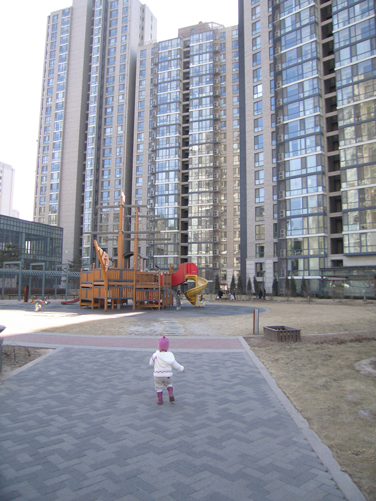 In the picture, you can see Teah running towards the children’s playground which is directly in front of our building. Of course, the play area is her favourite place but mine is the lake that lies in the middle of the eight buildings. It’s man-made with a small pagoda and the water gets green pretty quickly especially in the summer but it’s still very pretty and calming. The water is drained and refilled every few days so that it doesn’t get stinky and attract too many mosquitoes. No one is allowed to swim or play in the water because of safety however at weekends some Dads and their kids play with remote-controlled boats in the lake (and the Dads compete between themselves who has got the fastest, biggest and best boat!)
The apartments in our compound are all different layouts and sizes. We have a three bedroomed place but one bedroom has been converted into an office/study and my husband and I share the space,we both have our own computer desks and computers. I would really like a four-bedroomed place so that I could have my own office/study but due to the high rental prices in Beijing we have to make do with three-bedrooms! I’d also like to live in a duplex (two-floor apartment) but again that’s out of our price range. Ah well! We've lived here since last May and it's located opposite the east gate of Chaoyang park in the eastern district of Beijing where many foreigners live, work and play.It's called 'Greenlake Garden'
Even though I have lived in apartments for the last 10 years it doesn’t ever feel completely comfortable to me as I was brought up living in houses. It depends what you are used to, for example my husband has never lived in a house but personally, I like living in houses with gardens much better than in apartments. In the UK most people have houses and here most people live in apartments. What is the situation in Brazil, Yanko?
Here are the answers to the exercise I set on the passive (well done to Yanko, Pary, Laila and Jack for their attempts but some of you look at your mistakes)
1) Bodyguards protect the rich and famous The rich and famous are protected by bodyguards. 2) Bad weather delayed our flight to Rome. Our flight to Rome was delayed by bad weather.3) The cat chased the mouse The mouse was chased by the cat.4) My brother organised the football game The football game was organised by my brother.5) The doctor examined my chest. My chest was examined by the doctor.6) The gardener cut the lawn and trimmed the bushes. The lawn was cut and the bushes were trimmed by the gardener.7) Gloves protect your hands from the cold. Hands are protected from the cold by gloves.8) The child broke a glass vase. A glass vase was broken by the child.On to a few grammar corrections from Yanko’s’ ‘coffee blog’ (I was horrified to read how much coffee you were drinking in the past, no wonder you were an insomniac!)
'Nowadays I Take only three small cup of coffee per day. In the past I’ve usually took from 10 to 15 per day in the morning.'
Nowadays, I only drink three small cup s of coffee a (per) day. In the past, I had between 10 to 15 cups every morningIt’s more common to use the verbs ‘have’ or ‘drink’ coffee.In the second sentence, you have mixed the tenses, this sentence (because it’s finished in the past) should be in past simple tense. Please look at your use of perfect tenses Yanko, especially present perfect as you often use it in the wrong places. Perhaps you could explain to me when this tense is used in your next blog and how it is formed.
'A lot of coffee makes me feel very exited and some time makes me impatient and nervous and this affected my professional relation with other members. I’ve argued with all members. I friend of mine told me to avoid coffee and find out other way to keep attention.'
A lot of coffee makes me feel very excited and sometime s makes me impatient and nervous and this has affected my professional relationship with other team members. I’ve argued with all my colleagues. A friend of mine told me to avoid coffee and find another way to keep focused.
Yanko, learn the word ‘colleague’ as it’s useful to use this word when talking about the people you work with. Look at the sentences about that use present perfect tense-do you know why they are appropriate here?
That's all for today, fingers crossed for an improvement in the weather tomorrow
Trudi Vocabularyventure out to go outside and face risk or danger
superstition (n) an irrational belief
pagoda (n) A structure, such as a garden pavilion, built in imitation of a Buddhist tower
compound (n) a residential enclosed area consisting of many buildings
layout (n) arrangement or plan
converted (v) changed
to make do with something to come to terms with, cope with, accept
fingers crossed hopefully it will come true posted on Tuesday, 18 March 2008 | comment on this postMore on superstitions despite 'net' nuisancesDear All
It’s very infuriating for us’ netizens’ in China at the moment as we are all suffering from patchy internet access. Sometimes the net is working, sometimes it isn’t, access to certain foreign websites is blocked especially those concerned with media and video clips like utube. Internet disruptions usually occur when China is in the global media spotlight in a negative way and access to global information is denied to those who reside here. I’ve been trying to post a blog since Wednesday afternoon...
Anyway, I really want to say big thanks for all the comments that you (the readers) post, it takes hard work and time for you all to do it and I appreciate it very much. I’d like to get into conversation with you all about the topics you raise and answer all your questions but I’m not able to do it as thoroughly as I’d like. Hope you all understand.
Leila, here in China the first floor is what we in the UK would call the ground floor so there is often confusion between foreigners from different countries trying to communicate in English.
Tanya, your computer told you that you made a mistake because the sentence should have been written like this ‘Especially if it carries on everyday without exception’. By the way, I understand the horror of imminent exams as I have some next month too and I’m already losing sleep just thinking about them! The best of luck with your exams.
Welcome Mina and Larisa to the blog and actually not all compounds in Beijing have such good facilities as where I live. The privileged foreigners and wealthy Chinese live in places that are well-maintained but the average low-paid Chinese family live in pretty basic and non-luxurious conditions .For example, the lady who does housework for me and babysits Teah when I’m busy lives in the basement of a high-rise building, she has 1 room which is 3 square metres. There is no kitchen and only a shared toilet, no bath or shower facilities and lots of people live in similar conditions.
Monika and Marcella spoke about superstitions in their countries as did Yanko in his last blog, the topic of superstitions seemed to spark a lot of interest even though most people said they don’t believe in such ideas.
I’ll briefly say something about superstitions in the UK so you can compare and contrast with your own. Concerning numbers, it’s 13 that is considered unlucky and Friday 13th is a very unlucky day. I once read that Friday is considered an unlucky day because it is thought that Jesus was crucified on Friday but I’m not sure that this is the origin of the superstition. Passing someone on the stairs is unlucky, so is walking underneath a ladder. In fact, lots of people will deliberately walk around the foot of the ladder rather than walk underneath it! Breaking a mirror in Britain is supposed to bring you 7 years bad luck, opening an umbrella indoors is unlucky and we should never put new shoes on the table if we are superstitious. It’s unlucky to spill salt but you can avoid the bad luck by throwing a pinch of the spilt salt over your shoulder! I’m sure there are other unlucky things and actions but I can’t bring them to mind right now-I don’t believe in superstitions although I must admit I try to avoid doing unlucky things which is a contradiction!
Moving onto things that are lucky, a rabbit’s foot(not so lucky for the poor rabbit ), four-leafed clover and picking up a penny if you find one on the ground anywhere-we even have a saying to accompany this one ‘see a penny, pick it up, and all the day, you’ll have good luck!’. We always ‘touch wood’ for luck too.
A very British superstition is regarding the tame ravens at the Tower of London. It is believed that if the ravens leave the tower, the crown of England will be lost.
Thanks for everyone’s Easter wishes, Easter is only celebrated amongst the foreigners in China and is not a Chinese festival or special occasion. Personally, Easter is not very important to me but I do miss Cadbury’s mini eggs and the myriad of other Easter eggs available in the UK at this time of year!
I'll write more and talk about Yanko's use of 'tag questions' in his last blog tomorrow(fingers crossed the internet will be working!)
Vocabulary
infuriating (adj) annoying
netizen (n) person who uses the internet
patchy (adj) uneven
disruption (n) interruptions
global media spotlight something that is an important news story worldwide
imminent (adj) coming very soon
priviledged (adj) in a lucky situation;special advantages
well-maintained (adj) looked after well
spark (v) create or activate a response
deliberately (adv) opposite of accidentally; on purpose
clover (n) Any of various herbs of the genus Trifolium in the pea family, usually having three leaves and dense heads of small flowers
Tame (adj) opposite of wild
myriad (n) many differnet types and kinds
posted on Thursday, 20 March 2008 | comment on this postTag questions and loan wordsYanko,
Happy Friday-nearly the weekend!!
Today I want to highlight a grammar point called ‘tag questions’. Here is an example of a tag question that you used in your last blog
‘Here in Brazil the Friday 13th is another superstition, I think this is global, don’t I?’
Did you mean to ask the question about whether Friday 13th is a global bad luck day (which makes sense and I could answer ‘yes, it is’) or ask a kind of rhetorical question whether you think it’s a bad day or not?
The question that I think you wanted to write was:
‘Here in Brazil, Friday the 13th is another superstition, I think this is global isn’t it?
In question tags we usually use an auxiliary verb (have/was/will etc), ‘It was an interesting blog, wasn’t it?’
Do/does/did is used for the present and past simple, ‘Yanko studies English, doesn’t he?’
Normally, we use a negative question tag after positive sentences (1) and a positive tag after a negative sentence (2)
(1) Tanya will pass her exam, won’t she?
(2) You don’t live in a cottage, do you?
I was looking up some information on Portuguese as I wanted to see what loan words we have in English from your language Yanko (apart from ‘samba’!) Due to my internet connection, I couldn’t access any of the sites that came up after I googled so I thought that I would ask you to tell me some loan words instead. Can you write a few words from your language that are now used in English in your next blog? I know that the English language is a thief because it borrows so many words from other languages. It’s claimed, for example, that there are as many as 10,000 Spanish loan words alone.
I also didn’t realize that Portuguese is the fifth most popular language in the world and spoken by over 190 million native speakers in 8 independent countries. Macao, in China, is a former Portuguese commercial outpost, I’ve never been there but I wonder if the language is spoken there now or not. I have heard from friends that Portuguese cuisine has heavily influenced the region though.
Today, I'll leave you all with a photo that sends us all a very important message- TAKE LIFE EASY!!!!!
 My pizza delivery just arrived-bye bye for today!
Trudi
posted on Friday, 21 March 2008 | comment on this postYesterday on the 'Ranch'Hi Yanko
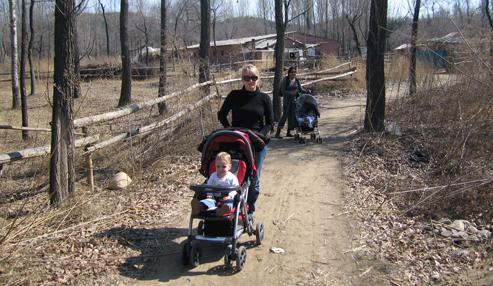
I hope you had a great Easter. Did you eat the chocolate you received or did you give it to your kids?! Although I didn’t do anything specific to celebrate Easter, I went out for the day with my family and some friends. We visited a place that is in the suburbs of Beijing, in the countryside and it took us about an hour to get there by mini-bus from where we live. The place we visited is called a ‘ranch’ but in reality it’s is worlds away from a real American ranch. It is supposed to be a countryside retreat for families with facilities to stay overnight and outdoor activities. We had a great day out because the weather was lovely (sun-burnt noses and foreheads all round) but the place did not live up to our expectations and we were a tad disappointed with it.
Does this match up with your idea of a ranch?
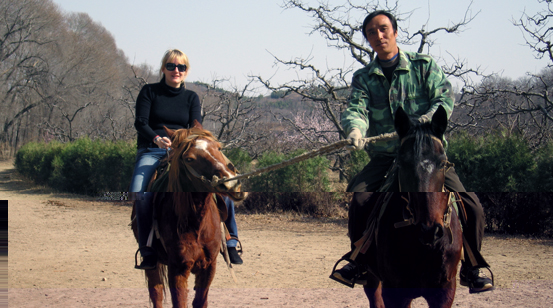
 We arrived about 11am and had drinks on the outdoor patio, Teah and my friends’ son ran around and investigated the area! At noon, there was a buffet lunch with freshly barbequed lamb, fish and sausages with salads, rice, fries and soup. It was nice to have lunch outdoors for the first time in 2008 and the food was decent. We then decided to go to the stables so the children could look at the horses. There were only 2 horses and 2 ponies and they all looked like they had seen better days. I rode one of the horses hoping for a steady trot along the horse trail but it decided to gallop all the way and I had a sore rump afterwards!!By the way, it was my first horse ride as I’ve only been on the back of a donkey before!
Tally-ho! Just finished my horse riding!!
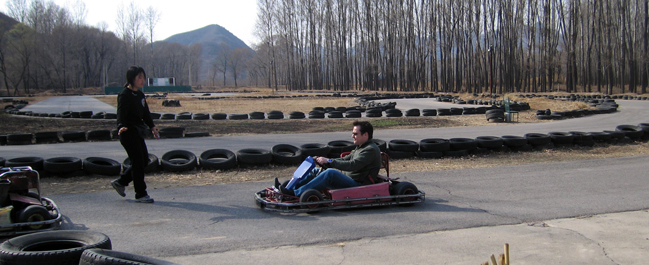
 Then we went to do some archery which was fun. Although Robin Hood makes it look like a piece of cake, for novices like us it was difficult! Most of our arrows hit the fences and stuck in the ground, missing the targets completely! Then we followed our map to the shooting range only to discover it didn’t exist (they plan to build one in the future apparently). Then we went to check out the outdoor swimming pool, it was a grey concrete square hole in the ground devoid of water. We then scouted out the karting circuit which was, by far, the coolest activity at the ranch and I’d go back there again just to whizz round the circuit a few more times.
Here is a picture of my husband flying round the track!
 Moving onto the kids indoor activity centre, it was filthy and dilapidated so we gave it a miss. The bowling alley was dimly-lit and in need of repair and was busy with other bowlers at the time we went there. There was a river nearby and although we felt like a bit of fishing, couldn’t find any designated areas or fishing equipment so we had to give up on that idea too.
Finally about 4pm, we got the bus home and all slept on the journey home, kids included! We all agreed it had been nice to escape the city and get to the outskirts for a day in the great outdoors but calling that place a ‘family ranch with many facilities’ was stretching the imagination a little.
Yanko, I really liked all the photos from your last blog and it was interesting to get a glimpse into your typical daily routine. I liked the information about the ‘van stop’ and it’s in this paragraph I’d like to point out a few errors. My changes are in italics:
‘Near the van, I introduce you to Sales. This man is responsible for organizing the van queue. He advises the passengers about who the next driver is and traffic problems. He’s very nice and polite and he says, “ I wish everyone a good journey”.’
What are your plans for this week Yanko? Mine consist of work, study and looking after Teah as usual, nothing special lined up for this week as yet.
Thanks for the loan words and the links!! Does that mean that cashew nuts originate from Brazil as well as Brazil nuts?
Trudi
Vocabularyranch (n) A large farm on which a particular crop or kind of animal is raised
world away from totally different to
retreat (n) A place giving peace, quiet, privacy or privacy, usually outside the city
a tad a bit
decent (adj) quite good
stables (n) a building that houses horses
gallop (v) a fast run of a horse
rump (n) buttocks !
a piece of cake very easy
novice (n) a beginner
devoid (adj) empty
scout out search and find
dilapidated (adj) disrepair or deterioration through neglect; broken-down and shabby.
designated (adj) specified
posted on Monday, 24 March 2008 | comment on this postErasmus experienceHow’s it going Yanko?
When I read your description of your job in your blog, I wondered what qualifications and university degree you had that led you into this field of work. What are universities like in Brazil? Are they government-funded? How many years is a typical undergraduate degree? Have you done any post graduate study Yanko?
My first degree was in English literature at the University of Leicester and it was a three year degree. During my university years, I did what is called the ‘Erasmus scheme’. This scheme offers funding to students and staff at European higher education institutions for exchanges to other EU countries. The student lives in the exchange university in the student accommodation and attends lectures and studies there whilst researching and writing a thesis .The exchange period is usually 6 months. I had a choice of where to go once I was accepted on the scheme and initially Greece was very appealing. I was thinking of the Greek islands, sun, sea, sand and wonderful Greek food and wondering if I would be able to find the motivation to study there with all those distractions! Knowing full well, that I would probably spend all my time chilling out on a Greek beach and working on a suntan instead of my thesis, I let my head rule my heart and settled on going to Strasbourg in France. The reason I made that choice was because I had been learning French and wanted to improve my language skills even further.
So I stayed in Strasbourg University during my time abroad and travelled around Alsace and into Germany very often. I also used the fantastic train system to visit many other places including south of France, Dordogne region and Pyrenees. I also allowed myself a beach holiday in Spain at the end of the 6 months for some R & R (rest and relaxation). It was a great experience and the Erasmus scheme even gives students a grant towards living costs. I lived on cheap croissants and baguettes and spent most of my grant on travelling around!!
Yanko, I read your blog that told us all about barbeque (I had to eat a sandwich afterwards as it made me hungry!) I’m waiting for an invite to come to your house for some authentic Brazilian BBQ :-) and a few shots of Caipirinha (do you drink it in shot glasses, or with ice or perhaps from the bottle with a long straw?!) I’m just going to correct a few of your uses of vocabulary today;
'decade 70' - in the seventies (this can be used for all decades e.g. in the nineties, in the eighties)
'gyms center ' - sports centre (a gym is either in a school or a room in a sports centre where you lift weights, exercise on a running machine etc)
'time lunch' - lunchtime
Now on to some readers’ comments (apologies I cannot answer all of them):
Habooba from Ahwaz- The name Teah has Greek origins and means ‘Goddess of the sun, moon and stars’
Cristina from Buenos Aires- My parents are both British but my husband is half Russian and half Bulgarian. Here is a picture of my parents and their dog whilst on holiday in the south of England right on the coast.
 Takehito from Japan, Visiting a ranch on weekends is not a very common weekend activity amongst Chinese people but foreigners, especially in spring and summer, often want to get out of the city and the pollution at the weekend and spend time with their kids outdoors. There are a few options just outside Beijing like the ranch, orchards, farms, spring resort, hiking in the hills. Apart from that people go to parks, go swimming, eat out, cycle and visit places like the aquarium or zoo and a big favourite is going shopping
Hyoshil from Lincoln- well done on using vocabulary from the blogs so successfully in your comments.
Beatriz from Uruguay, I don’t know the origin of the word ‘Easter’, rather than google it maybe another reader can give us the answer?
Tanya from Ireland thanks for your comments especially the super long one you wrote!
Got some serious study to do now and then I want to take Teah out for a walk as its pretty sunny today and the sky is clear. Then I’m going to attempt to make tandoori chicken tonight for dinner (the chicken is already marinating in the tandoori paste and it’s very red!), never made it before so wish me luck! Cooking Indian food is not my forte but I'm trying to learn.
Vocabularygovernment-funded (adj) paid for in full or part by the government
funding (n) a sum of money given for a specific purpose
exchanges (n) two students from different countries switch places for a short period of time thesis (n) an extended academic essay or project
distractions (n) an amusement or something fun that distracts from the real purpose.
head rule my heart to make decisions based on logic not on emotion
settled on decided/made the choice
grant (n) sum of money given to students for study and living costs
authentic (adj) real
marinate (v) to put meat in a marinade
forte (n) strength/strong point posted on Wednesday, 26 March 2008 | comment on this postPlaygroups and Dance groupsHope you are all having a good Thursday wherever you are.
I just got back home after a playgroup session and Teah has zonked out so I have a couple of hours to myself. The playgroup I take Teah to is an informally organized meeting of a few friends and their toddlers who range from 14 months old to about 2 years. This week it was held in the building opposite mine in a friend’s apartment. You can see Mums and babies in the picture below, I told them all to sit on the rug and pose but Teah kept getting up and running towards me shouting ‘Mama!”. I was on the cusp of giving up when I finally managed to get this shot.
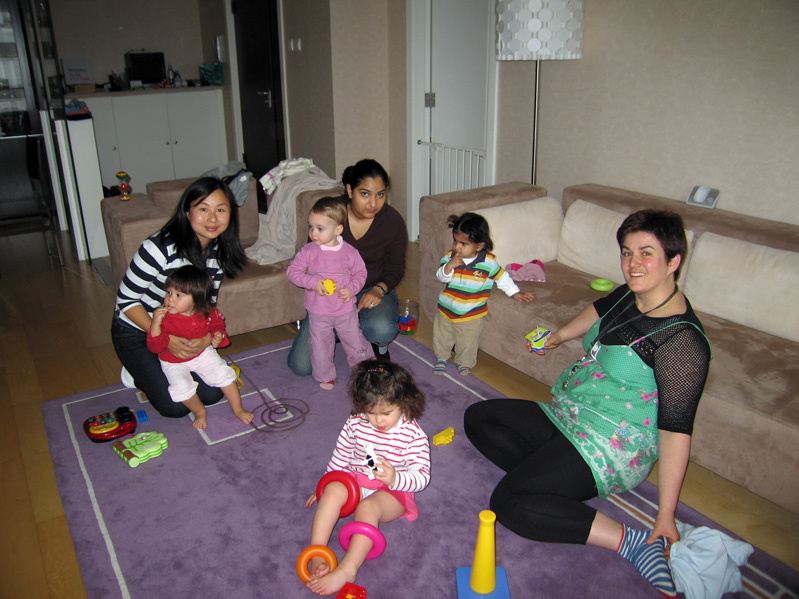
The kids run riot and we try to have a natter over a few cups of tea with cakes and biscuits.
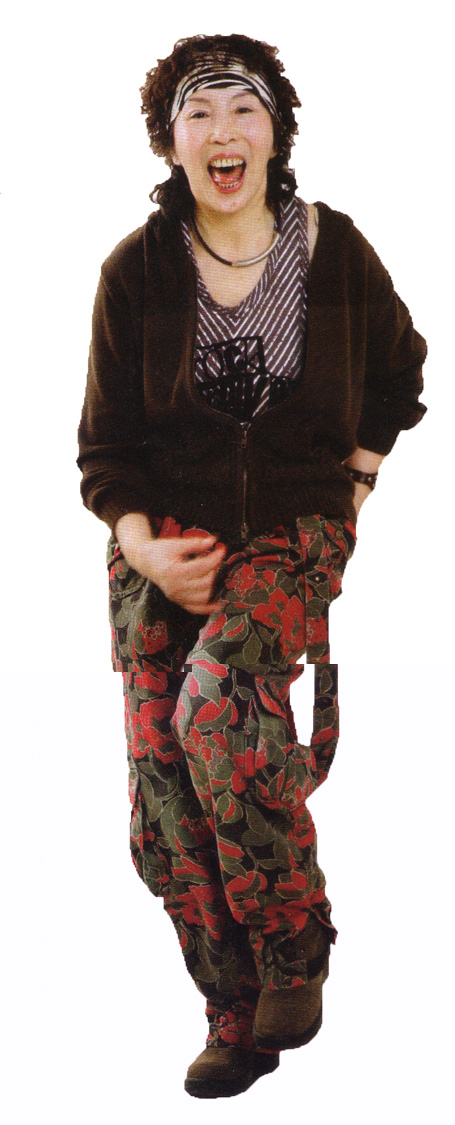
I read an article that made me laugh yesterday and as I have mentioned elderly ladies dancing in China in previous blogs, I thought I’d share this story with you. It was an interview with a 70 year-old Chinese lady who calls herself the ‘Hip-Hop Granny’. She saw teenagers doing hip-hop a few years ago and thought it looked like fun so she signed up for a class( I didn’t even know that one could learn hip-hop at a dance studio). However the dance teacher refused to let her join in because he thought she might injure herself. Refusing to be discouraged, she just turned up every class and stood in the back of the gym copying what the young hip-hop students were doing and taught herself by mirroring. Now she is the creator and head of Beijing’s Hip-Hop Granny Dance Team, they are a group of five all over 55 years old and even enter competitions apparently! She has become a favourite amongst foreign reporters as she has been inundated with requests for interviews lately and you might all get to see her team’s hip-hop moves because she is asking the government if her team can dance for the Beijing Olympics!! She's an inspiration to us all don't you think?!
Cheers
Trudi
Vocabulary
zonked out crashed out, fallen into a deep sleep due to tiredness
pose (v) to hold a position ready for a photo
on the cusp just about to/at the end of
run riot behave in a way that is not controlled, running in all directions and being noisy
have a natter chat/gossip
mirroring (v) copying/imitation
inundated (v) overwhelmed
posted on Thursday, 27 March 2008 | comment on this postSopping shopping(The word 'sopping' in the title means very, very wet)
Hi everyone!!
I had a really awful afternoon on Friday and, even though its Sunday now, I’m going to explain why. Fortunately I can laugh about it now but at the time it was far from funny.
I decided to go shopping with a friend to buy some spring/summer clothes at 1pm and we both planned to be home by 5pm because of our kids. I left home with an empty bag and a full purse hoping to get lots of bargains and as I got outside my apartment it started to drizzle. I was in two minds whether to go back home and get my umbrella but decided against it (thinking the drizzle would probably stop) and carried on walking to the taxi rank –no taxis there so I waited and waited. After 15 minutes I decided to walk to the main road to find a taxi and the drizzle turned into rain as I was on the move. Another 10 minutes later I finally found an empty cab and headed to the rendezvous point, an indoor clothes market. The taxi driver was pretty rude to me as rain drops from my bag and dripping off my now wet hair were falling on his seat covers! I thought it would only be a brief shower of rain...
We spent a couple of hours scouring the market for something to buy but amazingly, there was nothing either of us liked. How depressing! We were all psyched up ready to buy, buy, buy and there were no clothes or shoes we liked in the whole place. Finally admitting defeat, we went next door to a cafe for a hot chocolate and slice of cheesecake to compensate for the fact that our shopping expedition had been a flop.
It was 4.30 when we went outside and looked for a taxi to get home. Horrors! It was tipping down and all the taxis were full and the street was lined with people (like us) getting wetter and wetter and waiting for a taxi. We were the only fools without an umbrella though. To cut a very long and frustrating story short, it was impossible to find an vacant taxi and we had to walk home which took an hour and a half in the pouring rain. I was like a drowned rat when I got home and my clothes (even down to underwear) and boots were completely sodden. That’s my tale of woe over with so now onto some readers’ comments!!
Pary, when I first arrived in China only the extremely wealthy could afford to buy a car so the roads were full of taxis, buses, trucks and few private cars. Now most people who live in the city seem to have their own car and that is the reason why the city roads are so congested. On the Chinese news a couple of months ago, it stated that there are 5000 more new private cars on the road every month in Beijing alone.
Mercè how lucky you are to live so close to the sea, it must be heavenly to know that within twenty minutes you can see the sea and relax on the beach. I went to some beach resorts in Costa Dorada and Costa Brava when I visited Spain after Erasmus.
Vladimir in China people carry around an ID card when they are in the country and use passports when they travel abroad. People from the UK just use passports for overseas travel. I don’t know if any other country has the same policy as yours about having 2 travel documents and it must be a pain in the neck for you to have to worry about visa applications and the whole visa process.
August BR from Brazil, thanks for your comment and good luck with your English studies
Silwal Kishor if you are an Erasmus student you are not obliged to be able to speak the language of the country you choose to do the exchange in however it helps a lot if you can speak the lingo. I cannot speak Greek at all by the way.
Hi Nima Vazirian I’ve forgotten the exact thesis title but it was on Irish poetry mainly focusing on W.B Yeats (one of my favourite poets), Seamus Heaney and Patrick Kavanegh
Tanya, your wish is my command because here is a picture of the Hip-Hop Granny
 Pedro from Brazil do you live anywhere near Yanko? Thanks for your comments!
Jeronimo14 your patience at posting three comments has now been rewarded because I got the last one and thanks for posting it!
Yanko here are a few language pointers about the uni blog you wrote:
‘system education’, you need to invert these words to make the phrase correct Yanko because it should read ‘ education system’. I’m presuming you made this error due to interference from your first language-did you just translate from your language and use the same word order? You could have also written ‘the system of education’
‘Master Course’, we all understand what you mean by this but in English we usually say ‘ Masters degree’‘ingress’- you used this verb frequently in your blog about universities. Is this a direct translation from the word you use in your own language to describe students who enter university? The word usage isn’t correct and simply saying ‘ go to university’ or ‘ enter university’ is correct and adequate.
Let’s look at the following sentence that you wrote:
‘In 1981, the student wanted to ingress to Universities, have to do a written exam about all subjects learned in the fundamental e intermediate course.’
And compare with what I have corrected and re-written;
In 1981, students who wanted to go to university had to do a written exam on all subjects learned on the fundamental intermediate course.The phrase ‘fundamental intermediate course’ sounds strange in English and I don’t know what it means but I couldn’t change the phrase as I don’t know what courses or learning period that you are talking about. I changed the sentences to be about ‘students’ instead of ‘the student’ as you are talking generally about all students not one particular one and then I made the verb agree with the subject. I changed the sentence to include a relative clause but using ‘who’. Do you know how to form relative clauses? Let me know today if you need help with some explanation as there is only 1 blogging day left! Vocabularydrizzle (n) very light rain
in two minds about something undecided
rendezvous point arranged meeting place
scour (v) hunting everywhere; looking very hard
psyched up ready for, totally prepared
to admit defeat to realise you have to give up compensate to make up for
flop (n) failure
tipping down raining very heavily
like a drowned rat totally soaked and bedraggled looking
sodden (adj) wet through
tale of woe sad story
lingo (n) language
posted on Sunday, 30 March 2008 | comment on this postGood bye and good luckThe last day of March means my time as a teacher blogger has drawn to a close. I want to thank everyone for reading the blogs, thanks for your effort in posting comments and (most importantly of all), I wish you all the very best of luck and success in your English studies.
It’s a tricky business learning a language and has its highs and lows so give your self a pat on the back now and again for being a hard working and diligent English student. The photo I’ve put below is of Teah in the park and also of a Chinese guard who approached us and asked if he could practice his English. He’d been learning English for 10 years by himself using ‘New Concept English’ text book and had never spoken to foreigners before and he was so, so nervous as he started to speak and very tongue-tied. My heart went out to him because he was struggling but I really admired him for his dedication. He listens to the radio he has in his hands every day while he is guarding the park, just the English station though so he can improve his listening.
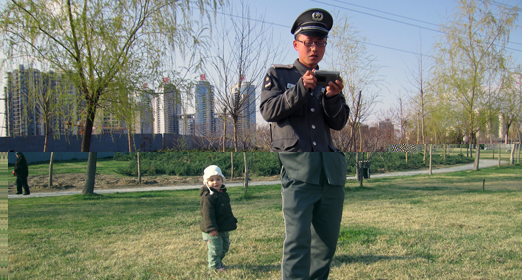
Just to finish off, here is a picture of Teah and I yesterday in the park.
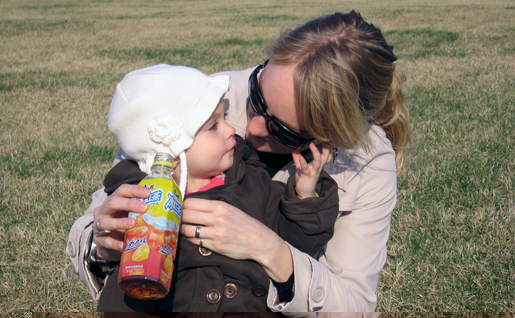 Best wishes to you Yanko, I hope you get the promotion that you want at work some day soon and that you’ll continue to improve in English. If I’m ever in Brazil, I’ll hold you to that barbeque invitation...
All my very best to all you global blog readers, it was great getting to know you Be healthy, be happy !
Trudi posted on Monday, 31 March 2008 | comment on this postFrom BBC Learning EnglishThank you very much Trudi for your sterling work as a teacher blogger with both Anastasia and Yanko. We are only hoping you are not completely 'zonked out' after all this effort!
From 1st April our new teacher blogger will be Anne Bell. Welcome Anne!
And, to finish off, here is some great news from Lewis Davies, our teacher blogger in August - September 2006. Just over a month ago, on 27th February, his wife Tomono gave birth to a baby boy! His name is Oscar and this is his picture:

Congratulations Lewis!
BBC Learning English team posted on Monday, 31 March 2008 | comment on this post | 


