January 2008YorkYesterday we went on another of our favourite local excursions from Leeds - this time to York, which is just a half-hour train ride away. York is a really historic city with a substantially intact encircling wall and a famous cathedral church, officially called York Minster. Although the city's a long way inland, it's situated on a river that gave access to the sea, and it was a significant port in earlier times. There was a Roman fortress here, and there are Roman remains visible here and there. Later, the Vikings established a major trading centre, which was the site of a huge archaeological excavation in the 1970s. There's now a museum on the site, where you can see reconstructed streets, buildings and boats, along with coins, jewellery, pottery, household utensils and other artefacts from as far afield as Russia, the Mediterranean and the Middle East. You also hear the sound of children playing and business being conducted in the Old Norse language, and in the interests of realism, in some places the air is full of the synthetic smell of rotting fish and other unidentified but mostly unpleasant odours!
The mediaeval city walls are built on a raised bank of earth (covered with daffodils in spring) and you can walk all the way around them, except for just a couple of short missing sections. There are four magnificent gates that were the original entrances to the city, and as you walk round you get good views of the old town, and especially of the Minster.
The Minster was completed in 1472, after 200 years of construction, and is the largest Gothic cathedral north of the Alps. In 1968 it was discovered that the central tower was in danger of collapse, and that was the start of the biggest repair job ever done on a mediaeval building, which included the provision of new foundations.
In recent times there's been a revival of the York Mystery Plays, which were performed in the Middle Ages - Silvia wrote about something similar in Elche.
I'm afraid I can't show you any photos of York, but you can easily find some on the internet.
Welcome back, Silvia. I can see that you had a great time over the New Year. On New Year's Eve we just went to the pub in the evening, and then, at midnight, we went out into the street to watch the fireworks that people let off all over the place.
"Where I stayed there were no internet facilities, nor any place with computers or Internet connections." That's a correct use of 'any'.
But look at this: "Unfortunately, we had any blackberry or any handle that was wi-fi capable." Here, you need to use "we didn't have any ....." or "we had no .....".
Use 'any' in affirmative sentences to mean 'it doesn't matter which' - e.g. "Pick any day you like."
And another problem with word order: "..... Sol square, where is the famous clock that struck twelve."
This should be: "..... Sol square, where the famous clock that struck twelve is." But you could also say: "..... Sol square, with the famous clock that struck twelve."
Naheed asked: "Why can't we use 'figures of the Spanish literature' in the above example? Why is it 'the greatest works of world literature' and not 'the world literature'?
The answer is simply that 'Spanish' and 'world' are being used as adjectives here, in the same way as:
modern literature
great literature
popular literature
etc.
Marianna commented: "I may assume from your few lines that you like the High Tatras and perhaps visited it from our side too."
Yes, you're quite right. I've crossed over from the Polish side and I've also done some trips from Poprad on the little train up to Stary Smokovec and beyond.
Christine said she was surprised by the immigration checks at the Eurostar terminal in Brussels. The reason is that Great Britain isn't a member of the Schengen group, so they scrutinise everyone carefully before they let them board the train.
Finally, for now, here are the solutions to the sentence transformations from December 27th:
1 The rescue operation lasted until 4.30 a.m.
> It wasn't until 4.30 a.m that the rescue operation finished.
2 Lots of other people bought too much food, and so did we.
> Like lots of other people, we bought too much food.
3 Representatives from every region take part in the meeting.
> It's a meeting in which representatives from every region take part.
posted on Friday, 04 January 2008 | comment on this postThe return journeySaturday morning
We're on the train from Leeds to London, speeding through the countryside of eastern England - pretty flat but very pleasant, and very green, which is something I particularly appreciate here in winter. I know that when we get back to Poland the landscape will still be more or less monochrome. We actually had some snow in Leeds a couple of days ago - enough for a thin covering, but it didn't last long. Yesterday we had quite a lot of rain, but today's sunny with blue skies. We're travelling first class, because we'd have had to pay more for second class, as a result of the crazy fare system in operation nowadays.
There are all sorts of fares, the best of which all have to be booked in advance for travel on a particular train, and are available in limited numbers, or not at all at certain times of day. From London to Leeds there are potentially 26 different fares, ranging from £7 to £138.50 - in other words the cheapest is about 5% of the most expensive!
When I wrote about the New Year, I forgot to tell you about the tradition of 'first-footing', which survives to some extent in Britain, although I think it's less well known by the younger generation. The idea is that at the start of the year, the first visitor to a house should be a man, who knocks on the door just after midnight to 'let the new year in'. He should bring a piece of coal (just a small one will do) and should be given a coin (again, it doesn't need to be valuable - it's just symbolic) by the members of the household. I remember when neighbours used to go round to each others' houses to let the new year in, but now it seems to be more typical for the 'man of the house' to slip outside just before midnight to be the actor of the ceremony. But in any case, as I said, I think this tradition is on the decline, like so many others. More often, nowadays, younger people just go out boozing, towns put on firework displays, and a lot of people simply sit at home and watch the New Year on TV, and might open a bottle of champagne if they're extravagant, or otherwise some other, more modestly-priced type of fizzy wine. We generally buy a bottle of Spanish cava.
In Poland, New Year's Eve balls are quite popular, with hours and hours of alternate dancing, eating and drinking.
Christine wrote from Germany: "We pour hot lead into cold water and predict, depending on the shape (not 'form'), something for the new year." In Poland, something similar happens on St. Andrew's Eve at the end of November. Then people tell fortunes by pouring molten wax into water and seeing what shape it forms.
Sunday evening
Back home now. We stopped off in Cologne again last night, and spent today travelling through Germany and Poland. A rather dull day today, with some snow, more and more the further east we went.
Naheed wrote: "It seems you celebrated Christmas in two ways. Christmas eve with semi-traditional Polish style dinner and Christmas with traditional English-style dinner." Yes, that's right. The best of both worlds, you could say. But they aren't really different worlds, at least not to me. And I think travelling by land helps you to preserve an awareness of the connectedness of places, even if they're on different sides of national borders and if the people living in them speak different languages.
And talking about language, if you fancy a bit of vocabulary practice, you could look back over this blog and the previous one (the one about York) and see if you can find words with the following meanings:
1 whole, unbroken, well-preserved
2 shades of black and white, without other colours
3 to examine carefully
4 not too expensive
5 a not-very-attractive smell
6 a trip to a place of interest
7 drinking (an informal word)
8 spending more than necessary (an adjective)
9 miscellaneous human-made objects (e.g. found by archaeologists)
10 to fall down (e.g. a building)
posted on Sunday, 06 January 2008 | comment on this postThe final weekThis is my final blogging week, unfortunately. Just as I was getting into the swing of it.
Great photo of the aqueduct in Segovia, Silvia. I must go there for myself and have a look. It's really amazing what the Romans achieved. I've seen quite a lot of Roman remains especially in the south of France, including the famous Pont du Gard aqueduct, which is 275 metres long, with three 'storeys', and crosses 49 metres above the river Gard. But the Romans were everywhere, it seems. I've mentioned previously the Roman presence at York. I once worked on an archaeological dig at a Roman fort near Leeds, and up in the hills to the west of Leeds there's a Roman road, running dead straight, with massive flat rocks laid down to provide a secure surface for wheels to cross the boggy terrain.
You write so well, Silvia, that there isn't really a great deal to be improved.
You can use 'get to' meaning 'get the chance to' - e.g.:
I never get to hear any good music.
In your sentence, I think you probably mean:
I had been there before, but the city always manages to enrapture me with its atmosphere.
The word 'necessary' has an ungradable meaning, so it isn't usual to say 'extremely necessary'. Instead, you could say:
What's extremely important is .....
Your use of 'scour' isn't quite right. You scour a place in search of something - e.g.:
We scoured the whole city looking for Roman remains.
I scoured all my dictionaries but I couldn't find the word anywhere.
In what you wrote, there's no suggestion of looking for something in particular, so you could say:
to explore the whole city on foot
to walk around the whole city
to roam around the whole city
When 'alike' is used as an adjective or adverb to say that people or things are similar, it isn't followed by a noun or pronoun:
All capital cities are alike in some ways.
Do you and your sister look alike?
So in your sentence, you should say:
The city looks quite like any other European capital.
(or: The city looks quite similar to any other European capital.)
'You don't have to' means 'it isn't necessary', so you should say:
You mustn't miss the old part of the town. (In other words, don't miss it!)
A few other points:
Here come two funny pictures.
the stroke of midnight
you'll have to pay for the cake
on the other hand (not 'side')
Here are the solutions to the vocabulary questions from last time:
1 whole, unbroken, well-preserved: intact
2 shades of black and white, without other colours: monochrome
3 to examine carefully: scrutinise
4 not too expensive: modestly-priced
5 a not-very-attractive smell: odour
6 a trip to a place of interest: excursion
7 drinking (an informal word): boozing
8 spending more than necessary (an adjective): extravagant
9 miscellaneous human-made objects (e.g. found by archaeologists): artefacts
10 to fall down (e.g. a building): collapse
And finally, today, a couple more photos.
Here's another image of the Yorkshire Dales:
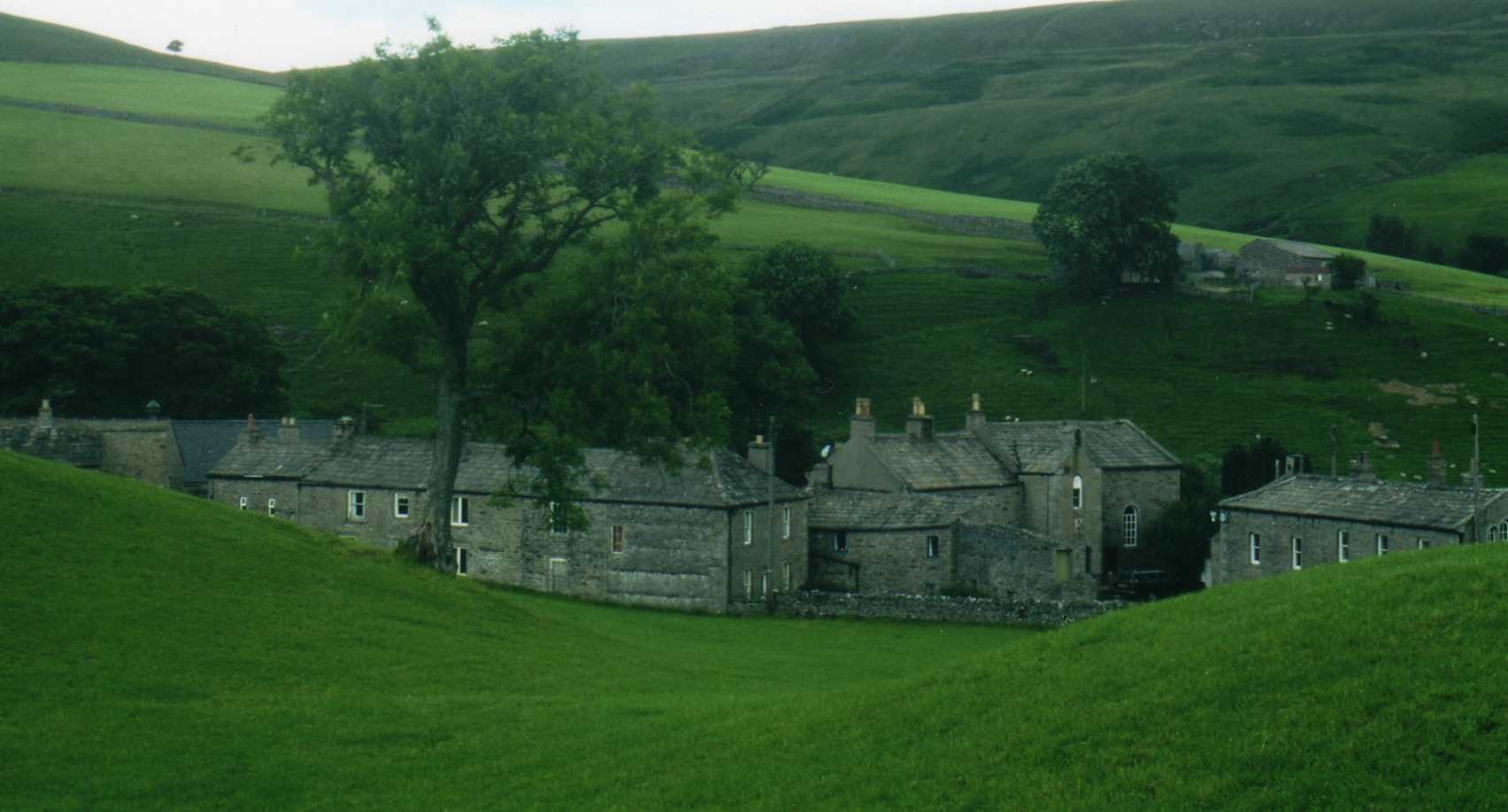
This is a tiny, remote village called Keld. Keld is an old Scandinavian name meaning 'spring' or 'source' of water, and it dates back to the days of Scandinavian settlement in the early Middle Ages. You can see how the houses huddle together in the shelter of the valley. They're built of the local limestone and almost seem to be part of the natural landscape.
And in contrast, here's a view of Scarborough (another Scandinavian name), one of the major towns on the Yorkshire coast (a town, definitely not a city!)
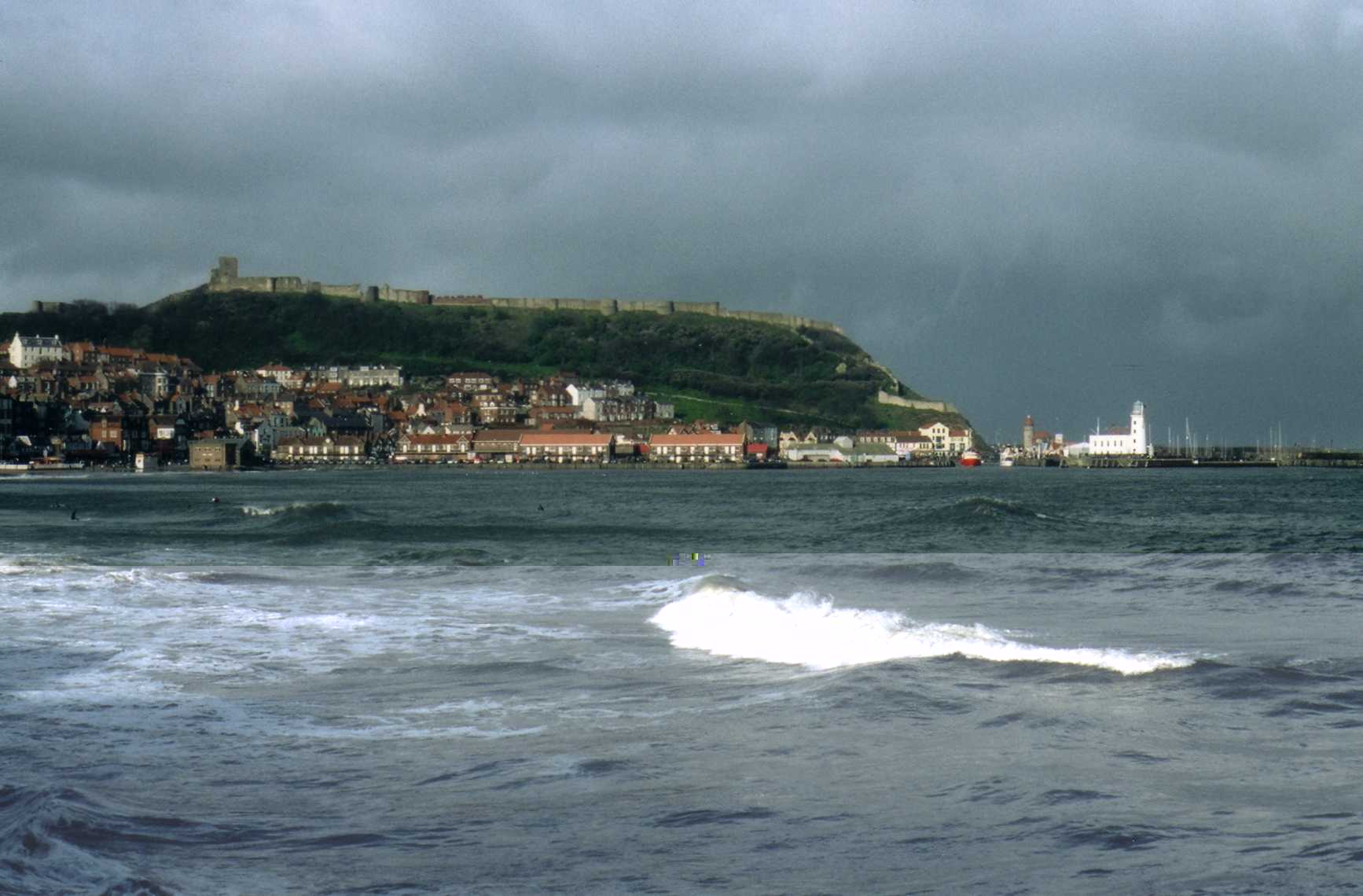
The massive headland juts out into the North Sea and separates North Bay from South Bay. The Romans had a signal station there, but what you can see now are the remains of a mediaeval castle. Scarborough is a working port - you can see the harbour with its lighthouse on the right - and a popular holiday resort, once extremely elegant but now rather down-at-heel. Like resorts in Britain generally, it lost out when more and more people started to spend holidays abroad - in Spain, for example! It's full of closed-down hotels and guest houses, and nowadays relies more on day trippers, although there are still some holidaymakers willing to risk the unpredictable weather and stay for a week or so. For us, it's another of our favourite days out when we're in Leeds.
Jonathan posted on Tuesday, 08 January 2008 | comment on this postBits & piecesA few bits and pieces connected with our journey back to Poland - because, after all, a journey isn't finished even when it's finished.
Mahjabeen writes: "I would like to ask why you have written 'we'd have had to pay more for second class'. Can I also write it like this: 'we'd have to pay more for second class'? Would this be correct or not?"
'We'd have to pay more' is possible, but I think 'we'd have had to pay more' is preferable because it's a past conditional, referring to the time of buying the tickets, before the journey and therefore before the time of writing.
On the way back, for the first time, the German-Polish border was invisible - not just because it was dark, but more importantly because Poland is now part of the 'Schengen' area and there are now no routine immigration and customs checks. No more fishing your passport out of your pocket or your luggage to show it to the men and women in uniform (two different shades of green - German and Polish).
Andy wrote: "I went to visit Cologne Cathedral on Christmas Eve; is it a so-called Gothic building?" Yes, it certainly is. Gothic was the prevailing style of church architecture in western Europe from the 12th century to the 15th/16th, with characteristic pointed arches, tall pillars and tall, thin, pointed windows, often with stained glass. The general effect is to lead the eye upwards, and the large areas of glass in the walls allow plenty of light in. The stability of the building is achieved by the balance of forces between different components of the construction, rather than by large amounts of thick, heavy stonework as in the earlier Romanesque style. We also stood admiring Cologne Cathedral, not for the first time, a few nights ago. It wasn't actually completed until the 19th century, although the bulk of it is mediaeval, and it suffered only minimal damage in the second world war, although the city of Cologne was bombed pretty intensively.
The original part of Barcelona is called the Barri Gòtic (Gothic Quarter), which is a cue to return to the subject of reading ..... On Silvia's recommendation, I read 'The Shadow of the Wind' (in English, unfortunately, since my knowledge of Spanish doesn't really stretch as far as reading novels) and enjoyed it immensely for lots of reasons - for the story, the characters, the evocation of Barcelona and its history, the idea of the Cemetery of Forgotten Books (which reminded me of Borges' 'Library of Babel', the labyrinthine library that contains all possible books).
I see that in the Plaça de Sant Felip Neri, one of the places in the Barri Gòtic which are mentioned in 'The Shadow of the Wind', there's a museum of old shoes, which connects with another previous topic in these blogs, and one of my photos, doesn't it?
Another fantastic book I've just read is 'Der fliegende Berg' ('The flying mountain') by Christoph Ransmayr. It tells of two brothers who head into the mountains of Tibet in search of the last undiscovered corner of the world, the last remaining patch of terra incognita. As you can imagine, though, apart from the literal journey and the external landscape, the book also evokes personal, internal mountains and journeys.
Fiction is generally printed in left- and right-justified text, i.e. the beginnings of lines of text form a straight vertical line, and so do the ends of lines. But this novel is in 'Flattersatz' - literally 'flapping or fluttering text', though Ransmayr says he would prefer to call it 'fliegender Satz', i.e. 'flying text': the lines are left-justified but of different lengths, so that at first glance it looks like poetry. Here's a short sample of what it might look like in English:
From what she said,
someone who could read and write
would be able to leave his time and his place like a deity,
by transforming thoughts, names, every one of his words
into writing
and inscribing them on a piece of wood, or a stone, or paper
in the certain knowledge that he was leaving a message
that would be legible
long after he had disappeared
or was trapped in some other incarnation.
What difference does this make? Well, I think it predisposes the reader to read more slowly and attentively, and it presents the text as one that might be read aloud, like some ancient epic story, or at least a text to be heard inside the reader's head.
Now I'm reading a Polish novel, a recent best-seller, 'Samotność w sieci' ('Loneliness in the net') by Janusz Wiśniewski. It's based around a relationship conducted by email, though it takes up all sorts of other contemporary themes, and timeless ones too.
Another perennial topic is, of course, the weather. This winter has been extraordinarily mild here in Łeba (so far?!) but here are two photos from a few years ago which show what happens occasionally under particular conditions - a combination of sustained very low temperatures and a continuous strong wind blowing from the north. What happens is that the waves break on the beach and the water immediately freezes, and the ice gradually builds up higher and out into the sea. Here you can see the narrow strip of sandy beach in the distance, and the much wider belt of ice in the foreground.
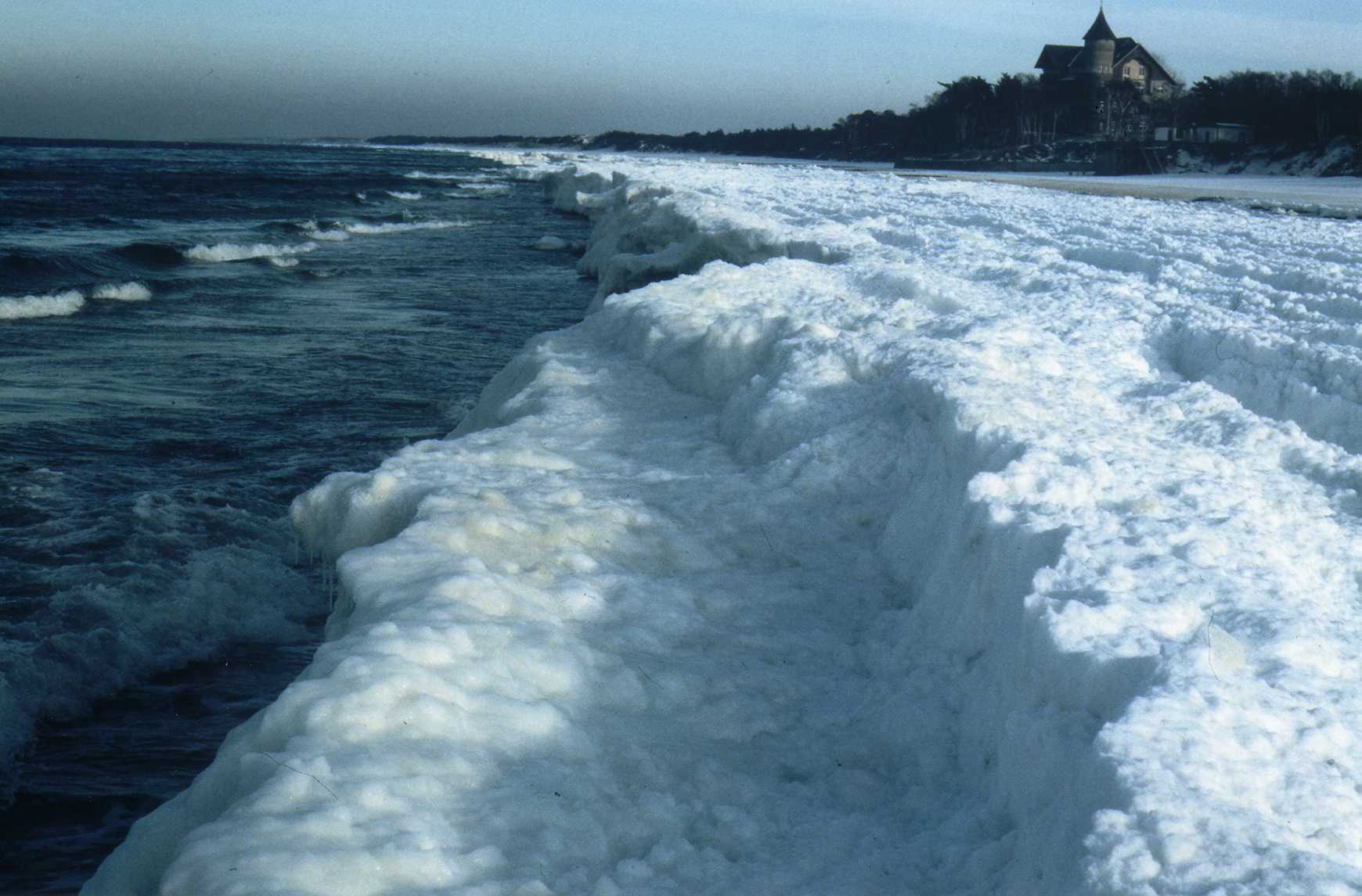
Later, after perhaps a week or two weeks of this, when the sea calms down, the waves begin to cut back into the ice and form 'cliffs' of ice of up to a couple of metres high. At the same time, as the temperature rises, blocks of ice detach themselves and start drifting away from the 'cliffs' like little icebergs. You can see two of them in the distance in the second photo.
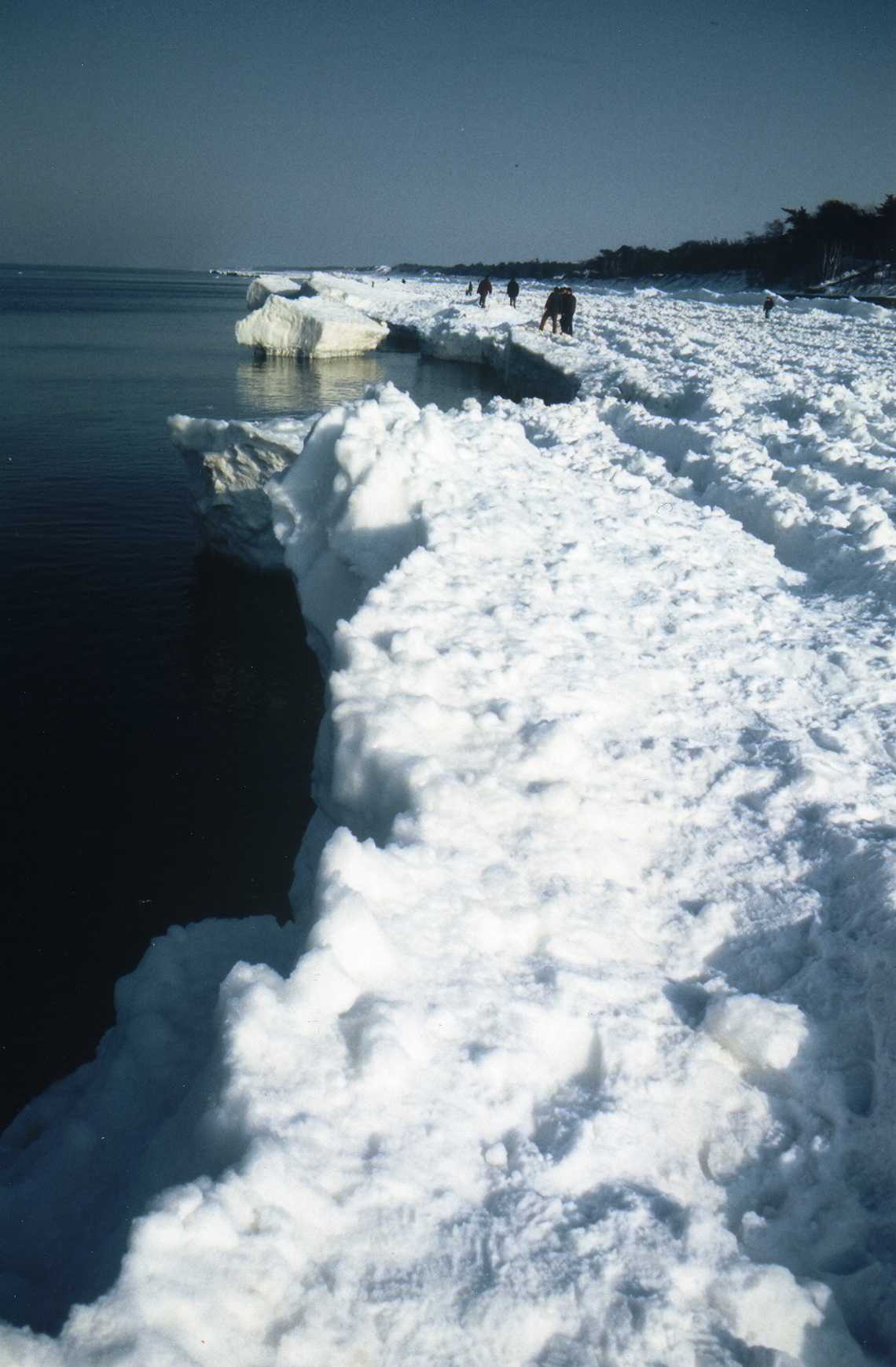
In fact, it looks like an Arctic scene in miniature. But, as I said, it doesn't happen very often.
In summer, there's an opposite effect. Because the Baltic Sea is so shallow, it warms up quite easily if there's a prolonged period of hot weather, and it often reaches a temperature that's quite pleasant for swimming.
You're right, Pary, that the water around the coast of Britain isn't very warm - especially not the North Sea coast. But people do go swimming, all the same.
We've had lots of rain over the past couple of days, but today's dry, quite sunny, and not at all cold for the time of year. Pary gives a dramatic description of the weather in Iran, and the disruption it's caused - I hadn't seen or heard anything about this in our news here. Let's hope things improve soon.
Jonathan
posted on Wednesday, 09 January 2008 | comment on this postDunes again
Your 'time flies .....' is very well written, as usual, Silvia. Good use of 'actually' and 'eventually', which so many people get wrong!
The “Nit de l’Albà” sounds like an amazing spectacle - and the 'cart wars' must be a bit dangerous, too, I suppose? I think I'd prefer to watch from a safe distance!
..... because of a work deadline - this is a compound noun like 'project deadline', 'work permit', etc.
On the other hand, it should be the origins of the festivity - or possibly the festivity's origins.
'to let people access to the restricted areas' is a mixture of different possible constructions. You could say:
to give people access to the restricted areas
to allow people access to the restricted areas
(Here, 'access' is a noun.)
to let people enter the restricted areas
to allow people to enter the restricted areas
to allow people to access the restricted areas
(Here, 'access' is a verb - this use of 'access' meaning 'get into' is rather formal.)
to let people into the restricted areas
to allow people into the restricted areas
Three things about the end of your description: ".....they must be well prepared, sober, and carry no illegal cart. For example, you cannot go in wearing summer clothes."
1 I can't quite imagine what these carts are like. What conditions do they have to fulfil in order to be considered 'legal'?
2 It would be more idiomatic to say and not carry any illegal carts.
3 The order of the information doesn't seem quite right. It sounds as if 'wearing summer clothes' might be an example of 'carrying illegal carts'. So it might be better to say:
.....they must be well prepared (for example, you cannot go in wearing summer clothes) sober, and not carry any illegal carts.
or:
.....they must be sober, not carry any illegal carts, and be well prepared. For example, you cannot go in wearing summer clothes.
I've got a couple more photos of our wandering dunes for you. In the first one, a group of people have reached the top and are standing round getting their breath back and admiring the views.

Incidentally, it's quite an exhausting climb, because the sand is very fine, dry and loose, so it's continuously slipping away from under your feet, and dragging you back downhill. Getting back down is easier - you can just slide or roll down.
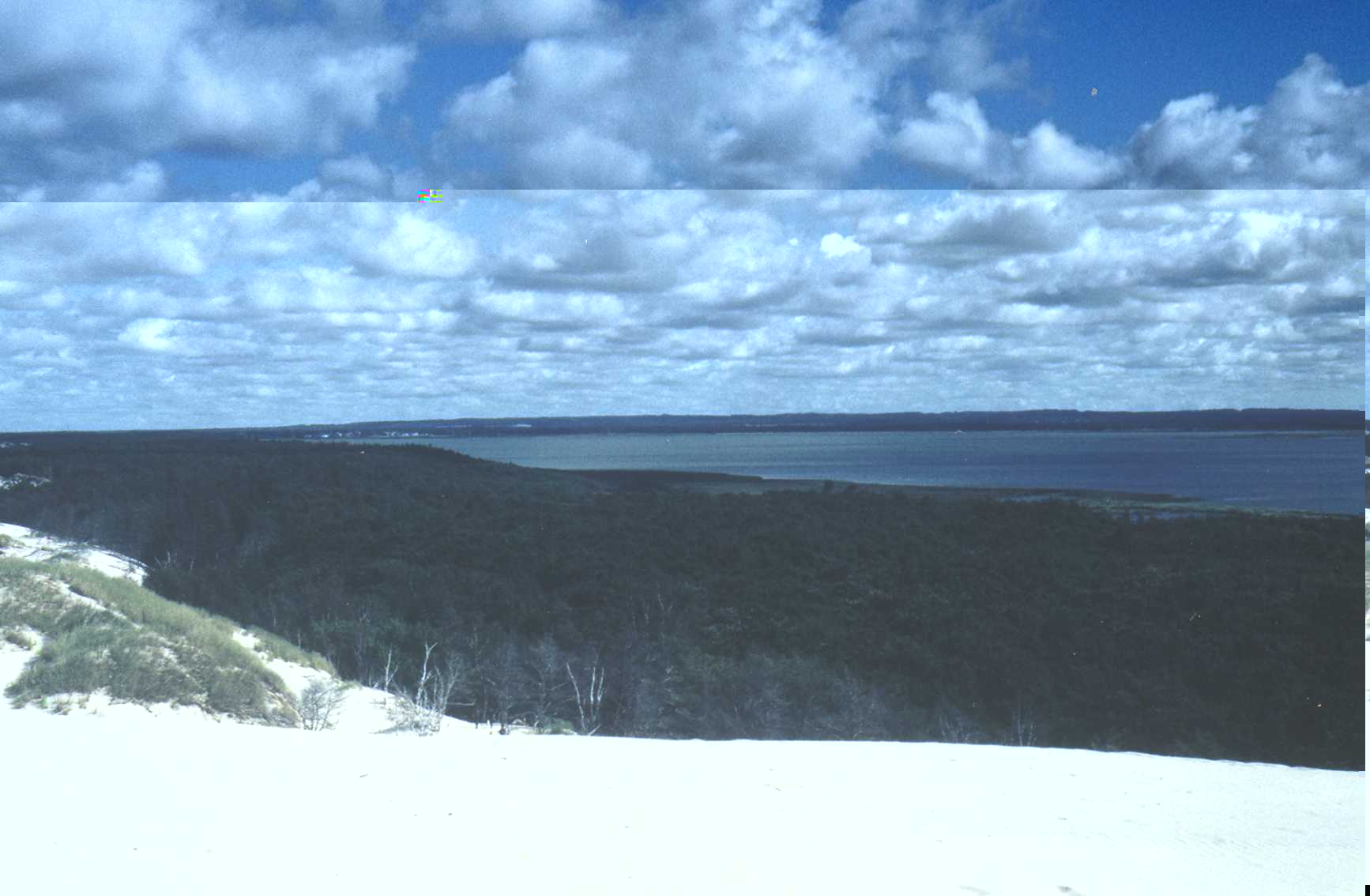
The other photos are taken looking down from the dunes over the lake.
Jonathan

posted on Thursday, 10 January 2008 | comment on this postFrom BBC Learning EnglishThanks to Jonathan for the very useful and engaging blog, not to mention the stunning photos.
For the next couple of weeks, we'll be running open blogs, which means anyone who has contributed to our blogs in the past can take part again.
It will be great to get an update on what's been going on in your lives lately!
All the best,
Jackie
BBC Learning English posted on Friday, 11 January 2008 | comment on this postJonathan's last blog
I'll get the language points out of the way first, Silvia .....
About Almodovar, you write: "As for his beginnings, he wasn’t considered politically correct. However, he is in fact a transgressor artist." The link word 'however' doesn't seem right here, because it signifies a contrast - but for a lot of people, being a transgressor artist and being politically incorrect would be pretty much the same thing.
"..... people excluded from the society" should be people excluded from society - i.e. from society in general.
And about Penelope Cruz: "She is actually one of his muses, and lately she has become his inspiration." But I think part of being a 'muse' is being an inspiration, isn't it?
"Now, she is trying to make her way overseas." This could mean that she's trying to leave the country. I suppose you mean something like:
Now she is trying to build a career overseas.
Now she is trying to establish herself internationally.
..... to become more famous beyond our borders.
in a Hollywood street.
The Others, which starred Nicole Kidman is a disturbing film with an unusual ending.
Luis Buñuel is a famous old film director.
I must make a point of seeing more Spanish films. I have to admit that most of the names you mention are unknown to me. Achero Mañas sounds particularly interesting
You can see him as a kind of modern poet.
"One of his films that is my favourite .....":
This could be:
My favourite of his films / My favourite film of his / My favourite film by him
(i.e. my top favourite)
or:
One of my favourite films by him
This film makes one think about what our ideals are .....
So there's always room for improvement. But more importantly .....
Thanks very much, Silvia, for all you have contributed to this forum over the past few weeks, and for all you've told us about yourself, your region and your country. It's been very educational for me, and it's really rekindled my interest in Spain and Spanish culture. In fact, it looks as if I might be going to Madrid later this year, so I'll be dusting off my Spanish textbooks in preparation for that.
You're really doing fine with your English. And I've noticed that even during this short time, you've managed to take on board some of the corrections I've suggested, and to implement them in subsequent postings. Good luck with your English and your professional life.
Thank you, too, to everyone around the world who has read and contributed to this blog, with questions, stories, opinions, greetings and supportive messages. I'm sure that your dialogue will continue. (I'll be reading, as well!)
Silvia, you wrote: "Jonathan, you seem to have travelled a lot." Well, not really, at least not compared with a lot of people nowadays. But I've travelled around Europe quite a bit, from North Cape at the extreme north of Norway to Cádiz in the south of Spain - by train, by bus, by ferry, by bike and on foot, wearing out innumerable pairs of boots and shoes on the way, and taking thousands of photos.
For the forseeable future, whatever other travelling I do, I'll certainly be travelling backwards and forwards between Łeba and Leeds, like a yo-yo or a pendulum. So here are a couple of final photos to illustrate the movement of that pendulum.
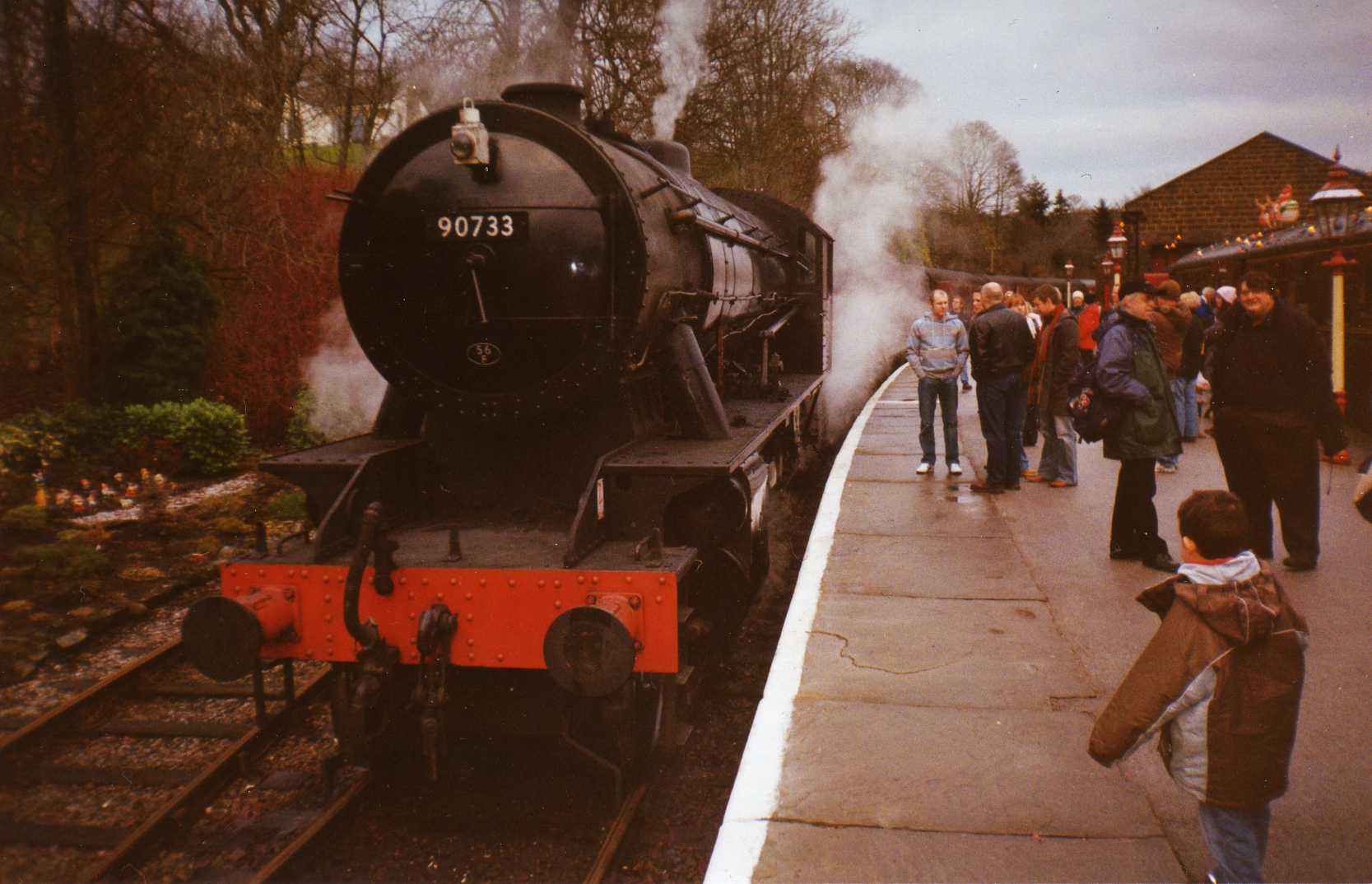
You already know that I'm a big train enthusiast. Well, much as I enjoy the comfort, convenience and efficiency of fast, modern trains, I also greatly appreciate the opportunity to travel back in time and ride on old-style steam trains. Yet another of our favourite days out when we're in Leeds is the trip along the Keighley and Worth Valley Railway. This is one of a large number of preserved railways in Britain which are operated entirely by volunteers - yes, I once worked there for a while, too!
And finally, back to Poland. Whether or not there's any more snow and ice, there'll certainly be three or four months of cold, grey weather to contend with. And then .....
One of the definitive signs of spring is the arrival of the storks, which fly in from southern Africa, where they've spent the winter. In fact, Poland is the most popular destination for migrating storks, and they're a characteristic feature of the summer landscape here. They build their nests - and return to them from year to year - surprisingly close to human settlement and activity: on rooftops, chimneys, telephone posts and special platforms that people construct for them, as well as trees.
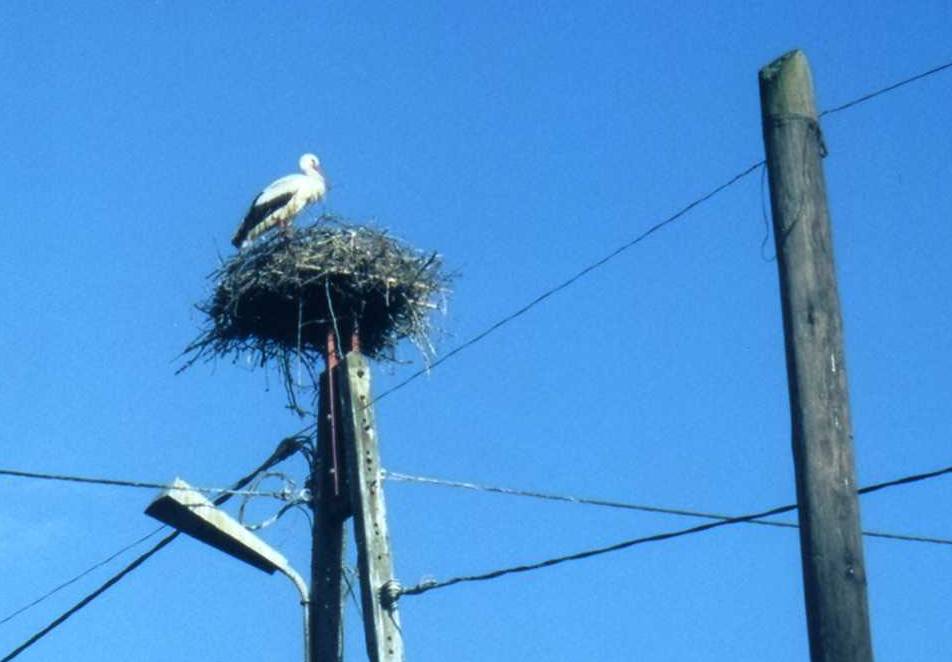
So I'll leave you all with that as a hopeful sign of spring, renewal and success in all your ventures.
Jonathan
posted on Saturday, 12 January 2008 | comment on this postI FEEL LIKE A LIFER ON DEATH ROWFirst things first. Hello, Federico! Hi there, Soyoung! It’s a year since we blogged each day for a month. And now the BBC has given me a few days to catch up with you. Are you still out there, on the other side of the world?
Federico, are you still making dangerous journeys across Peru to inspect mines? Still with the same girlfriend? Still spending Christmas on the beach? If you’ve got a little time to spare, it would be great to hear from you.
Soyoung, have you still got the same job? Still living in Seoul? Mother still doing all the housework? How’s your health? Any boyfriend news? Why not post us a quick blog?
Of course, it would be great to hear from anyone out there in cyberspace.
I feel like a lifer on death row; one who has just had a kind of reprieve. My column, as you may know, has been closed. I was just getting used to the idea that I would never again write to you. I was just getting used to the idea that I would never again hear from any of you – Kirsti and Marianne, Anita and Diema, Adriana and Ana Paula and all the hundreds of others (men as well as women!) who wrote to me so generously every fortnight last year.
It’s bitter-sweet, though. Like making upwith an old girlfriend when you really know the relationship has no future. I could get sentimental and romantic here. So let’s change the subject. How was your Christmas and New Year? Did you remember to raise a glass at midnight and toast ‘absent friends’ on New Year’s Eve? I did, and I only woke up with a very small headache the next morning (it’s obviously worth paying a bit extra for good champagne).
I was in Lille, in northern France, with my old girlfriend (yes, I know, forget what I just said about relationships with no future!!!). We took the train from St Pancras International (see The Stephen Keeler Column, 19 November 2007) and were in Lille in less time than it takes to get from London to Brighton. We stayed in a smart hotel in the centre of town and reserved a table at a Scandinavian restaurant for a splendid meal that night. We arrived at the restaurant at 8 pm and, five courses and several champagne cocktails later, stepped out onto the street at exactly midnight just as the fireworks started in the main square (the ‘Grand Place’).
We were carrying a bottle of champagne. We were wearing Italian party masks. It was mild (around 8 Celsius at midnight) and we were happy to stay on the street celebrating with hundreds of others. We were even stopped by a TV crew and interviewed for the local news. My French is embarrassingly bad – I can just about manage ‘Bonne Année!’ – but I’d drunk enough champagne not to care: suddenly I was fluent. If any French person out there saw me on their local news programme let me apologise now. My girlfriend had the good sense to remain silent (although I think her French is better than mine).
Anyway, the big news in the Keeler family this New Year was the arrival in London of Lucy’s boyfriend (from Dublin). Was it just a coincidence that he flew into Heathrow as my train was leaving St Pancras, and I arrived back from France as he was leaving for Dublin? Yes, that’s right, I didn’t get to meet him. Lucy evidently had a good New Year, and it was great to have her home for a couple of weeks.
She’s already gone back to university, and the house is quiet (and tidy and clean) again. She seems very happy there – although I’m still not sure she’s doing enough work. She’s invited me to visit her in March. Maybe I’ll get to meet the boyfriend then. I hope so. I’m looking forward to it.
Well, it’s one of those lovely, bright, chilly London days (January is often milder than February here). There are snowdrops in the garden. I’ve just had breakfast with friends – strong coffee and fresh croissants – and I’ve got a ticket for a concert in town tonight. Time for a shave and a shower, so I have to stop now. I’ll write again before this little window closes on 23 January. Bye for now.
Stephen Keeler
SOME USEFUL WORDS AND EXPRESSIONS
to catch up with
to make contact with someone again after a period of time and exchange latest news and gossip
lifer
a prisoner serving a life sentence
death row
the part of a prison where prisoners who have been sentenced to death are housed
reprieve
If someone who has been sentenced to death is reprieved (or ‘given a reprieve’) his/her sentence is changed and they are not executed. A reprieve is also an unexpected delay before something unpleasant happens.
bitter-sweet
Something which is bitter-sweet is both happy and sad.
making up with
becoming friends again after a quarrel
raise a glass…toast
When you drink a toast to someone you take a drink, usually (but not necessarily) wine or some other alcohol, as a symbolic gesture to show your appreciation of them or wish them success. ‘To raise a glass to (someone)’ can be used instead of ‘to drink a toast to (someone)’.
absent friends
When we drink a toast to friends who are not present at the time, we can say, “To absent friends”, which means that we are thinking of them and perhaps wishing they were with us.
courses
individual parts of a (formal) meal
masks
Masks are worn to cover and disguise your face. Ours were made in Venice of leather. Mine was black and my girlfriend’s was covered in multi-coloured glitter in diamond-shaped patterns.
glitter
tiny particles of shiny metal or plastic used for decoration
Bonne Année
French for ‘Happy New Year’
snowdrops
small, white flowers which bloom in early spring
in town
When someone who lives in or very near London says, ‘in town’, they are referring to London.
SOME WORK WITH PREPOSITIONS
Read the blog again and focus on the prepositions. Then complete the following sentences by choosing the correct prepositions from the list below (you will need to use several of these prepositions more than once):
1) I’ve been working __________ the same company__________ over three years now. In fact, I’ve been with them __________ I left university.
2) She lives __________ Korea, __________ the other side __________ the world.
3) My Australian friends spent Christmas Day __________ the beach __________ friends.
4) After the party the night before, he woke up __________ a headache and a sore throat.
5) How long have you been going out __________ your girlfriend?
6) Our party masks were made __________ Venice __________ leather, and covered __________ multi-coloured glitter.
7) While we were __________ the street we were stopped __________ a TV crew who wanted to interview us __________ a local news programme.
8) He apologised __________ his bad French.
9) I’m going to visit her __________ March.
10) I’ve just got time __________ another cup of coffee before I have to go. I’ve got tickets __________ a concert __________ Brighton this evening and I have to catch a train __________ six-thirty.
Prepositions:
at, by, for, in, of, on, since, with
ANSWERS: 1) for/at, for, since; 2) in, on, of; 3) on/at, with; 4) with; 5) with; 6) in, of/from, in/with; 7) on/in, by, for; 8) for; 9) for; 10) for, in, at/by.
posted on Saturday, 12 January 2008 | comment on this postHello from Jo!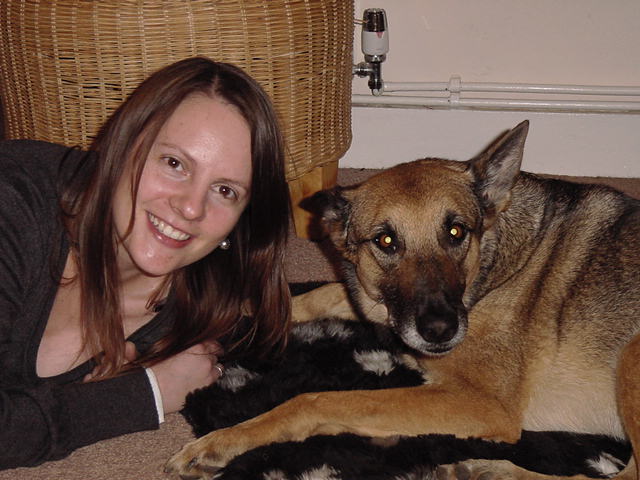
Hello, everyone! It’s great to be back blogging, even if it’s only for a couple of weeks. I won’t be blogging too often this time – probably just at weekends, as I have a very busy month ahead of me. But I hope you are all well and are having a good start to 2008. If it’s not too late, I’d like to wish you all a Happy New Year!
I’d also like to say a special hello to my two student bloggers, Naheed and Ha.
Naheed, how are you doing with your studies? Did your exams go OK? I know there has been quite a bit of unrest in Pakistan since we were in last touch. I always think of you when I see Pakistan on the news and I hope you and your family are all well and safe.
And Ha, are you still working hard, burning the midnight oil? How is your job? Have you figured out What Love Is yet? If so, can you let me know? And how are your plans to study for a Master’s?
It would be great to hear from you all and get an update on what has been happening in your lives.
As for me, Richard and I are still house-hunting. House prices in the UK are still very high, although they are starting to come down slowly. I still have my four cats and my dog, Raffles. Over the past few months I have been working on a new project for a UK publisher, writing a textbook for the Caribbean market. It’s a whole new experience for me, writing for the Caribbean. I have had to do a lot of research and reading, and it’s been a really steep learning curve, but I think it’s important to challenge yourself every now and then, don’t you? I would certainly get bored if I stopped learning things. We’re due to finalise the book by the end of February, so that’s why I’m pretty tied up at the moment.
Now, the New Year is often a time for new beginnings. Here in the UK, many people make new year’s resolutions. These are essentially promises to yourself. Often they entail kicking bad habits, such as smoking; or doing something positive, such as getting fit. I don’t often make new year’s resolutions, but just for the month of January, I have decided to give up booze. I have a bit of a spare tyre after all the excesses of Christmas, which I need to get rid of. Plus, it’s also good to give the liver a bit of a rest! I also want to start going to a new gym class called BodyJam, which sounds as though it is dancing to music.
Do you all make new year’s resolutions? If so, what are your hopes and plans for 2008?
Can’t wait to hear from you all,
Jo
Vocabulary
I’ve put the tricky vocabulary from my blog in bold below. The definitions follow underneath, but in the incorrect order. I know you all love a challenge! Can you match the vocab to the definitions?
Vocabulary
1) unrest
2) burning the midnight oil
3) steep learning curve
4) tied up
5) kicking
6) booze
7) spare tyre
8) excesses
Definitions
* when you have to understand how to do something difficult in a short period of time
* alcohol
* behaving in a decadent way
* angry or violent behaviour
* busy
* giving up
* working until late
* extra fat around your waist
posted on Sunday, 13 January 2008 | comment on this postNEW YEAR, NEW ME?Hello again!
It was nice to hear from one or two old friends. Thank you. It was also interesting to read Jo’s blog especially her confession about having a bit of a spare tyre at the moment. I know how she feels (although, looking at her photo I really can’t believe she needs to lose weight). My spare tyre would support a large truck! So I’ve got to get back into my running shoes, ignore the wind and the rain (at least it isn’t cold) and run off a few hundred calories every day. That’s one of my New Year resolutions (another one is to stop using brackets).
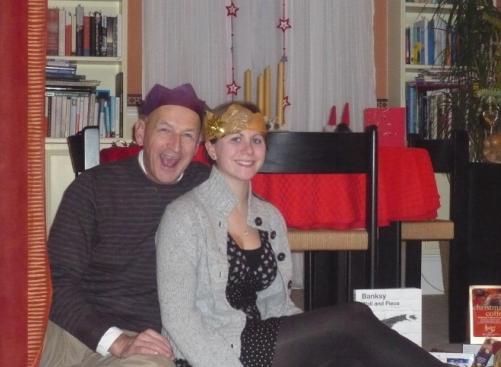
I thought you might like to see a photo from our Christmas. This is Lucy and me at home on Christmas Day. We’d already opened most of our Christmas presents but hadn’t had Christmas dinner when this was taken. We’re wearing party hats made out of tissue paper, which you always get in Christmas crackers. I hate wearing party hats. They make me look ridiculous, but I suppose they make everyone look ridiculous.
What did you get for Christmas? I got mostly books, CDs, wine and chocolate. I bought Lucy new clothes, books for university and a new laptop (her old one broke in October and it was going to cost more to repair than to replace!). I also needed three new tyres on my car (real tyres, not spares!), and then I got a letter from the Inland Revenue asking me, very politely, for more tax. Lucy needs help with her accommodation costs at university, and you should see my credit card bill for December! Money, money, money – everything costs money! (Another New Year resolution was to stop using exclamation marks!)
What are your plans for the New Year? New job? New house? Are you trying to give up anything? Smoking? Over-spending? Lucy is setting off for Amsterdam next week to raise money for charity. She has to get from St Andrews to Amsterdam without spending any money. If she achieves that, her sponsors (that’s more money I’ll have to pay out) will give a pre-agreed amount of money to Lucy’s charities (including cancer research, poverty relief and education organisations). I have no fixed plans yet but I hope to visit Sweden in the spring and work in Vietnam (Ho Chi Minh City) for a couple of months during the summer. I’d like to cycle along the Great Wall of China, from Beijing to Xi’an (where I used to live) in the autumn. It’s another charity event but I’m not sure I can raise enough money – there’s a limit to how many times you can write to all your friends asking for sponsorship.
If the last few years have been typical then I will probably start to lose weight in April, look like a completely new me by July and have put all the weight back on again by December. Seems a bit crazy, but just think of all the fun I’ll have doing it!
OK, so I have failed to stop using brackets, I’ve failed to stop using exclamation marks and, so far, I haven’t been for a run today. I hope you’re still keeping your resolutions. Perhaps you’ll write and tell us what they are and how successful you’ve been while I try to find my running shoes.
Bye for now,
STEPHEN KEELER
SOME USEFUL WORDS AND EXPRESSIONS
resolutionsIf you make resolutions to do specific things, you decide to try very hard to do them.
bracketsa pair of punctuation marks, like this ( ), which you put round a word, expression or sentence to indicate that you are giving extra information
tissue paperthin paper used for wrapping things which are easily damaged or from which decorations and party hats are made
Christmas crackera decorated, paper-covered tube (containing a small toy, a joke printed on a slip of paper and a party hat) which is pulled apart (making a small bang as it tears) by two people at, for example, a Christmas party or Christmas dinner
ridiculousvery foolish
laptopa portable computer
Inland Revenuethe British tax authorities
exclamation markthis punctuation mark !
give upstop
SOME WORK WITH PUNCTUATIONPunctuate the following sentences (don’t forget capital letters where appropriate):
1. can you lend me £20 until the end of the month
2. help she shouted as she fell through the roof
3. your friend george asked me whether he could borrow my car
4. look im sorry but i just cant help you right now she said slamming the door in my face
5. do you think this hat makes me look fat
no but I do think it makes you look ridiculous
ANSWERS:1. Can you lend me £20 until the end of the month?
2. “Help!” she shouted, as she fell through the roof.
3. Your friend George asked me whether he could borrow my car.
4. “Look, I’m sorry but I just can’t help you right now”, she said, slamming the door in my face.
5. “Do you think this hat makes me look fat?”
“No, but I do think it makes you look ridiculous.”
posted on Monday, 14 January 2008 | comment on this postBBC Learning EnglishDear all - teachers, students and commentators
I'm glad to see how active this open session is, I hope you are enjoying it as much as I am. I had no idea whether it would work but it's looking like a brilliant idea, so a big thank you to all who suggested that we try this.
I've noticed that there is a little bit of confusion about how this event will run so I am going to try to explain.
1) The open forums will run until Thursday 31st January (February will start with a new student and teacher blogger)
2) During this time, all previous teacher and student bloggers are free to blog as much as they want and commentators can add comments as usual
And that's it really :-)
A little note - Can everyone please remember that you are not allowed to include personal contact details in blogs or comments - it is a BBC thing - we will have to remove them or not post comments if you do.
Thanks
Paul
posted on Tuesday, 15 January 2008 | comment on this postA blast from the pastHey up, me ducks!
I can't believe that it has been almost a year and a half since I was the teacher-blogger. I wonder if many of you remember me from way back in summer 2006... I must say that i was thrilled to bits to get an email from Paul asking me whether I'd like to participate in the open blog. So much has happened to me since my last blog entry, it's hard to know where to start.
Unfortunately, my trusty laptop has decided to go on the blink this week which means I am blogging on my lunch break at work. Hopefully, I'll get it back before Friday so I can fill you in on all my news without having to rush.
I'd like to say a big 'HI' to Anita and Jenny, my student bloggers. I have just read your blog and comments Anita and am very touched that you wanted to catch up with me. It's great to hear your news and I look forward to reading more of your posts over the next couple of weeks. Are you still reading the blogs too Jenny? How is life in China these days?
Where do I start with my news? At the beginning I guess...
Tomono and I came back to the UK in December 2006. We had a tough couple of months job and house hunting before I finally found the job I wanted in marketing. I now work for an international student recruitment company called StudyLink. The job is very interesting and is the new challenge I was hoping for when i was in Japan. In a nut shell, I run campaigns to promote universities and colleges around the world to students who would like to study overseas.
The salutation at the beginning of this blog post will give you a clue as to where in the UK I am living. Does anyone know where in the UK people might use this kind of phrase?
Would you look at the time? I really should go back to work. I have a new campaign to plan and the deadline is looming.
I will try and blog again soon because I haven't told you my most exciting news! I wonder if anyone can guess what it is....
I'll try and find a nice photo next time too.
Lewis
posted on Tuesday, 15 January 2008 | comment on this postHello again from Delhi!Hello! How is everyone? Yumi? Adriana? I hope you're both really well and have had a great start to the New Year - and everyone else too! It’s so great to be able to catch up with everyone again.
Unlike Jo and Stephen :-) I am much slimmer than I was last time I wrote (well, I hope I am!) – we had a baby boy on December the 7th. We’ve called him Oslo William Bastin. In the UK it’s very common for people to have a first name and then a middle name as well as (obviously) their surname. Now before you ask, no we don’t have any real connection to Norway or its capital city – we just liked the name. Well, actually, originally we liked the name ‘Ozzy’ but weren’t so keen on ‘Oscar’ or ‘Oswald’ which are most often shortened to Ozzy. My husband had a bit of a thing about calling him Ozzy as his given name so we abandoned it until one day the name ‘Oslo’ just popped into my head.
‘William’ is the name that has run through my father’s family for generations – my great-grandfather was called William, my grandfather's name was William, my uncle’s middle name is William, etc. etc. That’s another thing that’s pretty common in the UK – lots of families have first names that are used again and again within the same family over many generations. So anyway, without further ado, may I present Oslo William Bastin:
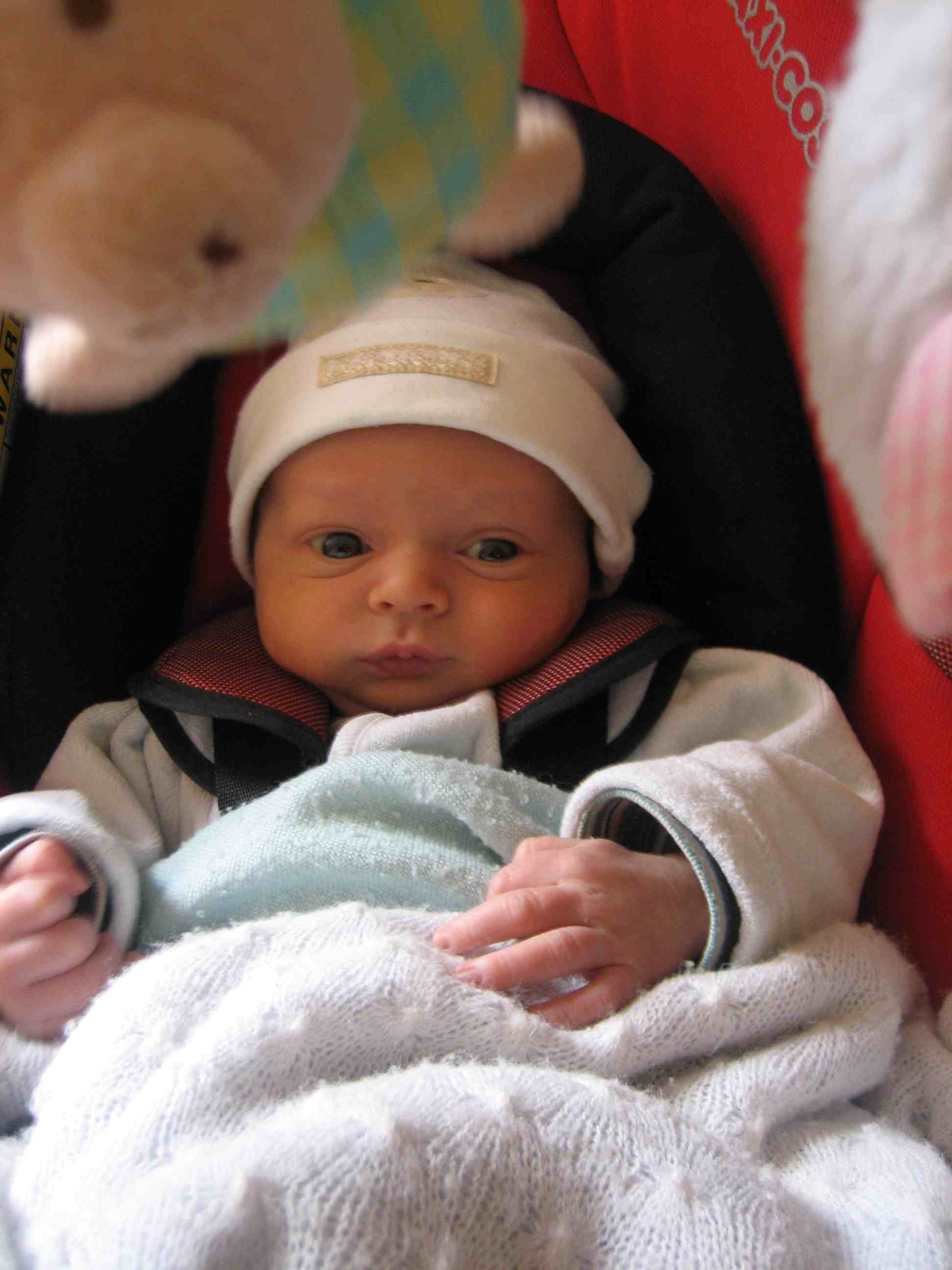
He’s quite sweet, isn’t he? He looks just like our other son, Louie, did when he was born – so now I’m really starting to wonder – do all babies look the same?
Louie has taken to being a big brother like a duck to water, although I have a feeling that if we left him alone with him he might give him a little pinch just to see what happened! He finds Oslo’s crying quite fascinating and likes to do impressions of it – very funny. Okay, okay – I’ll shut up now. I read the other day that you always have to remember that no one is ever as interested in your kids as you are!
Other than nappy changing and catching forty winks whenever we can, we’re gearing up for my parents’ arrival on Friday. Louie is VERY excited. As well as mooching around the city, we’re hoping to get out of Delhi for a few days to a small town called Orchha, where there are some beautiful old temples and palaces. Not long after they leave we’ll be starting to pack up and get ready for our big move back to England. We’ve had a fabulous three and a half years here but we’re both looking forward to going back to England, mostly to be closer to the family and friends we left behind and have missed a lot. Packing is going to be a bit of a nightmare though – our flat is extremely cluttered with all sorts of clobber that we’ve collected over the years… sorting through it all is going to be a bit of a challenge with two kids under our feet!
Anyway, better go and get some sleep while I can. I’ll blog again in a couple of days and, as ever, will include all the definitions for the highlighted words then. Meanwhile, see if you can figure out the meaning from the context!
With all best wishes and looking forward to hearing from you,
Amy
posted on Wednesday, 16 January 2008 | comment on this postHello again from York!I've really enjoyed catching up with everyone's news - good idea to have a reunion Paul!
Antonio and I were the first bloggers, back in June and July 2006 when World Cup fever gripped even (especially?) people like me who know nothing about any sport. Italy (Antonio's national team) were the overall winners and, on that great day, Antonio wrote his entire post in blue. Last year, England didn't even qualify for Euro 2008, so I will definitely be supporting Italy in the European Cup. Go the Azzurri ! In bocca al lupo - for a translation, check Antonio's blog:
Antonio's blog
(Thursday July 6, 2006)
Also.......many congratulations on your FCE result, Antonio, and your graduation. What subject are you thinking of for your next degree?
I work at a university in the UK and all the staff are encouraged to do research. Last year I used our blog to think about if (and how) online language learning is effective. I looked closely at the way Antonio and I interacted in the blog and at Antonio's responses to my language suggestions. It was very clear that Antonio's writing DID develop during the six week blogging period. This may have been because he was writing regularly, or perhaps because of my feedback, or perhaps he was doing other things to improve his English......who knows?! Anyway, it is possible that regular writing practice and regular feedback do help students make progress - and that online writing/feedback can be as effective as face-to-face.
I gave a presentation on my blogging research at a conference for English language teachers last year. Paul was there with the BBC Learning English team! After the presentation, a member of the audience suggested that I should look at the effect of the feedback on the people who write the COMMENTS in the blog. That would be interesting!
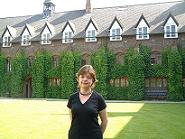
Here's a picture of me, at York St John University, standing in the quad (the photo of my face in the banner at the top of this page is from here.....)
To finish with, here's my paragraph about my blogging research findings again. Because it is difficult to be completely sure they are correct, researchers often explain their findings using 'hedging' language (in bold):
This may have been because he was writing regularly, or perhaps because of my feedback, or perhaps he was doing other things to improve his English......who knows?! Anyway, it is possible that regular writing practice and regular feedback do help students make progress - and that online writing/feedback may be as effective as face-to-face.
See you again soon!
Rachel (Wicaksono), posted on Wednesday, 16 January 2008 | comment on this postThe patter of tiny feetHey up, me ducks!
I've managed to find a few minutes to blog today. It's been a really hectic week at work and I've been flat out getting everything done for the upcoming campaigns.
I'm sure that you can guess from the title of this post what my big news is...yup, that's right I am going to be a daddy! Tomono is due to give birth to our first child on 17 February. We know the sex already, but are keeping it under our hat until the baby is born. Many people were quite shocked that we didn't wait to find out if the baby is going to be a boy or girl, but we really wanted to know. How about in other countries, what's the norm? Do people like to keep it a surprise or find out beforehand?
As you can imagine Tomono and I have been very busy getting everything prepared for the baby's arrival. We hit the sales hard after Christmas and picked up lots of bargains. Baby clothes are so small and cute! Last weekend when I was putting the cot together it suddenly hit me that within a few weeks there would be a little baby sleeping (and crying) in it. I felt a real sense of happiness, and looming responsibility as I screwed the pieces together. What kind of father am I going to be? What makes a good dad? Will I be able to give my family the life they deserve? And how on earth do you change a nappy?
I guess, I'd like to ask you all that same question. I know there is an infinite list of possible answers, but if you had to choose 3 characteristics that make a good father, what are they? I'd love to hear from everyone; those who are already dads, dads-to-be, sons and daughters, wives, mothers. All comments welcome!
Anita, you are right. The greeting 'Hey up, me ducks' is indeed used in Nottingham and the East Midlands. We actually live in Derby, which is a short drive west of Nottingham.
Again, time has caught up with me and I have to leave you all for now. Hopefully, I'll have more time to blog next week when I get my laptop back.
Have a lovely weekend!
Lewis
posted on Friday, 18 January 2008 | comment on this postJust chill ...Hi everyone!
It’s the weekend which means I have time to blog again. Isn’t this fun? It’s like a great big worldwide blogging party. Fantastic!
Firstly, let me say ‘Congratulations!’ to Lewis on the upcoming arrival of his little bundle of joy. Lewis, I am not a mum myself, so I have no parental words of wisdom to share, but I think anyone who thinks so seriously and carefully about how to be a good parent like you are doing is bound to be a great Dad. I wish you all the best.
Thanks to Wellebaby, Pary, Marianna, Habooba, David, Naheed, Filippo and Tomo for your comments. It’s great to be in touch with you all again! Pary, you asked about improving your vocabulary. Keeping a vocabulary notebook is a good idea – just jot down new words as you see them. But don’t try to do too much at once -- language boffins have found that we can only retain about 4-5 new words at a time. So sometimes, less is more! All of you who attempted my homework got it right – do I need to be more dastardly next time? Well, maybe not – it is the weekend, after all ...
Now, this morning I did something for the first time. I went to have a head and neck massage at a local clinic. I spend most of my day sat at the desk in front of the computer. And sometimes the muscles in my back and neck get knotted up. I thought the massage would help (it did a bit – but now I’m back at the computer again!). I also thought the massage might help me chill out. It didn’t really do that so much. Of course, I could have a nice glass of wine this evening to help me de-stress, but as I have given up booze for the month of January, this is not an option. In fact, I was interested to read Naheed’s last blog when she said that yoga helps her to relax. I have to agree. I don’t do yoga like Naheed, but I do do Pilates (not dissimilar to yoga) and a class called BodyPump. I find that when I am exercising I don’t think about anything else – there’s no time to think about work or house-hunting. So by the end of an hour’s class I am refreshed and relaxed. My head feels clearer. Even if I’m pooped (tired), I also feel happy. There’s a saying in English that ‘a healthy body means a healthy mind’. I’d say that’s quite a wise saying.
I wonder, what do you all do to unwind at the end of a stressful day?
Have a good (and relaxing!) weekend!
Jo
P.S. The last three words in bold in my blog mean the same thing. Can you think of any other synonyms for the word ‘relax’?
Vocabulary
little bundle of joy –a newborn baby
boffins – very clever people
retain – remember
dastardly – evil, nasty
knotted up – you can use this phrase to describe muscles that feel tight and uncomfortable. You can also describe your stomach as ‘knotted up’ if you feel nervous
chill out/de-stress/unwind – all mean ‘relax’
posted on Saturday, 19 January 2008 | comment on this postTHE WORST AND THE WARMEST
It’s official: the third week of January is the worst week of the year, in Britain. We are poorer, more fed up and less optimistic during this week than in any other week of the year. You feel overweight and unhealthy (remember what Jo said); Christmas credit card bills have to be paid; the sun isn’t shining; it seems to rain every day; you can’t quite believe it will ever be hot and sunny again.
But I heard another official statistic on the radio this morning: last night was the warmest January night ever recorded in London. And I can vouch for that. In the morning I went for a short run in the park wearing just T-shirt and shorts (normally, at this time of the year, I have to wear a track suit, a woolly hat and gloves when I go for a run). We had breakfast at a coffee shop in town – and sat outside! Then, in the evening we went to a concert at the Royal Festival Hall, on the south bank of the Thames in central London.
It was Beethoven’s First Piano Concerto and Rachmaninov’s Second Symphony. If I ruled the world everyone would have to listen to the third movement of the Rachmaninov every day during the third week of January, every year. You’d have to have a box of tissues handy, of course – it’s so schmaltzy, but it is exquisitely beautiful, too. And you know how easily sentimental music makes the tears flow down my face.
In the interval we went out onto the terrace to recover, and looked across the river. It’s probably the best view in London, the River Thames from Waterloo Bridge at night – so energetic and colourful and romantic. Anyway, forget the romance for a minute: it was actually WARM – at nine in the evening in the middle of January, in London. Come to London in January, and leave your winter clothes at home!
My phone bill arrived yesterday. So did my gas bill. And the bill for Lucy’s new laptop. Aaaggh! Never mind, I won a small Premium Bond prize and got my annual Public Lending Right statement. It’s always nice to get a cheque in the post – however small it might be. Of course, I spent it straight away. On books (Mister Pip by Lloyd Jones, and a travel guide to Vietnam), CDs (Polish Spirit by Nigel Kennedy, and a couple of Dvorak recordings) and a DVD (by the Leningrad Cowboys).
Lucy had an exam yesterday, so I called her to ask about it. She was pretty confident about the facts she’d had to learn, but was dissatisfied with the quality of the essay she wrote. Maybe it’s not such a good idea for the university to have exams in the worst week of the year. Or maybe, Lucy, it would be a good idea to do some work before an exam. Or am I just being too much like a dad? (Don’t answer that.) Anyway, it certainly wasn’t the warmest January night ever recorded in St Andrews. But next week it’s Burns’ Night, in Scotland, so no matter how cold it is outside there’ll be plenty of haggis and whisky and dancing to keep everyone warm.
As they say, in Scotland, ‘Slainte!’
And best wishes,
STEPHEN KEELER
SOME USEFUL WORDS AND EXPRESSIONS
fed up (with)
bored or annoyed [informal]
vouch for
If you say that you can ‘vouch for’ something, you mean that you have evidence from your own personal experience that it is true or correct.
track suit
a loose, warm ‘suit’ consisting of a top and trousers, designed to be worn when exercising
movement
section (of a piece of music such as a concerto or a symphony)
handy
nearby; within easy reach
schmaltzy
very sentimental
Aaaggh!
an expression of frustration and panic
Premium Bond
Premium Bonds are numbered bonds sold by the (government) department of National Savings, in Britain. Each month a computer randomly selects a number of bonds and the people who own them win prize money. The smallest prizes are £50 and the largest is one monthly £1m prize. I didn’t win that one!
Public Lending Right
A system for paying authors of published books a small sum of money each year for the number of times their books are borrowed from public libraries, in Britain.
pretty
rather
essay
a short piece of writing on one particular subject written by a student
Burns’ Night
Robert Burns (1759-96) is Scotland’s national poet. He wrote, among many other well-known works, Auld Lang Syne – the song we sing at midnight on New Year’s Eve. Scots at home and around the world celebrate Burns’ Night, on 25 January every year, with a haggis dinner, bagpipe music and recitations of some of Robert Burns’ poetry.
haggis
Scotland’s national dish, haggis is made from oatmeal and the internal organs of a sheep or a young cow, boiled in a bag made of skin – sounds disgusting; tastes heavenly especially with mashed potato and turnip and washed down with the finest single malt (unblended Scotch whisky).
Slainte!
A Gaelic (the native language of Scotland) word for ‘Cheers!’ – it is pronounced, more or less, like this: /slange/.
SOME BOOKS AND MUSIC FOR THE WORST WEEK OF THE YEAR
This week I bought and read, or listened to:
Mister Pip by Lloyd Jones (Penguin, 2006)
Delicate and brutal, gentle and savage, this novel reminds me a little of Joseph Conrad’s Heart of Darkness. It is set on a remote South Pacific island which is threatened by civil war. Matilda and her classmates suddenly find their lives forever changed by a teacher and a great English novel. I think you could read and understand this if you English is from intermediate to upper-intermediate upwards.
Polish Spirit by Nigel Kennedy with the Polish Chamber Orchestra (EMI/Opendisc, 2007)
Nigel Kennedy is a British-born virtuoso violinist who now lives in Poland. On this CD he plays two violin concerti, by Emil Mlynarski and Mieczyslaw Karlowicz (who I am ashamed to admit I had never heard of) and two nocturnes by Chopin. Gorgeous music.
Leningrad Cowboys Collection (DVD) directed by Aki Kaurismäki (Artificial Eye, 2006)
If you’ve never heard of rock and roll band from Finland, called The Leningrad Cowboys, you really must do something about that. Their haircuts are worth buying the DVD for. Don’t expect fine music. Do expect energy and volume: something to blow away the January blues.
Enjoy!
posted on Sunday, 20 January 2008 | comment on this postCh-ch-ch-changes!Hi everyone – first of all, congratulations Lewis! I can just imagine how you’re feeling at the moment… a veritable cocktail of excitement and trepidation ☺ I think Jo’s right you know, the fact that you’re wondering about whether you’ll be a good Dad means you’ll be fab! As a Mum to two and wife to one ☺ my top three characteristics for a good Dad have got to be patience, a sense of humour and (probably the most difficult) the magic ability to know when to help the new mother, and when to just get out of the way! Good luck!
Here in Delhi Louie and Oslo are both napping and I have a rare moment of peace and quiet for a bit of blogging. My parents and Ed (my husband) are awake, but they require considerably less attention. In fact my Mum has just brought me a nice cup of tea – bliss. My parents arrived on Friday and so far we haven’t done much except go out for lunch and take Louie to the park. That’s one thing I’m going to miss about living here – we have a park with swings and slides etc etc at the end of our road, and another one just a hop skip and a jump away where you can kick a ball around. In fact there are lots of things I’m going to miss – I don’t think it’s quite sunk in yet that we’re moving back to England. I am looking forward to it but I bet there’ll be a few tears when it’s time to actually get on the plane.
I think one of the things that really makes me sad is that neither Louie or Oslo will remember living here when they’re older even though it’s been such a pivotal time in our lives for me and Ed. When we arrived we had seven suitcases of stuff and just us. Four years later, we’ve had two kids, bought a house in England (while on holiday back there – not over the internet!), both crossed the big 30 mark, are returning with a whole CONTAINER of stuff (!) and made a whole heap of new friends, not to mention the travelling we’ve been lucky enough to do and the adventures we’ve had. Ah well - there’ll be lots more to come in England.
Thanks heaps for your comments and all your good wishes everyone! I’ve been enjoying reading your posts as always, Adriana – the yellow fever thing sounds pretty full on. I hope it settles down soon so you won’t have to worry about it anymore. Give your son a hug from me. And Yumi ! Great to read your post, I had been wondering whether we would hear from you. I hope you’re not working as hard as you were when you were blogging, are you? Hmm… I bet you are. Naheed – thanks for your posts on yoga. I’m hoping to start going to yoga classes again soon but I’ve had to wait a while after the delivery (I had another c-section ☹). I've got to agree with you and Jo on this one - destressing is so important. Like Jo, the other day I went for a massage. I had a shiatsu one which I hadn't tried before... it was SO relaxing, I really loved it. Wish I could have one everyday.
Okay, best get on. Here are those definitions I promised you. Hopefully I’ll be able to write another post before the end of the week. I know everyone keeps saying it, but it really is brilliant having these open blogs – so nice to hear what everyone’s up to.
XxxAmy
p.s. in case you're wondering about the ch-ch-ch in the title... ever listen to David Bowie? Fabulous song.
To have a bit of a thing about (something or someone): used when you have quite strong feelings for something or someone – can be positive or negative
Without further ado: without waiting any longer or talking about it any more
To take to (something) like a duck to water: to begin doing something very easily/naturally
To gear up: to get prepared/ready for something
To mooch around: to walk around somewhere in a relaxed way, normally looking at or doing things on the way
Cluttered: messy, with lots of stuff everywhere
Clobber: stuff!
To get under (someone’s) feet to get in someone’s way, making it difficult for them to do things
posted on Sunday, 20 January 2008 | comment on this postIF I RULED THE WORLDThere’s a song. I think it’s from a musical, based on a Dickens’ novel. Perhaps it’s called Pickwick. Anyway, the song is called If I ruled the world… and you should be very grateful you can’t hear me singing the first two lines for you now. It goes something like this:
If I ruled the world every day would be the first day of Spring;
Every bird would have a new song to sing…bla, bla, bla…
If ‘schmaltzy’ was a new word for you, in my last blog, you can use it again here. Every bird would have a new song…yeah, yeah. But I liked your suggestion, Pary (Iran), that I write something about how it would be if I ruled the world.
Well, for a start, I’d have to give the BBC World Service loads more money. Remember, I don’t work for the BBC. I don’t work (although I have done in the past) for the British Council, either. But I think, basically, that both organisations are on the side of the angels. The most enjoyable work I’ve ever done has been writing my Learning English column, last year, and working in the Far East and in Eastern Europe for The British Council, in the 70s, 80s and 90s. So, lots more money to both organisations so that we could offer free English lessons anywhere in the world to anyone who wants them. Have I got your vote yet?
If I ruled the world… Well, I spent a couple of hours, this afternoon, writing my manifesto. It was brilliant: it was clever, it was fair, it was humane and well-argued. It was also insane and financially illiterate!
I re-read it a couple of times and realised that it sounded like Karl Marx meets Groucho Marx, without any of the wisdom and none of the jokes. What a wonderful button the ‘delete’ button is. It’s all gone: the three-day working week I would have introduced, the abolition of compulsory attendance at school, the free public transport... all gone when I pressed ‘delete’. Too serious. A big mistake. Just like the big mistake it would be ever to let me rule the world.
All marmalade would be ‘Oxford’ marmalade (BBC rules prevent me from advertising the specific brand); all champagne would be free. The food would be Italian; the chocolate would be Belgian; the cars would be German; the beer would be Czech, and the women would be French (I think I’ve just alienated most of my readers, here).
I’d ask the Swiss to run the trains, and I’d want the Finns to take care of architecture. The Russians could write our great music and the Cubans and Brazilians could organise all our parties. The Japanese could do the graphics and the Norwegians could provide the scenery.
The climate would be Californian, but the rain would be British (although I remember how much we loved the warm rain in Shanghai during the summer months). And the language?
Hey, please take all this with a pinch of salt. You know me well enough now to know that I’m never very serious for very long (that’s my girlfriend’s biggest complaint – actually it’s not, it’s just one of so very many!). So have fun with this. Think about what you would do if you ruled the world. Write and tell us (you’re allowed to be serious if you want to be).
If I ruled the world I’d buy you all tickets for a summer of fun in London. That’s a solemn promise – and one I know I’ll never have to keep!
Bye for now,
STEPHEN KEELER
SOME USEFUL WORDS AND EXPRESSIONS
(to be) on the side of the angels
If you are ‘on the side of the angels’ it means you are well-meaning and, essentially good.
manifesto
a written statement of a political party’s aims and policies
humane
considerate; respectful; kind
insane
mad; crazy
Groucho Marx
one of the Marx Brothers, American entertainers and film-stars from the 1930s (Groucho wore glasses, had a thick, black moustache and sometimes carried/smoked a cigar.)
wisdom
To have wisdom is to have the ability to use your experience and knowledge to make sensible decisions and judgements. The adjective is ‘wise’.
button
key, on a computer
abolition
The abolition of a system or practice is the formal ending of it. The infinitive of the verb is ‘to abolish’.
compulsory
If something is compulsory you must do it.
alienated
If you ‘alienate’ someone you make them become unfriendly or unsympathetic towards you.
run
to be responsible for; to operate; to direct
(to take something) with a pinch of salt
If you take something with a pinch of salt you don’t take it very seriously.
PRACTICE WITH CONDITIONAL SENTENCES - DESERT ISLAND DISCS
There’s a well-known BBC radio programme, in Britain, called Desert Island Discs. Every week a famous artist, musician, writer, scientist or politician is ‘stranded’ on an imaginary desert island. They choose (and play and talk about) ten pieces of music they would want with them if they were really stranded on a desert island. At the end of the programme they are allowed to select a book and a luxury item of no practical value, to have with them on the island.
This is a game you can play with family or friends – in English. Choose your ten pieces of music, your book and your luxury item. Present them to the rest of the players (briefly) using sentence constructions like these:
I would want to have __________ with me…
I would take __________
I wouldn’t survive without __________
I couldn’t manage without __________
I’d love to have __________
I’d have to have __________
I wouldn’t want/need __________
__________ would be nice.
__________ would be necessary.
If I couldn’t have __________ I don’t think I’d last very long.
Remember, you don’t have to take it too seriously. Have fun!
posted on Wednesday, 23 January 2008 | comment on this postDESERT ISLAND DISCSI got it wrong in my last blog. In Desert Island Discs you’re allowed eight pieces of music (not ten as I wrote). You can choose one book (they already give you the complete works of William Shakespeare and the Bible or the Koran) and one luxury item of no practical use.
OK. Imagine the sound of seagulls and the soft whispering of the sea against pure white sand. The sun is high and hot but there’s pleasant shade under tall and quietly creaking palm trees. You’re swaying gently in your hammock, a coconut shell full of chilled cocktail (mine’s a caipirinha, if you’re offering!) in one hand, your expensive sunglasses in the other. And, since you asked, here are my desert island discs.
My first piece of music would be the Sibelius Violin Concerto in D minor, op 47, played by the Korean violinist Kyung Wha Chung, with the London Symphony Orchestra conducted by Andre Previn. It was recorded in 1970. I bought it as a vinyl long-playing record while I was a student at Durham University (1970-73). It was the first classical record I ever bought. I have no idea how many times I have listened to it but I think I could conduct an orchestra, without the score.
My second choice would have to be something by The Beatles. I grew up with them. I saw them live. Their music was the soundtrack to my youth. How to choose just one song, though? If I were feeling melancholy, I’d probably have For No One. If I were feeling good, I’d have Good Day Sunshine. Both songs are from my favourite Beatles’ album – Revolver. I’m feeling good right now, so it’s got to be Good Day Sunshine (if you’ve got it, listen to it now: I guarantee you’ll feel better – even if you already feel great).
Third? Mozart’s Great Mass in C minor. My favourite recording is by the Monteverdi Choir with the English Baroque Soloists, conducted by John Eliot Gardiner. I first heard this music used in a TV drama thirty years ago. I wish it had been played to me in the womb. If I listened to it every day of my life it would not be often enough. Sublime.
Number four would be The Rose of St Magnus by Ivan Drever (acoustic guitar) and Duncan Chisholm (fiddle). It is modern Scottish music at its very best. We played this at my wife’s funeral and I can’t think of anything more beautiful, or sadder.
I can’t believe anyone has ever played Beethoven piano music better than Mitsuko Uchida. My fifth choice would be her recording of the Piano Sonata no 1, op 106, “Hammerklavier”. I often play this all day, in ‘repeat’ mode, while I am writing. Somehow, it helps.
Only three choices left. This is impossible. I want Eric Clapton and Elvis Costello and Swedish and Hungarian folk music. I want some of the music I learned to like when I lived in China, and some of the dances my Czech and Polish students tried to teach me (I have two left feet when it comes to formal dancing).
Back to the ‘game’. My sixth piece of music would be the Dvorak Piano Trio in E minor, op 90, “Dumky”. I heard this piece of music for the first time in my life, live at the Lobkovic Palace inside Prague Castle (Czech Republic) on a stiflingly hot day ten summers ago. My wife was still alive (Lucy was only 9). It was one of the best summer holidays we ever had. She was diagnosed with cancer three months later. That afternoon, as I sat high up in the Lobkovic listening to the Dumky, all the windows were open. I remember the sound of soldiers, birdsong and distant bells far across the city. My wife and Lucy were at an outdoor performance of Mozart’s opera, The Magic Flute. I remember how enthusiastic we all were when we met up afterwards. Lucy couldn’t stop talking about the opera. I was thrilled by the Dumky. My wife was, as usual, quiet, thoughtful, serene.
Many years ago I worked in Kragujevac, in what today is Serbia. It was a summer school for Yugoslav university teachers. One of my British colleagues had brought some Leo Kottke cassettes and we listened to them the whole summer. I adore Leo Kottke’s music (acoustic guitar; north American folk music) and would choose, as my seventh piece of music, Pamela Brown – a sad song about the girl I never married.
That just leaves The Capriol Suite for string orchestra by Peter Warlock (1894-1930) as my last choice. When I die, if anyone feels like organising a funeral, I’d love it if they played the second movement (Pavane) very loud (even though I wouldn’t be able to hear it, of course).
Very loud? Yes, that reminds me of all the rock music I wouldn’t like to live without. Cream were one of my favourite bands of the late 60s, and I can imagine playing Sunshine of Your Love at maximum volume on my desert island – no neighbours to disturb; I could play air guitar without the risk of being seen by anyone, and it would scare the hell out of the seagulls! Then there’s all the religious music I like – especially organ music. But, actually, I think these really are the eight pieces I wouldn’t want to live without.
At the end of the radio programme they ask which record you would try to save if a large wave came up the beach and washed seven of them away. I would unhesitatingly save the Mozart Great Mass.
And finally, the book and the luxury item. The luxury item is easy: a never-ending supply of perfectly chilled champagne. Choosing just one book, however, is practically impossible. Think of all the writers you would want to read and re-read on your desert island; the novels, the short stories, the essays, the poems…
OK, I stopped writing for a bit, went into my kitchen, made a cup of tea and thought about it a bit more. The great British solution to all life’s little problems – a nice cup of tea. So, did I choose a book? Yes. If I could only have one book on my desert island I would choose Don Quixote by Cervantes, in English I’m afraid. I have never liked the book, never been able to stay awake while trying to read it, never understood what makes it a world classic. A good American friend of mine thinks I’m a complete philistine because I have never finished Don Quixote and I don’t find it funny. If I’m washed up on a desert island there’ll be nothing else to distract me (apart from the music). Maybe finally I will be able to read and appreciate it.
Sorry if I’ve bored you.
Make yourself a nice cup of tea, put Good Day Sunshine back on and everything will be fine.
Bye,
STEPHEN KEELER
PS: If you’re still out there somewhere, Federico and Soyoung, you’ve only got a week left to get in touch.
SOME USEFUL WORDS AND EXPRESSIONS
seagulls
large, white sea birds
shade
an area of coolness and darkness the sun does not reach
creaking
making a harsh sound when they move
swaying
moving slowly from side to side
hammock
a piece of strong cloth hung between two supports (often trees) and used as a bed
caipirinha
a Brazilian alcoholic cocktail made with rum, limes and sugar
conducted
directed; when someone conducts an orchestra or choir they stand in front of it and direct its performance
vinyl long-playing record
vinyl is a strong plastic used for making records; long-playing records were vinyl discs with several pieces of music recorded onto them (the common abbreviation for long-playing records was LPs); LPs were replaced by cassettes which were replaced by CDs
score
the score of a piece of music is the written version of it
melancholy
sad (a formal word)
womb
the part of a woman’s body inside which a baby grows before it is born [pronounced to rhyme with ‘room’]
sublime
Something which is sublime has a wonderful quality which affects you deeply.
fiddle
folk music violin; informal word for ‘violin’
two left feet
If you say that you have ‘two left feet’ you are saying that you are not a good dancer.
stiflingly
so hot it was difficult to breathe
air guitar
If you ‘play’ air guitar you mime to rock guitar music, usually in front of a mirror and with no one else around. Very embarrassing when you realise someone has been watching you pretend to be Eric Clapton for the last five minutes.
philistine
uncultured person
posted on Thursday, 24 January 2008 | comment on this postIN HOT WATER - AGAINOh dear, I’ve put my foot in it – again. If you read my last blog you’ll know that I’ve never been able to read Don Quixote by Cervantes – a great classic of world literature. It occurred to me that if I were ever stranded on a desert island it might be good to have a copy of Don Quixote with me so that, at last, I might be able to study it as it deserves to be studied. I said I found it difficult. I always fall asleep when I try to read it. I don’t understand the humour, either. All of those things are, I readily admit, my fault – not Cervantes’.
But it was all a bit too much for Paco (see ‘Comments’ on the blog). He wants to meet me with pistols at dawn to defend the honour of Spanish culture in general and Cervantes’ great work in particular. Paco, it’s only a book. And I am almost certainly wrong, wrong, wrong: not clever enough; not studious enough; not diligent enough; simply not capable of appreciating the greatness of a book which is loved and revered by millions (possibly billions) of people around the world. That was my reason for choosing to take it with me to my desert island – so that, at last, I might learn to understand this great work of art.
Believe me, Paco, and anyone else who thought I was insulting Spanish literature, I was not. Actually, I was doing exactly the opposite.
Think I’d better shut up now for a while. Going to curl up with a good book (but I’m not going to tell you which one!) before going out for my Burns’ Night supper.
Have a great weekend!
I’ll try to blog once more before 31st.
All the best,
STEPHEN
PS: Many thanks for all your generous comments, Kirsti, Ana-Paula, Anita... I'll respond directly in my last blog.
SOME USEFUL WORDS AND EXPRESSIONS
(to be) in hot water
to be in trouble
to put your foot in it
to do or say something wrong or embarrassing
stranded
abandoned; stuck
deserves
If a book ‘deserves’ to be studied that means it should be studied because it has some particular value.
pistols at dawn
This expression comes from ‘duelling’, a practice particularly common in France during the eighteenth and nineteenth centuries. If two noblemen had a disagreement they could solve it by duelling – fighting each other with either pistols (guns) or rapiers (swords). It was common for these fights (duels) to take place at dawn.
clever
intelligent
studious
A studious person spends a lot of time reading and studying.
diligent
Someone who is diligent works hard and carefully.
capable of appreciating
able to appreciate [note the construction with a change of preposition]
revered
greatly respected and admired
posted on Friday, 25 January 2008 | comment on this postG’day possums! (Guess who?)Hello everyone!
What’s happened to January? Where’s it gone? I’ve been saying to Chris for weeks that I was looking forward to catching up with everyone again, and now suddenly it’s nearly February!! Aaaaargh!!
So Happy New Year!! And how are you all? Did anyone happen to see the Sydney fireworks? They were pretty spectacular this year – friends of ours went down to the harbour to watch, which we weren’t brave enough to do with a two-year-old! It gets really crazy down there - people start camping out a day or so in advance, to get a good spot, which basically means sitting around in the baking hot sun! We actually spent New Year at a friend’s place – very casual, we did the Aussie thing and had a barbecue and a swim, which was great. There were some people there who we hadn’t seen for ages, so it was really nice to have a proper catch up.
Well, a few things have been happening since I was last in touch – I’ve got a new job, which is great fun but very full-on; I think it’ll be better when I find my feet. And my little boy has started preschool! He’s going 2 days a week, and he’s starting to get used to it; the first day he wouldn’t let me go and I ended up spending the whole day there! (Fortunately, I came prepared and brought something for lunch!) The second day he was much happier and I left after half an hour – the only thing was when I got home and saw all his trains all over the floor (yes, Hyoshil, Thomas the Tank Engine!) and he wasn’t there playing with them and I got all emotional … I guess that means when he starts proper school I’ll be a hysterical mess!! At least that won’t happen for another few years so I have time to prepare myself!
Talking of time, my wonderful husband has taught our boy a new phrase – “time is money”. You can laugh, but when we’re in a hurry to go out and Owen’s standing by the door with his hands on his hips going, “Come on Mummy, time is money”, it’s not so funny! I think Chris is starting to regret it too, now – Owen’s started standing outside the bathroom when Chris is inside and yelling it through the door!!
Here’s a picture for you – this was taken just before Christmas, and we were making Christmas cake. My Grandma always used to make the Christmas cakes in our family, and this year I asked my mum to send me the recipe so I could have a go, and it worked! I was a bit dubious – I didn’t think any Christmas cake could be as good as my Grandma’s, even one made to her recipe, but it was pretty close. It was also huge – it took us about 3 weeks to eat it (not a problem for me, I love Christmas cake!).
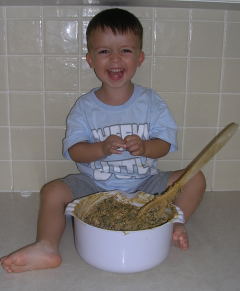
Anyway, it’s getting late, and I’ve managed to make myself hungry (why do I always end up writing about food?!), so I’ll say bye for now – I’ll be back again before the end of January (and I do mean this year!!) … Owen says hello to all the cheeky monkeys out there who might be reading this (actually, he says “time is money”!) …
Back soon,
Rachel
Vocab!
full-on (adj) - busy, stressful
to find your feet (expr) - to get used to something
dubious (adj) - doubtful
posted on Monday, 28 January 2008 | comment on this postMY SWAN SONG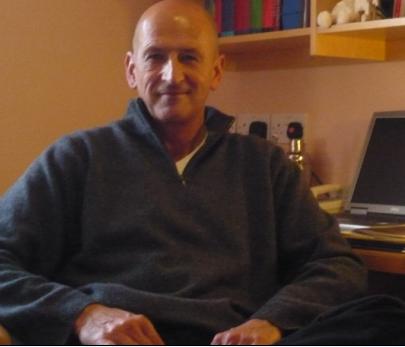
Wow! Have you read Benka’s prosepoem? It’s lovely. Very accomplished, too. Thank you, Benka (are you a published writer in Serbia?). Do keep trying to get a copy of Chernobyl Strawberries – is there no British Council library in Knez Mikhailova (Belgrade) any more? If it’s still there, they’re bound to have it.
And James – learning English in the public toilets of Taiwan! What an original blog that was – and maybe a new activity to recommend to my students? Hmm. Not sure about that, James. Great blog, though!
Hyoshil, yes, your comments finally got through. I’ve been wondering how you were doing. It was good to hear from you, and Kirsti (as always) and Marianna and Adri and Ana Paula and Pary and all the others – too many to mention both bloggers and those of you who have written comments on our blogs. Thank you all so much.
Elena (Moscow) had an interesting question about PLR (Public Lending Right). Yes, Elena, public libraries are, of course, free in Britain. The money which is paid to authors whose books have been borrowed from public libraries comes from a special fund (PLR) set up by the government.
As an author, I also receive a small amount of money each year for the number of times parts of my books (articles, study materials, etc) have been photo-copied in schools and colleges. Language schools and other educational institutions, nowadays, have to buy an annual licence to photo-copy published study materials. The money which the schools pay for the licence contributes to the fund which is used to pay authors. I am an inspector of language schools as well as an author, and one of the first things I always check when I do an inspection is that the school has an up-to-date photo-copy licence!
This has been a great month. Thanks to Paul and his team at BBC Learning English we’ve all been able to catch up and go on exchanging our ideas, opinions, enthusiasms. I’ll miss you all. When I pass through Lincoln, I’ll remember Hyoshil; when I think about Serbia, I’ll remember Benka; when I’m in France I’ll speculate about Kirsti; when I’m in St Petersburg, with Lucy at Easter, I’ll remember our Russian friends (and, by the way, you are our friends no matter what the politicians, on both sides, say and do) and when I pass through Poland or the Czech Republic or, farther afield, when I’m in the Far East later in the year, I’ll remember all our friends from Warsaw and Prague, from India and Nepal and China (good luck with the Olympics!) and Korea… I wish you all the very best – especially good health, prosperity and serenity. Oh yes, and whenever I think about Spain I’ll feel guilty that I never managed to read Don Quixote – my fault entirely.
Bye,
STEPHEN KEELER
PS: Lucy sends her regards, too. She’s hitch-hiking to Amsterdam right now, and hopes to be in Dublin by the end of next week. I’ve just received a text message from her. They’ve been on the way six hours and have managed to cover forty-five miles. Suddenly, Amsterdam seems much farther away than usual.
SOME USEFUL WORDS AND EXPRESSIONS
swan song
Someone's swan song is the last time they do something for which they are well-known.
prosepoem
A prosepoem is ‘a poem’ which is not written under the usual ‘rules’ of poetry (rhyme, metre, etc). It is sometimes called ‘free verse’. A prosepoem does not look like a poem, on the page.
accomplished
good; clever; skilful
original
unique; not like anything else; novel
got through
arrived
fund
a sum of money collected and used for a particular purpose
set up
established
annual
yearly
licence
permit; an annual licence is one which last for one year (and which has to be renewed annually)
contributes
goes (to the fund); is paid (to the fund)
catch up
to get up-to-date with each others’ news and gossip
farther afield
farther (or further) away
posted on Monday, 28 January 2008 | comment on this postSpam Manager!!!Paul (BBC Learning English)
Hello everyone, sorry for getting in the way again but I have an update on the comments issue. The spam manager has been a little bit over-eager in managing comments and 'disappearing' some of the things that you have sent in.
The techie team think they can fix it and they are working on it as I type, so we hope to have a new version soon. In the meantime we have managed to get the spam manager to give up its hoard of comments and we are adding the missing ones to this message and to the message that I will post in the student's blog. We may not have got them all back but we're publishing the ones that we do have.
Sadly it is impossible to post the comments to the actual blogs but at least you will be able to see and read the missing comments over the last few weeks.
Bye for now
 Paul Paul posted on Monday, 28 January 2008 | comment on this postPrams, Karaoke and Farewell...Hey up me ducks!
I'm so glad that the BBC team managed to publish all your comments! Thank you so much to everyone who posted answers to my question about what makes a good dad. It gave me plenty of food for thought and a great deal of encouragement too.
Tomono is now only two and a half weeks away from the due date, the cot is ready (with nifty animal mobile attached!), the car seat is fitted and all manner of baby goods have been purchased. One thing came up, however, that I really wasn't expecting. Last weekend my parents kindly took Tomono shopping for a pram. We picked one out - not too heavy or big so Tomono can get it in the car without having to spend 6 months at the gym - and ordered the colour we wanted. My mum then told us that we shouldn't have it sent to our house. "What on earth are you on about?" I asked. Apparently, it is bad luck to have a new pram in your house before the child is born. I was perfectly happy to go ahead and have it delivered to our house anyway but Tomono, not wanting to encourage bad luck of any description, insisted that we follow my mum's advice. So we had it sent to my office instead. This got me thinking about superstitions in other cultures regarding all things to do with babies...I bet there are some good ones out there - can't wait to hear them!
On a completely different topic, one of my colleagues at work told me a strange story about one of her neighbours. A lady who lives next door to her recently bought a karaoke machine from ebay. My colleague and this lady have been neighbours for about two years, but my colleague had always kept her distance as she finds her a little overbearing. One night her neighbour knocked on her door and she had brought her karaoke machine with her. She asked if she could come in and show off her new toy. Not wanting to seem rude, my colleague invited her in and helped her set it up, which was difficult because it didn't come with any instructions. Eventually, they got it set up and the neighbour proceeded to sing, without a break, for two whole hours. To say that her voice wasn't good is a big understatement. My colleague said that she sat on her sofa for two hours politely listening to her neighbour singing, out of tune and at the wrong rhythm, because she didn't want to be rude and ask her to leave. Incredible! Eventually, she went home after midnight but left her karaoke machine behind. My colleague is now terrified that she will come back for an encore. Again, a good question for you all: What would you have done in that situtation? Would you have asked her to leave? Would you have told her that her singing was like listening to cats fighting? Would you have sat there for over two hours and listened politely?
Anyway, I've been rabbiting on for ages. Tomono is downstairs waiting for me to watch a DVD together, so I'd best get a riggle on and say goodbye.
It's been a real pleasure catching up with you all. Anita, you are a model for all English learners and I'm so proud of your commitment and dedication. It's a shame we didn't hear from Jenny again but there's always next time, I guess.
Have a lovely rest of 2008 and hopefully two years down the track we'll all meet again...
Take care
Lewis
P.S. I'll leave you with a picture of us showing our love for the Bakewell tart. Yummy!
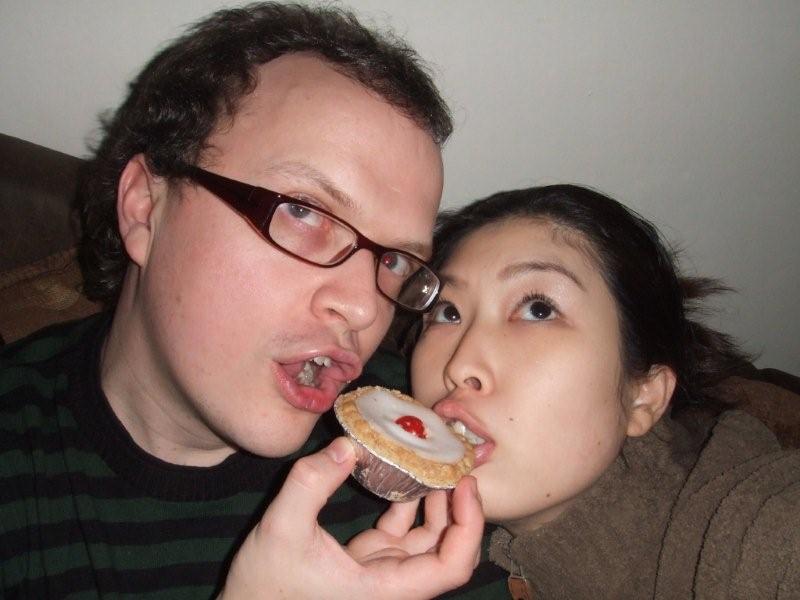
posted on Tuesday, 29 January 2008 | comment on this postTootle-pip!Hi, everyone!
Just a quick note to say Tootle-pip, as this open blogfest is drawing to a close. Sorry I haven’t had time to write more often.
Lewis, break a leg! Best wishes for your new arrival and on becoming a Dad! Hmmm, superstitions about babies? I think here in the UK, if your baby has teething problems, you are supposed to rub the mother’s wedding ring on the gums. I can’t really believe this works, but you never know!
It’s been great catching up with you all and it’s wonderful to see you all using the language you’ve learned on this blogging section of the site. Keep at it! You are all so dedicated and I just know that being part of the blog is improving your English. I’d like to say a special ‘well done!’ to my former student Naheed, who is a really committed blogger and deserves every future success in her studies and career.
Thanks for all your comments and I hope we can be in touch again soon – maybe this blog party can become a regular thing?
Keep learning English and keep having fun!
Jo
Tootle-pip – a rather old-fashioned way of saying ‘goodbye’
Blogfest – you can put the word ‘fest’ after many nouns. It’s short for ‘festival’, so it gives the idea of a party or celebration. For example, you might have a ‘foodfest’ if you have lots of tasty treats or a ‘musicfest’ if you have lots of music to listen to
Break a leg! – Good luck!
When a baby is teething, its teeth are breaking through the gums for the first time
Keep at it! – keep it up, persevere
posted on Wednesday, 30 January 2008 | comment on this postEternityWell, I guess January really is over, now! This is going to be a really short message (and an apology for being so slow off the mark!); I just wanted to wish all of you all the best for 2008!
Leila, my bosom possum, great to hear from you again! I have to admit, I kind of wish I was in Finland with the snow and the reindeer, as it’s TOO HOT in Sydney just now! Today was the worst kind of day – hot, humid and no fresh air anywhere – yuk! They’ve forecast storms for later so hopefully that will cool everything down a bit … Maybe we could arrange a country-swap for a couple of months each year?! I’m so glad you posted the comment, despite the technical problems – hopefully we might be able to catch up again next year!
Tomo – yes, the fireworks are amazing; every year I think they try to do something bigger and better. I liked the one where they wrote “Eternity” (I think it was 2000) – mainly because of the story behind it.
I’ll give you the short version of the story: for over thirty years, beginning just after the end of the first world war, Eternity was written all over the pavements of Sydney in chalk, always in the same handwriting. (It was copied on the Bridge for the 2000 fireworks). No-one knew who was doing it until one day in 1956 a minister of one of the churches saw a man writing Eternity on the pavement and asked him if he was “Mr Eternity”. And he was! His name was Arthur Stace, and he was a homeless alcoholic who was inspired to write the word 'Eternity' on the streets of Sydney. He wrote it over half a million times – up to fifty times a day. He died in 1967, and has become something of a local hero – if you’d like to know more, try entering “Arthur Stace Eternity” in a search engine, and you’ll get heaps of sites where you can get the whole story. And that’s just given me a brilliant idea for the title of this post!!
Filippo – Good to hear from you; how’s it going? Thanks for your reassurances about nursery school; it made me feel a lot better! I actually can't remember my first days at nursery, so I guess it can't have been that bad!
Pary – Happy New Year to you too! I’m so glad you left a comment; I was hoping I might hear from you! How’s your cheeky monkey? Does he know any really irritating phrases like “time is money”? (If not, I'm sure we could come up with come suggestions for you!) Please give him a hug from Oz!!
Erika – Thank you so much for your comment; nice to hear from you again! Here’s one more picture for you; our boy with his favourite Christmas present (a cricket bat, of course!!)

I’ve really enjoyed hearing from all of you (James, loved the photos of the toilets!!); I hope you’ll all continue to be inspired to keep reading and posting comments. And (to pinch an expression from Jo) – maybe this blogfest can indeed become a regular thing!
Best wishes to all of you,
Rachel H (and the cheeky monkeys!!)
posted on Thursday, 31 January 2008 | comment on this postFrom BBC Learning EnglishOn behalf of BBC Learning English and English learners everywhere in the blogosphere, I'd like to extend a big thankyou to all our teachers this month. Your stories have invigorated and encouraged us all... and you haven't eaten each other either.
Good luck in all your projects across the world. Stephen, you had better read Don Quixote before you trigger an international incident. And personally, I think you should read it in Spanish.
Now can we have a big drum roll for February's teacher blogger...Trudy Faulkner-Petrova!
William Kremer
BBC Learning English
posted on Thursday, 31 January 2008 | comment on this postOne last goodbye!Hello again everyone – apologies for not being able to blog more often I have been busy busy busy and I’m am tired tired tired… exhausted, in fact. Two kids?! What was I thinking?! Ahh no, not really. I only have to take one look at little Oslo’s sweet little face and I remember that it’s all worth it. And Louie’s too of course :-)
My parents are still visiting and we’ve been entertaining them with trips to the train museum (Louie was over the moon), various shopping expeditions and nice meals in restaurants. They’re off on Sunday though, but I don’t think I’ll be too sad as we’ll be seeing them very soon.
Anyway, I’m afraid I’m going to have to finish here as I’m about to fall asleep with my nose buried in the keyboard. Thank you for all the lovely comments – I’ve been enjoying reading everyone’s posts and all the comments, including those that came through after the spam filter was fixed… thank you!
With very best wishes to all of you out there… I hope you have a fabulous 2008. I'll leave you with a final photo of us at Louie’s birthday party earlier this month.
Xxxx Amy
But of course, before I go, here are those definitions from my last post…
Veritable: used to emphasise something, e.g. ‘a veritable feast’ meaning it really was a feast (!)
Trepidation: a feeling of fear that something bad is going to happen
Bliss: a feeling a true happiness
A hop, skip and a jump: a short distance (away)
To sink in: if something ‘sinks in’ it means you slowly understand or believe it
Pivotal: very important, causing change
Full on: extreme
posted on Thursday, 31 January 2008 | comment on this postJust before the deadline?!I'm not sure if I can sneak this post in before midnight on the final day for the open blog - but it's worth a try!
January should be a quiet month for me: dark nights; not much teaching, staying at home and marking my students' assessments; recovering from the over-spending and over-eating of Christmas and New Year..... But I've realised that the month has rushed to an end and tomorrow is already February.
The best thing I did this month, apart from reading all the great BBC Learning English blogs, was prepare for a conference presentation on 'English as an International Language'. Last semester, I recorded British students talking to International students at my university in York. I listened to the recordings to find out how the students worked together to create meaning. One thing I found was that the International students often helped the conversation along by saying (for example) 'could you repeat that?', 'do you mean....?' and so on. One possible conclusion of the study is that speaking English as a first, and perhaps ONLY, language makes it MORE difficult for British students to communicate in an 'international' situation. In my conference presentation I suggested that the British students and staff should have 'English as an International Language' lessons!
This is perhaps NOT what the mainly British audience at the conference wanted to hear! We probably assume that we are expert communicators in our first language in ALL situations.
 Anyway, my findings should be encouraging for language learners everywhere! Language learners do not expect perfect communication and are willing to 'negotiate' meaning. This can mean that they make BETTER communicators in a mixed language situation. So it's better to be a learner than an 'expert'!
And that's my final message for the end of this brilliant open blog month......keep on being a learner!
Rachel W xx
posted on Thursday, 31 January 2008 | comment on this post | |