


Bits & pieces
A few bits and pieces connected with our journey back to Poland - because, after all, a journey isn't finished even when it's finished.
Mahjabeen writes: "I would like to ask why you have written 'we'd have had to pay more for second class'. Can I also write it like this: 'we'd have to pay more for second class'? Would this be correct or not?"
'We'd have to pay more' is possible, but I think 'we'd have had to pay more' is preferable because it's a past conditional, referring to the time of buying the tickets, before the journey and therefore before the time of writing.
On the way back, for the first time, the German-Polish border was invisible - not just because it was dark, but more importantly because Poland is now part of the 'Schengen' area and there are now no routine immigration and customs checks. No more fishing your passport out of your pocket or your luggage to show it to the men and women in uniform (two different shades of green - German and Polish).
Andy wrote: "I went to visit Cologne Cathedral on Christmas Eve; is it a so-called Gothic building?" Yes, it certainly is. Gothic was the prevailing style of church architecture in western Europe from the 12th century to the 15th/16th, with characteristic pointed arches, tall pillars and tall, thin, pointed windows, often with stained glass. The general effect is to lead the eye upwards, and the large areas of glass in the walls allow plenty of light in. The stability of the building is achieved by the balance of forces between different components of the construction, rather than by large amounts of thick, heavy stonework as in the earlier Romanesque style. We also stood admiring Cologne Cathedral, not for the first time, a few nights ago. It wasn't actually completed until the 19th century, although the bulk of it is mediaeval, and it suffered only minimal damage in the second world war, although the city of Cologne was bombed pretty intensively.
The original part of Barcelona is called the Barri Gòtic (Gothic Quarter), which is a cue to return to the subject of reading ..... On Silvia's recommendation, I read 'The Shadow of the Wind' (in English, unfortunately, since my knowledge of Spanish doesn't really stretch as far as reading novels) and enjoyed it immensely for lots of reasons - for the story, the characters, the evocation of Barcelona and its history, the idea of the Cemetery of Forgotten Books (which reminded me of Borges' 'Library of Babel', the labyrinthine library that contains all possible books).
I see that in the Plaça de Sant Felip Neri, one of the places in the Barri Gòtic which are mentioned in 'The Shadow of the Wind', there's a museum of old shoes, which connects with another previous topic in these blogs, and one of my photos, doesn't it?
Another fantastic book I've just read is 'Der fliegende Berg' ('The flying mountain') by Christoph Ransmayr. It tells of two brothers who head into the mountains of Tibet in search of the last undiscovered corner of the world, the last remaining patch of terra incognita. As you can imagine, though, apart from the literal journey and the external landscape, the book also evokes personal, internal mountains and journeys.
Fiction is generally printed in left- and right-justified text, i.e. the beginnings of lines of text form a straight vertical line, and so do the ends of lines. But this novel is in 'Flattersatz' - literally 'flapping or fluttering text', though Ransmayr says he would prefer to call it 'fliegender Satz', i.e. 'flying text': the lines are left-justified but of different lengths, so that at first glance it looks like poetry. Here's a short sample of what it might look like in English:
From what she said,
someone who could read and write
would be able to leave his time and his place like a deity,
by transforming thoughts, names, every one of his words
into writing
and inscribing them on a piece of wood, or a stone, or paper
in the certain knowledge that he was leaving a message
that would be legible
long after he had disappeared
or was trapped in some other incarnation.
What difference does this make? Well, I think it predisposes the reader to read more slowly and attentively, and it presents the text as one that might be read aloud, like some ancient epic story, or at least a text to be heard inside the reader's head.
Now I'm reading a Polish novel, a recent best-seller, 'Samotność w sieci' ('Loneliness in the net') by Janusz Wiśniewski. It's based around a relationship conducted by email, though it takes up all sorts of other contemporary themes, and timeless ones too.
Another perennial topic is, of course, the weather. This winter has been extraordinarily mild here in Łeba (so far?!) but here are two photos from a few years ago which show what happens occasionally under particular conditions - a combination of sustained very low temperatures and a continuous strong wind blowing from the north. What happens is that the waves break on the beach and the water immediately freezes, and the ice gradually builds up higher and out into the sea. Here you can see the narrow strip of sandy beach in the distance, and the much wider belt of ice in the foreground.
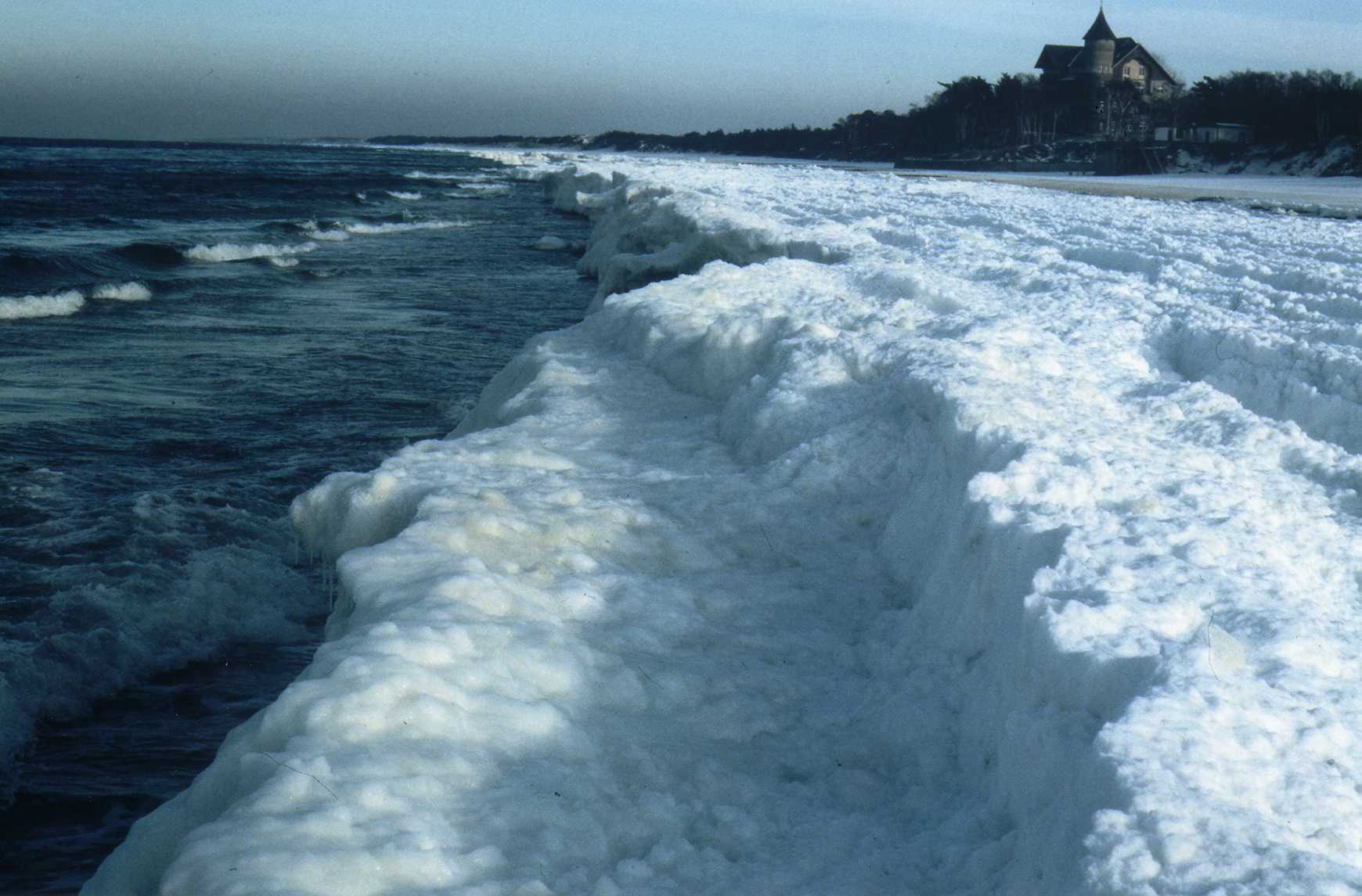
Later, after perhaps a week or two weeks of this, when the sea calms down, the waves begin to cut back into the ice and form 'cliffs' of ice of up to a couple of metres high. At the same time, as the temperature rises, blocks of ice detach themselves and start drifting away from the 'cliffs' like little icebergs. You can see two of them in the distance in the second photo.
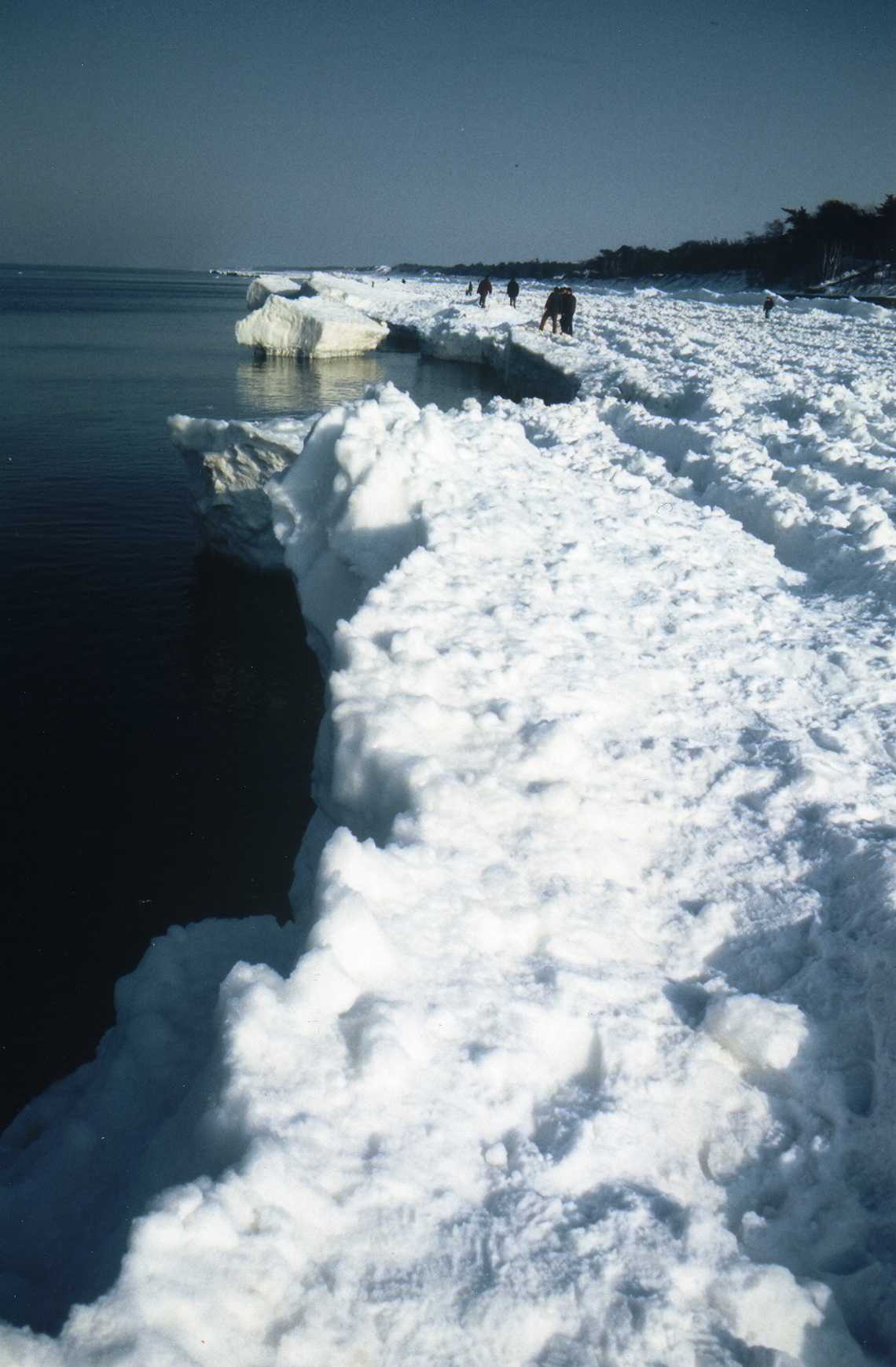
In fact, it looks like an Arctic scene in miniature. But, as I said, it doesn't happen very often.
In summer, there's an opposite effect. Because the Baltic Sea is so shallow, it warms up quite easily if there's a prolonged period of hot weather, and it often reaches a temperature that's quite pleasant for swimming.
You're right, Pary, that the water around the coast of Britain isn't very warm - especially not the North Sea coast. But people do go swimming, all the same.
We've had lots of rain over the past couple of days, but today's dry, quite sunny, and not at all cold for the time of year. Pary gives a dramatic description of the weather in Iran, and the disruption it's caused - I hadn't seen or heard anything about this in our news here. Let's hope things improve soon.
Jonathan
Comments
Hello Jonathan! It was interesting to read about the book you´re reading and Leba weather. Around here is still hot, but fortunately today we´re having a mild breeze tonight. Best wishes, Ana Paula.
Hello Jonathan! It was interesting to read about the book you´re reading and Leba weather. Around here is still hot, but fortunately today we´re having a mild breeze tonight. Best wishes, Ana Paula.
Hello dear Jonathan! Why is that? Why you has to break your blogging even after the most beautiful one! I´ll have to read it repeatedly though in order to take up all nuance of your style. I have read Pary´s description of the snowfall conditions in her country. I do know very well what a horrible situation it is. I worked one hour to put the snow away from my car on Sunday and it wasn´t as bad yet. Three winters back the snow was to the top of the car and being on the hill the more I shoveled it away the more the car drowe down the hill until it reached the bottom at the end to my helpless desperation. I wish you and others all the best!
Thanks for all your contributions. This blog has now closed and can no longer accept new comments.


