August 2007Hello Everybody!Hello everybody! My name's Catherine Chapman, I'm one of the English Language Teachers here at BBC Learning English and I'll be the teacher blogger for just a few days until Amy starts blogging on 6 August. Here's my picture: 
You can find out more about me by looking at my 'Meet the Team' page.
I'd like to start off by saying a BIG thank you to Jo and Ha, the outgoing bloggers, for their most interesting and entertaining blogs. And thank you to everybody who has been reading and commenting on the student and teacher blogs - it's always great to read your comments.
And now I'd like to extend a very warm BBC Learning English welcome to Yumiko - it's great to have you on board! I have to say, Yumi, that I am particularly pleased to hear you are a 'shopping queen' (what a nice expression!) - you are a woman after my own heart! The summer sales are in full swing here in London and I can't wait to get over to Oxford street to snap up some bargains. I was wondering, Yumi - do you go for smart clothes? designer? casual? Or maybe you have your own eclectic style. Please tell us a bit more about the type of clothes you like :-)
You have used some very nice words, phrases and sentences in your first blog, Yumi, and you write very coherently. I especially like the adverbial clause you use to organise your writing when you say 'before talking about myself more, I would like to talk about what I did today...' I also like your use of English when you say '...I ended up not buying anything...' You clearly understand that when a verb follows a preposition (like 'before' or 'up'), it must take the '-ing' form.
But do you know what preposition normally follows 'impressed'? You have written 'I was really impressed to this word.' - can you suggest a more suitable preposition?
I'd like to look at the '-ing' forms in another of your sentences, Yumi. You write: 'I am 25 years old, working for Japanese company, doing accounting, having 2 younger sisters and living with my parents and sisters.' In this sentence, at least one of the -ing verbs (working, doing, having, living) would probably be better in a simple form (without '-ing'). Can you tell me which one? I'm sure some of our readers will give you some advice... ;-)
Well that's all from me for today Yumi - I'm looking forward to hearing more about you and checking your answers to my language questions.
Bye for now, Catherine x
..........................................
Vocabulary
There are 7 words and expressions in today's blog - and I have written their meanings below - but they are all jumbled up! Can you match the words / phrases with their definitions?
Words / phrases
(1) outgoing
(2) it's great to have you on board
(3) a woman/man after my own heart
(4) in full swing
(5) to snap up some bargains
(6) eclectic
(7) coherently
Definitions
(A) a person you admire because they do or believe the same things as you
(B) to quickly buy some things (which are much cheaper than they normally are) before they are all gone
(C) joined together in a smooth and logical way
(D) operating at the highest speed or level of activity; in full operation
(E) it's good that you are part of our team
(F) leaving or retiring from a job or position
(G) made up of several different elements from a variety of sources posted on Wednesday, 01 August 2007 | comment on this postA Warm Welcome :) Hello Yumi and friends
It was SO nice to turn on my computer today and find so many lovely messages! Thanks everyone for your warm welcome, and a special thank you to Jill from Beijing for your kind comments about my photo: you are truly a woman after my own heart!
And of course, thank you Yumi for your latest blog. Shall we get started? Let's have a look at your 2 language questions, Yumi...
Firstly, you wrote: I used to wake up at 6:30 and (*1) managed to make it to work on time. Your question was: *1: Is this 'duplication' to use 'manage to do' and 'make it to do'? I would like to mean it is difficult but I made it.
Well, first of all Yumi, when you use 'manage to', you must follow it with a verb, so you could say 'managed to get to work' or 'managed to arrive at work'. Becuase you have used the phrasal verb 'make it', your sentence is grammatically correct. Regarding the meanings of 'manage to' and 'make it' – well, 'manage to' has the idea of 'succeed' and 'make it' has the idea of 'arrive' – but both of them have the idea of 'despite it being difficult'. So is it duplication (repetition) to use both of them? Personally, I don't think so, Yumi. I think the phrase managed to make it works really well in your blog for 3 reasons: 1) your vocabulary choice fits well with the informal style & tone of your blog; 2) the repetition of the idea 'despite it being difficult' works to emphasise, not duplicate, what you say and 3) the repeated 'm' at the beginning of 'manage' and 'make' sounds lovely!
Secondly, you wrote It is too cold to (*2) get out from the bed! Your question was '*2: Does 'get out' sound exaggerated or rude? I would like to mean 'wake up' but thought I should use different expression. Well, in answer to this question Yumi, you first have to think about meaning. If you want to say 'open your eyes because you have stopped sleeping' – use 'wake up'. But if your intended meaning is 'leave the bed and stand up' – you should say 'get out of bed' – and notice that the preposition is 'of', not 'from'.
And if you say it is too cold to get out of bed – no, that doesn’t sound rude or exaggerated at all, Yumi! It describes a feeling I remember very well from my childhood, before houses in the UK had central heating. In the winter time, there was often ice on the inside of the bedroom windows, and I well remember my parents using hot water bottles and blankets to make sure my sisters and I were nice and warm in our beds at night. But it was always freezing in the morning – way too cold to get out of bed!!! These days most houses in the UK have central heating and very good insulation, so those horrid winter mornings are a thing of the past for most of us. I usually get up at about 7.15am, shower and have breakfast, get ready and walk to the Tube station which takes about 15 minutes. The tube journey itself is very hot and crowded, but thankfully quite short, and I usually get to my desk around 9.30am. The first thing I do when I get to work is switch my computer on. And the second? I make a lovely cup of coffee!
Now, I'd like to look at the language questions I asked: and I'm pleased to see that you got a lot of help and advice from our readers:)
The first one was about –ing forms. I asked: You write: 'I am 25 years old, working for Japanese company, doing accounting, having 2 younger sisters and living with my parents and sisters.' In this sentence, at least one of the -ing verbs (working, doing, having, living) would probably be better in a simple form (without '-ing'). Can you tell me which one?
Well done, Yumi, you are quite right when you say 'I should have said ' I have 2 younger sisters.' Myen from Vietnam said 'I think 'having two sisters' would probably better in the simple form 'I have two sisters' because 'Have' is not an action verb. Is it right?' Myen (and others), you are absolutely right: in this sentence 'have' is not an action verb, and therefore is not used in the continuous form. Actually, 'have' can be both a state verb: 'I have 2 sisters' and an action verb 'Where's Alan? - He's having a shower'. For more information about state and action verbs – look at Ask about English or Learn it or The Flatmates episode 4.
One or 2 of you pointed out that it's possible to say 'I live with my parents and sisters'. That's true, but it's also correct to say 'I'm living with my parents and sisters', especially if it is a temporary arrangement.
The second thing I asked was: what preposition normally follows 'impressed'? Well done to all of you who said 'by' or 'with'! You can say I was impressed by his performance' or 'I was impressed with his performance' – with no real change in meaning.
So here are the answers to the vocabulary matching activity I gave you. Well done to those of you who got the right answers!
(1) outgoing - (F) leaving or retiring from a job or position
(2) it's great to have you on board - (E) it's good that you are part of our team
(3) a woman/man after my own heart - (A) a person you admire because they do or believe the same things as you
(4) in full swing - (D) operating at the highest speed or level of activity; in full operation
(5) to snap up some bargains - (B) to quickly buy some things (which are much cheaper than they normally are) before they are all gone
(6) eclectic - (G) made up of several different elements from a variety of sources
(7) coherently - (C) joined together in a smooth and logical way
Regarding the word outgoing - Penguin from Japan asked me an interesting question: can we use "the ingoing bloggers", for example, "welcome to Catherine and Yumi, our ingoing bloggers of the month."? And Ahmed from Casablanca asked: Is there any similar expression such as "the oncoming bloggers" or another term for the new bloggers we are welcoming? Well Penguin and Ahmed, I am going to pass your question to our friends on the comments board – and I will comment on their comments on my next blog! I hope our friends will also answer Ahmed's second question: 2" a shopping queen": Can we say "a shopping king" when it's the male who does the shopping?
Well that's all from me today Yumi, I hope you have a lovely relaxing weekend free from crowded trains ;-) And when you have time, perhaps you could tell us a little bit about your home city of Saitama...
;-)
Best wishes, Catherine x
posted on Friday, 03 August 2007 | comment on this postShort & Sweet Hello for the last time...
It was a pleasure to read your latest blog Yumi, and to find out a bit more about you. India, Thailand, Singapore... you are quite well-travelled! Where else have you been, and where would you like to go if money were no object??
I know how it feels to live in a country where you don't feel confident about speaking the local language, Yumi - I had the same experience myself in Turkey and also Argentina. It's quite tough at times. But I'm pleased to hear that you found the people in Singapore to be friendly and kind - it makes all the difference. Please could you tell us some of your top tips for surviving in a foreign country when you don't speak English so well...?
I'd like to answer a few more of our readers' questions... Firstly, thanks for all your answers to the question about an opposite word for 'outgoing'. You can see the correct word (it's a compound word, Benka) later on in today's blog.
Now, there is no real reason why you can't call a man who likes shopping a 'shopping king', Naheed, and I like Ernesto's comment that 'it fits better to a businessman who owns a big retail empire' - but I think you will hear the phrase 'shopping queen' more often!!! 'Shopping queen' is also a compound noun, Benka: it's made by combining two words to make a new word.
Emiliano, if you want to know the meaning of 'a woman after my own heart' - I explained it in my first blog ;-)
And for Ibrahim, Gulsun and Tulay: I lived in Istanbul from 1996 - 2001. I spent most of that time working at a language school called Interlang in Bakirkoy (a suburb of Istanbul) and then I worked at Istanbul Technical University - in Sisli! - for a year. I really loved Istanbul and Turkey - in fact I'm going to do a 'Mavi Yolculuk' in about 2 weeks' time! 'Mavi Yolculuk' means 'Blue Cruise' - a sailing trip round the Turkish coast - a beautiful part of the world.
Well, this is my last blog Yumi (so no homework from me today!!!), and it is now my very great pleasure to place you in the capable hands of Amy Lightfoot, the incoming teacher blogger, who will be with you for the next few weeks. I'm sure you will all make her feel very welcome.
All the very best, Catherine x
Vocabulary
well-travelled this is an adjective which we use to describe someone who has travelled to many different places
if money were no object if you could easily afford even the most expensive things
incoming the opposite of outgoing
short and sweet we use this expression to describe something that is brief but enjoyable posted on Monday, 06 August 2007 | comment on this postHello, it's Amy!Hello Yumi and everyone! This is Amy blogging now. I guess I am the ‘incoming blogger’! I’ve really enjoyed reading through all your recent postings and comments – there’s been such a great response to Catherine and Yumi’s blogs! And Yumi, I’m so impressed that you have taken the time to reply to each person individually. I will try and do the same sometimes ;-) Catherine – you’ll be a hard act to follow! :-)
First I’d like to introduce myself a little bit and then we’ll get cracking with some notes on language and the usual stuff. As Paul said, I live in New Delhi in India, although at the moment I’m in England on holiday for four weeks. I’m heading back to Delhi on Friday. I work there as a teacher and teacher trainer and have been there for three years. It’s a fascinating country and Delhi is a great city to live in, although it’s pretty hot at the moment. I’m hoping that it will have cooled down a bit by the time we return. We’ll see! I see you have travelled to India, Yumi – as Catherine said, you seem to have done lots of travelling! I’ll look forward to hearing more about that :-)
Speaking of fascinating countries, I’m looking forward to the travel tips for Japan that you promised Vincent and Sue, Yumi! I’ve always wanted to visit but so far have only managed a stopover in Osaka on the way to Australia a few years ago. I just stayed at a hotel at the airport and I remember (among other things) being very impressed with how technological the bathroom was! There were buttons everywhere! I really hope to visit one day.
Okay – let’s have a look at some language. First of all, in one of your recent blogs, Yumi, you asked us all whether we talk about real intentions and stated reasons. I think you put this very nicely. I think we all do this actually, regardless of our country or culture, although maybe we don’t define it in the same way. I think we all usually tell people the reasons we think will sound the most convincing, or appropriate, but there are usually underlying reasons for why people decide to do things, don’t you think? Sometimes these remain a secret!
Yumi your English really is great. You use some fabulous phrases and a nice mixture of simple and complex sentence structures. I noticed in your last couple of postings that you sometimes miss out prepositions, or use the wrong one. Below I’ve copied in some of the things you have written. Can you and the other readers have a think about what the missing or correct prepositions should be? Here you go…
1) I had so many difficulties with communicating ** people
2) They were very open for foreigners
3) You comment to every blogger
4) It varies for every country and culture
5) I do dance in weekends
I was interested to read the comment by Antonio saying how useful he had found Catherine’s matching exercise and that he usually just copied the new vocabulary into his notebook without always thinking about the meaning. I am a great believer in learning new vocabulary by looking at the words around it and trying to guess the meaning, rather than just heading straight for a dictionary. So, I thought we could try something a little bit different for the next few weeks. Each blog I will highlight interesting and useful vocabulary items as usual, but instead of giving the definitions immediately below, I’ll give you the definitions the next time I blog. Hopefully this will encourage you to use your loaf :-) and to try and figure out the meaning yourselves from the context, and/or consult friends or the dictionary to help you if necessary. You can then check your guesses or answers with the list of definitions that appears a couple of days later. I might even give you a little quiz one day! Some of the words or phrases might be a bit tricky to find definitions for in your dictionary, especially if they are phrases. Try looking up the key words and seeing if the phrase is listed (e.g. ‘loaf’ for ‘use your loaf’). Don’t forget about the online dictionaries – they’re a great resource and may be more up-to-date than your dictionary at home. Sometimes there may be more than one meaning for a word but I’d like you to concentrate on the meaning that fits the context the best.
Don’t forget to keep a record of all these lovely new words and phrases. I enjoy putting a tick next to any word that I look up in my dictionary – then I can see how many words I’ve been learning and also I’ll know if I look up the same word or phrase more than once.
Take care and more soon!
Amy
Today’s vocabulary (Definitions next time! – Remember to look at how the word is used above to help you understand the meaning)
A hard act to follow
To get cracking
To head back
A stopover
To put something (very) nicely
Regardless
Convincing
To remain a secret
To use your loaf
Context
Tricky
posted on Monday, 06 August 2007 | comment on this postBison!Hello again everyone! Thanks for all your comments and kind words. It’s great to see so many of you doing the homework! :-) I especially liked the sentences that Jill made using the new phrases – that’s a really good idea and I recommend all of you try to record your own sentences like these next to the definitions in your vocabulary notebooks. It will make the words more memorable. Have a look at the definitions given below though, Jill, your sentences are great but a couple of them need a bit of tweaking.
Ahmed asked me lots of questions so I thought I would answer some of them now before we look more closely at Yumi’s blogs. First of all, yes I am married! I have a lovely husband called Ed, who is from England, and we have a little boy called Louie who is just 19 months old and is a real troublemaker! He’s very sweet though and is just learning to talk. We’re also expecting another baby which is due in December – very exciting but a bit daunting! Two cheeky monkeys running around will be a lot of hard work, but lots of fun too ;-)
Ahmed also asked me whether I get homesick when I am in India. As I’m about to return there it’s a good time to think about that I suppose. I do miss my family and friends but I have also met lots of great people in Delhi and I enjoy my job so I don’t get the blues very often. One thing I miss, living in the busy city, is the beautiful countryside in England – it’s so green! My in-laws have a farm which is absolutely stunning and I miss going for walks in the fields. It’s no ordinary farm, either – they farm bison which are large animals, originally from North America. They are raised for their meat, which is apparently very tasty but as I am vegetarian I can’t vouch for this! I’ll try and include a photo of a bison below so you can see what they look like.
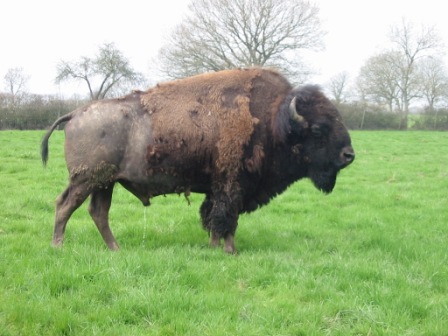
Okay – down to work. Let’s look at the answers to the preposition questions I asked – the moment you have all been waiting for! ;-) You’ve all done very well. Here they are:
1) I had so many difficulties with communicating with people ** A couple of you mentioned that you don’t need the first ‘with’ – that’s true. It’s okay but sounds a bit clumsy having two.
2) They were very open to foreigners
3) You comment on every blogger
4) It varies between every country and culture ** did anyone get this right? I think most of you said from but if you use this then you also need a 'to' in the same phrase, such as ‘It varies from country to country’ – don’t ‘cha just love the English language!)
5) I do dance on [or] at the weekends. ** Sanja mentioned that ‘on’ is US English while ‘at’ is UK English – that sounds about right but like lots of US/UK English words they’re now used quite interchangeably whoever is speaking
Now let’s have a look at Yumi’s questions.
From ‘Today is…’:
*1: I often heard the phrase 'Lucky girl!'. Can you also use 'Lucky woman'? Also, how can I express it with full sentence?
Yes, you can use ‘lucky woman’ – in fact, it’s quite common to say ‘lucky thing’ to refer to a person of either gender, as in ‘You won the prize? Wow, you’re a lucky thing, aren’t you?’ The sentence that you used in your blog needs a bit of work though – ‘I am a lucky girl that I could meet two teachers here’. Can any of our readers (and you Yumi!) rewrite this to make it a bit clearer?
*2: I would like to mention 100,000 people. Should I use 'one hundred and thousand of people'?
No need to use the ‘and’ here. You can either say ‘one hundred thousand people’ or you can say ‘a hundred thousand people’
*3: Should I use 'it' to mention Hiroshima city?
You would usually use ‘it’ to refer to a city (in fact, you referred to Delhi using ‘her’ in another part of your blog – ‘its’ would be better here). However, in the sentence that you wrote ‘Today there had a ceremony at 8am’, it would actually be better to say ‘Today there was a ceremony at 8am’
*4: ‘The famous shrine […] which was built in the surface of the wave’ Could you please teach me the right and sophisticated expression??
I’m not quite sure what you mean here – can you describe it a bit more? Do you mean it was built over the water?
From ‘Fireworks festival’
1 : Can I use 'authentic' for people? I saw this word expressing some food stuff.
I don’t think we usually use ‘authentic’ to describe people, it doesn’t sound quite right somehow. I think ‘real’ would work better here. ‘Authentic’ is often used to describe food though, you’re right.
2 : “It is rare that the street got full of the food shops(*2) and this attracts all the people!!!”
I understand what you mean here! It just needs a small change – there’s a problem with the verb ’got’ – can you have a go at re-writing this sentence as well?
Wow this is turning into a super long post! I’ll just say quickly – the fireworks festival sounds great Yumi. I hope you’ll get the photos working soon, I’d love to see some of the Yukata – I hadn’t heard of that before.
Okay – vocab below. Next blog we’re going to have a look at using articles, among other things ;-) See you soon!
Amy
Definitions from the last blog:
A hard act to follow: when someone starts doing something that someone has done very well before them, we say the first person is ‘a hard act to follow’ – phew! That’s difficult to define!
To get cracking: to start doing something
To head back: to return
A stopover: usually used when you stay for a short time somewhere that is not your final destination, when talking about a flight or a long journey
To put something nicely: to say something well
Regardless: without being affected by anything else
Convincing: believable
To remain a secret: to continue to be unknown to many people
To use your loaf: (Yes! This reviews one of the phrases from Jo’s great blog on Cockney Rhyming Slang) Loaf of bread = head… so ‘to use your loaf’ means to use your head
Context: the situation in which something happens. In this case, the words around the vocabulary you are learning.
Tricky: difficult
New vocabulary from this blog:(definitions next time!)
Memorable
To tweak
A troublemaker
Daunting
Cheeky monkey
To get the blues
Stunning
To vouch for something
Clumsy
Interchangeably posted on Wednesday, 08 August 2007 | comment on this postPolperroHi Yumi and everyone,
I was very interested to read about your night out with your colleagues and the comments that people wrote about it. It’s interesting how different cultures treat occasions like this. I remember being surprised when I first moved to India because when it is someone’s birthday normally they bring in sweets or chocolates or cake for everyone to share – sometimes for everyone in the whole office which can be 200+ people! In the UK it’s the opposite (usually) – other people bring in treats for the birthday girl or boy… of course when it’s my birthday I prefer the UK tradition but when it’s other people’s birthdays I like how it’s done in India :-)
So at the moment we are packing up and getting ready to head back to Delhi. The only thing I’m not looking forward to is the heat – I expect it’s going to be a bit of a furnace (although I’m pleased to hear from Paulraj that it’s been raining a lot). Some of you have asked whether Ed and Louie live in India with me – yes they do. Ed and I moved there in 2004 because I got a job there. He worked for a bit but now he’s a househusband and looks after Louie at home while I bring home the bacon .
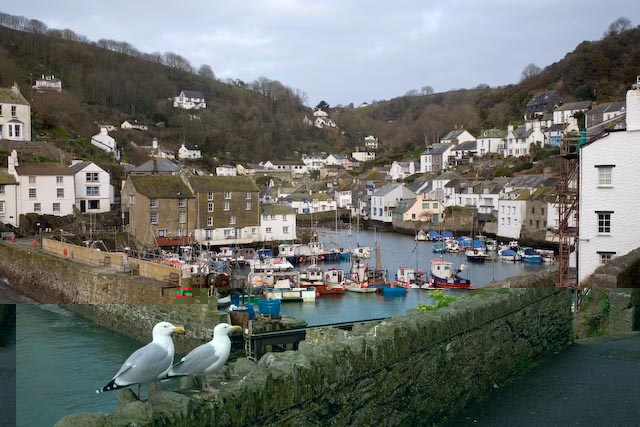
We’ve had a great holiday here and have been very lucky with the weather considering how much rain there has been in some parts of the country. I expect our readers will have heard about the horrendous floods we’ve been having? Terrible. We spent quite a lot of time in Cornwall where my parents live. Cornwall is a beautiful county in the far southwest of England, with lots of lovely beaches. My parents live in a little village called Polperro. It’s got its own harbour and narrow winding streets with lots of little shops. My father’s family has lived there for many generations – in fact my grandfather was born in the house just down the hill from ours. Our house was built by my great-uncle and so has always been in the family. My parents moved there about 10 years ago. Unfortunately Polperro does become quite overrun with tourists in the summer and feels a bit like a theme park – hundreds of visitors traipse through the streets each day. But it’s still very nice and when I’m not there I miss the sound of the seagulls (and my parents of course :-).
Here is a photo of the village (seagulls on the left!):
Okay, now I’ve noticed, Yumi, that sometimes you have problems with using articles (a, an and the) so I thought we could have a little look at that today. I know Jo talked about this part of grammar back in June, but extra practice always helps and besides, this is a very common problem because lots of languages don’t have the pesky little things. So - today we’re going to concentrate on the definite article – ‘the’. To do this, I’m going to tell you a story about someone I met recently when I was in Polperro. Have a read and then I’m going to ask you some questions…
The man I met is called Mr Warren. He told me that he is one of the richest men in the world. At the moment, he is living in the Seagull Hotel in Polperro. Everyday, he goes downstairs to the lobby, smiles at the American tourists, and goes and sits on a bench near the English Channel. He always sits on the same bench and stares at the sky. This is where I met him. We had an interesting conversation about all sorts of things including whether the rich are happier than the poor. It was an interesting chat.
Okay. So, you might be wondering – what kind of a weird story is this? Well, like I said, we’re looking at articles, so that’s exactly what I’d like you to do for homework. Look at the last paragraph and circle all the definite articles you can find. Then, I’d like you to decide why each article has been used. Here are some of the reasons (there are more!) why we might use the definite article – see if you can match them and we’ll discuss the answers in the next blog.
We use the definite article…
1. With the names of most rivers, seas and oceans
2. With the names of hotels
3. With superlatives
4. With groups of people
5. When we are talking about something we have mentioned before
6. When there is only one of something
7. When both the reader and speaker know the thing being spoken about
Just before I go, well done on all the suggestions for the sentences I asked you to rewrite. Here are a couple of ideas:
1) *I am a lucky girl that I could meet two teachers here
“I am so lucky to have met two teacher bloggers on this board” (thanks Naheed!) – I think the phrase ‘lucky to have done something’ works better here than ‘lucky girl/thing’
2) *It is rare that the street got full of the food shops and this attracts all the people!!!”
“It is rare that the street is / gets full of food shops” (well done Myen!) the important thing here is that the verb needs to be in the present tense, because we’re talking about a general fact. Instead of food shops, I think I’d say ‘food stalls’ though – they sound more temporary. For the second part I think ‘this attracts loads of people’ works best.
Okay, I’m off to do some last minute shopping. Next blog from Delhi, where I’ll try and reply to some of our readers' comments :-)
Amy
p.s. The photos are great Yumi! Glad you worked out how to post them.
p.p.s. Apologies to Sanja - I didn’t see that you had answered the tricky ‘between’ preposition question correctly – well done!
p.p.p.s (!) I realised that the bison in the photo I posted looks a bit bald. Actually that’s quite normal for the time of year the photo was taken as she was losing her winter coat – she’s very healthy even though she looks a bit bedraggled !
Definitions from the previous blog:
Memorable: easily remembered
To tweak: to change something a little bit
A troublemaker: someone who causes trouble – can be used affectionately or more seriously
Daunting: frightening or scary, usually because you don’t know if you will be able to do something
Cheeky monkey: an expression usually used to describe children who are a bit naughty (often used affectionately)
To get the blues: to start feeling sad
Stunning: beautiful
To vouch for something: to say that something is true
Clumsy:not smooth, awkward
Interchangeably:used the same way, can replace one another without a change in meaning
New words and phrases(definitions next time!):
To treat
Treats
Furnace
Househusband
To bring home the bacon
Horrendous
Winding
Overrun
Traipse
Pesky
Last minute
Winter coat
Bedraggled
posted on Friday, 10 August 2007 | comment on this postBack in Delhi safe and soundHello again! We’re back in Delhi now and I was right – it is a furnace! It looks like it’s going to rain so hopefully it will soon and then it will be much cooler.
Yumi, the photos are much easier to see now that you have made them bigger. The yukata really looks lovely. I hope you had a nice time at karaoke with your sister :-)
Let’s have a look at your answers to the articles homework.
*The*(1) man I met is called Mr Warren. He told me that he is one of *the*(2) richest men in the world. At *the*(3) moment, he is living in *the*(4) Seagull Hotel in Polperro. Everyday, he goes downstairs to *the*(5) lobby, smiles at *the*(6) American tourists, and goes and sits on a bench near *the*(7) English Channel. He always sits on *the*(8) same bench and stares at *the*(9) sky. This is where I met him. We had an interesting conversation about all sorts of things including whether *the*(10) rich are happier than *the*(11) poor. It was an interesting chat.
The reason why definite articles are used :
*1 : This is the man who is specified as the name are given soon after the noun. - yes, it matches reason #6 in the list I gave (see below)
*2 : This is the superlative degree so we have to use 'the'. However you can omit 'the' before 'best' and 'most'. (Is this true? I learnt it in school.) This matches reason #3, like you said. You can take out ‘the’ in certain cases before best and most, but generally we do use it with these words.
*3 : Moment is countable? I don't think so.... I think this is 'idiomatic'. you’re right, this is an idiomatic expression. If you want to match it with a reason from the list, it works best with #6
*4 : This mentioned the specified hotel and it has name. So we'd better use 'the'. yes, reason #2
*5 : This is the lobby in the Seagull Hotell. 'The' means 'the Seagull Hotel''s lobby. so we use ‘the’ because there is only one lobby – reason #6
*6 : In this sentence, I think we can omit 'the' as the word 'tourists' is the plural form. 'the' is used in order to specify 'American'. Here we can’t omit ‘the’ as we’re talking about a specific group of American tourists (the ones in the lobby). Reason #4
*7 : This is the name of the channel so we have to use the definite noun. Yep, reason #1
*8 : 'same' needs the definite noun when it is combined with nouns. i.g: 'it is the same clothes I bought!'. you’re right, but the general reason is #5, because we have already mentioned the bench
*9 : 'sky' is countable. (I did not know that.) But there is only one sky (although sometimes we might use it in the plural form – confusing, I know)! Reason number #6
*10 & *11 : Adjective can be used to show the people when it is used with the definite noun. i.g: The young should study hard. I learnt it in school!:) Yep, so it’s reason #4
The definite article is used:
1. With the names of most rivers, seas and oceans
2. With the names of hotels
3. With superlatives
4. With groups of people
5. When we are talking about something we have mentioned before
6. When there is only one of something
7. When both the reader and speaker know the thing being spoken about
And here are the definitions for the vocabulary from the last blog:
To treat: here, meaning to deal with something/to act towards something
Treats: something very nice (often food) which is enjoyed by someone alone or with friends as a reward or to celebrate something
Furnace: a very hot place
Househusband: the male version of a housewife, who takes responsibility for looking after the home and children
To bring home the bacon: to earn money for the family
Horrendous: horrible, terrible, very bad
Winding: not straight, with many curves. Usually used to refer to streets or roads. Careful with the pronunciation! The first ‘i’ sounds like ‘eye’, not ‘ih’
Overrun: ?to have too many people in one place, so that is it overcrowded
Traipse: to walk around leisurely without a particular destination
Pesky: annoying
Last minute: right at the latest time that it is possible to do something
Winter coat: the fur or hair that an animal grows during the winter or coldest part of the year. This usually falls off when it gets hotter
Bedraggled: dirty and/or untidy, often wet. Often used to talk about someone’s hair or clothes.
And now some replies to our readers’ comments from the bison blog… sorry if I have missed anyone out! As it’s the weekend the comments on the Polperro blog haven’t been published yet so I’ll respond to these another time.
Sanja – it’s funny how so many of us are vegetarian, isn’t it? Yep, ‘she is still over-weight’ sounds fine. It’s better to say ‘only a limited amount’ rather than ‘in the limited amount’ and there are two small mistakes in the questions you asked me at the end – can you find them? :-)
Rocio – I’m so pleased that you have joined us! Don’t be shy about writing comments or making mistakes, that’s the best way to learn! I’m glad you’re enjoying the blog.
Antonio – you were almost right with the vocabulary but check the definitions I gave for a couple of definitions which need a bit of tweaking :-) Yes, I got a job here and Ed came with me, then he found a job too! Louie was born here and after that Ed stopped work to look after him.
Naheed – did you mean to write to Amy or Yumi? This is Amy! Your sentences are good but ‘this attracts people a great deal’ doesn’t sound quite right. It’s better to say ‘attracts a great deal of people’. Thank you for your kind wishes for my family :-)
Ana Paula – yes Louie is very cute! I will try and post a picture of him here soon. We have some ideas for names for the new baby but they are top secret! ‘Don’t ‘cha’ is just a short/slang way of saying ‘Don’t you’ – it’s used more in speaking than writing and is quite informal. Your sentence is okay but needs a bit of re-ordering: ‘I’m a lucky girl because I have met two teachers in this blog’.
Jlge – Welcome! Glad you are enjoying the blog. Please write comments whenever you like.
Myen – well done rewriting the sentences and thanks for your comments about Polperro. The seagulls make a very distinctive sound. You might be able to find an audio clip on the internet somewhere if you’re interested… Sorry to hear there have been floods in Vietnam too. Your answers to the articles homework look pretty good – double check with the answers above to see if they’re all right.
Sevinc – Thanks for all your kind comments! The bison farm is very beautiful, in fact my husband and I had the reception for our wedding there when we got married three years ago. It was lovely. Our new baby is due in December – don’t know whether it’s a boy or girl though!
Paulraj – not so good to hear about the floods but I’m looking forward to a bit of rain to cool things down in Delhi! Well done on your sentences using the vocabulary. Just double check how you have used the words interchangeably, ashamed, memorable, and insisted.
Filippo – yes we have one or two names that we like a lot but like I said to Ana Paula, my lips are sealed! In the UK it’s quite common for people to keep the names secret. Do people do that in Italy?
Adek – No! Don’t build cities in the countryside! Then we wouldn’t have any countryside left! :-) Your re-write of Yumi’s sentence sounds good, ell done. As for your grammar question, this is a common confusion. Your first sentence ‘I recommend he sees a lawyer’ is correct. You can also say ‘I recommend seeing a lawyer’ (notice that here there is no ‘he’). However, the only time we use recommend with ‘to’ is if you are recommending something (a noun) to someone. For example, ‘I’d like to recommend this dictionary to you’. Can you rewrite your second sentence so that it is correct?
Ahmed – feel free to ask me as many questions as you like! I’m going to write about being vegetarian in the next blog so I’ll try and answer all your questions then! Quite a few people seem interested in that topic! Your vocabulary definitions look good – did you use the context to help you find the meaning?
Ernesto– I do feel a bit sad but at least I know that these animals are well taken care of, much better than lots of farmed animals. I think my mother-in-law feels sad that I don’t want to eat him!
Vina – hello and welcome to the blog! Your writing is good so don’t worry about that. Writing comments will help you to improve, too. I’ll be talking about the differences in culture between India and the UK in the next few blogs. Is there anything in particular that you would like me to write about?
Sandra – I think when you first move somewhere new it can be a bit scary but also quite exciting. I was lucky to come here with my husband so I always had him to help me through any difficult times. I love India and we had travelled here a lot before we moved to Delhi so that made it easier. I do miss my family and friends in the UK though. Your vocabulary definitions look good – double check with the answers I gave though :-)
Monica – thanks for all your lovely comments! I’m glad you like this website and the blogs. I have also been very happy to see people from so many different countries contributing to the comments. For this blog there were comments from people from 15 countries! The book you described sounds very interesting, I will have a look for it. Our new baby will by British because both his parents are – s/he might be Capricorn like his/her brother if s/he is late! I’m a scorpio. The definitions and sentences you wrote for the vocabulary are great! Well done!
Kishor – your answers look pretty good. Have a look at the answers I posted below for the vocabulary and the sentences to compare :-)
Mellisa – no, no, Ed and Louie live in India with me! So that makes it much easier. I couldn’t live so far away without them, whenever I have to travel for work I really miss them. Resting after a baby sounds like a great idea. In India women usually don’t leave the house for 40 days after the baby is born. In the UK people tend to get back to their normal routine quite quickly.
Thomas – thanks for all your interesting questions about being vegetarian which have inspired me to write about this topic for my next blog! I hope you will find all the answers there! :-)
Serena – yes I agree, we can learn a lot from our kids. I think between 12 and 24 months is quite a difficult time because they’re not yet able to fully communicate and, like you say, want to explore everything – even if it is dangerous! They are great fun at that age too though.
Jill – well done rewriting the two sentences. I’m not sure about saying ‘a troublemaker to my parents – can you rewrite that one? Also check the meaning of the word ‘naïve’ – it’s a funny one and can be difficult to use. Instead of saying ‘Don’t be daunting’ it’s better to say ‘Don’t be daunted!’. You have a word missing in the ‘vouch’ sentence. Can you find it? I’m not sure that this sentence shows the real meaning of that phrase. Well done on all the others and I will say hello to Louie from you!
Pilar – the sentence you rewrite sounds good, well done! I’m not that courageous really, I still get homesick! I’ll be telling you about life in Delhi over the next few blogs. Is there anything in particular (other than my daily routine) that you’d like to hear about?
I’ll write again on Tuesday… best wishes everyone!
Amy
posted on Sunday, 12 August 2007 | comment on this postMessage from BBC Learning EnglishDear all,
a quick note about comments on the blog pages. Over the weekend we had over a thousand comments on the blogs :-0
Sadly, most of the comments seem to be spam :-(.
Please don't worry if you posted a comment over the weekend and you haven't seen it yet. We are working our way through them and publishing all the non-spam comments but it will take a while to finish.
Best wishes
paul
posted on Monday, 13 August 2007 | comment on this postBeing vegetarianOh dear! It’s a shame all of our readers’ comments are mixed up with hundreds of spam messages… imagine turning on your computer and finding you have 1000 messages to go through – I get frustrated when I have four or five spam messages in my inbox! Hopefully it’ll be sorted soon. Keep writing in though!
As always I’ve enjoyed reading through your posts Yumi. The story about your (almost) English name is very funny. For a few summers I worked at a summer school in England and we had lots of students from Hong Kong. Two of the girls had chosen the English names Apple and Purple! I thought the names were quite cute but there’s no denying they are quite unusual, especially Purple! I’ll always remember them.
My name, Amy, is actually taken from the French verb ‘aimer’ which means ‘to love’. If you look up Amy in a name dictionary (do you have those in other countries?) it says the meaning is ‘beloved’, so that’s quite nice, isn’t it? It’s not such a common name. I’ve only met about three or four other Amys, although of course there are some famous ones like the singer Amy Winehouse.
I am also surprised to hear that it’s hotter in Tokyo than it is in Delhi. I’m sure it’s hotter than 28C at the moment. Maybe it feels hotter because it’s so muggy. I wish it would rain!
I’ve often heard that English language education in Japan focuses more on reading and writing than on speaking and listening. It sounds like you’re doing all the right things to improve in those areas, though. I’m sure students in Japan work harder than in England… how many alphabet characters do you have to learn all together?
Quite a lot of our readers have asked me questions about being vegetarian so I thought I’d talk about that a little bit today. I’ve been vegetarian since I was about 16. To tell you the truth, the main reason why I became vegetarian was because my best friend Jessica was and it seemed like a good idea at the time! These days the main reason I am vegetarian is that I don’t like the way animals are treated when they are raised for meat most of the time. However, some farms do treat their animals very well and sometimes I think about starting to eat meat again but only choosing to buy it from farms where the animals are free-range and organic. I don’t know if I ever will or not. I occasionally eat fish but try to buy fish which is locally caught and not endangered in any way. Other than fish, I try not to eat any animal products where the animal has died but this is quite difficult – I’ve read that in England postage stamps are made with gelatin on the back to make them sticky when you lick them. Gelatin is made from crushed up bones – eww!
Thomas asked me what happens when I go to someone’s house for dinner. This can be a bit awkward sometimes and I always try to remember to warn them before I go! Luckily in India being vegetarian is very normal so nobody thinks you are strange when you tell them. In fact, India is a vegetarian’s paradise! It’s one of the reasons I like living here so much. I was surprised when I moved here, though, because originally I thought there were more vegetarians than non-vegetarians in India. Like Paulraj says, this isn’t the case. Lots of people, especially the younger generations, are non-veg these days, although generally Hindus avoid eating beef and Muslims avoid pork.
More and more people are becoming vegetarian in the UK – it used to be quite difficult to find something to eat (other than a cheese sandwich!) if you were out and about for the day. Ed is also vegetarian and so is my mother which makes things a lot easier when we go and stay there! We are planning to raise Louie as a vegetarian as well although we do give him fish occasionally. Here he is enjoying a scrumptious vegetarian meal!

Before I go I just wanted to highlight a few things that you said in your last couple of blogs, Yumi, and see if you can find the small errors you have made for homework.
1*I asked friends how you think if my name were 'Yummy'.
2*I did not want to have the potato's name for myself!!!!!!!!
3*Have a nice day for everyone!:)
4*When I was 12 years
5*We learn much of grammar, reading and writing skills
6*Though I learnt alphabet in elementary school
7*I am very impressed to the comment from Yosuke san, who is the teacher in Junior high. (2 mistakes)
8*Usually I check some English websites, listen to English songs, sing them in Karaoke(:P), and writing Emails to my friends.
9*How do you use BBC website to learn English?
Now I’ll try and answer your (difficult!) questions…
From your ‘Fireworks, I finally made it!’ post:
1: Would anyone please let me know of the difference between 'think' and 'think of'? I thought 'think of' meant 'think deeper'. Not really sure though..
This is a tricky one! If you ‘think of’ something it really suggests the process of thinking. You can use it to mean ‘to remember’ (e.g. I was trying to think of your name’), or to show that you have been thinking about someone (e.g. ‘I’ll be thinking of you on your special day’).
2: Is 'lay' correct in this situation? ‘I lay down and slept in’ It is VERY popular again in Japanese school to answer the difference between 'lie', 'lay' and 'lain'.
Technically these are the 1st, 2nd and 3rd forms of the verb ‘to lie’ and yes, you have used it correctly here. I’ve got a feeling that there’s a difference in the usage of ‘lay’ between US and UK English but I can’t quite put my finger on it. ‘To lay’ is also a verb by itself, with the past tense ‘laid’. This is commonly used in the phrase ‘to lay the table’ meaning to put out all the plates, cutlery, etc (e.g. Please can you lay the table, dinner is nearly ready/I’ve already laid it!)
From your ‘English Education’ post;
1: Could you please teach me the difference of 'begin' and 'start'? I looked up the dictionary but they seem to have the same meanings. I would like to ask if these words have the formal or informal meanings.
Another difficult one! I think there is only a slight difference, which is that if you begin doing something it can suggest that the same thing happens quite often. E.g. I begin writing my blogs at 7pm every day. On the other hand, ‘start’ is more often used the first ever time you do something. For example, ‘I started playing piano when I was 6’. Oooh it’s a very small difference and I think you can use them fairly interchangeably. Do our readers have any other ideas?
Okay better go as I can hear Louie wanting some attention next door.
All the best,
Amy
Vocabulary from this blog (definitions, as usual, next time!)
To be sorted
There’s no denying
Muggy
Free range
Organic
Endangered
To not be the case
Out and about
Scrumptious
To put your finger on something
posted on Tuesday, 14 August 2007 | comment on this postIndependence DayGood morning/afternoon/evening everyone! It’s funny to think that as I write this some of you will just be getting up and others will only be halfway through their day.
Thanks for all your comments, readers! I’ll try and write some replies in my next post. Meanwhile, let’s have a look at those sentences I asked you, Yumi – you’ve done really well correcting them (as have some of our readers). You have rewritten numbers 3, 4, 5, 6, 8 and almost 7 correctly. Here are some points to note about the other ones:
1*I asked friends how you think if my name were 'Yummy'. ?
Here we need to put in ‘would’ because it’s a conditional sentence talking about something that is not real and is relatively unlikely. Also, in this case it’s better to say ‘what’ instead of ‘how’ you think. So, the correct sentence would be:
I asked [my] friends what they would think if my name were ‘Yummy’.
2*I did not want to have the potato's name for myself!!!!!!!!
Like the other sentences, it’s very clear what you want to say here, but it’s better to use the phrasal verb ‘to name after’ which is what you said in your previous blog (that you were ‘named after your father’). So you could write:
I didn’t want to name myself after a potato!!!!!
7*I am very impressed to the comment from Yosuke san, who is the teacher in Junior high. (2 mistakes)
Here I made a little error – there are actually three mistakes! :-( There is one mistake with a preposition and two with an article. Have a look:
I am very impressed by the comment from Yosuke san, who is a teacher in a Junior High school
I added ‘school’ just to make it a bit clearer but it’s okay without it as well.
9*How do you use BBC website to learn English?
Ooh Yumi! This is what we looked at the other day…
How do you use the BBC website to learn English?
Don’t worry! I know articles are one of the hardest things to get your head round. So far we’ve only looked at the definite article - the – so I think it’s time we had a little exploration of the indefinite articles as I’ve noticed that you sometimes miss these out in your writing, Yumi. To do this, I’m going to take a little shortcut and ask you to go to this link and read through Jo’s fabulous explanation of the uses of articles (it’s under the photo of Scratchy the cat) before you do the little practice exercise below. When you’re ready, read through the paragraph and decide whether the numbers should be replaced by a, an, the or (because I’m a bit of a meanie) nothing at all! (also called the zero article - what a ridiculous language, we even have a name for something that doesn’t exist! Invisible grammar! Could it get any worse? :-)
Okey dokey, here we go:
Over here we’ve just had *1* nice relaxing day off work to celebrate India’s 60th Independence Day. In Delhi it is celebrated every year by *2* event at *3* Red Fort which is *4* huge old fort in *5* north of the city. *6* new president (*7* woman – hurrah!) did *8* speech although I haven’t yet heard what she said because we don’t have *9* TV. There is also usually *10* commemoration at *11* monument called ‘India Gate’ near *12* eternal flame which burns all day and all night to remember *13* soldiers who have died while fighting for *14* India. All *15* shops and markets all over *16* city are closed, which is very rare. There is also *17* big tradition of *18* kite-flying on independence day – people fly *19* kites while standing on their (flat!) roofs and try to knock each other’s kites out of *20* sky! It’s all very good-natured though.
Here’s a photo of Ed on his motorbike with India Gate in the background…

Okay, hope that’s not too difficult :-) Answers next time.
More soon,
Amy
Definitions from last time – well done to everyone who got them right!:
To be sorted: to be fixed/okay again
There’s no denying [it]: you can’t say it isn’t true
Muggy: refers to the weather when it’s hot, sticky and humid. The air feels ‘heavy’ and you sweat easily.
Free range: this is when animals are given a lot of space to walk around in the open air, usually on grass. Most often used to talk about how chickens are farmed – the opposite is battery farming where the birds are kept in very small cages or packed in very closely next to each other :-(
Organic: this means as close to the natural state as possible. When used with regards to food, it means grown without any chemicals or fertilisers. For animals this also means that their food hasn’t had any chemicals added to it
Endangered: this means ‘in danger’ – if an animal is endangered it means that there is a possibility it might become extinct which is when there are no animals of that kind left in the whole world.
To not be the case: to not be true
Out and about: out of the house, doing things. It’s a nice general expression for when you’re doing lots of things during the day. ?
Scrumptious: very very delicious!?
To put your finger on something: to know exactly what is wrong with something, or different about it.
And today’s words…
To name after
To get your head round (something)
A shortcut
A meanie
Ridiculous
A fort
A commemoration
Good-natured
posted on Thursday, 16 August 2007 | comment on this postLots of replies to lots of comments!Hello everyone, hello Yumi!
As you haven't had a chance to do the homework yet Yumi I won't post the answers until tomorrow... how about that? Meanwhile I'll answer some of your questions and then write some reply to our lovely readers. Does that sound
good?
Yes there were a few errors in the post that you wrote but I understand that you didn't have time to double check everything. Just a couple of small points though - be careful with the spelling of 'vegetarian'. Look at the way you have spelled it and check it against here... there's a small mistake! ;-) Also, you used the word 'scordid' what do you mean? Perhaps the spelling was wrong... can you explain? In my next post we can have a little look at prepositions because I noticed a few errors with these. They are even more annoying than articles, aren't they?!
Your photos are great - the one of you and your sisters is very nice, you can see the family resemblance! Okay - let's have a look at your questions...
Amy, I am sorry that I will do the homework tommorrow as I have to wake up early. I did find so many mistakes AFTER I posted. Sometimes I had no time to correct so I just left(*1) them! I apologize to you for it.. Could you do me a favor(*2)? I would like to ask 3 questions for this time.
*1 Is 'left' correct in this sentence? I'm always confused by 'leave'.
*2 Can I say 'Could you do me some favors?' ?? Also, could you tell me other expressions when I would like to ask something to the people?
*3 Is 'distribute' correct? I thought I should have chosen another word, but I had no idea.
1) Yes, you've used 'left' correctly here, that's fine.
2) I think normally we just use the singular form when we ask people to help us out... maybe it's because we don't want to scare them off by telling them that you're actually going to ask them to do you more than one favour! You could also say 'would you mind doing a couple of things for me' or 'i don't suppose you could help me...' (that one is a bit more formal)
3) I'm not sure which 'distribute' you're referring to! Can you tell me? :-)
Okay, now just before I start with the vocabulary definitions and replies to comments, Ana Paula asked an interesting question which I thought you might all like to hear the answer too - she asked what the 'xxx' means after someone's name when they sign a letter. Until quite recently, I thought this was something that was common to lots of cultures but now I know that in fact it's quite rare. Putting 'xxx' at the bottom of a letter means 'three kisses'! One 'x' for each kiss. When I was little I used to write letters to my grandparents and I would sign them, 'love Amy xxoxoxoxoxoxxooxoxoxoxoxoxoxoxoxoxoxox' and do lots and lots of kisses. We always said that the 'o's were hugs but I don't know whether other people would agree with that or not. It's quite funny though, isn't it?
More on Monday!
Amy
Vocabulary definitions...
To name after: to give someone (or something!) the same name as somebody else you know
To get your head round (something): to understand something
A shortcut: a way to get from one place to another that takes less time than the normal route or way
A meanie: a word often used by children to describe someone who isn't very nice, often because they are selfish
Ridiculous: very silly!
A fort: a place that was built to protect the inhabitants or a nearby village or town. Most forts were built on hills so they had a good view of their enemies.
A commemoration: a ceremony to remember a (usually negative) event or person who has died
Good-natured: generally happy, not argumentative
And finally some replies to your comments...I hope I haven't forgotten anyone!
Silwal - you spotted my mistake! I was falling asleep after I'd written the blog and suddenly woke up thinking 'I wrote prime minister! it should be president!' and then I quickly came and changed it. Most of our other readers won't know what we're talking about because they would have read it after I changed it! Well done for doing all the homework... check your answers with the ones I post next time...
Jameel - well done on the vocabulary - double check your answers with the ones posted above
Ahmed - it's funny that you called my blogs 'meaty' when I've been writing about being vegetarian! :-) Vegetarians get their protein from dairy products and eggs, along with soya products like tofu (have you heard of that before?), lentils and pulses. I'll see if I can find a good recipe to publish on the blog one day soon... Check your answers to the articles homework next time!
Ana Paula - it sounds lovely in Brazil! I'm jealous! Please send some beautiful sunsets over to Delhi :-) I'll tell you a bit about my favourite places in Delhi in a future blog... We don't have a TV because in the past when we've had one (in England, for example) I spend far too much time watching TV and not enough doing other things. And besides, there's hardly anything good on anyway. Check your answers to the articles homework on Monday!
Jillany - hi there, that's a good question about 'speak to' vs 'speak with' - I'll have a look at that in my next blog when we'll look at prepositions a little bit. Hope you can wait until then!
Sanja - well done for correcting your first question. For the second one, I think it would be best to write 'could you tell me if there are any?'. The difference between 'some' and 'any' can be quite tricky... I'll see if I can talk about it in a later blog...
Rocio - ooh that's a difficult question! I love Indian food. I think my favourite dish is called 'Rajma' though which you eat with rice. It's made from kidney beans and comes in a gravy made from tomatoes and onions with lots of spices... mmm it makes my mouth water just thinking about it!
Robert - hi, yes I think being vegetarian is becoming more and more popular all over Europe although in some culture meat is such a big part of the diet that it is quite difficult not to eat it.
Adriana - that was a bit mean of your friend to tell you all those things while you were eating! He's probably right though :-) Yes I am seeing a doctor for my pregnancy - the same one who delivered Louie. She's very nice and I'm lucky to be in such good hands - in England it's quite common that you might never have met the doctor or midwife who delivers your baby so I'm really very lucky. I have health insurance as part of my job so I can afford to go to one of the best hospitals in India which is also very fortunate.
Fanny - yep that sentence is fine the way it is. 'Economic forecasting' is used here like a noun (the verb is in the gerund form '-ing'). You can't substitute it for 'economic forecast' unless you add an article (an or the). I think it does have a sarcastic meaning - I think it's saying that economic forecasting is less reliable than astrology! Hope this helps...
Thomas - thanks for your thoughtful comments. I hope Louie will grow up big and strong! There's no reason why he should eating a vegetarian diet, as long as we make sure that he eats enough protein. I'm not sure that it's really true that Europeans are stronger than Chinese people, maybe taller (although I'm very short - only 5' 3''). One of my favourite vegetarian things is tofu (soya beancurd) which I'm sure you have in China. I could eat it every day! I also like all vegetables, especially green ones because they feel extra healthy! I'll try and write something about superfoods later on...
Trang - welcome! Glad you have joined us. You asked a good question - you don't have to write your answers here, you can just do them on a piece of paper at home and then compare them with the answers I post. It's up to you! 'Crushed up' doesn't need a hyphen. It just means that something has been broken down into very small pieces. For example, you can have ice in ice cubes or blocks, or crushed up into very small pieces.
Sherzod - it's nice to see someone writing from Tajikistan, my friend visited there a couple of years ago and really enjoyed it. She said it was a beautiful country. To answer your question - I don't feel awkward when I see other people eating meat. I don't really try and encourage other people to be vegetarian because I think it's up to everyone to make their own minds up :-)
Jill - that's interesting about how you chose your name! I wonder what I would choose if I had to choose one... well done for correcting your sentences that I commented on last time. They look fine, except it might be better to say 'I caused a lot of trouble for my parents' rather than 'I was a troublemaker for my parents'. You could also say, 'I was a troublemaker, according to my parents' although the meaning changes slightly. 'Naive' is a difficult word. I'll try and use it in one of my future blogs.
Paulraj - I know, it's interesting isn't it that young people in England are becoming vegetarian whereas young people from vegetarian families in India are becoming non-vegetarian! Funny. Your sentences look really good except for 'I gave a big treat when I got a job' - can you try rewriting this one? Also 'traipse' uses the preposition 'through' and 'bedraggled' isn't used to describe behaviour, just appearance.
Farzan - thanks for all your kind words! I've always wanted to visit Iran. I'm just about to start reading a book called 'The Saffron Kitchen' which is about an Iranian family that lives in the UK and then travels back to Iran... sounds interesting. 'Shall we' is used to make suggestions, and in this case the compound verb 'get started' is used. I'm trying to think of some other examples which use the same construction... I'll let you know if I do!
Yvonne - thanks for your comment, glad you're finding the blogs useful.
Wisarut - I'm not sure which sentence it was that you found difficult - can you tell me exactly which one? I LOVE Thai food. In fact, I used to live in Thailand, I grew up in Bangkok and lived there between the ages of 5 and 17. Which part of the country do you live in? My husband and I once went to the Vegetarian Festival in Trang... have you heard of it?
Filippo - yes I've travelled to lots of places in India. Before we moved here my husband and I spent about a year all together travelling all over the country. I have been to Benares/Varanasi but not for years! I would love to go again... perhaps when it gets a bit cooler. I'll write a bit more about my travels in India in a future post.
Benka - well done on the vocabulary definitions. Yes you're right, vegetarian can be both an adjective and a noun, so when I used it as an adjective I didn't use an article. I'm glad you liked the photo of Polperro. The water you can see is a harbour where the fishing boats stay when they're not in use. There's a wall down there to keep the strong waves out when the weather is bad.
Monica - hello, I had a look for 'Third Class Ticket' in the bookstore today but they said it is out of print so I will try and get a secondhand copy. It's nice to hear that you have read Rosamund Pilcher's books. My mother loves them. I also love being pregnant, although I do get tired sometimes! That's very sweet about your little girls talking to your belly :-) Well done on the vocabulary! Your sentences are great :-)
Myen - yes, you can say someone is 'as cute as a button' - that's quite a nice phrase, isn't it. I'm glad you're enjoying the blog!
Arun - it would be my pleasure to explain how to use the phrase 'my pleasure'. It's most often used when you do something for someone and you enjoyed doing it. They say thank you, and you say 'my pleasure' to show them that you didn't mind doing them the favour and that you liked doing it. For example if someone needs help with their maths homework and you love maths, you help them out and then they say 'thank you' and you say 'my pleasure'. Hope that's clear!
Mellisa - wow you ask some difficult questions! I'm not really familiar with Alexander Popo's work so it's hard to work out the meaning of that part of the poem without reading the whole thing. I think it means don't be too quick to take up trends but also don't hang onto traditions longer than necessary... or something like that? Difficult! As for 'literally', this means that the meaning is clear from the sentence and is exactly what it says. For example, 'I literally laughed until I cried'. Sometimes we use this expression 'to laugh until you cry' to mean we laughed a lot, but if we include 'literally' it means that we actually did cry from laughing too much!
Pilar - hello again! I work here in India as a teacher and teacher trainer. Recently I have been writing lots of materials for some new courses that we are running at our language centre. My hobbies are looking after Louie and cooking! I love cooking...
Rahul - glad you're enjoying the blog!
Vina - nice to hear from you. I think the number of househusbands, especially in Europe, is increasing every year. It's good for us women, I think! (Although I do miss Louie when I am at work).
Adek - yes Louie is here with us, in fact he was born in Delhi. He doesn't seem to mind the heat too much although we'll all be happy when the cool weather starts at the end of September...
Marina - I have a typical 9-5 job (actually it's 9-6!). I spend a lot of time writing materials and then some of my time teaching as well. I used to do a lot more teaching. I coordinate the teacher training programme for the teachers at our centre which is a lot of fun. Our students are very hardworking and very serious about their studies!
Manoj - I'll try and talk about some of those things that you mentioned in my future posts. Glad to hear you are enjoying the British Library! posted on Saturday, 18 August 2007 | comment on this postBack again!Hello everyone -
Sorry for the silence over the weekend - there was a problem uploading onto the website! I'll write a longer post later today but I'm glad to see it's all working again :-)
Amy posted on Monday, 20 August 2007 | comment on this postGulmohar ParkHi Yumi and everyone…
I’m sure we all know that dreaded feeling on a Sunday Yumi… you can also call it the ‘Monday Morning Blues’ and it can start anytime from Sunday morning onwards :-( Having just had a nice long holiday I’m not suffering from it too much yet, luckily. We’ve got lots of lovely public holidays over the next couple of months as well so that should help a bit.
Today I thought I’d tell you a little bit about where I live in Delhi. The residential parts of the city are often referred to as ‘colonies’. We live in a colony called Gulmohar Park. It’s named after the beautiful, shady Gulmohar tree which produces striking red flowers in the Spring – I think it’s English name is the ‘flame tree’.
We live in a three storey building in a typical arrangement where our landlord lives on the ground floor and rents out the flats above him. I think originally houses like this one were occupied by a single joint or extended family, with the parents in one flat and then their sons and their families in the other. In fact, our landlord is trying to get his son to get married and then move into our flat when we leave next year. He doesn’t seem very keen on the idea though. Some of my students live in joint families of up to 15 people but these days it seems to be getting less and less popular.
Near our house are some beautiful parks, full of different kinds of trees. People are often surprised when I tell them that parts of Delhi are really quite green. It’s one of my favourite things about the city.
About two minutes walk from my house is a little market where you can buy everything you need. There are two small beauty parlours, several grocery shops, a vegetable shop, a milk shop and two drycleaners. Oh and a stationery shop. You wouldn’t know it was all there just by looking at the outside of the building. It’s so handy having everything so close by.
Here is a photo of me, Ed and my Mum when my parents visited two years ago in a park near our house – see! It’s really green! (Can you see how pregnant I was?! It was about a week before Louie was born).
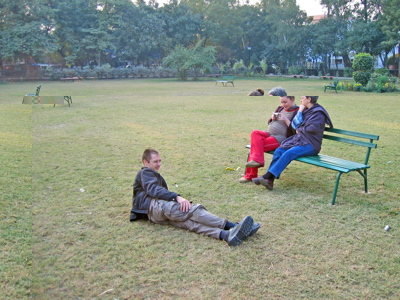
How about you tell us a bit about your neighbourhood, Yumi? You’ve done very well on the articles homework, Yumi, as have many of our readers. Out of 20 you got just 5 wrong which is fab considering how difficult they are.
Here are the answers (the ones in bold are wrong – explanations below):
Over here we’ve just had *1* *the* nice relaxing day off work to celebrate India’s 60th Independence Day. In Delhi it is celebrated every year by *2* *an* event at *3**the* Red Fort which is *4**the* huge old fort in *5**the* north of the city. *6**The* new president *7* (*a* woman – hurrah!) did *8**na* speech although I haven’t yet heard what she said because we don’t have *9**a* TV. There is also usually *10**the* commemoration at *11**the/a* monument called ‘India Gate’ near *12**the* eternal flame which burns all day and all night to remember *13**the* soldiers who have died while fighting for *14**na* India. All *15**the* shops and markets all over *16**the* city are closed, which is very rare. There is also *17**a* big tradition of *18**the* kite-flying on independence day – people fly *19**na* kites while standing on their (flat!) roofs and try to knock each other’s kites out of *20**the* sky! It’s all very good-natured though.
*1* this should be ‘a’ because hopefully there are lots of nice relaxing days off work, not just one!
*4* here again, it’s not clear that it’s the only old fort in the north of the city, so we would use ‘a’
*8* in this pattern, subject + verb + countable noun you need an article, here ‘a’ because she’ll probably be doing lots of speeches
*10* here also we would expect there to be more than one commemoration at the eternal flame, so it should be ‘a’
*11* actually you didn’t get this one wrong, but it is possible to use either ‘the’ or ‘a’ in this case
*18* here ‘kite-flying’ is a verb used like a noun so we don’t use an article.
Okay, now for today’s homework… a bit more work on prepositions as this seems to be another of your weak spots Yumi (there aren’t very many!) I recommend that when you learn a new verb and write it down in your vocabulary book, you should write down any prepositions that commonly go with it. Try to think about ‘chunks’ of language rather than just individual words.
Have a look at this list of verbs used in the short sentences here and see if you can tell me what prepositions normally go with them… you might spot some review questions in there!
I was very impressed **** him.
It looked very familiar **** me.
I am quite familiar **** his work.
It varies **** country to country.
It varies **** countries.
I think you should speak **** him about it.
Have a go – answers next time :-) Meanwhile, take care…
Amy
Vocabulary for you!
Dreaded
Residential
Shady
Striking
Storey
A flat
To be keen on an idea
Handy
Fab
posted on Monday, 20 August 2007 | comment on this postWorking dinnersHi Yumi! Hello everyone!
Lucky you going to Korea for a holiday – that sounds great. Some friends of mine worked as teachers in Korea for a few months and it sounds like a very interesting country. Also my boss’ wife is Korean and she recently taught me how to make ‘Kim bap’ which is very similar to Japanese sushi rolls – mmmm scrumptious. Actually, I made some for lunch last night and had it today. It’s one of my favourite things to have because it’s quite easy and tastes so healthy, if ya know what I mean. I make the rolls with egg and vegetables in the middle though, not fish. Yum! Ooh that reminds me - I promised some of our readers that I would post a vegetarian recipe here one day. I haven't forgotten! I just have to decide on one first...
Okay, let’s have a quick look at the answers to the homework and then I’ll see if I can answer your questions Yumi… you got 100% correct! Fantastic. Some of our readers did too so that’s great. Here are the answers just to be sure:
1. I was very impressed **by OR with** him.
2. It looked very familiar **to** me.
3. I am quite familiar **with** his work.
4. It varies **from** country to country.
5. It varies **between** countries.
6. I think you should speak **to OR with** him about it.
Just a couple of notes: for number 1, we can use either ‘by’ or ‘with’ but it changes the meaning slightly. If we use ‘by’ it means that the person is impressive in their own right. However, if we use ‘with’ it can suggest that the speaker has had something to do with the action which makes them impressed. For example, if the speaker had helped him to prepare for a performance and then the performance goes very well, they might say ‘I was very impressed with him’ whereas if they had nothing to do with the performance they would be more likely to use ‘by’. This is a very small difference though…
For number 6 (Jillany asked about this one) both ‘to’ and ‘with’ are correct. The only difference is that ‘with’ is more often used in American English and ‘to’ is more often used in UK English.
By the way, on the subject of US and UK English, Sanja asked an interesting question. She wants to know whether it is okay to use American English when taking the TOEFL test. Now I don’t know that much about this test, but the advice I always give my students is that they should choose either American or UK English and stick to it. As long as you use one type consistently then you should be okay. For example, if you spell colour ‘color’ but ‘favourite’ with the ‘u’ then that’s not so great. Having said that I would try and check on the TOEFL website to see if they mention it anywhere – you don’t want to lose marks!
Okay, now lets have a look at your questions, Yumi. First of all the question about ‘distribute’ from one of your older posts. Here is the sentence you used it in:
Have you heard of 'Maid Cafe'? There are quite a few coffee shops and the girls who wear the maid clothes will serve you. She is distributing(*2) the ads of the 'Maid Cafe'.
The way you’ve used it is fine, although I would say that it’s a little bit formal considering the tone of the rest of your piece of writing. It’s probably better to use a phrasal verb here… can all of you tell me which phrasal verb you think would be best? That’s your first task for today!
Next, you asked me about the sentences ‘Now I'm done for this week!’ or I’m done believing you from the Beyonce song. You mentioned that perhaps it was passive. Actually it isn’t passive, but it is correct. In fact, ‘done’ is used as an adjective here. We can swap it with ‘finished’ (also an adjective) and it will still have the same meaning (you might need to add the preposition ‘with’ in the second sentence). I think this construction of ‘to be done with something’ is originally US English but it’s used fairly commonly all over these days.
Finally, you asked me for some suggestions for some formal phrases for the dinner you are going to host for the Americans. Well first of all I should tell you (as I’m sure you know) that Americans tend to be more informal than formal. However, everyone likes to be treated like a king so a bit of formality can’t be a bad idea! Here are some ideas for some useful phrases – I hope this is the kind of thing you were thinking of – let me know if it isn’t:
We’re very pleased to have you here with us in Japan.
Would you like me to explain the menu to you?
Is there anything (else) I can get you?
Can I offer you some…?
What do you think of the view? :-)
I hope you have enjoyed your stay here.
We look forward to working with you again
All right, lets have a look at your other question, about the use of ‘even’, in my next post – Kay has also asked me about this.
For now, here is the vocabulary from this blog and the definitions from the last one.
Later alligators,
Amy
Vocabulary definitions from the previous post…
Dreaded: (adj) used before something that makes you feel anxious or afraid – something you are not looking forward to
Residential: describing an area where people live, as opposed to ‘commercial’ which refers to an area where business takes place
Shady: how it is usually underneath trees, where the sun is partially blocked. Often cool.
Striking: unusual or interesting enough to be easily seen or noticed
Storey: a floor of a building – e.g. I live on the third storey
A flat: UK English for an apartment, a house on one floor of a building
To be keen on an idea: to like an idea, to think it is a good idea
Handy: useful
Fab: short for ‘fabulous’, meaning fantastic, very very good
…and today’s words and phrases
Whereas
To stick to something
Consistently
To swap
To tend to be
To be treated like a king
posted on Wednesday, 22 August 2007 | comment on this postFormal or informal?All right?
Sometimes in the UK people greet each other with ‘all right?’ instead of hello or hi, but you have to say it quickly for it to sound right... it ends up sounding like ‘awwrite’ or something like that! It’s very colloquial though… I wouldn’t go saying this to your American business contacts, Yumi! :-)
Thanks for all your comments readers, I will try and answer some of them this weekend. I always enjoy reading them. Quite a few of you have asked me if I can tell you if you make any mistakes when you write your comments – this would be a bit tricky to do for everyone! I’ll try and answer all your specific questions though and point out any major errors :-)
Ah yes, before I continue – Myen noticed a mistake! When I was writing about Sanja’s question about the TOEFL exam I wrote that she wanted to know if she could use American English on the exam – of course she can! It’s an American exam! I meant to write, can she use British English on the TOEFL exam… oops. Sorry everyone! Hope you weren’t too flummoxed by this error!
So Yumi, you sound a bit worried about your business English skills! I’m sure they are much better than you think they are. You’ve asked some interesting questions. First let’s have a look at…
Formal vs informal language…
I think you’re right: English doesn’t have the same level of formal language that Japanese has, and in fact the use of English has become increasingly informal over the last few decades. Now there is a movement called the ‘Plain English’ campaign which says we should just keep things simple and not use lots of long sentences and jargon. In fact, many legal documents in the UK have been ‘translated’ from quite difficult-to-understand formal language into simpler, more straightforward language so that everyone can read and understand them.
It’s pretty funny how formal language seems to work in English though. You asked about the words would and could. Yes, you’re right, these are more often used in formal situations. Informally we would be more likely to use other phrases. As a general rule, the longer the sentence when making a request, the more formal it is. Have a look at these sentences:
Open the door.
Please open the door.
Could you please open the door.
Could you possibly open the door please.
Would you mind opening the door please.
Would you mind terribly opening the door please.
If you wouldn’t mind, please could you open the door.
If it’s not too much trouble, please could you open the door.
You see what I mean?! The sentences all say basically the same thing (they’re all requests to open the door – except for the first one which is more of an order). The level of formality increases with the number of words! It’s funny, isn’t it?!
I don’t know if you can say that ‘would’ and ‘could’ are more formal than ‘will’ and ‘can’ – in some cases I suppose they are but in others they are used differently. ‘Would’ and ‘could’ do feature in quite a lot of formal phrases though.
You can certainly say ’How do you do?’ when being introduced to someone. This is quite formal though, and some would say a little bit old-fashioned although that shouldn’t put you off. Nothing wrong with being a bit old-fashioned :-) ’How are you?’ is much less formal, followed by ’How’s it going?’ and then the very informal ’All right?’.
Using the verb ‘to prefer’
Yumi asked:
-I tend to use 'the' more often than 'a/an'.
-I prefer using 'the' to 'a/an'"
Should I use the word 'prefer'? To be honest, I am not very good at using the word 'prefer' - it was the word which I got in the quiz in high school, and I always made a mistake.
Both of your sentences are correct but they have different meanings. If you say ‘tend to’ it just means that it is what you normally do. However, if you say ‘prefer’ this means that you like using ‘the’ more than ‘a/an’. Both are grammatically correct – you just have to decide which meaning you want to convey.
You also asked:
-I prefer to drink orange juice rather than have orange itself.
-I prefer drinking orange juice to having orange itself.
In the sentences above, the reason I should use 'rather than' is, I said 'prefer to drink' so that 'to + verb' will cause repetition of 'to'?
Again, both these sentences are fine, except you’re missing the articles! You should have ‘an’ before orange in both cases. You’re absolutely right about dropping the second ‘to’ – this is quite common in English. In fact – that reminds me - Sevinc asked me a similar thing about a sentence I wrote about Gulmohar Park:
"Near our house are some beautiful parks, full of different kinds of trees." in this sentence; the subject of the sentence "Near our house" is it or not?. if so the verb "to be" should be is, isn't it! due to singular subject. but you use "are" which is used for plural subject.
Actually, in this sentence I have left out the word ‘there’ after ‘near our house’ –you can call this ‘ellipsis’, when you leave out a word so that it sounds ‘smoother’. ‘Near our house’ isn’t the subject of the sentence, that’s a separate prepositional phrase (I think! Agh!) – the subject is ‘there’ but it’s not actually written. I think this kind of ellipsis is more common when we speak but as it is a fairly informal blog, it’s okay! :-) So you see, this is a similar situation to leaving out the ‘to’ in Yumi’s sentence above.
To learn some more about formal business language why not have a look at the Talking Business page of the BBC website? There’s some really good stuff there.
Phew! This has been a bit of a heavy language session! I’ll leave talking about using the word ‘even’ until next time I think – hope you don’t mind. Ooh before I forget, the question I asked you in my last post: which phrasal verb can you use instead of ‘distribute’? Well, quite a few of our readers and Yumi had a good answer: ‘hand out’. Well done. You can also use the phrasal verb ‘give out’.
Okay, I’m off to cook dinner now. Noodles I think, yum!
In a while, crocodiles.
Amy
Definitions for you…
Whereas: this is used as a linker between two parts of a sentence to show contrast. It has a similar meaning to ‘although’ – more formal though!
To stick to something: to keep doing something
Consistently: without changing, doing something in the same way
To swap: to exchange one thing for another
To tend to be: to make the same choice about something more often than not
To be treated like a king: when people act towards you in a very nice way, giving you everything you need
…and a few new words too :-)
Colloquial
Flummoxed
Movementcheck how it’s used here!
To put someone off
To convey
posted on Friday, 24 August 2007 | comment on this postWallahsHi everyone! Yumi I’m glad to hear your business dinner with the Americans went well, I knew it would. It's always a good idea to have a killer view on hand to provide a source of conversation! That’s too bad that your boss couldn’t make it, but then maybe that was a good thing in the end? With all this entertaining you’re doing I think you deserve a promotion!
So you might be asking yourselves, what’s a wallah? Well it’s a very useful Hindi word that you can combine with all sorts of things to talk about a person who does a particular job or who comes from a particular place. For example, people who are from Delhi are called ‘Dilli-wallahs’, while people who drive taxis can be called ‘taxi-wallahs’. It’s basically just a suffix to show that you are talking about a type of person.
When we first moved to Delhi I was fascinated by all the different wallahs who walk through our colony each day plying their trade. What was even more interesting, is that each of these different trades-people have a particular noise that they make as they walk up and down the streets. For example, the fruit and vegetable wallahs shout to let you know what nice fresh vegetables they have. The kavadi wallahs also shout, but this time it’s “Kavaaaaaadi! Kavaaaaaadi!’ Some of the others use things like a horn or a bell or a little drum, but they always make the same sound so you can hear who’s around without having to look out the window or go outside. Handy!
Well I promised that I would talk a little bit about using the word ‘even’ as Yumi and a couple of our readers have asked about it. So I thought I’d make it a bit more interesting by combining it with a little description of some of the ‘wallahs’ who work in our colony each day. Read this next bit carefully and then I’m going to ask you a couple of questions as the end for homework.
The flower-wallahs
Well as you can tell by the name, the flower-wallahs sell flowers. They cycle around with a cart attached to their bicycle, full of beautiful fresh flowers. They’re not really around during the summer months but in the winter we see them everyday. Even though the flowers are more expensive than if we bought them from a big market we still buy them because it’s so convenient.
The fruit-and-veg-wallahs
Yep, you guessed it, these guys sell fruit and veg. They push hand carts through the streets with all their wares arranged in incredible displays. Sometimes they even polish the vegetables and fruit to make them look more appealing. They’re always there – pushing their carts of fruit and vegetables around, even if it’s raining cats and dogs.
The pressing-wallahs
You might be wondering what I mean by ‘pressing’ – well, it’s kind of an old-fashioned word for ironing. They use amazing huge irons which they pile full of hot coals – I still haven’t quite figured out how they control the temperature but our ironing is always perfect. They don’t move around but there have little stalls set up at various places in the colony, each with a few pressing--wallahs hard at work. We always take our ironing to the same place. They even deliver it at the end of the day!
Here’s a photo of some people having a laugh at the pressing-wallah we go to – you can see one of the irons on the edge of the table:
The kavadi-wallahs
These wallahs are really something special. Basically they recycle everything. When you’ve got a whole lot of recyclable stuff, you can call one of these guys into your house. They sort out all the things they want to take (like newspapers, cans, glass jars, bottles, etc.) and then they weigh it and then they even pay you for it!!! We were completely blown away the first time this happened. In the UK in some places you pay for your recycling to be collected and taken away!
The monkey-wallahs
The monkey wallahs cycle around with one or two monkeys on the back of their bicycle, usually dressed up in little costumes. They’re looking for people to pay them a bit of money to watch the monkeys do a little show, while the monkey-wallah plays his drum.There’s one monkey-wallah that I see quite often. He doesn’t even let you glance at the monkeys without asking you for some money! I don’t really agree with making animals perform. Even so, I sometimes sneakily watch from my terrace when my neighbours over the road pay him to make the monkeys do their tricks.
All right, hope you enjoyed that – now for the questions:
1) How many different uses of the word ‘even’ can you find?
2) What can you tell me about the position of ‘even’? Which part of the sentence does it normally go before?
Okay – just got time for the vocabulary and then I’m off to bed. I’ll write some replies to our readers’ comments tomorrow.
Good luck with the homework! Answers on Tuesday…
Amy
More definitions…
Colloquial: informal – usually used to refer to language or words
Flummoxed: completely confused
Movement: a group of people working together who share the same ideas
To put someone off: to make someone dislike or not want to do something
Jargon: (I forgot to put this one in the list!) language that is used by a particular group of people that people outside that group don’t understand
To convey: to communicate
…and more new words and phrases
Killer
To make something (*see context)
To ply
Wares
Appealing
To rain cats and dogs
To figure out
To have a laugh
To be blown away
To glance
posted on Sunday, 26 August 2007 | comment on this postTips on writing and replies replies repliesHi everyone –
Just before I get started with some individual replies, I thought I’d give you all a few tips on improving your writing, because quite a few readers have asked about that. I suggest that you read as much as possible – sounds a little strange but by reading you start to notice the way other people put their sentences and paragraphs together and this will help you to do this in a similar way.
Also, try leaving what you have written for a few hours or better still, overnight and then coming back to it. It’s always easier to find and correct errors when you’ve had a break from what you’ve written. This is true for whole essays, single paragraphs or even sentences for a piece of homework!
Lastly, try not to worry too much about making mistakes – that’s all part of the learning process. Concentrate on getting your ideas across and making sure that what you are saying is clear. Don’t try and write long complicated sentences – keep them short and simple and then the chance of making mistakes is smaller.
Okay – now for some individual attention! :-)
Sevinc - hi there, I hope you saw my answer to your interesting question in the 'Formal or informal?' post. Well done on the prepositions homework - almost all right!
Antonio - welcome back! My brother and his family live in Northern Ireland, just outside Belfast. I've only been once - it's quite an interesting place!
Silwal - hmm... you've asked an interesting question. I'm not sure what a single family is, although we sometimes refer to a 'single-parent' family: that's when there's just one parent (usually because the parents are divorced or never married). I think this is much more common in the UK than in Nepal or India! A nuclear family is one where just the parents and young children live together. You can also call your parents or your husband/wife and children your 'immediate' family. This is the most common situation in the UK. As I understand it, a joint family is when parents live with their older children who are married and have their own families. It's usually the sons you stay with their parents in India, while the daughters go and live in their husband's family. 'Extended family' refers to relatives like uncles, aunts and cousins as well as the immediate family. Hope this answers your query! Thanks for your input on the TOEFL test too. You might like to read Paulraj's comment about the joint family system, too.
Ana Paula - thanks for your kind comments! At the time that photo was taken i was nine months pregnant and getting quite fed up! I imagine it will be similar this time. It's fun being pregnant until it gets uncomfortable, then you just want to get the baby out as soon as possible!
Kay - I hope you've had a chance to look at yesterday's post where I talked about using 'even'. Have a look at the position of it in each of the sentences and see if you can figure out the rule. I'll let you know on Tuesday!
Sanja - thanks for all the compliments! :-) I hope you found my answer to your question about the TOEFL test useful. Silwal wrote something interesting about it too in one of his comments - have a look.
Diema - well done for doing the preposition homework - just a couple to double check. Keep it up!
Paulraj - thanks for all the information you gave about joint families, it was very interesting. I think there are all sorts of social changes happening in India at the moment, particularly in the metros, like you said. It seems like the social structure is becoming more similar to what it's like in the UK - fewer joint families (there are hardly any of these in the UK, except perhaps amongst British Asian families), higher rates of divorce and a lack of responsibility taken for aging parents. I I have always been fascinated by how interlinked the lives of people in Indian families are compared to in the UK where some people only see their grandparents once a year at Christmas. t's quite sad in some ways I think, don't you?
Adek - that's a good question. 'How about' can indeed be followed by the gerund, but then it must go directly after it, without a subject in between: e.g. 'How about telling us a bit about...' This is fine as long as the subject is clear. If not, then you can use the structure like this: how about + subject + verb, like I have used it. Here's another example: how about we go to the cinema tomorrow? And yes, it was quite cold when that photo was taken - it gets really cold here in Delhi in the winter. Boiling hot in the summer and freezing in the winter - it's a bit crazy!
Farzan - that’s an interesting question. You can say ‘I want to go to London early next week’ or ‘I want to go to London at the beginning of next week’. For later on the week you can say the opposite: ‘I want to go to London late next week’ or ‘I want to go to London at the end of next week’. Hope this helps! Your writing is quite good – have a look at the tips I wrote at the top of this post.
Monica - thanks for all your lovely comments! I looked through all my photos but couldn’t find one of a Gulmohar tree. I’ll see if I can take one this week though and post it for you :-) I love the name that you have in Portuguese for sticky rice – that’s so funny! I’ll try and post that recipe soon, ooh and you’ve given me a good idea for a subject for a post – I’ll write something about languages in India soon and my experiences of it… I also had a c-section with Louie and it looks likely that I will have another one with this baby although I will try not to! This baby will also be born in Delhi. The doctors here are also quite keen on doing c-sections… in England it’s the opposite because it’s free healthcare and they don’t want to spend money unnecessarily! What to do?
Adriana - thanks for posting your answers to the homework – keep reading (and writing)!
Myen - yes, that’s right – Gulmohar Park is named after the trees because there are so many of them here. As I said to Monica, I’ll try and post a picture of one soon. Next year we’re planning on moving back to England, probably in March. I love living in India but I miss my family and friends in England and am looking forward to being closer to them. Well done on the homework and for correcting your mistake!
Ahmed - thanks for all your comments. Sorry I can’t point out all your mistakes – there aren’t very many of them though! You have a good vocabulary. Well done on the homework. And I’m glad you’re enjoying the blog!
Trang - your writing’s not that bad! See the comments I made at the beginning of this post with some tips for improving writing. I’ll see if I can answer your query about those question words (ask, recommend, require, etc.) in a later blog… Meanwhile, try having a look in the dictionary and seeing if you can write some sentences with them.
Mauricio - no, it’s not that my landlord’s son is not keen on living with his father – he already does! I think he just doesn’t want to settle down and get married! Glad you are enjoying the blog :-)
Wisarut - it’s nice to hear it’s raining in Thailand too. Guess what? My parents lived in Khon Kaen in the 1970s and again after I left Thailand, from 1999-2004! I visited them there a few times, it’s a nice town. My parents aren’t Thai, both are British but they have been associated with Thailand through work and study since they were in their twenties. My favourite meal is gaeng kiew wan jae and I LOVE kanom krok!
Yasser - I work at the British Council in New Delhi! I wonder who your teacher was?! I’m sure I know him. Glad to hear you have been enjoying classes there… keep reading and writing!
Stevieboy - I think you mean ‘having said that’. You use it when you are about to say something that is opposite to what you have just said. So for example, ‘I think you will do well on the test. Having said that, you still need to study a lot’. Does that help?
Hyoshil - I haven’t heard of BiBim Bap – I’ll ask my friend to make it for me one day, it sounds delicious :-) Glad you’re enjoying the blog and I’ll pass on your regards to Louie!
Marianna - thanks for your lovely comments and it’s nice to have you back with us! I’m always amazed by how many different countries are represented by our readers, it really is incredible, isn’t it?
Suchitra - thanks for writing! Hmm… that’s an interesting question. The biggest difference between US and UK English is the vocabulary – we use some words differently and some words the other type doesn’t have at all. Also spellings are sometimes different and also grammar. For example, US English doesn’t use the present perfect tense as often as we do in UK English. They tend to use the past simple instead. For example ‘I did it’, instead of ‘I have done it’.
David - Wow! What a compliment! I think the reason you have difficulty understand some people is probably because you’re less exposed to those accents. Try and watch films made in different countries with actors from different places (speaking in English of course) and this will help. I think everyone finds some accents difficult to understand, even I do! There are even some British accents which I have to listen very carefully to before I completely get what they’re saying… it’s not just you!
Filippo - hmm.. that's difficult. I don't really have much of a sweet tooth although I do like chocolate cake every now and then! I think if I had to choose I'd go for savoury foods...
Moham - well we've kind of chosen some names but they're secret! So perhaps the maths teachers have the right idea! :-) I'm glad you're enjoying the blog. Have a look at my comments above for some ideas on improving your writing.
Robert - thanks for writing. Have a look at the tips I’ve given at the top of this post for improving your writing skills – hopefully they should help you… Don’t worry about making mistakes! Try keeping a diary in English too so that you have lots of practice. That should also help.
Sorry if I’ve missed anyone out! Vocabulary definitions etc. coming tomorrow…
All the best,
Amy
posted on Monday, 27 August 2007 | comment on this postGranny and GrampyI’m sorry I didn’t get a chance to blog yesterday. This time I was the one doing the entertaining, not Yumi! I invited three new teachers round to my house for dinner as they’ve only recently arrived in Delhi. We had vegetarian lasagne and when they left one of them said that he doesn’t normally like vegetarian food but that the dinner was delicious, so I guess that’s a good thing! So anyway, I didn’t have time to write unfortunately so here I am with all the answers you’ve been waiting for today.
Let’s get straight down to work.
In the last post I asked you to do two things: tell me how many different ways I had used the word ‘even’ in my post and comment on the position of this word in the sentence.
In the text I wrote I used ‘even’ in 5 different ways…
1) Even + bare infinitive verb (three examples of this use)
Sometimes they even polish the vegetables and fruit to make them look more appealing.
They even deliver it at the end of the day!
They sort out all the things they want to take (like newspapers, cans, glass jars, bottles, etc.) and then they weigh it and then they even pay you for it!!!
2) Negative auxiliary + even + bare infinitive verb
He doesn’t even let you glance at the monkeys without asking you for some money!
3) Even + if + subordinate clause
They’re always there – pushing their carts of fruit and vegetables around, even if it’s raining cats and dogs.
4) Even + though + subordinate clause
Even though the flowers are more expensive than if we bought them from a big market we still buy them because it’s so convenient.
5) Even + so + comma + main clause
I don’t really agree with making animals perform. Even so, I sometimes sneakily watch from my terrace when my neighbours over the road pay him to make the monkeys do their tricks.
The function of ‘even’ on its own is to highlight the fact that there is some element of surprise in what you are saying – that it is unexpected. ‘Even though’ is used with a similar meaning to ‘although’. ‘Even if’ shows that there is some uncertainty about whether something will happen or not. ‘Even so’ has a similar meaning to ‘however’ or ‘in spite of this’.
In all these cases, ‘even’, ‘even if’, ‘even though’ or ‘even so’ are usually used directly before the part of the sentence they are emphasising – that is the general rule to remember.
So Yumi – let’s have a look at your uses of ‘even’ in your latest post…
1) A funny thing was, my grandaunt told me she was so angry at the wedding ceremony! […] Even so she could not resist it, because children must not lose face of their parents.
Here you’ve used the phrase ‘even so’ correctly – you can substitute it with ‘however’ and it works fine - you need a comma though. Two more little points – instead of ‘grandaunt’ (which makes a lot of sense) we say ‘great aunt’ and ‘great uncle’ to refer to our grandparents’ sisters and brothers. Also, the action of ‘losing face’ is done by the person who loses it – you can’t really do it for them. So you should say ‘children must not make/let their parents lose face’, or something like that.
2) But she always said she did not wanna talk about it, even not remember so I could not ask more.
Here you have used even with a negative form – there’s something wrong though. Have a look at my negative example above and see if you can correct it… here’s a tip: you don’t need to add any words.
3) She even told me that she slept only 4 hours every day to finish every daily work!
This is okay, however you need to decide what is the most surprising: the fact that she told you about this, or that she only slept four hours. If you want to emphasise the lack of sleep, where should you put the ‘even’? Also, instead of saying 'every daily work' it's better to say 'all of her daily work' or something like that.
Two questions there for you to answer for homework!
It was very interesting reading about your grandmother. I think it’s quite common for people from that generation to not want to talk about the war – wherever they are from. My grandfather (we used to call him ‘Grampy’) was in the navy and he never really liked talking about it. I can understand why – he just wanted to put it all behind him.
I think I told you before that my Grampy was born in the house almost opposite ours on the hill in Polperro. He and his family lived there for a few years and then moved just two doors down! Meanwhile my Granny lived in the middle of the village and her parents ran a dairy, with the help of her and her four siblings. They had a small business selling cream by post – they would package it up and stick labels on it and send it through the post to people who ordered it all over the country. The place where they had the dairy is now a pub.
It’s amazing when you think what our grandparents have seen during their lifetimes, don’t you think? My Granny’s father was the first person in the village to own a car – he used to drive around picking people up and taking them for a ride! And now you can hardly move because there are so many of them…
Anyway, here’s a photo of Ed, Louie, my Granny (Louie's Great-granny!) and me from this summer. My Grampy died about five years ago so he never met Louie which makes me quite sad :-( In our culture we don’t have a specific time or day when we remember our ancestors – we usually just mark the day when they died by doing something like buying flowers or visiting their grave. I think it’s good to have a special period of time for doing that though, it’s important to remember that without them you wouldn’t be who you are today – don’t ‘cha think?
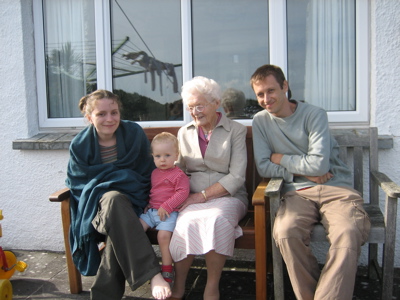
Thanks for all your comments on my previous posts. I should point out that ‘wallah’ and ‘kavadi’ are both Hindi words but I guess it’s quite likely that at least ‘wallah’ might be absorbed into the English language in the not too distant future. I’ll try and say a bit about English in India in my next post – Monica asked me some questions about that.
Also a couple of you have asked about the phrases I used ‘See you later, alligator’ and ‘In a while crocodile’ – they’re just silly phrases that children use sometimes (and adults too I suppose!). Sometimes you hear one person say one and the other person replies with the other one… they don’t really mean anything except ‘see you later’ but it’s the rhyming that makes them appealing.
Okey dokey (there’s another rhyming phrase for you!) here’s the vocabulary…
Killer: here it’s used as an adjective meaning really good (!)
To make something: here meaning to be able to attend. ‘Sorry I can’t make it to your party’
To ply: to work at some business, especially trading – buying and selling
Wares: items for sale
Appealing: attractive
To rain cats and dogs: to rain very heavily
To figure out: to work out, to solve
To have a laugh: to have fun
To be blown away: to be totally surprised or shocked
To glance: to look very quickly at something or someone
And today’s items…
A function
To put something behind you
Two doors down
To absorb
posted on Wednesday, 29 August 2007 | comment on this postPotato salad!Dear Yumi,
I’m very sad that this will be my last reply to your posts! I hope you will still continue to write comments after tomorrow. It has been very nice reading everything you have written and answering your thought-provoking questions. Even when you are half-asleep your English is very good!
You corrected your ‘even’ sentences well…
But she always said she did not wanna talk about it. She did not even wanna remember So I could not really ask anymore to her.
and…
She told me that she even slept only 4 hours every day to finish all the daily work.
Just one small point though – I think instead of saying ‘to finish all the daily work’ it would be better to say something like ‘so that she could finish all her daily chores’. Chore is a better word that work here because it is more descriptive of the kind of work she was doing in the home.
You also used this sentence in your latest blog…
We felt we can not even remember the student life, although it was just a year ago!
And here you’ve also used it correctly – well done! There’s something about the tense you’ve used at the beginning though which sounds a bit strange although I think it is still correct. It might sound better to say ‘We can’t even remember our student life’ and THEN you could use ‘even’ again by saying ‘…even though it was just a year ago!’ Whaddya think?
It was interesting reading about your student days… I finished university in 1999 – it really does seem very far away! I met Ed, my husband, at university, so I’m glad I went, but I didn’t have the time of my life while I was there. - mostly because I missed all my friends from school. I studied Experimental Psychology which was quite interesting, but I think if I was to do it all over again I would do something like South Asian Studies or something like that. I don’t know what it’s like in Japan, but in the UK you have to decide what your major subject will be when you apply. In the US I know that you decide in your third year which I think is much better. I was only 16 when I decided which subject I would do!
Oh yes, you also asked in another post about whether getting married when you were over 28 was too old. Well these days in the UK I think it’s quite common to be at least that age when you get married. Ed and I got married when I was 26, and then had Louie when I was 28. People keep telling me that that’s quite young to have a baby these days as so many women in England concentrate on their careers before having children. I always wanted to have children when I was relatively young though.
Okay – now I promised ages ago that I would include a vegetarian recipe so in your honour, Yumi, I have decided to give you and all our readers one of my favourite recipes and the only thing I have had a craving for since I have been pregnant this time… Potato salad! Okay… I know it’s only a simple dish but it is delicious and very easy to make – and who doesn’t love potato salad! I know it’s quite popular in Japan. The secret of this one is in the dressing…
Ingredients:
5-6 medium sized potatoes
Pinch of salt
Pepper
1 small onion or 3 spring onions.
1 small handful of fresh parsley
Four tablespoons of yoghurt
Two tablespoons of mayonnaise
Method:
Peel the potatoes and boil them in water with a pinch of salt. Meanwhile, chop the onion very finely into small pieces. If you are using spring onions chop both the white and green parts. Make the dressing by mixing the mayonnaise and yoghurt with a little bit more salt and some freshly ground pepper. Chop the parsley and add this to the onion. When the potatoes are cooked (be careful not to overcook them or they will go all mushy), let them cool for a while until they are just warm, not hot. Add them to the onion and parsley and pour over the dressing. Mix it all together. If you want a bit more dressing then add more yoghurt and a little bit of mayonnaise. Put it in the fridge and let it cool and then eat! Yum scrum! It’s best served with a green salad (lettuce, tomatoes, cucumber etc) and makes a lovely lunch.
Well I hope you like the recipe and that you can buy all the ingredients where you live. If you'd like to see some more vegetarian recipes have a look at the BBC Good Food website. There are heaps of non-vegetarian recipes too.
Okay Yumi well I wish you all the very very best for the future and like I said at the beginning it has been great blogging with you :-)
Take good care and don’t work too hard!
Love,
Amy xxx
p.s. I really liked your photo from the Taj Mahal – here is one of us!

Vocabulary definitions from last time:
A function: what something does, it’s reason for existing!
To put something behind you: to stop thinking about something and start concentrating on other things.
Two doors down: two houses away
To absorb: to take in, to make part of something
And today’s…
Thought-provoking
Half-asleep
Chore
The time of your life
Craving
Dressing
Finely
Mushy
posted on Friday, 31 August 2007 | comment on this post | |


