November 2009Musicians and moneyHi Cheikh,
Your postings just get more and more interesting. You've really opened my eyes to a brand new (yet very old), culture. Thanks!
You've hit the nail on the head when you talk about how each of us often thinks that it's everyone else's culture that's strange, never our own. A lot of people think, 'Whatever I do makes perfect sense. But what you do is so weird!'
I'm fascinated by the people who can march into your house, and by virtue of being able to play a musical instrument, demand to be paid. I can play a few chords on the guitar. How would I do in Mauritania?
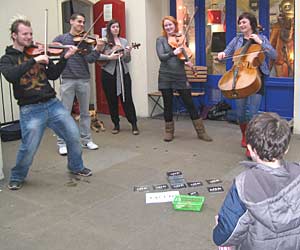
I was thinking of you while I was out at lunchtime today. I was in Covent Garden, a busy shopping area in the middle of London (just a 5 minute walk from Bush House, where the BBC Learning English office is). It's popular with tourists so there are often street performers putting on acts for the visitors. Today I saw some musicians playing and they had a little green basket on the ground in front of them. People who'd enjoyed their music were encouraged, by the buskers, to drop a few pennies into the basket. I thought, if they were in your neck of the woods, they might not ever need the basket!
Looking at your last two postings, I thought we'd concentrate on agreement today. In English, verb forms change depending on whether the subject is singular or plural. For example,
The bus was late. (singular noun, singular verb)
The trains were full. (plural noun, plural verb)
That's easy enough, the tricky bit is to remember to keep your subjects and verbs singular throughout your sentence – from beginning to end.
You also need to keep a similar subject throughout your sentence. For example, if you start a sentence talking about they, you can't finish the sentence talking about him.
Here are a few examples from your writing where you start off OK but as your sentence progresses you change from singular to plural or vice versa.
There are a few words in bold in the first two sentences below to highlight the words that need to agree. In the final two sentences I haven't bolded anything, just to make your task a bit harder!
… but your comments which I really appreciate and will soon reply to – spurs me to carry on.
Some of us also ask the dead for help and believe that their ancestors still have a great role to play in their own lives; they watch them and protect them from evil.
…who must be a religious scholars.
It (slavery) is still a hot debate over here, whether it exist or not.
Here are a few more words that should be one word, not two:
any one
some one
And here a a couple of vocabulary items to consider too:
All is used to talk about more than 2 things.
Both is used to talk about 2 things (though if we use both, we don't need the word two in the sentence as well). How could you improve this one?
I read all your 2 blogs.
A more usual word than incriminate is outlaw + verb+ing (For example, They outlawed begging last year.), or make it a crime to do something. (The government made it a crime to discriminate against older people)
So your final task is to improve this sentence. You've got a few things to think about here. It starts in the past and then goes into the present tense. There are two words that should be one. And the word incriminates isn't correct.
We passed a law that incriminates to call some one a slave.
Hope you have a good weekend.
All the best,
Nuala
Vocabulary
You've hit the nail on the head – (idiom) You've described exactly what the situation is
makes perfect sense – is very logical
weird – (informal) very unusual
march – walk in a very determined way
by virtue of being – because they are
chords – when you put your fingers on an instrument (here, a guitar) and play notes together in harmony
putting on acts – showing off their talents (singing, playing a musical instrument, doing a card trick, etc.)
buskers - people who play musical instruments in public for money
a few pennies – one or two coins, a small amount of money
your neck of the woods – (informal) near where you live (or work)
progresses – goes on, continues
vice versa – the same is true in the opposite order (here, I said your writing changes from singular to plural. But I also meant it sometimes changes from plural to singular)
posted on Friday, 06 November 2009 | comment on this postPolitical business as usualHi Cheikh,
Another post, another fascinating insight into your world. Your last posting about corruption in politics, and civil servants who look after their own, was very interesting indeed.
But I have to say, when I look at the recent British political landscape, I don't see too many differences between our two countries.
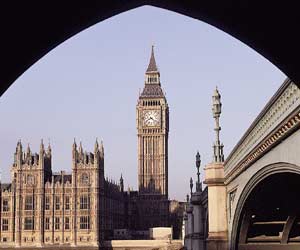
I don't know if you've heard the story, but the most recent scandal here has been about the amount of money our elected politicians (MPs) have been claiming. If they've paid for a train ticket to go to a meeting on political business, it's perfectly reasonable that they should be able to get the money back. No problem there. But how about claiming money back for cleaning a bird house in your garden? I don't think so! Maybe it is true that 'politics is a dirty business' after all!
Now, to your post. Let's look at some vocabulary (including some more of those troublesome words that are written as one word, rather than two).
bile criticism
This should probably be vile criticism. Bile is the liquid you throw up, when you're being sick and finally have no more food to bring up.
…is down to two folds
You can either say:
is down to two things
or
is twofold
And notice as well that twofold is one word.
…handing out power to the civilians
Should be:
handing power to the civilians
If you hand something to someone, you give it to them. If you hand out something, you give something free to people who need it (for example, food or clothes)
There were a couple of words I wasn't sure about. When you were talking about bribes, you said:
staff of the circuit that the paper has to go through
I'm not sure what you meant by circuit. I thought maybe department or area but I'm not sure.
And footy confused me too in this sentence:
… many people live on a footy amount monthly
Did you mean tiny? Footy is informal for football.
Here are seven words from your posting that should be written as one word, rather than two:
some thing
an other
out side
arch- enemy
what ever
every day
home work
So my challenge to you Cheikh is to write your next posting while keeping a sharp eye on these tricky one word monsters!
All the best,
Nuala
PS Most of your last homework was fine but have a look at 4 and 5 again if you've got time. You need to put both in another position in sentence 4. And in the final sentence, the pattern is: We passed a law that + outlawed + verb+ing.
4. I read your blogs both entirely.
5. We passed a law that outlawed to call anyone a slave.
vocabulary
look after their own – care for their family and friends only
keeping a sharp eye on – looking carefully for
landscape - situation
don't see too many differences – both are very similar
scandal - event or behaviour which the public disapproves of or that that causes the public to feel shocked
claiming – asking for the money that you have already spent to be given back to you (for example, for staying in a hotel on a business trip)
a dirty business – a corrupt or dishonest situation
throw up – empty food from your stomach through your mouth
keeping a sharp eye on – looking carefully for
posted on Wednesday, 11 November 2009 | comment on this postIt's half past northHiya Cheikh,
I feel so mellow after reading your last posting I'm not sure I can make myself meet my deadline of writing back to you by the close of play today!
The vision you conjured up of staring up into the vast night sky, drinking camel's milk and composing romantic verses has unsettled me entirely. You've made me realise I don't need a watch or clock, it's a compass that's missing in my life!
I'm looking out the window at the dull, grey London skies and the rain falling down in sheets against the anonymous, brick city offices and thinking thoughts that have nothing to do with work. You've inspired and corrupted me too. I need to get back to nature. Here's what I should be doing right now:

Ah, I feel better already!
Reluctantly, I turn back to work…. Today, I thought we'd look at some rules about punctuation, as well as some rules about articles.
Throughout your last post you used brackets (...) when you should have used quotation marks " …" For example:
I hope your answer was a resounding (no)
should be:
I hope your answer was a resounding "no"
We use brackets to add some detail that might not be essential (but is, the writer thinks, still somehow interesting).
I know with the blogging software we use here it's sometimes difficult to see what your posting is going to look like until you've posted it. But I do think you need to give some thought to breaking up your text more. I don't know if you write your blog on the computer first, say in Word, before inputting into the blogging software. If you don't, I think you should as that might help you notice that your posting is often one long, unbroken stream of text.
English writing can sometimes be difficult for speakers from Arabic countries because they're writing in a different script (or alphabet) to the one they're used to using for writing in Arabic. However, I believe the rules are the same in Arabic writing as they are in English – each new topic or idea gets a new paragraph.
The use of paragraphing is particularly important on the web, where a lot of people find looking at a lot of very dense text very tiring (on their eyes)
Have a look at your recent posts and see if you can find ways you could break up the text a bit. On a blog, it's often a good idea to put an extra empty line between each paragraph, just to break up your text on the screen for your readers.
In your next posting, cast a critical eye over your writing, in terms of how your paragraph it.
Next, let's talk about articles. I'm sure you know that if there's only one of something, we use the definite article the:
the Sahara, the moon, the Mississippi
But did you know that we sometimes don't use the at all? For example, when we're talking about generalisations with plural nouns (films):
I love films, don't you?
And with uncountable nouns (music):
I find music very relaxing.
Here a few examples from your last blog where you used the but you shouldn't have:
… to keep up with the chock-a-block life
… away from any kind of distraction about the nature
… and the human fate
Next, let's look at the indefinite article (a and an). We use the indefinite article when we introduce something for the first time in a conversation, when we mean one. Here are a few examples from your blog where you're 100% on the money using indefinite articles:
… from a hectic day
… perform a new sort of meditation
… on a trip my friends and I took
Now, here's your homework. Below there are 10 sentences taken from your last blog. Your job is to decide if each sentence is correct or not in its use of articles. I've thrown in one sentence where agreement is the issue. If you sort out the agreement, the articles will be ok then too.
One final clue before you start - there are five correct sentences:
1. Are you run off your feet most of the time?
2. You would wake up every day without alarm.
3. Then you would watch the lonely rising sun.
4. … it sinks … behind the sand dunes.
5. … you want to take look.
6. … the tea maker has enough time
7. The Bedouins here spend several hours holding a green tea ceremonies
8. … in the modern civilization
9. Though we are called underdeveloped world …
10. We prefer the compass to the watch.
Thanks again for a really inspiring posting. I'm going home now and I'm going to throw away my alarm clock for good!
All the best,
Nuala
Vocabulary
mellow – very relaxed
the close of play – (from cricket) at the end of a match. Now used in business to mean at the end of the business day (usually 5.30 pm)
conjured up - made something appear as if by magic
unsettled me – changed the way I usually think things should be or have to be (usually when we use unsettle we mean change in a negative way. I'm using it here to show that some people might think my new way of thinking is very radical and therefore wrong)
sheets – (to talk about rain) a lot of
corrupted me - made me think bad thoughts (that work isn't so great after all and that the relaxed life is more for me)
breaking up separating out, leaving space between
stream - continuous flow of things (here, words on the page)
dense – very concentrated
cast a critical eye over – look at something in a critical way (trying to find mistakes or errors)
100% on the money – 100% correct
for good – for ever
posted on Friday, 13 November 2009 | comment on this postLife in the slow laneHello Cheikh,
Thanks for your interesting posting about life in the slow lane.
My life often feels like this:

But along with a lot of city people, I'm trying to find ways of slowing things down a bit. In fact there's a whole movement dedicated to slow food. The folks at Slow Food are concerned that we've lost our interest in where food comes from, how it's grown, how we buy, cook and eat it.
We also have an online feature you might be interested in at BBC Learning English. It's called Slow London.
But maybe this is all just the tip of the iceberg. After reading your blog I think we need a world-wide push for Slow Everything! Maybe you'd like to take the lead on this project Cheikh. I'll supply the images!
Today I thought we'd look at some punctuation (inverted commas, sometimes known as 'scare quotes'), as well as some common collocations (or words that go together) and other vocabulary.
I'm sure you know that when you want to show the exact words that someone has said, you use inverted commas or quote marks.
He said, "I'm from Paris."
But we can also use quote marks to show our distance from a word or idea.
Keith thinks his poems are fantastic but I'm not impressed by his "art" at all.
Here, the speaker is saying s/he doesn't think that what Keith writes is poetry at all, even though Keith clearly thinks his writings are very poetic.
In this example from your posting I think there are two words that you could have put in scare quotes, while the word suicide doesn't need the quotes at all. Which words would you like to show you disagree with or would like to distance yourself from here?
This horrible crime "suicide" has become an almost normal act in the civilized world.
Here are some common collocations which means get things done
achieve goals
do things
do activities
complete tasks
meet deadlines
However, we don't achieve activities in English. What collocation would you like to put in here instead?
… you can drive your car and achieve many different activities
This next sentence I'd like to look at is quite complicated:
Today's discussion aims only to argue that we can't seem to get a benefit in our progress without losing another.
The word only is in the wrong place. Where you have it just now means the only thing you want to do today is argue. You don't want to talk, eat, dance or laugh, the only thing you want to do is argue.
Where it needs to go is near the benefit if what you want to say is that the benefit is the only thing to be discussed. However, there are a couple of problems to be sorted out there first.
Only already has a negative meaning but you've got a negative with benefit – can't seem to get. So, first you need to change the negative part of benefit into a positive. Secondly, the collocation with benefit is have or gain. Thirdly, the second half of this kind of only phrase is by + verb+ing. For example:
We only got to go to the party by promising to come home by 10.30.
He only finished the work by staying really late at the office last week.
So to re-cap, to improve this sentence, you have four things to do:
move only
change the benefit part from negative to positive
choose the right collocation for benefit
delete some words in the second half of the only phrase and add by + verb+ing (by losing)
So can you see how you could improve your original sentence?
Finally we use on the contrary when we want to contradict what has been said previously. We often use it if we want to disagree with someone else who has spoken or written. For example:
A: Rich people are generous.
B: On the contrary, I find people who have a lot of money want to keep it all to themselves.
In the paragraph before you use On the contrary you're talking about how people in the desert have a lot of time to think about and consider things. The paragraph that follows contrasts the desert with the city. So a better introductory phrase would be:
In contrast
However
On the other hand
That's all for today. Looking forward to hearing from you soon,
Nuala
Vocabulary
the slow lane – the slow lane is the part of motorway or highway where slower cars drive (as opposed to the fast lane). Here, it means a way of life that isn't hectic or fast-paced but slow and relaxed
concerned - worried
dedicated – putting energy, time and effort into something
just the tip of the iceberg – only a small noticeable part of a problem, the total size of which is really much greater
take the lead – be the boss, be in charge of or be the manager
posted on Tuesday, 17 November 2009 | comment on this postWedding day blues and pinksHello Cheikh,
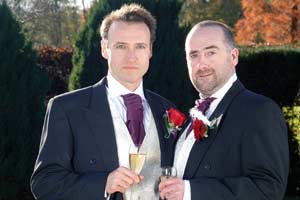
Thanks for telling us about the wedding traditions in Mauritania. It's so interesting to see the differences between our two cultures in wedding celebrations and ceremonies. In Britain, if a bride didn't smile on her wedding day, most people would think something was very wrong indeed. It's fascinating to learn that a woman's smile on her wedding day isn't a universal expectation.
An old tradition we have over here for a bride is that on her wedding day she should have or wear:
Something old
Something new
Something borrowed
Something blue
to bring her good luck.
On a more modern note, something you might find interesting is that five years ago the law was changed here in Britain. Now gay or lesbian couples can formally declare their love and commitment through civil ceremonies in this country. As far as I know no Muslim countries recognise gay and lesbian relationships. Do you have any gay or lesbian friends in Mauritania? What do you think about same-sex civil partnerships?
Turning to your post, I thought we'd look at word order, too many/too much, the present simple and a few bits of vocabulary.
In your posting, you wrote:
… they slightly differ from one district to another
Usually adverbs come after the verbs the talk about, describe or modify:
She ran quickly
They sang beautifully
And here's an example of a couple of words where the order should be reversed:
… her coming up marriage
Sometimes there's no real logic for why words are in the order they are; it's just the way they are. For example:
… the mission is yet to be over
is usually written like this:
… the mission is not over yet
Next, too many and too much. When we use too many or too much we mean that there is a lot of something, and that we don't like it. We mean in a negative way that we don't like the situation. So for example, we might say:
There's too much pollution in London
or
There are too many dogs in the park
to show that in this situation we think the pollution and dogs are a bad thing and that there is too much of one and too many of the other.
With that in mind, let's look at your sentence:
There are too many social traditions here in Mauritania
Do you really think the traditions are a negative thing and that there are too many of them in your country? If not, how would you re-write that sentence?
Finally, let's revise the present simple. It's formed like this:
verb
I drive
you walk
we write
they look
verb+s
he sits
she runs
it eats
And one of its uses is to talk about habits or things that happen repeatedly. Your stories about what traditionally happens at weddings is a good example of where we'd usually use it.
On the whole you used the present simple very well when you were talking about weddings in Mauritania. However, when you were talking about the 'kidnapping' tradition in rural areas, you started using a lot of woulds and the past simple. I've bolded some verbs below to highlight what I mean. Have a look at them and see if you can figure out a better way to tells us about this tradition.
One more very strange tradition which is more common now in rural areas, is that the bride close female friends would try their best to kidnap her at any time during the wedding party which usually goes on for seven consecutive nights. When they succeed, they would hide her away from the groom friends. Sometimes even take her outside the neighborhood and make sure to limit the number of people who know her whereabouts.
Socially, the bride must conspire with them and abide by the plot instructions, otherwise she would be considered a bad girl.
Then the groom and his friends would have to embark on searching the whole area, house-by-house, looking for her until they find her.
And even then, the mission is yet to be over, they would have to fight the bride female friends until they free her completely and bring her back to the groom. Sometimes she manages to stay for several days in her hideout.
In some areas, failing to get her would mean that the groom has failed to live up to his responsibilities and consequently lose his bride.
Just before I sign off, let's look at a couple of bits of vocabulary from your posting to the commentators:
Taru - … that kind of language would prople them to think.
Did you mean probe or prompt??
Taru - … the frizzing weather
Did you mean freezing?
Sunshine - make this name more attracting
Attractive is the form you would usually need in a sentence like this. But actually I think there's a better word - pertinent (which means relevant). Is that what you meant?
Sunshine – hedge you name
Did you mean hide?
Sunshine – … they used to burry newborn girls burry
The correct spelling is bury
And finally, a word about your homework. You did very well on it. Top of the class Cheikh! I was interested in the words you chose for your scare quotes. When I was writing to you, the ones I was thinking about were 'crime', and 'civilized' but I think your choice of 'normal' was perfectly justified too.
One last thing about sentence 3. You've changed it beautifully but there's just one more thing we could do to make it really perfect. It would sound more natural if you changed a to one, like this:
… we only gain one benefit by losing another.
That's all for now,
Nuala
Vocabularya universal expectation – expected everywhere
commitment – willing to give your time and energy to something that you believe in (here, a relationship)
civil ceremonies – official, formal (but not religious) acts, often fixed and traditional, performed on important social occasions
posted on Monday, 23 November 2009 | comment on this postGiving thanks for what we're givenHi Cheikh,
Thanks for your last posting telling us what you imagine someone's first experience of air travel might have been like. It was funny and eye-opening! I particularly liked the part about wearing electronic hats and being able to chat together without language.
It's a fascinating thing to do – trying to think about an ordinary, everyday experience from someone else's point of view – and one probably all of us should try to do a bit more often.
It was Thanksgiving yesterday. You asked if we celebrate it here. The answer is mostly no – it's an American and Canadian holiday. But since my partner's American, I do sometimes get involved in a turkey with all the trimmings feast (well, a nut roast for me, because I'm vegetarian). Here's a snap taken at an American friend's flat last year where we all celebrated Thanksgiving in London.
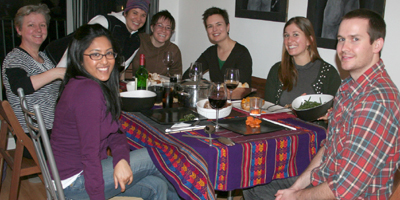
And here's dessert – traditional pumpkin pie. I'll fess up now – I didn't really like it. Pumpkins are a vegetable to me. It just seems weird eating them in a pudding! If we're going for an American meal, give me apple pie and ice-cream any day.

Let's look now at some of your writing from your last post. Your meaning is very clear most of the time and you've used lots of interesting expressions. For example:
common ground
They are studying to get a job rather than to form a broad view of the world.
I can't deny the contributions that most celebrities make …
hindering
Your dog wouldn't take you to court
I couldn't really find a grammatical or vocabulary-based theme in your work today for me to focus on and give you feedback about. So instead, I'm just going to look at two or three parts of your posting in a bit of detail.
First of all, I'm not sure what you wanted to say here:
While I was wandering in the desert, for some description, suddenly the whole sky was lit up and I couldn't recognize what was going on.
Perhaps for some inspiration?
The beginning of this sentence isn't quite right:
All what I remember is that I felt I was traveling so fast.
You could either say:
All that I remember is …
or
What I remember is …
A note about spelling. I presume because you've spent time in the States that your spelling is American. But if you, or any of our blog readers, are interested in British spelling, travelling is a good example of one of the differences between American and British spelling. American spelling often goes for one l when you add –ing to a word that ends in l. For example:
traveling
fueling or re-fueling
Whereas in British English the final l is usually doubled in those words:
travelling
fuelling or re-fuelling
Another word that you spelled correctly in American English was the word practice, when you used it as a verb here:
The experience I got (had) there can not be taught or found in books. It must be lived and practiced.
In British English, we make a distinction between the verb and the noun in words like:
practise (verb) – practice (noun)
advise (verb) – advice (noun)
A general point about your writing is that you tend to use the pronoun he almost exclusively. It may be a deliberate choice, and if so, that's fine. However, you may like to consider being more inclusive in your writing. For example, let's look at one of your sentences (and I've re-phrased it a bit. I hope you don't mind):
When anyone wants to travel across the planet, all he needs to do is to specify where he wants to go and he is there in a jiffy.
You could make it more inclusive by saying:
When anyone wants to travel across the planet, all he or she needs to do is to specify where he or she wants to go and he or she is there in a jiffy.
or
When anyone wants to travel across the planet, all s/he needs to do is to specify where s/he wants to go and s/he is there in a jiffy.
or
When people want to travel across the planet, all they need to do is to specify where they want to go and they are there in a jiffy.
or
When anyone wants to travel across the planet, all they need to do is to specify where they want to go and they are in there in a jiffy.
Some more traditional grammar books might say that anyone … they is wrong, but actually this usage has been around for a very long time. And more recently it's become popular because people are trying to move away from using he to mean everyone and the other options above (he or she and s/he) seem quite clumsy.
Hope that helps a bit! That's all for now. Hope you have a good weekend.
Best wishes,
Nuala
Vocabulary
eye-opening – very surprising and which teaches you new facts about life, people, etc
a nut roast – a vegetarian dish made of nuts and eggs
fess up – fess is short for confess which means to admit or say that you did something that you know was wrong (here, I'm suggesting that saying I don't like pumpkin pie is wrong because it's such a central part of a Thanksgiving dinner)
weird - unusual
pudding – dessert, the final part of a meal where people usually eat pies cakes fruit or other sweet things
almost exclusively - nearly all the time
clumsy – awkward posted on Friday, 27 November 2009 | comment on this postYour good news storyHello Chekh,
Your news story about the Humanity Vitamin Plus vaccine was a lovely way to finish your November blog. Thank you Chekh!
It's been a real pleasure blogging with you and I'm sure I speak for all of our blogging readers and commentators when I say how interesting and thought-provoking we've all found your postings this month. Thanks for sharing so many interesting stories and photos about your country, culture, wedding customs and national dress!
I'll sign off now but before I do, I'd just like to tell everyone that in December we'll be having another open blog, when we'll be able to catch up with previous student and teacher bloggers. So although I'll say goodbye to you now, I hope we'll be hearing from you again very soon.
Best wishes,
Nuala
posted on Monday, 30 November 2009 | comment on this post | November 2009
| Sun | Mon | Tue | Wed | Thu | Fri | Sat |
|---|
| 1 | 2 | 3 | 4 | 5 | 6 | 7 | | 8 | 9 | 10 | 11 | 12 | 13 | 14 | | 15 | 16 | 17 | 18 | 19 | 20 | 21 | | 22 | 23 | 24 | 25 | 26 | 27 | 28 | | 29 | 30 | | | | | |
|


