


Musicians and money
Hi Cheikh,
Your postings just get more and more interesting. You've really opened my eyes to a brand new (yet very old), culture. Thanks!
You've hit the nail on the head when you talk about how each of us often thinks that it's everyone else's culture that's strange, never our own. A lot of people think, 'Whatever I do makes perfect sense. But what you do is so weird!'
I'm fascinated by the people who can march into your house, and by virtue of being able to play a musical instrument, demand to be paid. I can play a few chords on the guitar. How would I do in Mauritania?
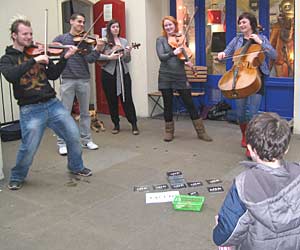
I was thinking of you while I was out at lunchtime today. I was in Covent Garden, a busy shopping area in the middle of London (just a 5 minute walk from Bush House, where the BBC Learning English office is). It's popular with tourists so there are often street performers putting on acts for the visitors. Today I saw some musicians playing and they had a little green basket on the ground in front of them. People who'd enjoyed their music were encouraged, by the buskers, to drop a few pennies into the basket. I thought, if they were in your neck of the woods, they might not ever need the basket!
Looking at your last two postings, I thought we'd concentrate on agreement today. In English, verb forms change depending on whether the subject is singular or plural. For example,
The bus was late. (singular noun, singular verb)
The trains were full. (plural noun, plural verb)
That's easy enough, the tricky bit is to remember to keep your subjects and verbs singular throughout your sentence – from beginning to end.
You also need to keep a similar subject throughout your sentence. For example, if you start a sentence talking about they, you can't finish the sentence talking about him.
Here are a few examples from your writing where you start off OK but as your sentence progresses you change from singular to plural or vice versa.
There are a few words in bold in the first two sentences below to highlight the words that need to agree. In the final two sentences I haven't bolded anything, just to make your task a bit harder!
… but your comments which I really appreciate and will soon reply to – spurs me to carry on.
Some of us also ask the dead for help and believe that their ancestors still have a great role to play in their own lives; they watch them and protect them from evil.
…who must be a religious scholars.
It (slavery) is still a hot debate over here, whether it exist or not.
Here are a few more words that should be one word, not two:
any one
some one
And here a a couple of vocabulary items to consider too:
All is used to talk about more than 2 things.
Both is used to talk about 2 things (though if we use both, we don't need the word two in the sentence as well). How could you improve this one?
I read all your 2 blogs.
A more usual word than incriminate is outlaw + verb+ing (For example, They outlawed begging last year.), or make it a crime to do something. (The government made it a crime to discriminate against older people)
So your final task is to improve this sentence. You've got a few things to think about here. It starts in the past and then goes into the present tense. There are two words that should be one. And the word incriminates isn't correct.
We passed a law that incriminates to call some one a slave.
Hope you have a good weekend.
All the best,
Nuala
Vocabulary
You've hit the nail on the head – (idiom) You've described exactly what the situation is
makes perfect sense – is very logical
weird – (informal) very unusual
march – walk in a very determined way
by virtue of being – because they are
chords – when you put your fingers on an instrument (here, a guitar) and play notes together in harmony
putting on acts – showing off their talents (singing, playing a musical instrument, doing a card trick, etc.)
buskers - people who play musical instruments in public for money
a few pennies – one or two coins, a small amount of money
your neck of the woods – (informal) near where you live (or work)
progresses – goes on, continues
vice versa – the same is true in the opposite order (here, I said your writing changes from singular to plural. But I also meant it sometimes changes from plural to singular)
Comments
Hi Nuala, thanks so much for your posting,i've learnt a lot of knownledge from you after reading your comment. Thanks and have a nice weekend
I enjoy to read your post and it is helping me to brush up my intermediate english.
Hello Naula! Your post is excellent. You’ve covered a lot of important grammatical structures which are useful for a learner. I’ve tried to correct the sentences which you pointed out to be incorrect from Cheikh post. Let’s startoff: 1. ....but your comments which I really appreciate and will soon reply to are spurs me to carry on. 2. Some of them also ask the dead for help and believe that their ancestors still have a great role to play in their own lives; they watch them and protect them from evil. 3. who must be a religious scholar. 4. It (slavery) is still a hot debate over here, whether it exists or not. 5. I read all your blogs. 6. We made it a crime to discriminate anyone as a slave. Have a nice weekend! Bye for now. Mahjabeen
hello! You`ve used informal language in the entry. Is it necessary to teach students informal English?
Hi Naula, You are hitting the nail on the head by discussing the grammertical mistakes.Your presentation with examples are interesting.We generally came across buskers here in trains but without instrument. Have a nice day. Thanks
Thanks for all your contributions. This blog has now closed and can no longer accept new comments.


