June 2008Hello from Portsmouth!Hello everyone! My name is Sophie and I’ll be blogging on this website throughout the month of June. I’m looking forward to getting to know you all and helping you as much as I can. I think this teacher-student blog is a terrific idea and I hope you’ll take as much advantage of it as possible.
I’ll begin by introducing myself a little: I was born in 197X in London, within shouting distance of Wembley Stadium. When I was 13 my family and I moved to France (my Mum is French), so I grew up bilingual. When I was 18 I went back to the UK to attend university, where I read Politics and International Relations. After I got my degree I decided I wanted to travel the world so I studied some more and became an EFL teacher. My first job was in Poland – it was pretty cold there. My next job was in Russia – even colder! I met my husband in Moscow and then we both moved to Egypt where it was much warmer! For the past six years we’ve been living in Japan but now I’ve decided to come back to the UK to study (again!) as a French and German teacher. The course will take a year but right now I’m on a three-month summer intensive refresher course at Portsmouth University to brush up on my German language skills as they’ve lain pretty dormant since I was last at school. It’s a lot of fun being back in the classroom as a student again, but it’s also quite hard work. I could do with a German teacher-blogger to help me! So there you are: my life so far in a nutshell.
I’d love to know where you’re all from so please, don’t be shy, write in and tell me a little bit about yourselves. It’s also very useful to be able to tell people about yourself when you meet them socially or in an interview setting. Plus, you never know what you might have in common!
Lukasz, I enjoyed reading your blog. Where are you from in Poland? (I lived in Bydgoszcz for a year.) It’s a pity you’ve never been in the UK for more than a week at a time, and in London too, which is quite cosmopolitan to say the least, so it doesn’t surprise me to learn that you’ve had trouble meeting people whose native language is English! You’ll probably need to do a homestay the next time you come to the UK for a week – it’s a brilliant way to immerse yourself, not only in the language but also in the culture. Did you study English at school in Poland? What was that like? Have you been studying English since? Some of your colloquialisms and vocabulary are of quite a high standard. Have you taken any EFL exams such as FCE or IELTS? This might be a good idea if you want to use English in a future job. I feel as though I know what you’re talking about: I have also decided to change career (albeit in the same type of profession). It’s certainly a tough decision to make but it’s good to dip into something new and challenge yourself. Do you have any ideas about what you’d like to do? Now that Poland is a member of the EU there are many Poles who’ve upped sticks and are living over here. There are now quite a few delis offering Polish pickles and sausages! Do you have any friends or relatives who’ve left Poland for the UK? Would you ever consider taking the plunge yourself? I look forward to reading more about you and your interests.
Here are a couple of corrections for your blog (not many!):
1) ...the IT career... You need to define the career you had with the definite article ‘the’ even though you made it clear it was yours;
2) ...attractive to me...
Vocabulary:
shouting distance Usually we say 'within throwing distance', so not very far. How far can you throw? In this case, I lived so close to the stadium, you could hear the crowds!
attend You can also say 'go to' university.
read Many people say 'study' these days, but the correct (and possibly old-fashioned) term is to read for a degree.
EFL English as a Foreign Language.
brush up on This is what you do when you want to refresh your knowledge of something. It’s almost as if you are brushing away a layer of dust on a book before you open it.
lain dormant Dormant comes from the French dormir which is to sleep and lain comes from the verb to lay, so my skills have been asleep for awhile!
in a nutshell A nutshell is quite small, so if what you say can be contained in a nutshell, you are being brief.
setting Another word for situation.
cosmopolitan There is a women’s magazine called Cosmopolitan, and even a cocktail, but the true sense of the word is a multi-ethnic, international mix of people and styles. The word derives from Greek cosmos (the universe) and polis (city).
to say the least This means “at a minimum” so I’m just going to say as little as possible about the topic and let you guess the rest. The British are fond of understatements.
immerse This means to submerge or throw yourself into something completely. It’s often used to describe the action of putting something into water.
colloquialisms A colloquialism is an informal or conversational way of saying something.
FCE First Certificate of English: an exam which tests your English skills.
IELTS International English Language Testing System: another exam which tests your level of English skills usually in order to get a job or into higher education.
albeit Another word for although.
dip into To dip into is to try or taste something but with caution, like dipping your toes into the sea to test the temperature of the water. You can also take a dip which means go for a swim.
upped sticks To up sticks is to leave a place and go elsewhere. Some people say that the 'sticks' are items of furniture (so you pick them up and move), and others say that it is to do with raising a mast before a ship sails.
delis Plural. A deli is short for delicatessen which is a place where you can buy delicacies or special food. It comes from the German Delikatessen, which in turn comes from an old French word which means "delicious things (to eat)". It’s not connected to the modern word delicate which now means fine or dainty. Delicate has its roots in Latin as delicatus, meaning "giving pleasure or delightful".
taking the plunge To take the plunge means to be brave and dive into something. Usually you would plunge into a swimming pool.
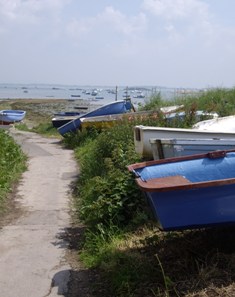
P.S: I’ve just realised that much of my first blog is connected to water in some way: immerse, dip into, take the plunge... Perhaps it has something to do with living by the sea in Portsmouth. It’s the first time that I’ve ever lived by the sea and I’m loving it! So here’s a picture of the little lane which leads to the sea round the back of my halls of residence. Does anyone else live by the sea?
posted on Sunday, 01 June 2008 | comment on this postHello again from Pompey!Wow! What a response! You are all such prolific writers, it’s unbelievable! I received a massive 44 replies to my first posting and I shall do my very best to reply to as many of you as possible. However, I must also actually write some content of my own so this second posting looks to be a very long one!
Firstly, I’d like to apologise for the error I made in replying to Lukasz’s first blog (his first draft), which was sent to me personally, but not posted online. So, rather stupidly, I responded to it, unaware that no-one else would have read it! I sincerely apologise for the confusion - perhaps Lukasz might allow me to include part of his first draft next time so that others may understand which errors I had corrected? As you can see, it is my first attempt at teacher-blogging, so I hope you’ll be patient with me!
Secondly, let me explain ‘Pompey’ from the title: I’m not talking about the military and political leader of the late Roman Republic, but the nickname of the city and of Portsmouth F.C. The real meaning of the word Pompey isn’t known, but there are several theories, of which I have a few examples:
1. When the Portuguese took possession of (what was once called) Bombay, they called it Bom Bahia, two words meaning good harbour. When Charles II married Catherine of Braganza, Bom Bahia was given to Charles as a wedding present, but when the Portuguese seamen brought the Princess to Portsmouth to be married, they may have noticed how Bom Bahia and Portsmouth resemble each other and might have called Portsmouth Bom Bahia, which, to English ears would sound like Pompey. Moreover, both Bombay and Portsmouth have good harbours; the two cities are pretty flat (except that Bombay has a bit of high ground between Malabar Point and Mahaluxmi), and both are only a few feet above sea level.
2. Another theory is that Portsmouth F.C was formed from the Royal Artillery team, who were the original Pompeys. At a Queen's Birthday Review the Royal Artillery lined the parade instead of marching past. They were upset about having to do a job which was (in those days) done in Paris by the Fire Brigade (les Pompiers), and the next time the team turned out they were called 'Pompiers' and the name stuck.
3. Portsmouth F.C is nowadays known everywhere as Pompey - the first use of it in a local newspaper is in connection with the Portsmouth football team which was formed in May 1898: "Wilkie, amid tremendous cheering from the Pompey lads, won the toss, and played with the wind in their favour."
(Evening News - December 9th 1899 p.3, col. 6.)
4. There is also a theory which contends that Pompey is of naval origin. It may have been used for Portsmouth long before the existence of Portsmouth F.C. It is possible to trace its origin back to 1797, at the time of the famous Spithead mutiny. Some of the mutinous vessels’ names were: the Terrible, the Glory, the Defiance, and the/La Pompee. Two delegates from each ship assembled on board La Pompee at Portsmouth - and later, two drunken seamen were arrested in London, incapable of saying little else than that they were going to Pompey – so it’s possible that all the mutinous seamen at that time referred to their delegates being at Pompey... and the name stuck.
5. There is also the possibility that an evangelist bishop, who once visited Portsmouth, declared that it was a wicked town, liable to share the fate of the old city of Pompeii.
6. Another theory claims that the name originates in Shakespeare's Anthony and Cleopatra (act 1, scene 4), where a messenger reports to Caesar: "Pompey is strong at sea". Then in scene 2, Anthony says, "Sextus Pompeius hath given the dare to Caesar, and commands the empire of the sea." Portsmouth was the premier naval port, so the derivation is clear.
7. A final possibility is that Pompey is the result of the inarticulate pronunciation of inebriated sailors who were trying to say POrtsMouth POint, the spot where they changed from ship to shore.
As you can see, there is plenty of speculation and no-one seems to agree on its exact origins. Even when I asked true Pompeians where their nickname came from, they didn’t know! Anyway, after all that, all YOU need to know is that on May 17th this year Pompey won the F.A Cup, the first time in 69 years! And I can tell you, moving to Portsmouth on that day was something else! People were running around on the streets, cheering and laughing, driving around the city, blaring their horns and waving little blue and white flags. The atmosphere was one of fun, happiness and amazement.
Anyway, I digress. In response to Lukasz, I’d like to say how well you write and how enjoyable it was for me to read your blog. Well, I should say blogs, as you have already written two! I read with much interest your description of Poland before and after it opened up to the rest of Europe (and the world). When I lived there in 1996-7, I saw first-hand how people lived and noticed how they dressed and behaved. It seemed to me people were quite well educated in the sense that most valued a good education and indeed, in my classes many students would say to me that a good education was something of an opportunity, not to be squandered. They had a thirst for knowledge and asked me many questions about what it was like in the ‘West’.
I also noticed how women loved to dye their hair! Almost every woman I came across had dyed it bright red or jet black or platinum blond! Have you ever noticed that in Poland? Are the women still dying their hair? Perhaps it was a sign of rebellion or wealth? I don’t know but I remember how it struck me then.
It also struck me how many people lived in huge grey tower blocks – I myself lived in one: on the outside it looked downright ugly, but on the inside it was a little haven, a cocoon where I could escape the harsh winter. In fact the walls had been wood-panelled and it looked a bit like a mountain log cabin! It was very odd indeed, but incredibly warm, welcoming and comfortable, much like the people (albeit not the comfortable bit!).
Your early schooling in the Netherlands reminds me of what I went through as a kid moving to France. I didn’t understand much of what was going on around me in class most of the time. In fact, it’s still happening to me now in my German class!
You say the Poles seem to be too concerned with acquiring wealth and goods, etc. I think the Brits can be a bit like that too, in fact, we have a phrase for that: “Keeping up with the Jones’”. The Jones are the neighbours, so if the neighbours have a nice new car, then we must have one too. If they have a new extension put on the side of their house, then we need to build one, too.
OK, let’s look at some of your errors and I’m going to be very picky as your English is already very good.
1) ...and some of it with my jaw dropped... A good try (and very flattering!), but the correct way to say this is “and for some of it, my jaw dropped” or “and some of it with my jaw wide open”.
2) For the enlightenment of some of our readers out there, the IB is the International Baccalaureate, a (rather difficult) end of high/secondary school exam.
3) ...my teacher got amazed at me... You can be amazed, but not get amazed, so the correct sentence is: (I’ll let you correct it yourself!)
4) ...Very strenuous these two were... I like the use of strenuous here, however, the word order sounds a bit odd. You could say it like this but when writing, it would be best to write it in this order “These two years were very strenuous”.
5) ...not part of the EU then... I know there’s only one EU, so it sounds strange to have to define it with a definite article, but we also say the United States, the Russian Federation and the UK.
6) ...these were a fine 7 years... You need to show how these years were fine, just as you would say “a dreadful 7 years”.
7) ...a chance to visit UK... Can you correct this yourself?
8) ...I then thought I needed to develop... Not the same as: I then thought, “I need to develop”.
9) ...to think about what I want to do... We think about or of something.
10) ...I never took/sat any English exams... We take or sit exams, never do them, which, I’m sure you’ll agree, is very strange indeed!
11) ...introduced a market economy... You need to add the indefinite article here, because you’re describing a type of economy.
12) Enough of the pathos... We say we have enough of something: “Oh, I’ve had enough of these German lessons!”
13) ...of the European Union... Another definite article error. Check out the link (on the side of this blog) to an exercise on articles.
14) I’d love to go one day... You want to go to Spain, not come. You can only come back once you have been there.
15) ...it goes in line with... We either say “it is in line with something” or “goes hand in hand with something” – you probably got the two mixed up somewhere along the line!
16) ...working for a software company... We don’t know which one you worked for, so use the indefinite article here.
17) ...how you’ve managed to have friends... We say “to become friends” but we don’t know how you managed to do that.
18) ...he could well be... You need to show the conditional aspect of this assertion.
19) ...as a saint almost... The correct word order is “almost as a saint”
20) ...is underway already... Again, the correct word order is...? I’ll let you try that one!
21) ...we seem to have developed...
Vocabulary:
prolific If you are prolific, you are very productive.
F.C. Football Club.
amid In the middle of something.
won the toss To win the toss of the coin is to see which team starts with the ball in the match.
contends To contend something means to argue or assert a point.
mutiny A mutiny is a rebellion. Ever seen “Mutiny on the Bounty” starring Marlon Brando?
vessels A vessel is a boat or ship but also a container like a bowl or jug.
evangelist Evangelism is the Christian practice of proselytization, which means to inform others about the Kingdom of God. The four Evangelists were Matthew, Mark, Luke and John. An evangelist bishop would spread or preach the Christian faith.
liable To be liable for something is to be legally responsible or answerable for something.
derivation From the verb ‘to derive’ + from, which means to originate from, or the source of something.
inarticulate If you’re inarticulate, you’re either tongue-tied or incoherent. In this case, the sailors were inarticulate because they had drunk too much. See below.
inebriated Another word for drunk (and I’m not talking about the past participle of ‘to drink’!).
speculation To speculate about something is to make a guess.
F.A Football Association.
something else Another type of British understatement where you say it was so bad or good or wild that it became something else.
blaring Very loud, raucous. “The radio was blaring away but no-one was listening to it”.
digress To digress is to go off the point or deviate. Lukasz rambles, I digress!
first-hand A personal or direct experience. We also say ‘from the horse’s mouth’!
squandered Misspent or wasted.
it struck me Something suddenly occurred to me.
downright Absolutely or totally.
haven A refuge or safe place.
picky Can mean meticulous (positive meaning) or fussy (negative meaning). You can decide which I have been with poor Lukasz! He is very brave having his errors corrected for the worldwide web to see!
OK, I’m going to have to log off now as it’s getting late and I haven’t even started my German homework! I hope this blog has been helpful and informative. Next time I will respond to the some of the comments that were made. Bye for now!
posted on Tuesday, 03 June 2008 | comment on this postJust a quick one!Hello everyone! Thanks for all your comments. This is (hopefully) going to be a quick blog in order to respond to everyone, as promised.
Guzin, it’s very nice to meet you. Your comments were a pleasure to read and I loved your use of “no pain, no gain” to explain the fact that we need rain to enjoy flowers! I’m sorry I haven’t visited your country (yet!), so I’d be delighted if you could tell me (and the others) more about it. May I just say that when you write, it might be an idea to put your thoughts into paragraphs to make it easier for people to follow. One idea per paragraph.
Beyza, I can’t believe you’re learning three languages all at the same time! It’s incredible! I wish you all the best – I’m having enough trouble with German right now! Thank you also for your valuable comments, especially about whether one should use to or for: you can use both!
Leila, it’s nice to meet you, too. Finland is another country I haven’t visited but would very much like to. What is the weather like up there right now? Do you get four seasons? I’m sorry I’m so ignorant: you’ll have to tell me more about life in Finland!
Ana Paula, good luck with the FCE exam later this year! I like the way you have tried to use “brush up” in a phrase, but don’t forget to use the prepositions “up” and “on”: “this blog area is an excellent way to brush up on my English and meet interesting people”.
Duke Lee, what an interesting name! Is Duke a nickname by any chance? It’s a small world really if someone from China knows about Portsmouth University! Are you a student or do you work?
Silwal, thank you for your warm welcome. I am surprised (but very pleased) that you have time to write despite working nights and with two young children, too! Keep up the good work but don’t tire yourself out!
Redouane, no your English isn’t catastrophic, far from it! (You should listen to my German, then you would know what catastrophic is!) Here are a few corrections: “I have lived in France for 2 years in Lille in the north”. You don’t live in Lille anymore, so you should use the past simple “I lived in France...”. Don’t make it more difficult, go with your instinct, it’s usually right! “My wife met difficulties to adaptate with the weather”. You can say “My wife had difficulties...” or “My wife met with difficulties...”. The former is what people usually say, the latter is less commonly used – probably only in written format. “Adapt” is probably the word you meant to spell and we use “to” with it: adapt to the weather, adapt to a new culture, etc. Hope that’s helpful!
Jurate, I had to laugh out loud at your comments – it is true that in France there are some people who simply refuse to speak English and can be quite petty about it. It might have something to do with national pride or the age-old rivalry between the UK and France. Nevertheless, in some ways, I kind of agree with the French – as a visitor we probably need to try to speak their language a bit; at least meet them half-way. If they see you are trying your best then they might soften up and respond in English to help you out. Good luck with your final school exams. When are they?
Manish, ich bin fein, vielen Dank. Aber ich bin ein bisschen müde! I’m not sure that phrase is 100% correct! Anyway, well done on getting your ZD certificate – is that a useful certificate to have for business? You are quite right: a language can be used as a tool to confound others! Just today in class my teacher was using Schwabian and Bayerlisch dialects and I was lost!
Natasha, thanks for your nice comments. Yes, it is a good experience for me to be a student again: it gives me a better insight into what it is like to be on the receiving end of a lesson and will help make me a better teacher and, dare I say it, a better and more humble person. Where are you from in Belarus and what do you do?
Sergio, thanks for your interest in my blog. Yes, you can say “Nice to meet you” even if it is online. You make a good point there, as this kind of communication is relatively new and there are no fixed guidelines (that I know of) on how to converse. In answer to your question, I want to be a teacher of French and German because although I love teaching English I would also like to add a couple of other languages to my bow.
Cris, it looks like you are an avid learner of languages. I admire your dedication! Which part of Buenos Aires are you from? I ask because I was there last year and fell in love with the country and the city. I also fell in love with the culture and the food and the wine and the fantastic welcome I received, despite being British!!!
Hello Paula and thank you for your kind comments. I look forward to reading more about you with a few newly learnt expressions thrown in – do you like challenges?
Beatriz, thanks for response. I am glad to have a blogger from Uruguay as I would love to learn more about your country. I was there last year on a day trip from Argentina – I went to Colonia, which was so beautiful and peaceful. Is the rest of Uruguay like that? By the way, I hope you are no longer confused about the first blog I wrote in response to an inexistent posting by Lukasz.
Mauricio, hello! Thank you for your response. I think there was some confusion because the first day my blog was published Anne’s photo was still up. Anyway, it’s nice to meet a fellow teacher, even if it is in a different discipline. What is it like in “small portion”? And why is it so named? Do you get small portions to eat? (Joke!)
Hello Habooba. Thanks for writing in. I’ve never met anyone with a name like yours; does it have a meaning? My middle name is Jameela and maybe you know what it means...
Hello Naweed. No, I’ve never been to Afghanistan, but I do know it’s quite mountainous. Is it hot during the day and cold at night? Here are a few corrections for you: “have you travel to Afghanistan” should be “have you travelled” or better still, “have you ever been to Afghanistan?”. “I have graduated” is perfect but “intermedait” is written “intermediate” and “callege” is “college”. Keep up the good work!
Hola Merce, thanks for your warm welcome. I agree, this is a very cool website with so many people from so many backgrounds. In answer to your questions, no, I never used my degree to work in Politics and IR. In fact I think many British graduates end up in completely different jobs! This isn’t to say that I didn’t like Politics and IR, in fact I loved the course: it was very interesting. I don’t know much about Portsmouth but I am learning and will update you as much as possible.
Kuldeep, your response was by far the most fascinating: you have managed to use all the expressions from my blog! Well done! I also agree with your ideas about learning paying big dividends and reflecting a positive outlook on life. Education and skills are things no-one can ever take away from you. By the way, you say “I upped my sticks” but actually you should say “I upped sticks”. No need to add “my”. Thank you for your compliments about my hair – it is all natural! My father is from Simla, which probably explains my colouring!
Janestory, thanks for your response, too. It looks like you have been everywhere in China, which is no mean feat given its size! I like the way you used “brush up on” (well done!) and gave a very comprehensive first entry. Now I don’t know what to ask you!
Pary, I was most certainly NOT bored reading your entry. Thank you for an informative insight into your life. How cheeky is your cheeky monkey? Ardebil sounds beautiful with mountains, volcanoes, lakes and hot springs – wow! Can you upload pictures on the site?
James, nice to meet you too. There’s no need to be so formal, just call me Sophie. What do you do and where in China do you live?
Antonio, thanks for your entry. Yes, I am sorry it was so confusing. Perhaps Lukasz will add his previous errors so that you can make sense of my corrections. How come your next entry will be from Belgium? Are you on holiday or on business?
Marianna, nice to meet you. I like the expression of sitting on two chairs at the same time. Is that a typical Slovakian expression?
Mahjabeen, thank you for writing in. Did you write in twice or are there two people called Mahjabeen from Pakistan?
Manuela, it’s nice to meet you, too. I’m jealous of your level of German – you must be pretty good if you’re studying for a degree in interpretation and translation! “Resume studying” is perfect - no-one gets back to studying. What do you do on Republic day in Italy? Is it a national holiday? Over here, we celebrate the Queen’s birthday; in fact, she celebrates it twice (well, she is the Queen!): one is an official birthday (on the first, second, or third Saturday in June, celebrated in London by Trooping the Colour, which is also known as the Queen's Birthday Parade), the other is her real birthday (April 21st).
Ernesto, it’s nice to meet you. I speak a little Japanese, but now I’m getting confused with German! I have to think twice before I answer a question in class, in case I use Japanese!
Vladimir, thank you for your warm welcome. I found Russian incredibly difficult to master, but that was before I tried Arabic and Japanese! Is Ukranian very different from Russian? I’ve never been to Ukraine and I regret not visiting the country whilst I was living in Russia. But maybe one day...
Silvana, how nice to read all about you. It was strange to read that you live 1500 kms away from the beach but then I realised you’re from Brazil! I like the way you used the phrase to describe how your skills have lain dormant, but I have to say they don’t seem that dormant to me!
Anna, nice to meet you. Yes, we do have a lot of cliffs and pebbly beaches in the UK, but there are some sandy beaches too. I really like living by the sea and I now realise what I have been missing all my life! It’s going to be difficult to leave Portsmouth at the end of August. Don’t worry about making mistakes; in fact, the sillier, the better – that way you’ll remember not to make them in the future!
Bonjour Concetta! How do you say bonjour in Piemontese? Well done on passing PET – how did you find Newcastle?
Chico – you are another prolific writer, well done! But then you are already an English teacher, so it’s not surprising! Which chat shows do you like? Do you know Parkinson? He’s a well-known British talk-show host and has had many famous people on his show over the years.
Thao, thanks for your warm welcome. In answer to your questions, yes, I like warm climates, but I think I prefer temperate ones. I don’t have any children and my hobbies are photography, cycling, sightseeing, dabbling in writing travel articles and having a good tie with my friends (if that can be called a hobby!). What about you? Apart from soaking in the sea and lounging around in the sun? LOL!
Farha, it’s nice to meet you. Yes, it must be difficult to teach a language well when it isn’t your first language. There’s a lot of pressure on teachers to speak it fluently and with the correct accent. I’m concerned that my German won’t quite be up to scratch when I start teaching but I reckon that the best we can do when we live far away from any native speakers is to watch videos/dvds or listen to the radio, if possible.
Hello Bluefish – interesting nickname. Why do you have such a name?
Joaquina, welcome to you too! What do you do? Which exam are you taking in two days’ time? Please don’t panic! The examiners aren’t there to make you fail. In fact they probably want you to pass. I will cross my fingers and think of you. Take a deep breath and do your best, that’s all you can do. Best of luck!
Hello Mariusz and thanks for your welcome. I can’t imagine anyone being frightened of rain. Are you sure that was what you felt? It must have rained a lot while you were in Ireland! I sometimes feel homesick, too. At the moment I miss my husband (who is currently in Japan).
Vijay, it’s nice to meet you too. What do you do?
Hello Madhav, nice to meet you. I’ve never met anyone from Kathmandu before. What do you like to do in your spare time? You say “it cent percent not for me” and I think you mean “it is not one hundred percent for me”. Why not? What do you want to do and where would you like to go?
Hello Manish! I think it is a very good start coming to this website and writing in. There are many things you can do here: games and activities to help improve your English skills in many different areas. Have a look around the site and try out some of the exercises whenever you have time to log on, but above all, have fun!
Hello Le from Shanghai – it’s nice to meet you. What do you do?
Hello Christy. Life in Japan is good – the country is highly developed in terms of industry and there are more convenience stores and coffee shops than you can throw a stick at! However, the culture can take some getting used to and the language is particularly tricky (well, it was for me, anyway!). The courtesy that you speak of and that most people think of when they think of Japan, is connected to the culture. What passes for common courtesy over here doesn’t apply over there. For example, holding a door open for someone in the UK is common courtesy, whereas in Japan it doesn’t happen very often! So you might think the Japanese are quite rude when they’re not, they just have different social rules.
Nice to meet you, Ryou. Do you live in Korea? You wrote “I lived in korea” which means you did live there but not anymore. Perhaps you mean “I live in Korea”? Also, “I want improving English” should be “I want TO improve MY English”. “I is feeling that english is very difficulty” = “I feel that English is very difficult”. Yes, English is quite difficult. Are you taking lessons anywhere?
It’s lovely to meet you all but that’s all for now. I must go to bed – it is now past midnight! I will try to add some photos and content next time. Bye!
posted on Friday, 06 June 2008 | comment on this postHello again!I haven’t written for a couple of days because I’ve had to move and, in doing so, had no internet connection. But it’s up and running now, which is a relief because it felt very odd indeed not being connected to the worldwide web. I really felt like I was one of Homer’s Cimmerians! So what have you all been up to? Joaquina, did you pass your exam or is it too early to tell?
I’m so glad you all appreciated the individual comments in my last blog. It took me a long time so I doubt I’ll be able to do much of that again! Today I’ve written about my weekend along with some photos so you get a feel of what I get up to. I will respond to Lukasz and to some of the other bloggers next time.
Let me tell you what’s been happening in my neck of the woods. On Saturday I spent most of the day studying hard for my test on Monday. This is despite the fact that my teacher had warned me not to study in big chunks, but to do a little bit of German each day. I know he’s right but I can’t seem to get organised! I tell my students the same thing but life just gets in the way somehow and the days just fly by. It also feels as though there aren’t enough hours in the day – does anyone else feel like that?
Anyway, on Sunday I went to the Isle of Wight (click the link on the right for the map) with a couple of friends from the German course. It was a gorgeous day: the sun was shining, the birds were singing and people were out and about with their dogs. We took the Hovercraft (see pictures below) which was a lot of fun. It only took ten minutes to skim across the water. You couldn’t see much out of the windows, though, because of all the spray but on the way back we passed very very close to a huge container ship (sorry, no photos – they didn’t come out very well) which was a bit scary because it was piled high with containers.
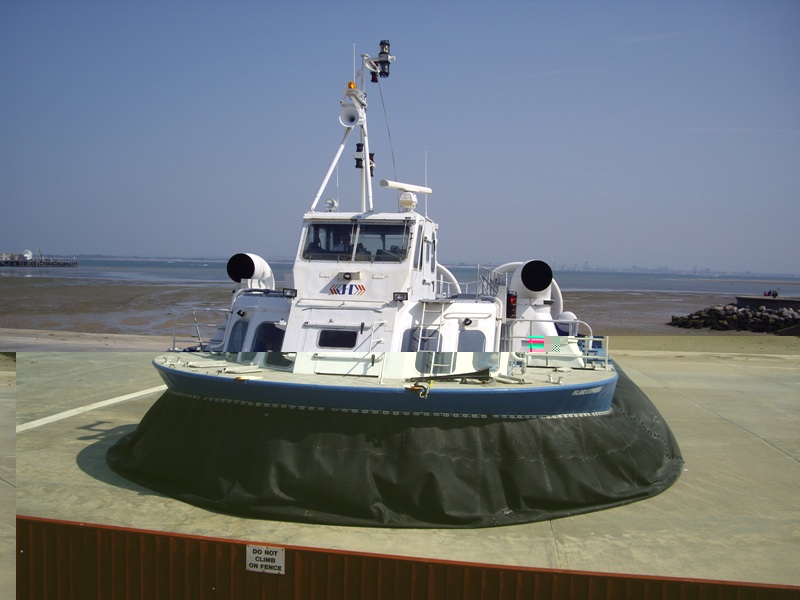
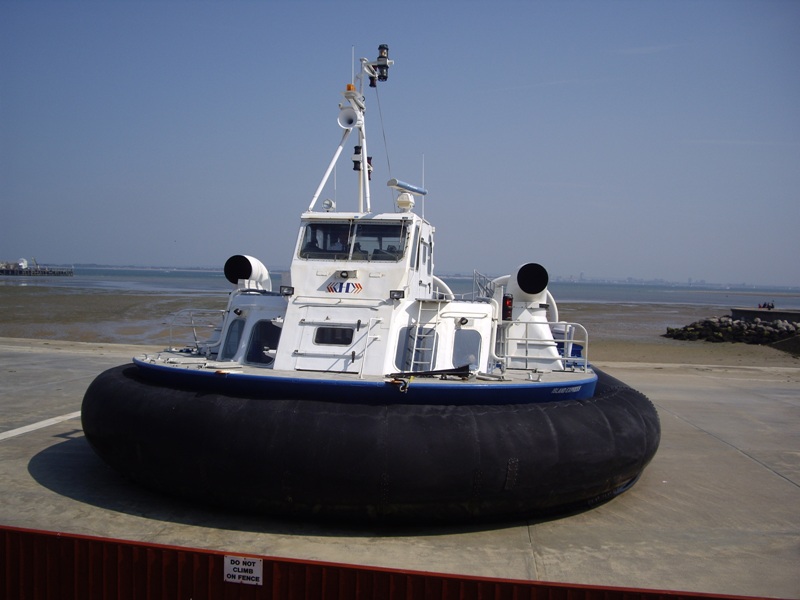
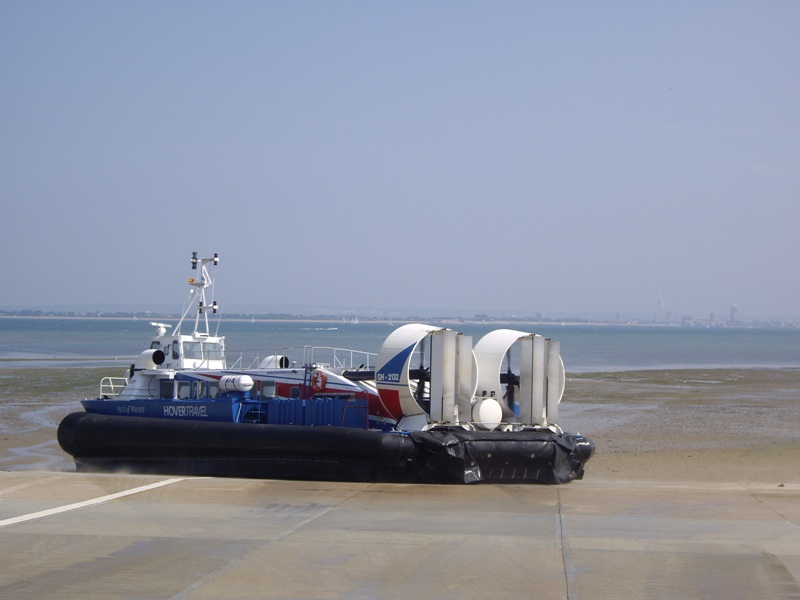
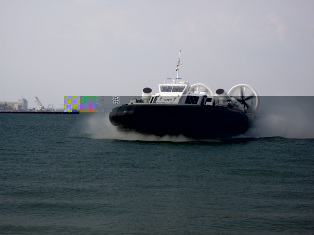
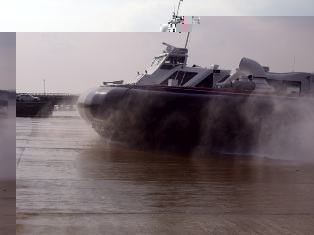
Anyway, once we arrived, we were standing around discussing what we were going to do next (you can tell this trip wasn’t very well organised!) when my lovely straw hat (specially bought for the occasion) blew off and got carried away, twirling and dancing in the wind, before settling down nicely on some train tracks nearby! So we went to the station and asked if anyone could retrieve it, but we were told it was impossible because of safety issues. Nevermind!
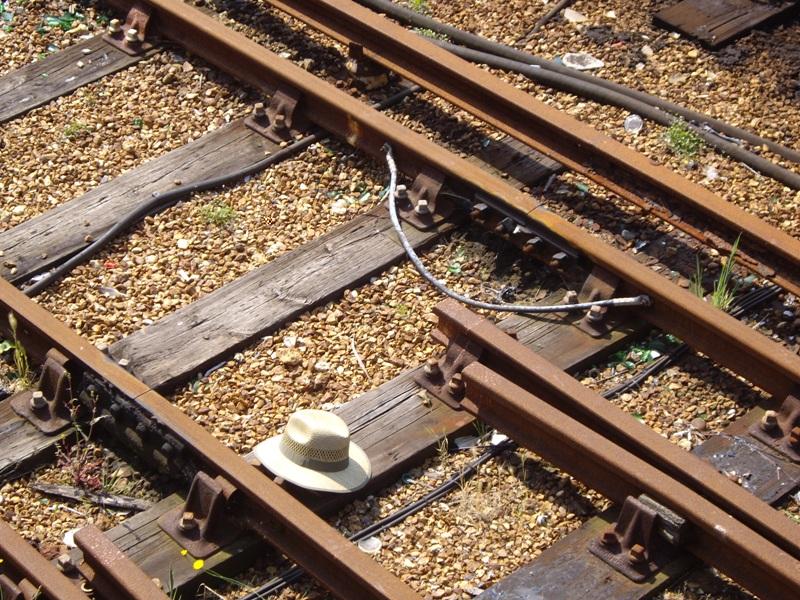
We caught a bus and travelled south for about half an hour and got off at Shanklin where there’s a lovely esplanade and impressive cliffs. We stripped down to our bathing suits and jumped into the sea. Well, no, not really, I’m exaggerating! The water was pretty cold (remember, it was sunny and warm so the difference in temperature was quite noticeable), so we tiptoed in, gingerly making our way across the pebbles (this is the UK, remember, so no soft white sand like in Brazil!). After a while of trying to get used to the rather cool temperature of the water, we were finally brave enough to take the plunge (remember this expression?) and we spent a delicious half hour swimming and bobbing about. In fact, the real reason we had to keep moving was because the water was so cold!
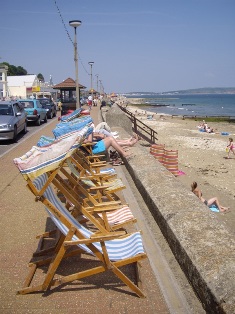
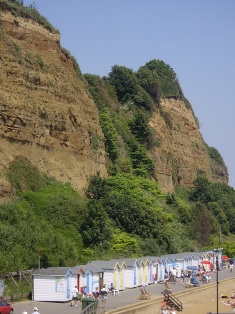
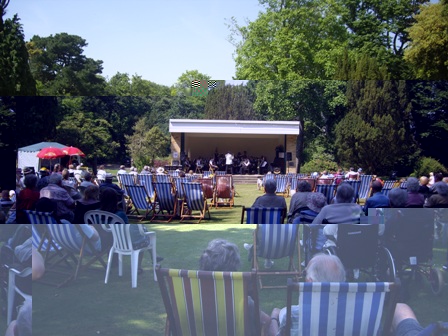
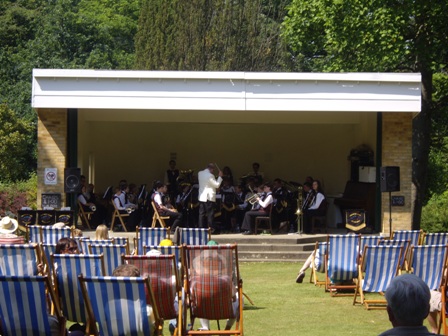
After our little dip (remember this expression?), we went to a pub overlooking the esplanade and had fresh fish (and chips!). I had the plaice and my friends had the red snapper, fisherman’s pie and fishcakes. We then went for a stroll to walk things off and came across a brass band. So we sat down and listened to the music. It was quite nice but it reminded me of what Sir Thomas Beecham once said: "Brass bands are all very well in their place - outdoors and several miles away." I think I might agree with him – it’s not my cup of tea.
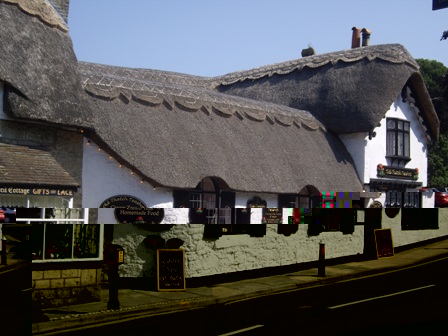
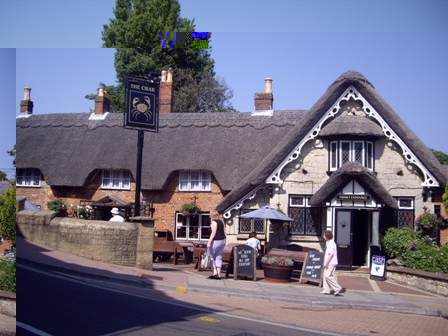
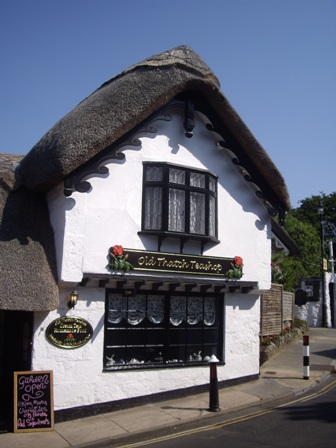
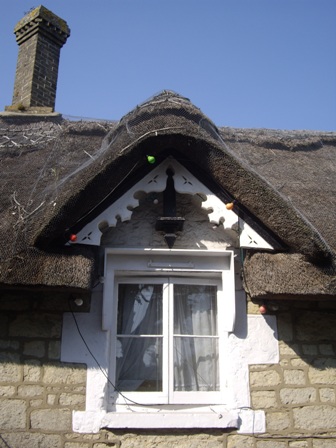
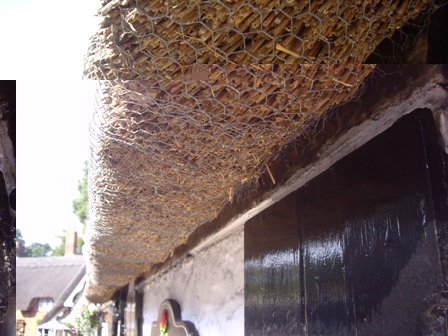
We bought some ice-creams and walked on until we arrived at the old village of Shanklin – a fabulously twee little place with more thatched cottagesthan you can throw a stick at! I fell in love with the place (I’m a bit partial to chocolate-box villages) and was secretly wondering if they had any schools in the area where I could work once I finish my studies...
After a long day of swimming and walking in the hot sun we went home, tired but happy. It had been a grand day out.
Vocabulary:
up and running This means that your appliance or electrical equipment is now working.
Homer’s Cimmerians Homer's Cimmerians were mythical people living in a land of continuous darkness.
my neck of the woods Check out the link below for a detailed explanantion: Learn it! - neck of the woods
chunks A chunk is a thick piece of something like 'a chunk of ice'. So you can imagine that I have been studying German in big amounts.
out and about It means to be outdoors and walking around.
skim To move or glide lightly over or along a surface, usually water.
spray The spray is water (or any other liquid) broken up into very small droplets and blown or falling through the air.
container ship This is a very large ship designed to transport cargo around the world.
piled high A pile: things lying one upon the other, like a pile of paper or a pile of bricks. If it's piled high, then it is a very big pile indeed!
twirling To twirl is to turn or rotate rapidly. Similar words (synoyms) are spin, revolve and whirl.
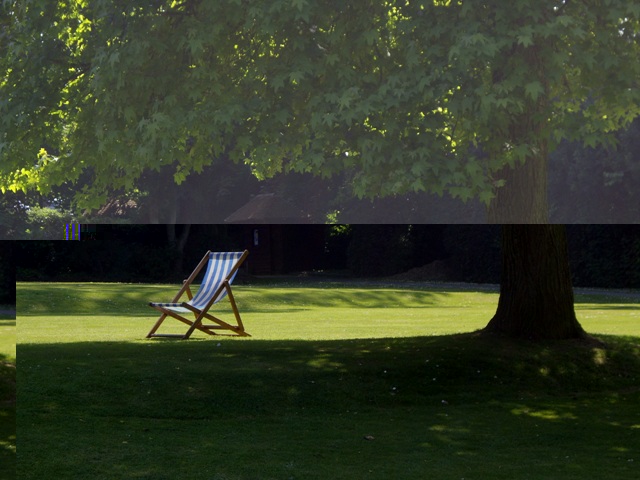
esplanade An esplanade is any open, flat space, especially for public walks or drives and usually along a beach. Look at the picture above which shows people sitting on deckchairs looking out onto the beach.
stripped down to This is when you get undressed. We had our bathing suits on underneath our clothes, so we stripped down to our bathing suits.
gingerly This is when you do something prudently, with caution or with great care. Synonym: warily.
bobbing about To bob about is to move up and down with no specific aim, usually when floating in water.
brass band A picture speaks a thousand words. Have a look at the pictures above.
my cup of tea Everyone has a different way of having their tea - some with sugar, some with milk, some with one but not the other. This expression means that everyone's taste is different, so if you don't like something (it doesn't have to be tea - it can be anything!) you can say it's not your cup of tea.
twee Something which is twee is dainty or quaint.
thatched cottages These are houses which have roofs made of straw. Look at the pictures above.
more...than you can throw a stick at This expression means that there are many, many things (such as thatched cottages). You can also shake a stick at something, which means the same. There are too many things for you to shake or throw a stick at.
partial Partial has two meanings; it can mean a part of something or (in this case) favouring something or someone over another.
chocolate-box villages This kind of village is so picturesque that it could be a pretty picture on a chocolate box. Some biscuit tins in the UK also have twee village scenes.
grand There are many different meanings of the word grand but the one I mean is splendid or great.
The Isle of Wight posted on Tuesday, 10 June 2008 | comment on this postAfter the Isle of Wight...Dear Lukasz (and everyone), I fully agree: finding a good title is the most difficult part of the blog! As you can see, I’m trying to keep some sort of sequence going on here, but you’ll find that today I’ve gone back a few blogs to respond to some of Lukasz’s comments. I hope you can follow...
My thanks go to Carrie who commented on my last blog about the thatched roofs - she wrote quite extensively about them on April 22nd so if you’re interested, please do go and have a look at how they make them and with which materials. I learnt quite a lot myself!
Lukasz, in response to your 21 Mistakes blog: you are quite right, a couple can mean two or a few and, just as beauty is in the eye of the beholder, so is the number that your interlocutor is referring to. Usually it isn’t really necessary to know exactly how many s/he means, but if in doubt, it’s best to ask!
Word order is a fascinating thing, isn’t it? When I tried to learn some Polish whilst living in Bydgoszcz, I was very happy because no matter which way round I put my words in a sentence, they seemed to make sense in the end. Not so in German, which I’m having trouble with: every word has its proper place.
I did like your use of the word ‘get’ with amazed – it shows you are trying some new things, experimenting with the language which is a good thing to do. I’ve been trying that in class but without success!
I liked last Friday’s blog because you explained in detail the weather and seasons in Poland. It reminded me of my time there and my favourite season in Poland, which is autumn. This is because the sudden cold snap you get in the autumn ensures a rich variety of colours such as gold, amber, burnt orange and crimson. I also love that season where my Mum lives near Fontainebleau in France. There is a large forest there and in the autumn you can go for long walks with a piercingly bright blue sky overhead and crunchy leaves underfoot. It’s gorgeous.
I loved Monday’s blog with all the photos. And, although I tried very hard, I could not find a single error! Did I put you off after the 21 errors? (Joke!) In any case, you are a great student because I have very little to correct! (Another joke!) Well done on finding the similarity between the usage of ‘part’ and ‘half’. Moreover, you have put your finger on an important aspect of connotations in English: that between negative and positive meanings. It is true that people can and do use ‘twee’ and ‘chocolate-box villages’ in a negative way, but I meant it positively, as I adore the rustic charm of English villages. In fact, before these words had a somewhat negative connotation, they were simply used for what they stand for. You’ll find that English (and other languages, too, bar so-called dead languages such as Latin and ancient Greek!) evolves over time and what may be considered rude or sarcastic once had a ‘straight’ meaning, e.g. ‘cool’, ‘bad’ or ‘gay’.
Thanks for the joke about Brits getting a sunny day once in a while! Actually, it has been very pleasant here in Portsmouth since mid-May. But the wind is quite strong (as it is a coastal town) and can be quite cool. So the weather can be rather deceptive as you think it’s warm enough to shed a few items of clothing, yet cool enough for you to get sunburnt without knowing it!
Anyway, onto something more interesting (not everyone wants to talk or read about the weather all the time!). Has anyone noticed what day it is today? Over here this particular date (the number in combination with the day), can have a negative or postive effect on people: some people believe it brings bad luck, others good luck. Other superstitions to watch out for are black cats passing in front of you and walking under a ladder! Carrying a dead rabbit's foot (usually on a key chain) will ward off any bad luck for some. In the USA, the number thirteen often does not exist on hotel room doors and in Japan, the number four is often absent in parking bays as it represents death (the word for the number four has the same sound as the word for death). Any superstitious students out there? Have you been avoiding black cats and ladders all day? What superstitions do you have in your country?
To finish off, here are a few pictures of local places and things. I’ve also added a couple of (find out exactly how many!) pictures of my friends and I in response to a couple of requests. Until next time!
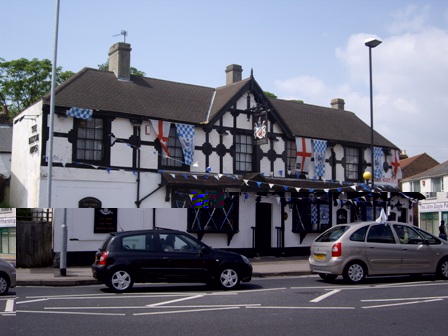
This is the local in Milton (The Milton Arms) where I used to live in Pompey before I moved to Southsea. I shall now be looking for a new local in Southsea.
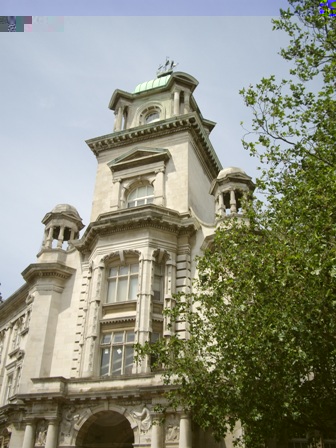
The building where I have my German lessons every day. It's called Park Building because... you guessed it! It's next to a park!
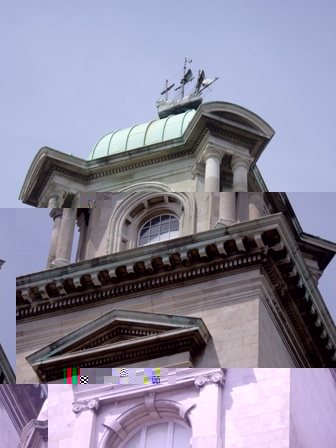
Here it is again in a close-up. Can you see the ship on top of the roof?
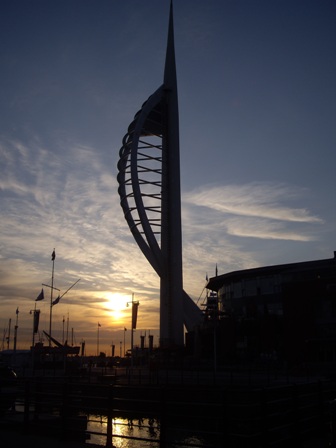
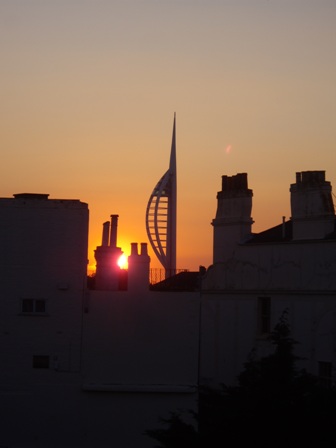
The Spinnaker Tower at sunset (a reference to a type of sail) in Gunwharf Quays (a shopping and entertainment area in Pompey).
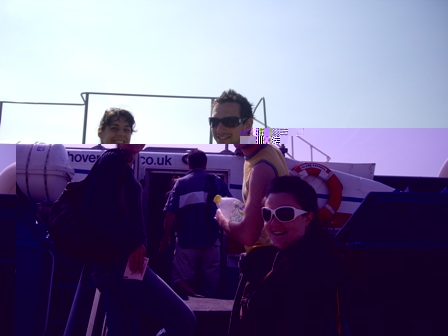
My friends climbing aboard the Hovercraft.
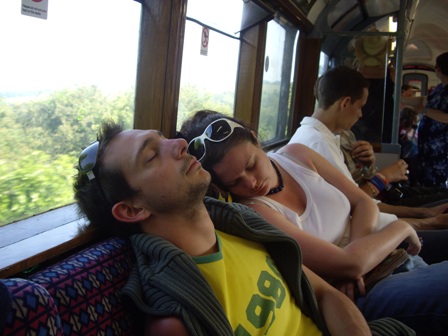
The end of a long day on the Isle of Wight...
View from my room! Sorry, no pictures of me this time as I am always the one taking the pictures!
Vocabulary:
beauty is in the eye of the beholder A person (the beholder) may decide for him/herself who is and who isn't beautiful.
interlocutor An interlocutor is the other person you are having a conversation with.
cold snap A cold snap is a sudden drop in temperature, sudden like a snap or click of the fingers.
piercingly To pierce something is to break something open such as with a jab of a knife. It's usually a small tear or hole. But it is also used to demonstrate when someone has very sharp eyes as in "he has piercing blue eyes" as if they are so sharp and blue you feel they are boring a hole into you. In this case I wanted to show how the sky is such a bright blue in the autumn that it pierces through the treetops.
put your finger on To put your finger on something is to spot or know something, usually of current interest.
connotations Ideas that are implied, suggested or connected in some way. See below.
rustic It's often used with the word charm. Rustic is connected to living in the country, rural. It can also have a negative meaning such as artless or unsophisticated. It's the antonym (opposite) of cosmopolitan, which I explained in a previous blog entry. You can have rustic bread in the supermarket, which has connotations with freshness and simplicity.
stand for To stand for is to mean something. 'Bad' now stands for 'good' in slang as in: 'That's really bad!' meaning 'That's really good!' (Teenagers usually use this expression.)
bar Except for.
sarcastic If you are sarcastic you are being harsh or bitter, derisory or ironic.
deceptive From the verb to deceive. It is something illusory or misleading.
shed To shed something is to cast off such as a snake may shed its skin.
superstitions A superstition is a belief not based on reason or knowledge about the significance of a particular thing or occurrence.
ward off To ward off is to keep something away from you, such as lots of vitamin C might ward off a cold or the saying "an apple a day keeps the doctor" away or garlic and a Christain cross can ward off a vampire!
posted on Friday, 13 June 2008 | comment on this postA Shakespearian weekend awayHello again. This weekend I went to visit a friend of mine in Buckinghamshire. We started off by having lunch at one of her locals, the Red Lion. The weather was gorgeous, so we sat outside, in the beer garden and had our and drinks there. We had brie and bacon sandwiches and bitter shandys. It was then that I realised that I’d forgotten my camera so I’m afraid there are no photos with this blog. Sorry!
However, this weekend was no ordinary weekend. My friend has been volunteering her time running the bar and front of house for a local amateur Shakespeare company, set up outdoors on a beautiful estate. So I was roped in to help! After a long and lazy lunch, we drove over to the estate and set up the bar. Before long, people were coming in, ordering drinks and having picnics in the grounds.
When the play (A Midsummer Night’s Dream) began, my friend surprised me with a free seat so I could watch the play. The performance was very strong and the amateurs were excellent – most had already done some acting before, so they all knew their lines and where to stand. The costumes were amazing, especially Oberon’s (the king of the fairies) who wore a long cloak made of peacock’s feathers. At the interval, however, I went back to the bar to give my friend a hand. It was quite busy then but it wasn’t too bad and luckily my mental arithmetic held up!
After the interval, I slipped back into my seat and watched the play. The director had obviously allowed the actors some leeway as they were exceptionally funny at times. The spectators were in fits of laughter and enjoyed themselves immensely, as did I.
Here’s a quick synopsis: The play is about Hermia who has refused her father’s choice of suitor, Demetrius, because she loves another man, Lysander. Her refusal is punishable by law so she and Lysander elope. Before they go, they tell Hermia’s childhood friend Helena what they plan to do. However, Helena is head-over-heels in love with Demetrius.
Meanwhile, Oberon, the king of fairies, enlists the help of his mischievous sidekick, Puck, to find a love-potion so that he may enchant Queen Titania and have her fall in love with him. Oberon overhears Demetrius disparage Helena, so he instructs Puck to administer the love-potion on Demetrius, too.
Puck makes a mistake, though, and administers the love-potion onto Lysander’s eyelids. (The love-potion makes the recipient fall in love with the first person they see when they wake up.) Unfortunately, the first person he sees when he awakes is Helena and he falls madly and spontaneously in love with her, much to Helena’s bewilderment.
Meanwhile, some local artisans are rehearsing a play. Mischievous Puck transforms the head of the weaver into that of a donkey and the weaver’s friends flee in terror. Titania, upon receiving the love-potion, wakes up and sees the weaver (with the head of a donkey) and immediately falls in love with him!
Oberon finds out that Puck has enchanted Lysander instead of Demetrius and tells Puck to make amends. Puck therefore administers the potion onto Demetrius who also falls in love with Helena! Hermia is angry when she finds out that both Lysander and Demetrius are in love with her friend. The two men decide to duel for Helena’s love but luckily Puck intervenes (he is mischievous but not a bad fairy) and the two men escape without injury.
That evening, Puck administers more love-potion onto Lysander which reverses the spell. Oberon then removes Titania’s enchantment and the King and Queen make amends. The four lovers (Helens, Demetrius, Hermia and Lysander) are now happily in love with the right person but at a loss to explain how they got so mixed up and wonder if it had all been a midsummer night’s dream.
At the end of the performance, the audience and the actors congregated at the bar where my friend and I had another busy time serving the customers. We finally closed the bar and left at around 1 a.m.
On Sunday morning (today) we got up late and went to the cafe (pronounced caff in English) across the road from my friend’s house for a slap-up full monty. Then all too soon I had to catch my train back to Pompey, having regretfully turned down a very kind offer of a barbecue lunch. I had to get back to study for my test on Monday.
Goodbye for now, from your teacher-student-barmaid!
Vocabulary:
locals A local is a pub (bar) which is near your home and which you go to regularly. In my last blog I posted a picture of the Milton Arms, my old local.
beer garden A beer garden is simply a small garden usually at the rear of the pub where you can sit and drink outside when the weather is good - and no, Lukasz, it's not just for three days in the summer!
bitter shandys A bitter is a type of beer and you can have it as a shandy, that is mixed with lemonade.
front of house This is a theatrical term, referring to the part of the building that is open to the public. In theatre and live music venues, it typically refers to the auditorium and foyer, as opposed to the stage and backstage areas.
estate An estate is a piece of property, usually a large one with an elaborate house on it. It can also mean a housing development but here I am talking of the first variety.
roped in To rope in comes from a cowboy term where you catch the cows or bulls with a lasso. It can also mean to lure or entice, sometimes through deception.
fairies A fairy is a supernatural being, usually in a diminutive human form and has magical powers with which it can intervene in human affairs.
cloak It is a loose outer garment, like a cape or coat.
peacock it is a bird with a greenish, iridescent tail marked with spots. The tail can be spread open in a fan.
interval Another word for intermission, the half-time between acts of a play.
give my friend a hand This means to give someone a helping hand, or to give someone some help. You can use the expression with or without the word 'helping'.
mental arithmetic This is mathematics that you do in your head, without a calculator or using your fingers!
held up To hold up is to maintain a position or condition or to endure something. It can also mean to stop or delay. A hold up is a robbery, usually in a bank where a robber shouts "This is a hold up!" or stick up, which means s/he is going to rob the bank and everyone must put their hands up.
leeway If you have some leeway, you have extra time or space within which to operate.
fits of laughter This is when you laugh so much you can't stop.
suitor A suitor is an old-fashioned word for a man who courts a woman.
elope To elope is to run away, usually as lovers. my husband and I eloped to Las Vegas where we were married!
head-over-heels If you fall head-over-heels in love, you are falling madly and passionately in love.
enlists To enlist someone is to get them to help you. It can also mean to join the army so be careful which meaning you use!
mischievous sidekick If you are mischievous you are teasing and playful. You like to play tricks on people. A sidekick is someone who is a close friend or assistant.
enchant To enchant someone is to subject them to magical influence or to bewitch them.
overhears To overhear is to hear another person's conversation, usually without intent. To eavesdrop is to listen to other people's conversations on purpose, without them seeing you.
disparage To disparage someone is to speak of or treat them badly.
administers To administer something is to give or apply in a formal way or to apply something as a remedy, like a doctor does. In this instance, it is the latter meaning.
recipient The receiver of something.
spontaneously Suddenly, without warning.
bewilderment To be bewildered is to be confused.
artisans An artisan is a person skilled in an applied art or a craftsperson.
weaver A weaver is an artisan. S/he creates things out of different materials, such as a thatcher, who weaves reeds or straw to make a roof.
flee To run away, usually out of fear.
make amends To compensate for an injury, loss, or insult.
duel A duel is a fight between two people.
spell A word, phrase, or form of words supposed to have magic power. Synoyms: charm or incantation.
at a loss If you're at a loss about something, you are in a state of bewilderment or uncertainty, puzzled or perplexed.
congregated To congregate is to come together or assemble, especially in large numbers. A congregation is a group of church-goers.
slap-up full monty A slap-up meal is an in formal way to say a meal was first rate or excellent. A full monty is slang for the whole thing, everything that is wanted or needed. If you ask for the full monty in an English caff, you'll get a typical English breakfast which consists of a fried egg, fried bread or toast, sausages, baked beans in tomato sauce, grilled tomatoes, bacon, mushrooms and sometimes hash browns (crisp-fried potatoes made by dicing, chopping, or mashing boiled potatoes and browning them in hot fat or oil). Yum! posted on Sunday, 15 June 2008 | comment on this postShort but sweetHello everyone. This is going to be a quick blog as I haven’t got much to say today. Thanks for your good wishes regarding my test. I’m not sure I’ve done very well. We’ll see. I have a one-to-one tutorial with my teacher on Friday afternoon – that’s when he’ll go over the test and all the homework with me. We have a short test every Monday morning on whatever we should have learnt in the previous week. It’s probably the best way to keep us learning but it’s also the toughest!
Tomorrow we have some government inspectors visiting us to check up on the teaching standards here. It’s nerve-wracking for our teacher, really, but we will try to be especially nice to him so that he looks good in front of the inspector!
Here are a couple of shots of my ‘cell’: the small room I have in the student halls of residence. So far the kitchen has remained clean and tidy, which is a relief. I hate having to clean before I can cook.
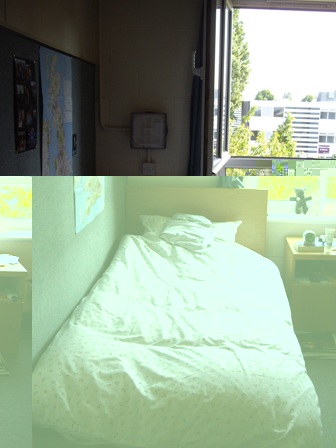
This is my cell...
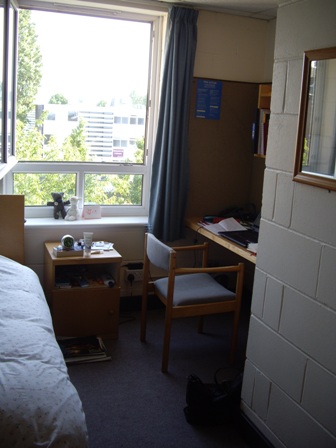
...from where I write to you all!
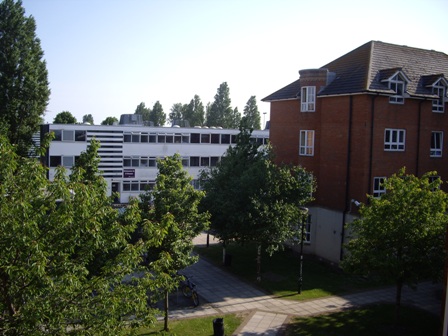
The view from my room. The people on the other side of the corridor are luckier: they have a view of the sea!
Lukasz, you asked about what you should be doing in order to sound more natural. Apart from what you listed, which is exactly what I’d recommend (especially reading as it really broadens your vocabulary), I’d say getting a penfriend in an English-speaking country would help, e.g the U.S, the U.K, Australia and so on. Especially if s/he were your age, then you would pick up expressions and vocabulary that you could use. I think there are some new penfriend associations that can be joined via the internet - not the slow and old-fashioned pen-to-paper and stamps way! I will look into it for you and let you know towards the end of the month.
As I said, this is a short blog as I need to get some sleep! I will write more in a couple of days. Happy learning!
Vocabulary:
This time, I've shortened the list as last time there were (too) many new words in order to explain the play.
tutorial A tutorial is a class in which a tutor gives intensive instruction in a subject to an individual student or a small group of students.
to check up on To check up on someone means to investigate or inspect someone.
nerve-wracking Extremely irritating or annoying. You can have a nerve-wracking day or there could be some nerve-wracking noise nearby. Also spelt nerve-racking.
cell A cell is usually associated with prison! It's small and hasn't got much furniture in it.
posted on Tuesday, 17 June 2008 | comment on this postRestaurant review!I had an interesting dinner party the other day: I had been invited to a Moroccan restaurant by some of the other students on my course. I was told there would be some interesting entertainment... can you guess what it was? Have a look at the pictures below!
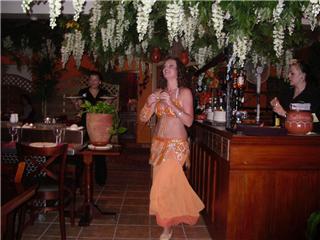
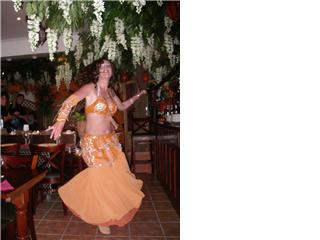
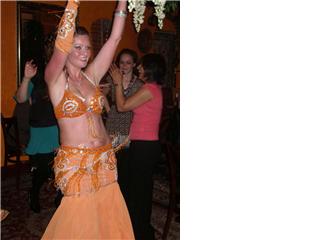
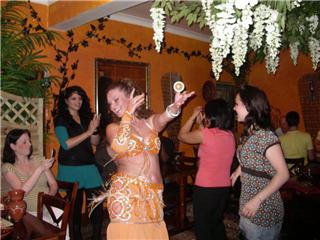
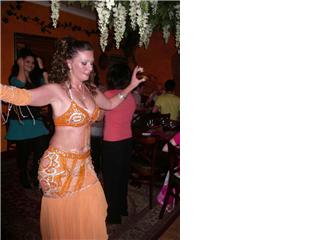
The belly-dancer was brilliant and as you can see, some of the students I was with got up and joined in! I was convinced the belly-dancer was from Morocco (given that we were in a Moroccan restaurant), but to my surprise she was British! She had certainly learned how to dance very well.
However, the evening was partly marred by a particularly awful waitress. I'd ordered some water with my meal and she gave me an expensive one litre bottle of still mineral water whilst she gave the others free pitchers of tap water! I certainly didn't need a whole litre, nor expensive water (as you know, I am now a poor student!) so I told her, in the nicest possible way, that there might have been a mistake in the order. She told me that as I hadn't specified that I wanted tap water, I was given the expensive stuff. I told her I didn't realise one had to specifically ask for tap water and that I thought it was her job to ask the customer which type of water s/he wanted. She then said to me that it was up to me to ask for it and so the argument went round and round until she finally gave up (I am quite stubborn; it runs in the family!) and took the water away from me and five minutes later turned up with a pitcher of tap water.
What do you think? Who was right? Has anyone had similar problems in restaurants? Are you offered tap water and/or mineral water?
Anyway, there were more problems to come. I'd ordered a mouth-watering-looking dish of braised lamb in an apricot and prune sauce. However, when it came, there were no apricots nor prunes in the dish, but potatoes and carrots! I looked at the menu agan but there was no mention of carrots and potatoes. So I called the waitress over (yes, the same one!) and told her I thought some ingredients were missing. She then leaned over me, saw the carrots, prodded them with her finger and asked me what they were. I could not believe what had happened! She was poking my food with her finger! She obviously thought the carrot was an apricot (they're both orange, so I suppose she was short-sighted or something!). I told her what it was and she just sighed in exasperation and said she'd speak to the chef. Then she was gone for ten minutes! Meanwhile, my food was getting cold whilst everyone else was digging into their food and having a good time.
Ten minutes later she came back with a steaming dish of pune and apricot sauce saying that the chef had forgotten to add those ingredients in. Bizarre! How does one forget to put in some ingredients and not others? Anyway, I added the sauce into my dish and it turned out to be delicious and very satisfying as I had the added bonus of potatoes and carrots!
The evening finished without any other major upsets, which was a relief! Your homework, if you'd like to do it, is to re-write the conversation/argument I had with the waitress from reported/indirect speech back into direct speech. In the next blog I'll put up the direct speech version so you can check.
'Till the next time! Have a good weekend.
Vocabulary:
marred To mar something is to damage or spoil something to a certain extent. The object becomes less perfect, attractive or useful. Rather formal use.
pitchers A pitcher is a container, usually for liquid. A synonym is jug.
stubborn To be stubborn is to be obstinate, fixed or set in purpose or opinion.
mouth-watering When something is mouth-watering, it makes your mouth water, or fill up with saliva because it looks so good to eat.
braised Braised is a way of cooking meat, fish or even vegetables by sautéeing them in fat and then simmering slowly in very little liquid.
called the waitress over To call someone over is to ask them to come to you.
prodded There is a synonym for the verb to prod a little further on in the text. Can you find it? It also begins with P.
short-sighted To be short-sighted or near-sighted means you cannot see far without glasses. It's the opposite of long-sighted wchich means you need glasses to read something up close, like a book.
sighed To sigh is to make a sound with your breath, by expelling air from your mouth. You usually do this when you are tired or annoyed.
exasperation To be exasperated is to be annoyed or fed up with someone or something.
digging into It's an informal way of saying that you started eating your food. You can also tuck into your food or even shovel it in but that wouldn't be very pretty to watch!
steaming If something is steaming, it is very hot as there is steam coming off it. Your bathroom usually gets steamy when you've had a hot bath or shower.
posted on Saturday, 21 June 2008 | comment on this postA tour of PompeyHello. I hope you've all had a good weekend and did your homework! I spent most of Saturday studying in my little cell but then on Saturday night I went and painted the town red with my friends. We had a quick Indian takeaway and went to a couple of pubs and a club, but not necessarily in that order. It was a fun night and a well-deserved break from all that studying.
The next day some friends of mine and I hopped on an old Routemaster and toured the city with a very well-informed guide. He had a lovely Pompey accent, but he talked so much I'm afraid I've only retained about 10% of what he said! My head is still full of German adjective endings. Here are a few pictures from the tour:

This is the Warrior, an old ship built around 1860. It's black on the outside because it has an iron-clad hull. On the inside there are wooden panels. If you look closely, you can see it has masts (for the sails) but also a couple of funnels because it is also a steamship. At the time, people weren't too sure about steam-powered ships, so they also had sails, just in case! Here's another picture:

In this picture you can see some brightly-coloured flags running down the sides of a mast. If you look at those on the left, starting from the top, you'll be able to read the name of the ship: the first flag (the one with a red square in the middle, then a white square around it and a blue trim) represents the letter 'W'. The next flag represents an 'A', the next two 'R', the one after that is an 'I', the one before last is an 'O' and the final flag is another 'R' so you have Warrior, the name of the ship! Neat, isn't it?
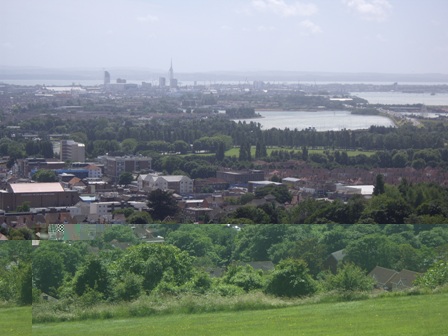
This is a view of the city of Portsmouth from the top of Portsdown Hill. You can see the sea and the Isle of Wight in the distance, plus the Spinnaker Tower.
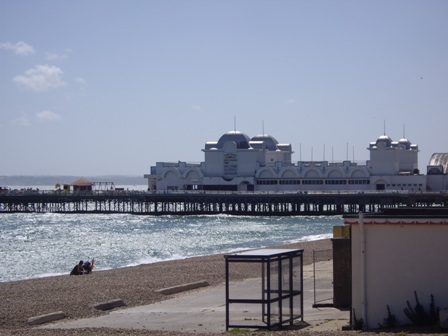
This is South Pier, which was rebuilt in 1974 after a fire broke out on the set of Tommy. The fire was supposed to have been caused by overheating of the lighting among the old wooden beams.
This is a view of the pier from the other side, with a landscaped bit of garden. There are lots of flowers and lovely gardens here, another reason why I like this city so much. I believe Pompey won the 'Britain in Bloom' competition last year.
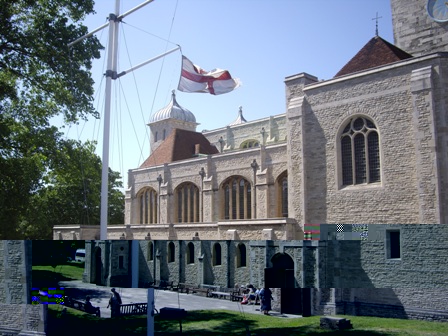
It was a pretty windy day so it took me several attempts to get a shot of St George's Cross flying high. This is in front of Pompey Cathedral.
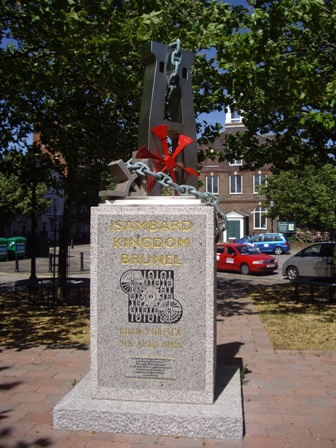
This is a picture of a kind of stone memorial for Isambard Kingdom Brunel, a British engineer (1806-1859) who was born in Portsmouth. He is best known for the creation of the Great Western Railway, several famous steamships (including the first one with a propeller - there's a miniature red one on the memorial), and lots of important bridges and tunnels.
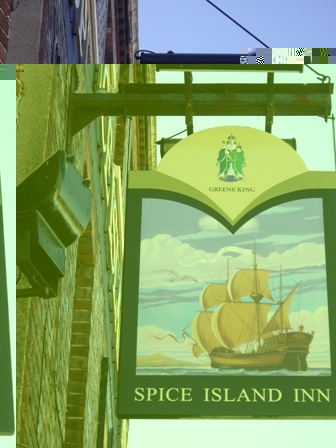
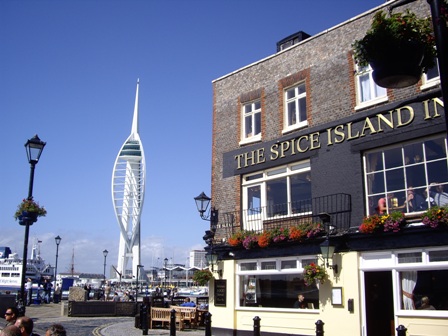
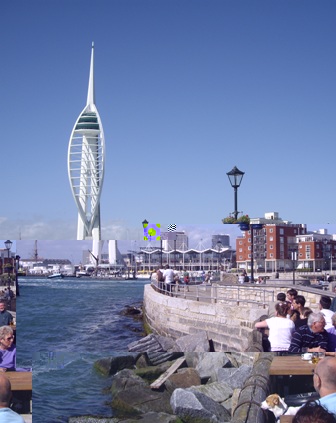
After the tour, we went for a spot of lunch in Old Portsmouth, a part of town which is, of course, old, with cobbled streets and a lovely atmosphere. We went to the Spice Inn (a very old pub dating from the 1700s!) which is on Spice Island, so named because it was one of the first places that spices arrived on trade ships from Jamaica. We ate a Sunday roast whilst looking out over the harbour.
Tomorrow I'm going to be involved with some pupils from local schools who will be coming to Portsmouth University for an Able Linguists' Day. It's a chance for us to show schoolchildren the importance (and fun) of learning a language. These pupils are already studying languages at school (usually French, German or Spanish) and range from 11 to 15 years old. I have devised a tongue-twister activity for them which should be fun - here are a few:
Fischers Fritz fischt frische Fische. (Which means: Fisher Fritz fishes fresh fish.)
Es klapperten die Klapperschlangen, bis ihre Klappern schlapper klangen. (The rattlesnakes rattled until their rattles sounded weaker.)
Sechshundertsechsundsechzig. (Six hundred and sixty-six.)
What do you think? Can you say them? Can you say them quickly? It's a challenge for me, too! Here are some you may know in English:
A quick witted cricket critic.
I saw Susie sitting in a shoe shine shop.
Where she sits she shines, and where she shines she sits.
How can a clam cram in a clean cream can?
Have you got any tongue-twisters in your language? Lukasz, have you got any Polish ones we could have fun with?
I'll post the reported to direct speech homework answers in the next blog to give you all a bit more time to do it. Thanks to everyone for their comments and especially to Antonio from Belgium who wrote in and told us about online penfriends and Stephen Keeler who is currently appreciating the blogging!
Bye for now and best wishes to you all for the week. Will blog some more after Able Linguists' Day.
Vocabulary:
painted the town red It is an expression which alludes to the kind of unruly behaviour that results in a lot of blood being spilt!
Indian takeaway We didn't take an Indian man anywhere! We went to an Indian restaurant and ordered food to take away and eat elsewhere. Americans call it 'take-out'.
hopped on To hop on is to jump on. If you hop, you are jumping around on one foot.
Routemaster A Routemaster is the name for the old, red double-decker buses that travel around London. It is the kind that has an open back end where you can easily catch the bus by hopping on. There is a pole which you can grab as you hop on. Silly Sophie forgot to take a picture for you!
iron-clad hull The hull of a ship is the hollow, lowermost part, partially submerged and supporting the remainder of the ship. (If you look at the picture, it's the black part.) This particular ship was not made of iron (like the Titanic) but made of wood. The outside was covered or clad in iron to make it stronger. Furthermore, if you refer to something as iron-clad, it means strong or unbreakable like an iron-clad contract.
funnels The funnels are the chimneys where the steam comes out.
trim The trim is the border or edge.
Neat This is an American colloquial (informal) term meaning great or cool. "Hey, that's so neat!"
Pier As you can see in the picture, it is a structure built partly on land and on sea, usually for recreation purposes.
the set of Tommy A set is a film or movie set, the place where the director 'shoots' the film. Tommy is the name of the film that was being made there.
landscaped A garden which has been planned and designed.
St George's Cross The national flag of England (a red cross on a white background).
cobbled streets These kinds of streets are made from cobbles, stones in lumps about the size of your fist, put together rather roughly and haphazardly. It's quite bumpy. It's not at all smooth like tarmac. You can also use the expression to 'cobble something together', which means you arrange something together quickly and/or clumsily, like a piece of homework written at the last minute!
Sunday roast This is a typical meal eaten on Sundays. You can have it at home or in a pub. It's usually either beef or lamb with Yorkshire pudding (a kind of savoury puff pastry), gravy (sauce), roast or boiled potatoes, carrots and peas. You can either have horseradish sauce with the beef or mint sauce with the lamb.
pupils Another word for students, but younger ones, usually school-age. Not to be confused with a part of your eye!
devised Imagined, planned or created.
tongue-twister A tongue-twister is a phrase that is quite difficult to say so you almost need to twist or turn your tongue in your mouth to say it!
posted on Monday, 23 June 2008 | comment on this postMy daily doseHello. It's a sunny and blustery day out today. I'd love to go for a bike ride or just amble down to the beach, but I have quite a lot of homework to do before I can go and watch the semi-final of Euro 2008 between Germany and Turkey, preferably in a pub with my friends (and my German teacher!).
Speaking of homework let's look at that homework I set you last Saturday which was the dialogue between the waitress and myself:
Waitress: "What would you like to drink?"
Me: "Some water, please."
Waitress: "Still or sparkling?"
Me: "Still, please."
(And that's where I should have realised she meant still or sparkling mineral water!)
A little later...
Waitress (opening the bottle and pouring out a glass for me): "Here you are."
Me: "Oh...erm...I'm really very sorry but I think there may have been a mistake. I wanted tap water, not mineral water."
Waitress: "Well, you didn't say so when you ordered it."
Me: "Well, yes, I realise that, but I thought it would be still tap water in a pitcher like everyone else here. I didn't realise I had to ask you specifically for tap water. Surely you could have offered me either."
Waitress: "No, you have to ask for the type of water you want."
Me: "Well I didn't know I had to ask. I thought you would offer me, the customer, the choice."
Waitress: "It's not up to me to do that. You must specify which you'd like. We atutomatically offer mineral water if you don't say what you want."
And so on until...
Waitress: "Fine, I'll change it." (That's when she takes away the already opened and poured bottle of water and brings back a pitcher of tap water, which some of you seem to think she might have spat in it!!! Oh no!!!)
Me (meekly): "Thank you."
Later...
Me: "Excuse me please!"
Waitress: "Yes?"
Me: "There seems to be a problem with my order. I ordered the lamb in an apricot and prune sauce, but this clearly isn't. I can't see any apricots or prunes in the dish."
Waitress (prodding the carrots in my dish with her finger): "What's that, then?"
Me (slightly astonished): "That happens to be a carrot!" (Thinking: take your fingers out of my food!)
Waitress (*sighing*): "OK, I'll see what the chef can do about it..."
10 minutes later...
Waitress: "Here you are. Our regular chef isn't here tonight and so our sous-chef must have forgotten to add those ingredients or something."
Me: "I see."
No apology or anything! Really! I'm not going back!
Well done Maione for having a go. I particularly liked the part where you have the waitress say "YOU haven't specified you want tap water so you are given the expensive stuff!"
I can't quite believe what happened to you, Cristina. When I was in Buenos Aires, the meat was cooked to perfection every time. Remind me NOT to ask you for the name of the restaurant you went to!
And Sylvia, what a really awful place you went to - and so expensive! I laughed out loud at the end when the non-Swiss waiter said you surely couldn't be from Lugano! I suppose in situations like these, it's best to laugh!
Thank you for your wishes regarding the Able Linguists' Day and also the government inspection last week. The inspection went well but I can't say much more than that as it is confidential! On the other hand, I can tell you about the Able Linguists' Day. The pupils were talented, personable and enthusiastic about it all (probably because they got the day off school to come here!). I joined in a lesson where we watched part of a film ("Goodbye Lenin", a romance set during the fall of the Berlin Wall). This proved to be rather challenging as it was all in German (no English subtitles), but the pupils clearly enjoyed it and we then had to act out a scene of what we thought might happen next. It was all a lot of fun. I think they all went home happy about their day.
Welcome back, Lukasz! I was beginning to miss my daily dose of what you get up to. Good to see you hard at work doing up the garage and then enjoying yourself at the impromptubbq. On your use of language, yes, very good, we would call them paving stones even if they are red and look like bricks. This is because you are laying them down. Then I must have confused you by talking about cobblestones because you use it in your next entry. Stick to your first word and meanwhile I'll look around for a picture of cobblestones. Well done on reading Agatha Christie. She certainly has a very clear writing style, perhaps purposefully so that we might guess who the murderer is? (I never manage to figure out who it is anyway!)
OK, enough nonsense from me for one day! I will just finish by saying my husband Simon will be coming to visit me in a couple of months, but before he does, he'll be taking over from me in July and chatting to you! He's currently living in Kyoto, Japan.
Vocabulary:
blustery When it's blustery, it's windy, but not constantly. It's usually violent and gusty.
amble A synonym is to stroll. It's walking at an easy, slow pace.
meekly In a humble or submissive manner. (Mainly because I was embarassed at having to argue!)
having a go Make an attempt at something. E.g: "I've never been horse-riding, but I'll have a go at it." You can also say 'give it a go'. Be careful not to confuse with 'have a go at someone' which means to tell someone off or start an argument!
confidential Private or secret.
daily dose A dose is a quantity of medicine prescribed to be taken at one time, usually daily. You can use this expression in many situations where you take or use something daily, like 'my daily dose of caffeine' (meaning my daily cup of coffee) or my daily dose of Lukasz's blog.
impromptu Suddenly or hastily prepared.
bbq Short for barbeque
figure out To understand or to solve something. posted on Wednesday, 25 June 2008 | comment on this postProcrastination...Today I have done very little, hence the title of the blog. I woke up fairly early (for a Saturday) and had a good breakfast of bacon and eggs. Then I went into town with my friend Rachael and we bought some sorely needed stationery supplies. I felt I couldn't possibly do any studying unless I had a proper folder, nice writing pens and other bits and bobs. We got back and I had a spot of lunch. I then sorted out all my paperwork into the big folder that I'd bought, labelling everything neatly with my nice new pens. Then I thought I'd have a break: a nice cup of tea and a few biscuits whilst I read the next chapter of the paperback I'm reading at the moment. That chapter turned into two, then three... my tea got cold. I had to make another one. Then I needed more biscuits... Finally, I was getting a bit sleepy (the sun was shining through my window making my cell very warm and cozy), so I thought I'd have bit of a shut-eye. I curled up on my bed and had a bit of a snooze... until my friend gave me a call about half an hour ago, bright and cheery, saying she'd done lots of studying and wanted to go out for dinner. I felt very guilty! So she's given me an hour to do SOMEthing so that when I do meet her later I won't feel as though I haven't accomplished anything. Do you get days like this or is it just me?
It's now Sunday - last night I went out to an Indian restaurant with my friend. On the way there we passed by this building:
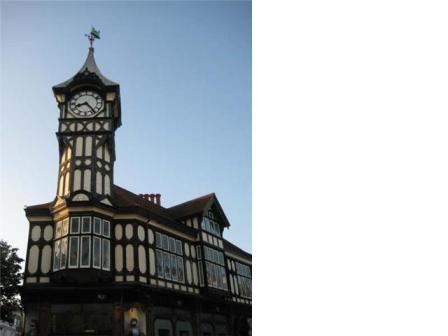
Top half...
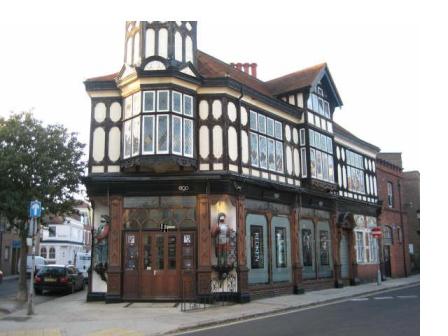
...and bottom half. (I couldn't fit the building into one shot!)
Isn't it beautiful? Can you guess what it is? If you look closely you might be able to make out that it is in fact a hairdresser's! Very posh, isn't it?
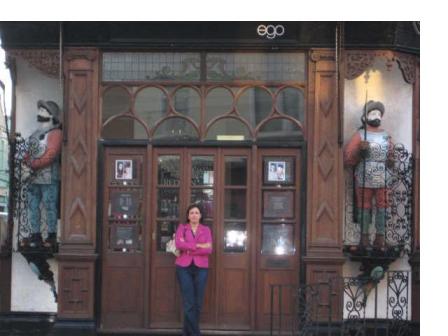
And finally you have a photo of me as my friend was on hand to take a picture.
Today I have been studying quite hard in preparation for next week's test and also because I don't want to miss the Euro 2008 final tonight. I don't know much about football, but I do like to watch the important games and get into the spirit of things. If you want to know more about football, then you can ask Simon whatever you like next month - he's really into it, a fervent supporter of WBA and he has also written various articles on football. Unfortunately, this is my last blog so I must say goodbye and thank you and wish you all the best in your future and hope you will continue improving and having fun with your English. I've really enjoyed meeting you all and conversing with you. Best of luck, Lukasz in pursuing a new career! Bye!
Vocabulary:
procrastination To procrastinate is to put off till another day or time. In my case it's usually out of habitual carelessness or laziness! Synonyms: to defer or postpone.
hence Synoyms: therefore, consequently, thus.
sorely needed Extremely or greatly needed.
bits and bobs An idiom which means small things or remnants; the same as 'odds and ends' or 'bits and pieces'.
paperback A book bound in a flexible paper cover, often a lower-priced edition of a hardcover book.
shut-eye An informal way to say you want to get some sleep.
snooze Another way to say sleep. Other synoyms: slumber, doze, nap.
make out In my last blog I explained 'figure out' which is a synonym of 'make out'. Make out has lots of other different meanings so be sure to use it in the right context! You can:
a. make out (write out or complete) a bill or check;
b. establish or prove something;
c. decipher or discern (the picture in this blog);
d. imply or suggest: "He made me out to be a liar";
e. manage or succeed: "How are you making out in your new job?";
f. slang: kiss and caress.
posh Elegant and fashionable, usually with the underlying meaning of a superior type or class.
on hand Physically present. My friend was right there in front of me and ready to help.
get into the spirit of things When you get into the spirit of things, you are enjoying the atmosphere and the mood. You can also get into the swing of things like at a party.
fervent This means having or showing intensity of spirit, feeling or enthusiasm for something. You can be a fervent admirer of something or make a fervent plea.
posted on Saturday, 28 June 2008 | comment on this postFrom BBC Learning EnglishSadly, it's time to say goodbye to Sophie who will now concentrate on her studies. Good luck Sophie - and thank you so much for a fantastic blog!
However, the Teacher Blogger's hat is not leaving the Handy family just yet because from tomorrow we will hand the blog over to Sophie's husband, Simon. Welcome Simon and enjoy the experience!
BBC Learning English team posted on Monday, 30 June 2008 | comment on this post | |


