


After the Isle of Wight...
Dear Lukasz (and everyone), I fully agree: finding a good title is the most difficult part of the blog! As you can see, I’m trying to keep some sort of sequence going on here, but you’ll find that today I’ve gone back a few blogs to respond to some of Lukasz’s comments. I hope you can follow...
My thanks go to Carrie who commented on my last blog about the thatched roofs - she wrote quite extensively about them on April 22nd so if you’re interested, please do go and have a look at how they make them and with which materials. I learnt quite a lot myself!
Lukasz, in response to your 21 Mistakes blog: you are quite right, a couple can mean two or a few and, just as beauty is in the eye of the beholder, so is the number that your interlocutor is referring to. Usually it isn’t really necessary to know exactly how many s/he means, but if in doubt, it’s best to ask!
Word order is a fascinating thing, isn’t it? When I tried to learn some Polish whilst living in Bydgoszcz, I was very happy because no matter which way round I put my words in a sentence, they seemed to make sense in the end. Not so in German, which I’m having trouble with: every word has its proper place.
I did like your use of the word ‘get’ with amazed – it shows you are trying some new things, experimenting with the language which is a good thing to do. I’ve been trying that in class but without success!
I liked last Friday’s blog because you explained in detail the weather and seasons in Poland. It reminded me of my time there and my favourite season in Poland, which is autumn. This is because the sudden cold snap you get in the autumn ensures a rich variety of colours such as gold, amber, burnt orange and crimson. I also love that season where my Mum lives near Fontainebleau in France. There is a large forest there and in the autumn you can go for long walks with a piercingly bright blue sky overhead and crunchy leaves underfoot. It’s gorgeous.
I loved Monday’s blog with all the photos. And, although I tried very hard, I could not find a single error! Did I put you off after the 21 errors? (Joke!) In any case, you are a great student because I have very little to correct! (Another joke!) Well done on finding the similarity between the usage of ‘part’ and ‘half’. Moreover, you have put your finger on an important aspect of connotations in English: that between negative and positive meanings. It is true that people can and do use ‘twee’ and ‘chocolate-box villages’ in a negative way, but I meant it positively, as I adore the rustic charm of English villages. In fact, before these words had a somewhat negative connotation, they were simply used for what they stand for. You’ll find that English (and other languages, too, bar so-called dead languages such as Latin and ancient Greek!) evolves over time and what may be considered rude or sarcastic once had a ‘straight’ meaning, e.g. ‘cool’, ‘bad’ or ‘gay’.
Thanks for the joke about Brits getting a sunny day once in a while! Actually, it has been very pleasant here in Portsmouth since mid-May. But the wind is quite strong (as it is a coastal town) and can be quite cool. So the weather can be rather deceptive as you think it’s warm enough to shed a few items of clothing, yet cool enough for you to get sunburnt without knowing it!
Anyway, onto something more interesting (not everyone wants to talk or read about the weather all the time!). Has anyone noticed what day it is today? Over here this particular date (the number in combination with the day), can have a negative or postive effect on people: some people believe it brings bad luck, others good luck. Other superstitions to watch out for are black cats passing in front of you and walking under a ladder! Carrying a dead rabbit's foot (usually on a key chain) will ward off any bad luck for some. In the USA, the number thirteen often does not exist on hotel room doors and in Japan, the number four is often absent in parking bays as it represents death (the word for the number four has the same sound as the word for death). Any superstitious students out there? Have you been avoiding black cats and ladders all day? What superstitions do you have in your country?
To finish off, here are a few pictures of local places and things. I’ve also added a couple of (find out exactly how many!) pictures of my friends and I in response to a couple of requests. Until next time!
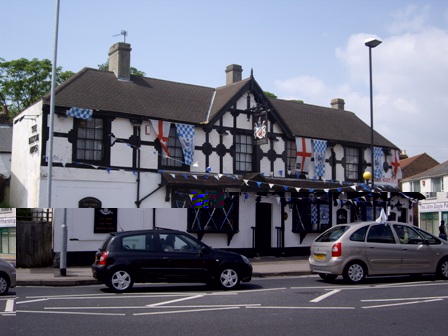
This is the local in Milton (The Milton Arms) where I used to live in Pompey before I moved to Southsea. I shall now be looking for a new local in Southsea.
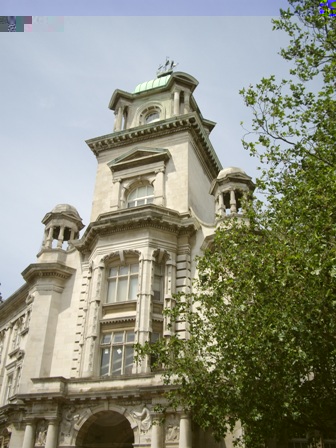
The building where I have my German lessons every day. It's called Park Building because... you guessed it! It's next to a park!
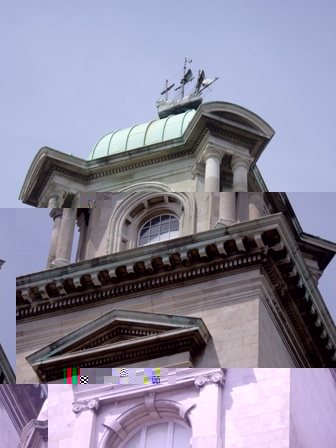
Here it is again in a close-up. Can you see the ship on top of the roof?
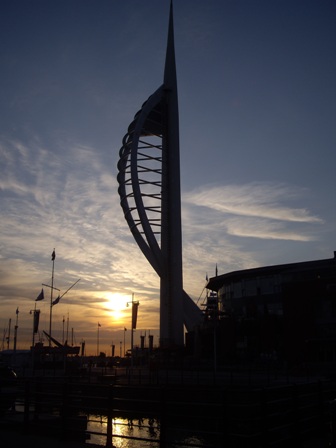
The Spinnaker Tower at sunset (a reference to a type of sail) in Gunwharf Quays (a shopping and entertainment area in Pompey).
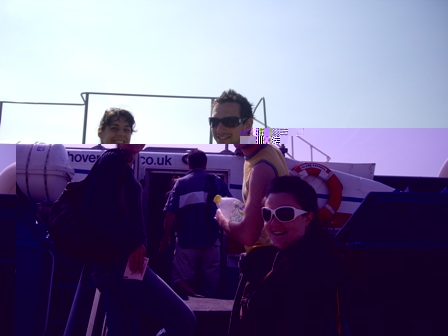
My friends climbing aboard the Hovercraft.
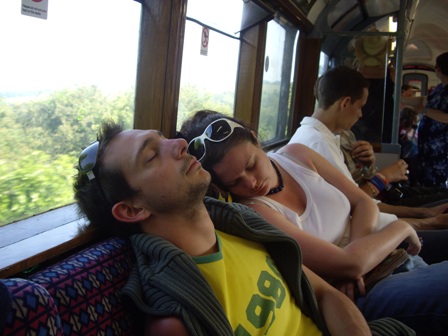
The end of a long day on the Isle of Wight...
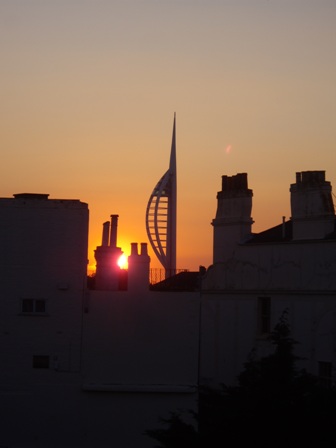
View from my room! Sorry, no pictures of me this time as I am always the one taking the pictures!
Vocabulary:
beauty is in the eye of the beholder A person (the beholder) may decide for him/herself who is and who isn't beautiful.
interlocutor An interlocutor is the other person you are having a conversation with.
cold snap A cold snap is a sudden drop in temperature, sudden like a snap or click of the fingers.
piercingly To pierce something is to break something open such as with a jab of a knife. It's usually a small tear or hole. But it is also used to demonstrate when someone has very sharp eyes as in "he has piercing blue eyes" as if they are so sharp and blue you feel they are boring a hole into you. In this case I wanted to show how the sky is such a bright blue in the autumn that it pierces through the treetops.
put your finger on To put your finger on something is to spot or know something, usually of current interest.
connotations Ideas that are implied, suggested or connected in some way. See below.
rustic It's often used with the word charm. Rustic is connected to living in the country, rural. It can also have a negative meaning such as artless or unsophisticated. It's the antonym (opposite) of cosmopolitan, which I explained in a previous blog entry. You can have rustic bread in the supermarket, which has connotations with freshness and simplicity.
stand for To stand for is to mean something. 'Bad' now stands for 'good' in slang as in: 'That's really bad!' meaning 'That's really good!' (Teenagers usually use this expression.)
bar Except for.
sarcastic If you are sarcastic you are being harsh or bitter, derisory or ironic.
deceptive From the verb to deceive. It is something illusory or misleading.
shed To shed something is to cast off such as a snake may shed its skin.
superstitions A superstition is a belief not based on reason or knowledge about the significance of a particular thing or occurrence.
ward off To ward off is to keep something away from you, such as lots of vitamin C might ward off a cold or the saying "an apple a day keeps the doctor" away or garlic and a Christain cross can ward off a vampire!
Comments
My aunt believes, that you never be allowed to donate a knife. You have to pay for it, e.g. with 1 Cent. In the country, on 6.January the farmer smokes the cowshed to banish all daemons and ghosts. But I think, this is now more a tradition than a superstition. ^^
Hi teacher, thank you for the photos. The ship above the building is interesting, is it a symbol of sth? I want to tell you about a very strange superstition among Arabs in Iran! It is believed that a newly wed girl should not visit another newly wed girl until the appearance of the new lunar month. It says, if it happens, the one who's been met would be able to concieve for years...
hi Sophie,this is the first time i have found the courage to write to you to answer about superstitions.In Italy there are the same superstitions which you have described in your blog.Much worse than this,it is when a person is comsidered a symbol of bad luck and is avoided by everyone.One of our best literates,Pirandello wrote a famous short story about this tragedy,whose title is "La patente"where the main character asks fr a legal authorisation,a licence to be considered a symbol of bad luck.Bye bye for now maione
Hi Sophie! The pictures are really nice. The building wherre you take your German classes are beautiful. I hope I can see you in one of the future pictures that you´ll post here. Best wishes, Ana Paula.
Hello Sophie! Despite the fact not being as fluent as Lukasz, I am going to tell you about an unbelievable thing I met on Friday the l3. The story begins at the end of April when I met a very prety woman first time as I was visiting a galery in the town. We spoke and I asked her I would do her a portrait and she agried. I did two portraits one in a tempera colours which I devoted lots of time and attention and the second in a dry chalks. On Friday afternoon I´ve plucked my courage and made a call if she wants to see the finished works. We met and she wanted to take the tempera work immediately agreeing to pay 66 eur aproximately(2 OOO SK). I sugested her to think about and to come for it next Saturday on my painting course. Then, I realized that it was Friday l3 and was hapy and proud on myself I was able to sell my own work. But, I´ve just made a foto of them in to my computer and, actualy, I can´t imagine to give it away. So, whas the day fortunate or not? Happy day to you on the test! And, I think there isn´t the expression ´sitting on three chairs´ in Slovak. Bye!!
Hi.In our country, if you are under a crow or a bird poos directly on you, it brings you bad luck; and if you give your friend or relative a clock, you mean that he\she will die soon. If you give them a scissors, you mean to cut the friendship
Thanks for all your contributions. This blog has now closed and can no longer accept new comments.


