October 2007G’day from Oz!Hello Satya and everyone, and welcome to the blog for October! I have to admit to having a few butterflies about this – I’m a bit of a technophobe, and have never done a blog before, so fingers crossed it will all work out OK!
Let me tell you a bit about myself. As you all know, I’m Rachel, and if you look at the title of today’s blog, you might be able to work out where I’m writing from. Any ideas? That’s right – Australia. Sydney, to be precise. Although I’ve lived here for several years, I’m not actually Australian; I’m a Pom, which is Aussie slang for someone from England. (And a bit more Aussie slang for you – G’day is what Australians say to greet someone (like “hello”) and it’s pronounced Giddai.) Anyway, I’m doing all sorts of things at the moment; writing materials, teaching and training up as a teacher trainer. AND I have a two-year-old son! Phew! His name is Owen and he really keeps me on my toes. I’m sure I’ll be telling you much more about him and his antics over the next month …
Well, I thought I’d start off by telling you a bit about Sydney. I’m sure you all know of its two most famous landmarks – the Opera House and the Harbour Bridge. Maybe even Bondi Beach as well! We live about 20 minutes out of the city, in a suburb called Hurlstone Park. What we really like about it is the fact it’s really quiet, not busy at all. It’s almost like living in a village; there’s a main shopping street with a few shops (just the essentials), and everyone knows everyone else. We’re also on the Cooks River, so there are a lot of parks nearby, which is great for Owen! The other great thing about living where we do is that we’re close to other suburbs that have a lot of restaurants, cafes and bigger shopping areas, so we can get our fill of the hustle and bustle and then come home to some peace and quiet. Sydney is a very multicultural city, with people of all nationalities, so it’s easy to experience other cultures (my favourite part of experiencing other cultures is trying their food!). To give you an example, if you walk down the main street of Dulwich Hill, our neighbouring suburb, there are Chinese, Turkish, Lebanese, Thai, Vietnamese, Pakistani and Egyptian restaurants, plus an Italian deli, a Greek cake shop and an Eastern European smokehouse (they make sausages and cured meats). (And yes, I have tried all of them!!)
Satya, it’s nice to “meet” you – I’m really looking forward to getting to know you better over the next month and hearing about what you’re doing. Good luck in Chennai with the robot; I hope you manage to get it finished and also that you have internet access so you can let us know how it’s going!
I thought I would pinch an idea from Amy (hope you don’t mind, Amy!) – I totally agree that it’s better to try and figure out the meanings of words from their context, so I’ll just give you a word list at the end of each entry. If you’re keeping a vocab book, that’s great – try and write the whole sentence with the word underlined so you can see the context, then you can add a definition, pronunciation etc as well. I’ll post the definitions every couple of weeks in case there were any you couldn’t get.
Here’s just a little bit of homework to get us started …
Have a look at this sentence from today’s post:
• I have a two-year-old son
Why is it two-year-old and not two-years-old?
Can you think of any more examples like this? (It’s possible to use other nouns apart from year.)
And this one …
• I’m really looking forward to getting to know you better
Why is it getting and not get?
Can you see an example of this in your post from today and correct it?
And finally …
I’m going to be a bit mean with this one and not give you any help – see if you can correct it yourself and we’ll talk about it next time …
How could you rewrite I have started learning English just 4 years ago to make it more correct?
Anyway, that’s it for today. We had a public holiday today (hurray!) so I’ll write soon and let you know what we got up to! (If I’m feeling really brave I might even try and include some pictures …)
More later,
Rachel
Vocab from today:
to have butterflies (expression)
technophobe (n)
(to keep your) fingers crossed (expr)
keeps me on my toes (expr)
antics (n.pl)
start off (v)
hustle and bustle (n)
pinch (v) – there’s more than one meaning to this one!
figure out (v)
to get up to (something) (v)
posted on Monday, 01 October 2007 | comment on this postOops!Hello Satya and everyone,
Firstly, thank you all so much for your amazing response to Monday’s post – I’m a bit overwhelmed, actually (in a good way!). I’ll set aside some time soon and reply to you all properly, but keep up the good work!
After my first post on Monday, I realised I’d forgotten to mention another important person in my life (and the reason I’m in Australia!) – my husband Chris. Oops!! Although, in my defence, he did read it before I posted it and didn’t say: “But what about me?”
Anyway, I’ll give you a bit of an introduction …In some ways, Chris is a typical Aussie male; loves sport (especially cricket and rugby, which is known as “footy” over here) and has an accent so strong that when we first met I couldn’t understand him! By the way, Satya, are you also a cricket lover? I’ve never yet met someone from India who isn’t.
A couple of weeks ago I organised a surprise “unbirthday” party for him – if you’ve never heard of an unbirthday party before (I don’t think it’s a word, actually!), let me explain. Chris’ birthday is actually in January, which is a bad month for a birthday in Oz (Oz = Australia, Chandra) because it’s the middle of the summer holiday so a lot of people are away, and also a lot of restaurants close for a post-Christmas break. Way back in January he’d said he’d like a birthday party later in the year when more people would be able to come and it would be easier to get a venue. I let him think I’d forgotten all about it, but secretly I was plotting with a couple of his mates … We booked a room in a local pub, told Chris he was going to watch a footy match but didn’t tell him that we’d invited pretty much everyone he knows! Anyway, he was absolutely bowled over – no-one had let the cat out of the bag, and we’d even got him a cake in the shape and colours of the jersey of the footy team he supports, the Cronulla Sharks; I’ll be brave and try including a picture - here it is.

Now I said no-one let the cat out of the bag; no-one, that is, except Owen! When Chris got home from work on the Friday night (the day before the party), Owen goes running up to him and announces: “We got you a birthday cake, Daddy”! Aaaaargh! Fortunately, Chris thought he was just playing and didn’t take it seriously!
I thought I would also show you this photo of them together on Father’s Day, which in Australia is in early September (it’s in June in England, so my poor father always misses out and gets his card in September!). I got them matching shirts, which I know is very corny but they looked great!
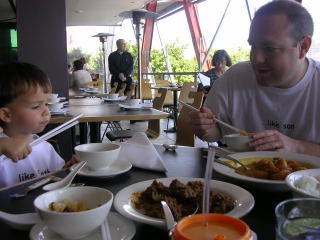
Owen & I took him to the Malaya, which is a bit of a Sydney institution. It’s a restaurant that has been around for 40 years, and has been a favourite of his ever since he was a little kid. It used to be a cheap and cheerful, but is now quite upmarket and recently moved to Darling Harbour, so you can have a great meal looking out over the water. We had a really nice lunch – Owen tried a bit of everything but couldn’t really cope with the spicier things and the waiters had to keep bringing him more water! They even let us take a doggy bag home so we could finish it off for dinner.
Well, I suppose we should get down to business …
Here are the answers to the last homework (well done Naheed for being so quick to have a go! And congratulations to all of you for getting pretty much all of it right!)
• I have a two-year-old son
We say two-year-old and not two-years-old because the phrase here is being used as an adjective, and so it doesn’t have a plural form. The noun it describes can be plural, but the adjective phrase is singular.
Other examples are:
a three-rupee note (thanks Naheed!)
a four-wheel drive car
a twelve-seater mini bus
three two-kilo bags of rice
• I’m really looking forward to getting to know you better
We use getting because “to” in this case is a preposition and not an infinitive, so it’s followed by a gerund (-ing form) or a noun. Look forward to is more formal than looking forward to, but both forms need a gerund or a noun.
Another example of this type of sentence (from my post on Monday) is: I have to admit to having a few butterflies.
An example with a noun is; I’m looking forward to my holiday.
• I have started learning English just 4 years ago
EitherI started learning English just 4 years ago
The point that you started learning English is finished and in the past, so we use the past simple.
Or I have been learning English for just 4 years
This sentence focuses on the length of the action rather than the starting point, and it refers to the present (you’re still learning English now), so we use the present perfect continuous here.
Satya, I’ve read your last two posts with interest! Glad to hear you’ve arrived safely in Chennai and have a bit of time to complete your manually operated gantry crane. (I’d love to see a picture of that!) I also loved your story about Ghandigiri – I’ll see if I can give the idea a kick-start over here ;-)
I’m going to be a tiny bit cheeky and not answer your questions tonight (it’s late in Sydney and I’ve just got home from work). I’ll do it tomorrow when I’m a bit more awake and can give you the attention you deserve – hope that’s OK!
And just to be really bad – have a think about this from my post today:
• When Chris got home from work on the Friday night (the day before the party), Owen goes running up to him and announces: “We got you a birthday cake, Daddy”!
Why have I used the present simple here when I’m clearly talking about the past?
I would love to hear how occasions like Father’s Day are celebrated in your countries, so feel free to post a comment and tell me about it!
Catch you later,
Rachel
way back (adv)
to plot (v and n)
to let the cat out of the bag (expr)
to be bowled over (phr vb)
take sth seriously (expr)
corny (adj)
a Sydney institution (n)
cheap and cheerful (adj –can be used as a noun informally)
upmarket (adj)
a doggy bag (n)
kick start (v and n)
get down to business (expr)
have a go (expr)
posted on Wednesday, 03 October 2007 | comment on this postYour QuestionsHi Satya,
Hope the conference is going well and that you’ve managed to get your robot finished!
As I promised yesterday, I’m going to answer your questions – Owen is having a snooze (there’s no way I can use the computer when he’s awake as he takes over to go on the Thomas the Tank Engine website …) and I’ve set myself up like a true Pom with a cup of tea and a biscuit, so I’m ready to go!
You wrote:
* Is it October 2 or 2nd October or October 2nd?
You can actually use all three – 2nd October is British (and Aussie) English, whereas the Americans tend to say October 2nd. (Make sure you use a capital O for October.)
* Is everything okay with the sentence "It was my third day of waiting"?
Grammatically the sentence is OK, and I can understand what you mean. However, a more natural way to put it would be something like: I had been waiting for three days, or It was the third day I had been waiting.
* What's the difference between everybody and everyone? Any rules?
They’re both the same – just like somebody/someone, anybody/anyone.
It’s good that you used a singular verb, as that’s how the grammar works:
Everybody was watching them curiously.
If you’re using everyone / everybody with a possessive, it’s more formal to use a singular pronoun, and less formal to use a plural pronoun –
Has everyone finished his or her dinner? (more formal)
Has everyone finished their dinner? (less formal)
When everyone had finished eating, the waiters took their plates away.
( it needs to be plural here - you can't say his or her plates)
* I guess I really had problems using perfect tenses (present, past)... can I use 'had' there?
This was your sentence:
Everybody was watching them curiously. They had entered into the Manager's Chamber and placed all the flowers on his table.
I don’t think you need to use the past perfect, as you’re describing events that happened at pretty much the same time – they entered the room and put flowers on the table. You only really need to use past perfect to make it clear which event happened first.
* Where should I use "could" and "can"?? What's the difference between these two sentences:
I could not get that
I cannot get that
In the context you’re using it, the only difference is between the past (the first sentence) and the present (second sentence) to talk about your ability to do the homework. As I’m sure you know, could has several uses in English, which I’m happy to discuss with you if you’d like (just let me know!).
I am going to be a bit picky about the whole sentence, though – hope that’s OK!
You wrote: sorry for I could not allot much time to your homework.I just want to have a look at the way we use “sorry” – you could rewrite that sentence in a few different ways:
1. Sorry I could not allot much time to your homework. (without for)
2. Sorry that I could not allot much time to your homework.
3. Sorry for not being able to allot much time to your homework.
If you use for, you need to follow it with a noun or a gerund (-ing form).
I also wanted to comment on your blog entry about your journey to Chennai – your use of tenses was very accurate, so well done!
Satya, it’s great that you’re able to cast a critical eye over your writing and pick up on things that you’re not sure about – that’s definitely a good way to improve your English because it means you’re getting the feedback you need, so please keep asking questions and I’ll do my best to answer them for you! (To those of you who had a go at answering Satya’s questions, that’s fantastic!) I also wanted to say as well that if you’d prefer me to give feedback in a different way, just let me know – this is your month!
For everyone (everybody!) else who’s reading this, thank you so much for your comments and questions – as I said last night, I’ll get round to answering you all individually next week, so watch this space! And please keep up with the comments; I’m really enjoying hearing from you all.
Here’s some vocab from today’s post, and also some great expressions that Satya used in his first few posts (I’ve included the sentences that Satya used so you can see the context) …
watch this space! (informal expr)
get round to (phr vb)
keep up with (phr vb)
pick up on (phr vb)
cast a critical eye over (expr)
to be a bit picky (expr)
set myself up (phr vb)
takes over (phr vb)
snooze (vb/ /n)
(What a lot of phrasal verbs! Sorry!)
Here are Satya's ...
So, we have ample time to complete our robot.
Sorry I could not allot much time to your homework.
Please take pains to correct my language.
And seeing as this is a very language-heavy post, I was wondering how you all record the new vocab that you come across? It would be great if we could share ideas about recording vocab – I think that could be really helpful. Cambridge has a great website where you can check words online using the different dictionaries that they publish – Advanced, Phrasal Verbs, even American English! Here's the link for you:
Anyway, with his usual good sense of timing, my boy is waking up so I’d better go before he realises I’m on the computer! Next time I’ll tell you how we spent our public holiday on Monday – if you’re really lucky I might even publish some more photos!! (I’m working all day Saturday, so I’ll catch up with you all after that).
Satya, I’m looking forward to hearing all about your experiences in Chennai! Have a great weekend everyone!
Bye for now,
Rachel
posted on Thursday, 04 October 2007 | comment on this postOur Day OutHey up Satya and everyone!
(Thought I’d start this one with a Yorkshire greeting – Yorkshire is the county where I’m originally from in England, in the north east. Anyway, we often say “hey up” to greet people.)
How are you all doing? Hope you’re enjoying the weekend – I guess for some of you Sunday won’t have started yet, as it’s only mid-afternoon here (Owen is asleep again). Satya, I’m sorry your robot wasn’t as successful as you’d hoped, but I hope the rest of the conference is living up to your expectations. I’d love to hear more about your childhood experiences (especially stealing exam papers!) when you have a bit more time …
Well, as I promised, I’m going to tell you a bit about what we did on the public holiday last Monday, and I have a little quiz for you! Everyone in NSW* had the day off because it was Labour Day (the rest of Australia had to work! Ha ha!) We went on a trip to a wildlife park in the west of Sydney (about 45 mins drive from where we live), which is full of Australian animals and birds. It’s very hands-on; there are some enclosures where the animals are free to roam about, and you can buy food for them and feed them yourself. We spent the whole morning there and had a ball – Owen loved looking at all the animals (apart from when he found a gate and found that more interesting than anything else – he was opening and closing it for about half an hour before we decided we’d had enough and dragged him away!), especially the lizards and the owls. It was really hot, though, about 38° - normally in Sydney it’s quite nice at this time of year, around 22 or 23, but Monday was a scorcher! It’s cooled down again now, though, thank goodness – one thing I really find hard about living here is the heat!
*NSW = New South Wales, the state of which Sydney is the capital city.
So I thought I would show you some of the animals we saw there and see if you know what they are: I’ll start off with two really easy ones, and I’ll put the answers below.

1.This animal only eats Eucalyptus leaves and spends a lot of its time sleeping.
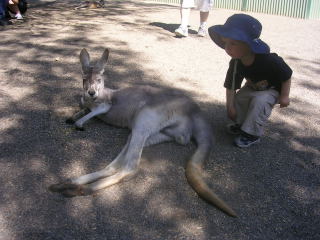
2. This animal is a marsupial – it has a pouch. It moves around by jumping (Owen says it goes: “boinga boinga”) and its baby is called a Joey.
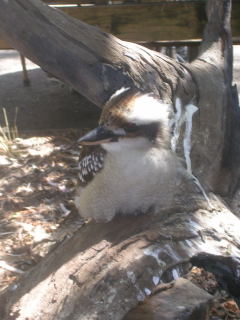
3. This bird is related to the kingfisher family, and makes a noise that sounds like laughter.

4. This animal is covered in spines and has a long snout to sniff out food. (Extra points if you can identify the other creatures in the background!)
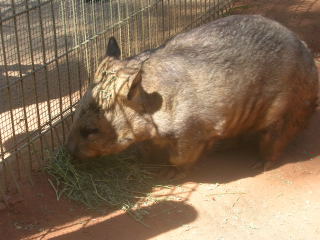
5. This animal is also a marsupial and is mainly nocturnal.

6. This animal was introduced to Australia from Asia by the Aborigines around 5,000 years ago.
So how did you do? Here are the answers, just in case you need them!
1. Koala
2. Kangaroo
3. Kookaburra
4. Echidna (and Chris and Owen!)
5. Wombat (these are my favourites!)
6. Dingo
One great thing about Australia is the diversity of wildlife, and parks like this one are fantastic in being able to display this variety. I have actually seen five out of these six in the wild (no dingoes yet) and I have to say it gives me a real thrill – maybe in that sense I’m still a bit of a tourist; Chris does not get excited about seeing a kangaroo, whereas I do. I have to say, though, I’m not a fan of Aussie spiders – some of them are enormous, and Australia is home to the ten deadliest species of spider in the world. Not good for someone who is terrified at the thought of one!
Anyway, I’ll stop scaring myself (and maybe some of you – sorry!) and move on to happier things – like English!! Hurray!
Well done to all of you on the homework from Wednesday – I have indeed used the present tense to make the story more vivid and immediate! This is more common in spoken English (and especially in jokes), but can be used for effect in written English.
Thank you also for all your excellent suggestions on how to record vocabulary, and I’m really impressed that so many of you are so diligent about it. If anyone reading this is new, or hasn’t had chance to read the comments, here’s a quick summary from what everyone said:
• work out the meaning from the context
• write down the word as part of a sentence
• make a word tree (nouns, adjectives etc that can be made from the word)
• sort the words into themes
• use a computer dictionary that you can edit
• keep a notebook especially for new vocabulary
• make a mind map
• write each word on a card with pronunciation, meaning etc (Chris used to do this at University when he was learning Ancient Greek and found it really helpful. He used to keep them in a hat and play ”Hat Greek” to test himself.)
• make up some sentences using the word
• use the new vocab as much as you can
Great stuff! Seriously, I couldn’t have suggested anything better myself, so well done!
Satya, thanks for your last set of questions; I’ll attempt to answer them …
After sleeping for more than 10 hours, I woke* up now. I have decided to spend this day sleeping in my room. My friends had* gone to watch another Robotics event. So, I stayed all the day alone in my room.
I would use the present perfect for the first sentence because you’ve used the word “now” and the sentence is relating the past (being asleep) to the present (waking up):
After sleeping for more than 10 hours, I have woken up now.
And present perfect again for your other question: your friends went to a Robotics event with the result that you are alone now.
So, if we look at the whole paragraph, I think it would be better to say:
After sleeping for more than 10 hours, I have woken up now. I decided to spend this day sleeping in my room. My friends have gone to watch another Robotics event. So, I have stayed alone in my room all day.
This assumes that at the time you are writing:
• you woke up very recently
• you decided before you went to sleep that you would spend the day in your room
• your friends are not there – they’re at another event
• you haven’t seen your friends since you went to sleep
Does that make sense? I hope so! I also hope it’s what you meant (let me know if not and I’ll have another look).
Sometimes, when I stay alone, my thought process gets accelerated. I become more* philosophical.
That’s fine – no problem!
(I don't think you need "gets", though - just use "accelerates".)
One day, I wish I would be a writer*...
You’re right to pick up on this as a mistake; it’s quite a common problem in English. It would be better to say:
I wish I could be a writer
In English, we use wish + could or would rather than wish + can or will, so well done for getting that part right. However, there’s a difference in meaning between could and would in this case.
If we use wish + would, we are expressing annoyance or criticism of someone else, e.g.:
Owen, I wish you would stop playing with that gate!
Chris, I wish you would turn the cricket off – it’s really boring!
(Yes, these are real life examples – did you guess?!)
We can express a future hope like this:
I wish I could be a writer
I’d like to be a writer
I hope to be a writer
Wish + past simple is talking about the present:
I wish I was / were at the beach (but I’m not, I’m sitting at the computer)
I wish I had more time to write about this (but I don’t – Owen will be awake soon)I wish I could go back to England more often (but I can’t – it’s too far)
Wish + past perfect is talking about a past regret:
I wish I had started writing this post earlier (but I didn’t and now I have no time)
Satya wishes that the wire hadn’t burned (but it did and now the robot doesn’t work)
If you like, here are a couple of sentences to practise this. Before you answer, think about whether it’s the past, the present or the future, and whether you’re criticising someone. Fill in the gaps with an appropriate verb form.
1. I wish I …………eaten so much for lunch – I feel really sick now.
2. Owen, I wish you ………… stop putting your toys in the fridge.
3. I wish I ………… a faster internet connection – uploading this post will take ages!
4. I wish I …………be the BBC teacher blogger again next year.
If anyone is really keen for more practice, try writing a couple of sentences about yourself and post them as comments and I’ll have a look at them.
Phew! So much grammar! I think I’ll stop here before I put you off English completely!
Next time I write I’ll have a chat with all of you individually, so keep the comments coming!
Bye for now, possums*,
Rachel
Today’s vocab:
to live up to your expectations (expr)
hands-on (adj)
to roam about (phr vb)
to have a ball (expr)
scorcher (n)
marsupial (n)
spines (n.pl)
thrill (n)
deadly (adj)
diligent (adj)
put you off (phr vb)
And a final thought … I wrote: Everyone in NSW had the day off
Is there a difference between have the day off and take the day off?
If so, what is it?
*A very famous Australian TV personality (Dame Edna Everage) says this at the end of her show.
posted on Sunday, 07 October 2007 | comment on this postFor all you dedicated bloggers ...G’day and hey up! (Look, I’m bilingual!!!)
This post is entirely dedicated to those of you who are faithfully posting comments – if you keep reading, you’ll find your name somewhere, I guarantee it! And please do keep them coming (I know say this every time, but it’s absolutely fantastic to have a global classroom of such interesting people!). Satya, I’ve read your last two posts with interest, and certainly haven’t forgotten your questions – I promise I’ll get to them in my next post!
Before I start, some quick feedback on the homework; most of you got the answers to my questions right:
1. I wish I HADN’T eaten so much for lunch – I feel really sick now.
2. Owen, I wish you WOULD stop putting your toys in the fridge.
(No, he doesn’t really do this, but only because he can’t open the door!)
3. I wish I HAD a faster internet connection – uploading this post will take ages!
4. I wish I COULD be the BBC teacher blogger again next year.
Well done on having a go at some sentences of your own, too – just make sure you keep an eye out for wish + would; if you’re not complaining about something, it’s better to use could.
As for the difference between have the day off and take the day off – a lot of you got this right and also expressed the difference very clearly, so well done for that too! (I just reread your comments to see if there was one I could pinch, but so many of you got it right it wouldn’t be fair, so I guess I’ll have to do it myself!)
Have the day off – someone has given me the day off (e.g. it’s a public holiday, the office is closed, etc)
Take the day off - I have decided myself that I’ll have the day off (e.g. I’m sick, I don’t feel like going to work, etc).
I also need to apologise that I’m only posting this now – I had intended to get it on the site yesterday, but hope you will all forgive me! (And NO HOMEWORK today otherwise we’ll be here forever!!) I have a couple of really exciting things coming up that I plan to tell you about – tomorrow night I’m going to the Night Noodle Market in the city, and on Sunday I’m doing my favourite Sydney walk, from Coogee Beach to Bondi Beach, so more on those as they happen.
OK, let’s get down to it – apologies if I misspell anyone’s name (my spell check doesn’t even recognise the word blog, so I don’t hold out much hope!). I hope I’ve replied to all of you – if I’ve missed anyone out, send me a comment and complain, and I’ll rectify it as soon as I can!
Bye for now,
Rachel
Silwal Kishor from Nepal – Thank you for all your comments, and for the interesting information you’re telling us about your country. I didn’t realise that in Nepal you celebrate birthdays according the lunar calendar (I think the Koreans do as well – does anyone else?). I think you’re right about people seeing Australia as a place of opportunity, as I’ve met a lot more Nepalese people recently through work than when I first arrived here. I’m glad you’re using the blog to brush up your English – especially the phrasal verbs! – that’s great!
Adriana from Brazil – Believe it or not, although the koalas look very soft and fluffy (which they are), they also smell very strongly of eucalyptus, because that’s all they eat, and if you stroke one a couple of times your hands will smell too! Kangaroos can cause a lot of damage to cars – they are quite common on country roads especially around dusk and dawn, when they can be quite hard to see, and because they’re such big animals they can really damage a car if it hits them at high speed. For this reason, many cars in the country are equipped with “roo bars”, which are metal bars fixed to the front of the car to avoid damage if a kangaroo is hit. I’m very impressed that you’ve been reading the Sydney Morning Herald (the website is: if anyone else is interested in having a look). Keep up with the comments!
Ana Paula from Brazil – Good work on all the vocab; I’m really impressed by your dedication! Are you studying for one of the Cambridge exams, or just using the website to practise your English? There’s another really good website with Cambridge practice activities: I’m sure you know of it already, but just in case you don’t, here’s the address: . Please say G’day to your sister from me, and tell her to keep on letting you use the computer!
Naheed from Pakistan – How great that you’re using a grammar book to practise the language points we discuss on the blog – good thinking! Owen isn’t really good with chopsticks – he just wanted them because we had them, but it didn’t take him long to figure out that if you bang them on the table you can make a really loud noise!
Rafique from Pakistan – Well done on all your answers to the homework! Australians do indeed have a horror of the rule book, which is why there is so much slang! Watch this space for more … and keep commenting!
Carolina from Argentina – Welcome to the blog! I’m really glad you’re so motivated to reply to all my posts, it’s great to hear from you so regularly! I hope you had a wonderful Mother’s Day last weekend and didn’t have to do any housework at all! I missed out on the UK Mother’s Day (in March) this year because I was here, and I missed out on Aussie Mother’s Day (in May) because I was in the UK! That’s doing well, isn’t it?!
I am totally with you on cockroaches – they are truly disgusting creatures that make my skin crawl to think of them! They’re not so common in the UK, so I really got a shock when I came to Oz, especially because they’re so big! And they fly! Eugh!
Your husband is absolutely right about the rugby- one day soon I’ll do a post on Aussie sport (I’ll have to get Chris to check it before I put it up in case I make any mistakes!). Actually, I’m OK on rugby, it’s cricket that causes problems!
Yvonne from Germany, NRW, Ahaus – Hi! Thanks for all your comments and for being so good about the homework! I will try and write a bit more about Yorkshire and also (of course) about Sydney. I would love to hear a bit about where you come from – I have visited Germany several times (never been to Berlin, though), and am curious to know what NRW stands for, and whereabouts it is. It was interesting to read about how you celebrate your national holiday; there is a similar event in Oz on January 26th, called Australia Day.
What sort of work would you like to do in the UK?
Paulraj from India – Yes, Aussies definitely love their sport! (You’re talking to the wrong person about cricket, though, I just don’t get it!). I’m sure Chris would love to sit down and have a chinwag with you on the topic – he’s a mad fan and is also a member of one of the local teams – they play every Saturday. Owen made his day recently by saying “Do you want to play cricket with me, Daddy?” I’m not sure he knows what cricket is, really, but Chris was pleased to bits!
You ask a good question about Owen’s accent – it’s kind of a mixture of both, but mainly mine because I’m the one who he spends the most time with. I guess when he starts preschool he’ll become a proper little Aussie and all my hard work will be lost!
I really enjoyed your description of the peacocks and tigers – there were some peacocks at the wildlife park (even a white one, which was really beautiful). We are big fans of tigers in our house, and also of elephants (when Owen was younger, he couldn’t say elephant so he used to say “hennant” instead!). I should plan a trip to the zoo, really, so he can see them for himself.
Yes, you are right about my use of the past perfect in my post about the unbirthday party – great to see you picking up on examples from my writing!
And regarding dingoes, I’m actually not sure whether they’re dangerous or not – I suspect they’re fairly unthreatening creatures as long as they’re not provoked. I’ll do some research and see if I can find out (that means I’ll ask Chris!).
Marianna from Slovakia – Dobry den! Well done on the Germany sentence – very good! That’s not the first time someone’s said that to me, actually … wonder why?! Chris studied Ancient Greek as part of his Master’s degree at Durham Uni in England (that’s where we met). He’s also done some Latin and German, and a bit of French (my sister lives in France, so we both madly try and brush up our French whenever we go and see her!). Actually, I can tell you a story about Chris’s Ancient Greek lessons (I’m sure he won’t mind). The lessons used to be held first thing on Monday mornings (always a bad time, in my opinion!!), and the teacher was a rather elderly man who believed in round-the-class translation. I’m sure if you’ve ever had a teacher like that you know what happens – you work out which sentence you will have to translate and then don’t pay attention to anything else! Anyway, Chris used to walk into class, fall asleep, wake up to translate his sentence and then go back to sleep for the rest of the lesson! Occasionally he didn’t wake up, then his mate had to poke him in the ribs and point out which sentence they were up to in the text!
Regarding what you say about wombats, it is hard to see them in the wild, generally – I hadn’t seen one until a couple of years ago when my parents came over for Owen’s naming ceremony. We rented a house in Kangaroo Valley (about 2 hrs south of Sydney) for a few days, and there were heaps of them! They’re nocturnal, so we used to go outside at dusk and keep an eye out for them then.
Wisarut from Thailand – Thai food! Yay! I’d never tried Thai food before I came here, and I love it! I still find it hard to eat really spicy food, though (Chris does – I don’t think he has any sensation in his mouth at all, as he can eat things that would make my mouth explode! You know on cartoons where you see someone eat something spicy and then steam comes out of their ears? That’s me!). Owen is a big fan of chicken satay, and I’m slowly trying to introduce other things as well – what sort of foods did you eat when you were little? Anything you would recommend for a two-year-old?
How’s work going – hope it’s less frustrating now! I’ll tell you a lot more about Oz if you tell us a lot more about Thailand – it’s one of the countries that’s on my list of places to visit (unfortunately it’s a very long list, and I don’t think I’ll ever get round to going everywhere! Oh well!).
Abdul Razaq from Afghanistan – First of all, Happy Birthday to Tawab for yesterday - even though my sense of world time is really bad, I'm pretty sure it's no longer 9th Oct in Afghanistan! Please wish him a happy birthday from Australia, even if you’re not going to celebrate it until the end of the fast! How old is he?
You asked about improving your speaking and writing; I can certainly give you some ideas, but I’d like to see if anyone else has any suggestions? How do you all improve your spoken and written English? Regarding writing, a lot of the students I teach keep a diary so that they can practise writing in English, especially the new grammar and structures that they have learned. There are also some good websites for this (have a look at my comment to Ana Paula for one suggestion). Regarding speaking, I don’t know how much access you have to English materials, but one way would be to listen to a TV or radio program in English and try to repeat some of the words or phrases to practise the pronunciation. If you have any examples of written English, try reading it aloud, slowly and first and then more quickly to get used to how it sounds and links together. (You could even use the posts on the Teacher Blog for this!). Your vocabulary is already very good, so use your knowledge of English words and phrases whenever you’re writing and speaking so you can consolidate this too. Hope that helps – and please keep the comments coming!
Sara from Saudi Arabia – Yes, there are lots of differences between Aussie English and British English (especially regarding slang). I’ll have a think about some examples and post them for you all to have a look at. You’re right, G’Day is a short form of Good Day, and goodonya for working it out! (Now can you guess what goodonya means?!)
Myen from Vietnam – I have indeed tried Vietnamese food (and love it!); see my response to Lam Tran below for more details! Well done on the homework – I’m not keen on Aussie spiders either, believe me! Eugh! Owen loved the kangaroos; you can actually buy food for them and feed them as you walk around, and he loved doing that. I felt a bit sorry for them, though, as there were heaps of people doing the same thing and I think they must have been a bit sick of it after a while! Thank you so much for all your comments – keep them coming!
Adek from Poland – Thanks for all your comments; it’s great that you check in so regularly. I think Pom can be used a bit disparagingly, but I’ve mainly encountered it as a statement of fact. Aussies and Kiwis often tend to refer to people from the UK as “whinging Poms” in reference to the fact that British people complain a lot (I just say that if Oz was more like England we wouldn’t need to complain, and then they shut up!). It’s funny, though, I’d rather be called a Pom than a Brit – isn’t that interesting? I wonder why? (You don’t have to answer that!)
I was OK with Owen getting that close to the kangaroos – at the wildlife park they’re quite used to people touching them, and there are people-free areas where they can go if they’ve had enough. I was watching him pretty closely, though, and would have whisked him away at the first sign of trouble! There was one point where he nearly trod on a sleeping kangaroo’s tail (accidentally), which could potentially have been a bit tricky!!
Rocio from México – Yes, Sydney is a very beautiful city, and there will definitely be more pictures, now I know how to do it!! Well done on the homework – you’re spot on! Thanks for your request about gerunds and infinitives; I think a lot of people find that difficult, so I’ll do a focus on that for everyone next week sometime – keep checking in and commenting, it’s great to hear from you!
Lam Tran from Vietnam – I loved your descriptions of Women’s Day and Teacher’s day; sounds like I should plan to visit Vietnam between October and November so I can be involved in both! (That would be great, actually, because then I could spend my birthday there too!) Yes, I have tried Vietnamese food, and I love it! I’m really lucky where I live because not only is the Vietnamese restaurant in Dulwich Hill fantastic, but also there is a large Vietnamese population in Marrickville (the next suburb down from Dulwich Hill) with lots of really good restaurants. I especially love the fresh prawn rolls (I think they’re called goi cuon, is that right?), but I’d love to hear any recommendations for things to try! Keep the comments coming!
Zainab from Iran – You’re absolutely right about the difference between have the day off and take the day off – well done!!
Paco from Spain – Thanks for your comments, and well done on the homework – top marks! Glad you liked the photos; watch this space and there will be more!
Sara from Bahrain – What a good idea to turn Mother’s Day into Family Day; that covers everyone! Please keep on reading and commenting; it would be good to hear from you again.
Milan from Viet Nam – It was great to hear how you spend Father’s Day. I like the idea of karaoke, but I don’t think I could convince Chris! (Maybe I could do a surprise unbirthday karaoke next year!) I think you’re onto something with an unbirthday party for either you or your mum so you don’t have two parties in the same month – let me know if you do it and how it works out!
Hyoshil from Lincoln – Thank you so much for your reassurance about Thomas the Tank Engine – it’s nice to know there is light at the end of the tunnel (also nice to know that my boy is not the only one with a train obsession!). Did you enjoy your time in Oz? And what do you think of Lincoln? Lincoln is not too far from where I’m from – I was born and grew up in Doncaster.
P – I have no idea why Aussies speak so quickly, but you’re right, they do! Your question about written styles is a good one – written English is pretty much the same in Oz and the UK; it seems to be the US that’s different. Spoken English, though, as I guess you’ve worked out, is a totally different story!
Manas from India – Well done with the “wish” homework; perfect! Glad you liked the photos – more coming soon, hopefully!
Antonio from Belgium – Thanks for the comments! Please keep reading the posts and letting me know what you think!
Pary from Iran – How’s your boy doing? Sounds like he keeps you on your toes as much as mine does! I’d love to hear more about the different celebrations you have in Iran, as there doesn’t seem to be nearly as many in Oz. I especially like the sound of Teacher’s Day!!
Josie from The Netherlands – Lovely to hear so much about you! What’s it like having a six-year-old? (I can’t imagine that at the moment, although I’m sure it will happen to me sooner than I expect!) Tiago is a lovely name – I wonder what the English version is? Does anyone have any ideas? Please pluck up the courage to write again – we’d love to hear from you!!
Filippo from Italy – Ciao! Yes, Chris eventually recovered from Australia’s loss to Italy (I didn’t care, I was supporting England – pointlessly, as it turned out!!). Actually, your comment made me think a bit about the World Cup – as I’m sure you know, there’s a large Italian population in Australia (especially in Sydney and Melbourne), and in fact one of our closest friends is an Italian-Australian; there was a real case of divided loyalties when Oz made it through into the cup. In our case, our friend was supporting Oz, until they were knocked out, but he took a lot of stick for it from people who thought he should have been supporting Italy. Interesting stuff!
The concert in Rome sounds fantastic – have you ever been?
Anna Yin from Toronto – That’s a very tricky question – thank you! (It’s always nice to get tricky questions!). I’m going to throw it at a few of my colleagues for their suggestions, and I’ll get back to you – hope that’s OK!
Sunday from Beijing,China – Well done on your first comment! Great stuff! I’m glad you’re learning so much from the site, and I’m looking forward to reading more comments in the future.
Reza from Belgium – Thank you for your feedback; the reason I don’t include a definition for the new words is I’d like you to try to guess them from the context (that’s a really good skill to have when dealing with vocab). I also try and reuse the new words in my other posts, if I can, so you can see other ways they are used. What I plan to do is post a list of definitions every two weeks, so you can check up on any that you weren’t sure of. Hope that helps!
Tiasha, Sri Lanka – I’m glad to meet you too! Thank you very much for your comments; keep reading and writing to us!
Sylvia from Leeds, Yorkshire UK – Now I’m the one who’s excited (let me explain!). I lived in Leeds for 3 years when I was at University there, and loved it! So your comment brought all sorts of memories flooding back, especially about the cold and dark! But how lovely it will be when they switch on the Christmas illuminations (do they still do that?). How’s the teacher training going?
David from from China and living in Germany – Here’s a bit of trivia for you - do you know another symbol of Australia? (It’s on the coat of arms.) It’s the emu, and the reason these two animals are on the coat of arms (instead of wombats, for example!) is that neither of them can walk/move backwards. As for the difference between dingoes and wolves, there my knowledge fails me (except that they’re both part of the dog family). If I ever do find out, though, you’ll be the first to know!
Chandra from India - I will indeed keep saying more and more about Australia (until my knowledge runs out, and then Chris will be doing the blogging!)
Daria from Russia – I’m so glad we’ve inspired you to pluck up your courage and start some active learning – that’s fantastic! Keep the comments coming!
Pilar from Spain – Glad you liked the photos; Aussie animals are pretty special, aren’t they! Does your dog really bite the furniture? Maybe you could put his toys in the fridge as a punishment ;-)
Leila from Finland – G’day possum! Are you sure you’re not an Aussie Sheila yourself? (For those who wanted some slang, Sheila means “woman”, although it’s not so common any more, so my Aussie husband informs me! The equivalent for a man is “bloke” – doesn’t seem quite even to me!). Great to have you back on the blog!
Suchitra from Nepal – Yes, Sydney is a great place to live, although I never thought I’d end up here! You’re absolutely right about the diversity of cultures here, and I totally agree that it’s good to experience so many things – I went to a lovely Nepalese restaurant a couple of weeks ago with a friend, and really enjoyed it! So did my friend, and she’s lived in Sydney for years and never tried Nepalese food (I guess that’s the downside to such a variety – it takes ages to try everything!) I’m glad you enjoyed the Aussie animals – so did we!
Sky from China – G’day! I like kangaroos too (but I like wombats even more!). You’re absolutely right about one man’s meat being another man’s poison, but you have to remember that kangaroos are very common in Oz, and are often farmed for meat and skins etc. Personally, I am a bit squeamish about eating kangaroo (as I am about duck, rabbit and other fluffy animals!), although I have done it once, in a Thai restaurant!! It was actually quite nice – it was served in a curry with peanuts and potatoes (I think it’s called Massaman curry, is that right, Wisarut?), but I don’t think I really need to eat it again (the kangaroo, not the curry! I believe the traditional way to eat it is wtih beef, which suits me much better!). Hope you do come back again, it would be nice to hear more from you!
Tanuja from India – Thanks for your comments! Keep checking in, and we’d love to hear from you again!
Phuong Nga from Vietnam – Glad you like the blogs! Keep checking in and seeing what’s happening (and what homework I can come up with!)
Fatemeh from Afghanistan – Welcome! It’s always nice to meet someone new! Keep reading the blog (and adding comments). You did a good job with the first homework, so try the others and see how you do.
Anna from Warsaw, Poland – I certainly can tell you about traditional Australian food (food being my favourite topic!). I think maybe other people might be interested in this too, so I’ll do a post on it soon (maybe with some recipes?)
Hualan from Melbourne – Yes, I know exactly which holiday you are talking about! Everyone else, you’ll have to wait until November (aren’t I mean?!) to find out all about it! And well done on knowing all the animals!
And just a little bit of vocab - if you've managed to read until the end of this enormous post, congratulations! Give yourself a pat on the back!
to keep an eye out for sth (expr)
to brush up (phr vb)
to make your skin crawl (expr)
a chinwag (n, informal)
to be pleased to bits (expr)
to provoke sb (v)
goodonya (Aus. slang)
disparaging (adj)
to be onto sth (expr)
there's light at the end of the tunnel (expr)
to pluck up (one's) courage (expr)
to bring (a memory or experience) flooding back (expr)
squeamish (adj)
posted on Wednesday, 10 October 2007 | comment on this postNoodles!Hi Satya and everyone,
First, let me try and give you the websites I mentioned on Wednesday, as for some reason they didn’t work when I tried to link them! I’ll just type in the addresses rather than trying to set up a link, then you can copy them if you’re interested.
The Sydney Morning Herald’s website is: www.smh.com.au
And the Cambridge exam practice site is: www.flo-joe.co.uk (Ana Paula, I’m glad you already know of it – everyone else, I’d encourage you to have a look, especially if you’re considering taking a Cambridge exam like FCE or CPE).
Let’s talk about food! Yay! As you know, last night I went to the Night Noodle Markets, which are held every year in Hyde Park, in the city centre, as part of Good Food Month. I’d never been before, so I was really excited and also quite curious to see what there was and how it was organised. There was one major downside – Chris had to take a day off yesterday as he really wasn’t well, so he couldn’t come with us :-( It’s not the end of the world, though, as the markets are on again next week, so we’re going to go again next Thursday! Here's a picture for you - it's not great, but you'll get the general idea.
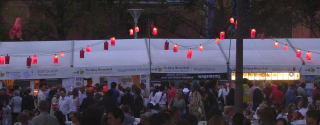
Owen was all excited because we went in on the train, and he loves train trips! Every time the train stopped he said,” Doors closing. Please stand clear.” which I thought was hilarious!! Anyway, we arrived at the markets and met our friends (they have a little boy too, called Harry, who is 3 days older than Owen) and went for a look round. It was packed with people – there were tables and chairs set up but they were all taken, so we ended up having a picnic on the grass, which was really nice. The stalls were arranged in a square round the outside of the seating area, and we did a complete circuit before deciding what to have. It was great – there were lots of different Thai places, plus Chinese, Japanese, Singaporean and others, as well as a bar and some stalls selling various desserts (more on those later!). I got Owen some chicken satay sticks (the chicken is marinated on skewers, and served with peanut sauce), and I had two of my very favourite things – salt-and-pepper squid, and a Japanese dish called okonomiyaki (apologies to anyone from Japan who might be reading this – I have no idea how to spell Japanese words in English!). Okonomiyaki is like a savoury pancake, made with a light batter, then a layer of cabbage, and then a topping. They had my favourite topping, bacon and potato, so I was really pleased. On the top of that they put mayonnaise, seaweed and (I think) barbecue sauce – delicious! Owen helped himself to the squid and the pancake, and seemed to enjoy both, which was great.
By the time we’d had a look round, got our food and eaten it, the boys were getting a bit crazy; it was getting dark, and there were lanterns and fairy lights everywhere – lovely, but they also attracted a lot of moths, which I wasn’t so crazy about! Owen and Harry were running about like mad things whilst we were trying to eat, so one of us had to keep getting up and bringing them back, especially when they saw the fountain and decided it would be a really good idea to try and climb in!! In the end, we ended up bolting our food down and then bribing them with dessert! There were a couple of dessert stalls, one selling ice-cream (there’s a factory close to where we live where they make it, and I have to say it’s fantastic!), and one selling little Dutch pancakes called (I think) poffertjes. We went for the pancakes, which came with slices of fruit and chocolate sauce and were absolutely delicious! So, all in all, it was a great night (although I was absolutely knackered by the time we got home, and so was Owen!), but I think it’ll be better next week because we know what to expect, and also because Chris will be able to come; he was pretty gutted that he’d missed out! I’ll also try and get a better photo (maybe even one with us in it!), as I was so busy trying to eat and keep an eye on Owen that photo opportunities were quite limited! Phew!
OK, I’ll take my food-lover hat off now and turn myself back into a teacher …Let’s have a look at Satya’s questions from his last posts.
• People say that the IITians had* showed some partiality towards the students from IIT.
This is correct, because you’re using reported speech (you’re telling us what someone else said). I would, however, change say to said, as you’re talking about the past:
People said that the IITians had showed some partiality towards the students from IIT.
Think about what the people actually said at the time (direct speech):
“The IITians have showed some partiality …”
This is in the present perfect, so in reported speech we need to use the past perfect.
If you look at Amy’s post from the 27th September, you can see more examples (and homework!) of this.
• Some of the readers have asked a question: If I wished to be a writer (Rachel... is it correct to use 'wish' like this?), why did I choose engineering??
Again, this is correct! Your use of ‘wish’ is OK; you are using it in the past simple (= wanted) because, again, you’re reporting what someone said.
It might be interesting (well, I’m interested, even if you guys aren’t!) to have a look at the meaning of if in your sentence. In this case, if = if it is true that … or if it is the case that …
Here are some more examples:
If you wanted okonomiyaki, why did you buy chicken satay?
If Chris was sick, why didn’t you stay at home and look after him?
If you want to try some salt-and-pepper squid, you only have to ask.
If you’d like some more practice, why don’t you write some sentences for homework? ;-))
And finally, Satya asked me a really horrible question (only joking, Satya, all questions are good!)
• Rachel...I still find problems using the tenses... could you teach me about the tenses...and how to use them...
Firstly, I think you can use tenses much better than you think! Here’s an example of your writing from one of your posts:
After I had written my last post, I went back to the campus to watch some other events. I was watching curiously when one of my friends came and told me that one of the co-ordinators had scolded our friend. We immediately rushed to the spot to check it out.
I’ve changed it slightly to get an example of all the past tenses (what you originally had was fine!) …
We’ll discuss this more in the next post, so have a think about the following things:
• In the extract, can you find the past simple, past continuous, and past perfect simple tenses?
• Can you find an example of reported speech?
• Can you draw a timeline of the events that Satya describes?
And a special task for Satya:
• When you write about how you stole the exam papers (we’re all nagging you about this, aren’t we?!), I’d like you to try doing it this way (if you have time):
• Firstly, write your post without thinking too much about grammar – just write as naturally as you can.
• Then, look at what you’ve written and see if you want to correct anything.
• Next, compare the two versions and let me know if you have any questions.
• (You don’t have to post both versions unless you want to)
• If anyone else wants to try this, feel free! You don’t even need to post it as a comment – the idea is for you to get used to looking at your work and trying to correct it yourself.
Satya, I’m assuming that you mean mainly past tenses, as you seem to use these the most, but let me know if you want to work on anything else and I’ll see what I can do :-)
Well, once again I’m working tomorrow, so I’ll be back on Sunday to tell you all about my walk from Coogee to Bondi (if it happens – the weather has been very dodgy over the last couple of days!)
Enjoy your weekend!
Rachel
Vocab
packed (adj)
to end up (phr vb)
downside (n)
to bolt (food) down (phr vb)
to go for (phr vb)
knackered (adj – informal)
gutted (adj – informal)
dodgy (adj – informal)
posted on Friday, 12 October 2007 | comment on this postCoogee to BondiG’day all!
(Should be good night really, as I’ve just got home from work!)
Let me tell you about my lovely beach walk on Sunday! I’ve done this walk several times since I arrived in Sydney, and it’s one of my favourites. It basically follows the coast from Coogee beach to Bondi beach, and takes about two hours if (like me) you keep stopping to stare at views and catch your breath after climbing hills! Some dedicated people like to run the route – really dedicated people who live locally run it on a daily basis, but that’s way out of my league :-)
Coogee
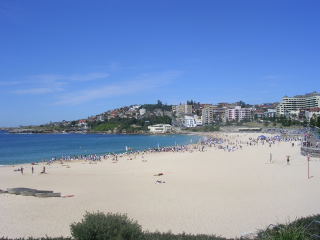
So, the first beach, and the starting point (or finish point, depending which way round you do it), is Coogee. As you can see, it’s quite big. I don’t know much about it other than that, as I tend to go to some of the more child-friendly beaches (coming up!). Coogee is home to a lot of backpackers, especially Poms!
Gordon's Bay
There's no beach here, just rocks (good for clambering over!), beautiful greeny-blue water, and a very evocative smell of seaweed!
Clovelly

After Coogee, you come to Clovelly. Clovelly is quite sheltered, as the bay is long and narrow, and for this reason it’s a very popular family beach – in fact whenever we take Owen to the beach we tend to go to Clovelly. The last time I took Owen, Harry came too and all they did was scoop up sand in their spades, throw it into the sea, get more sand, repeat … I’ve never had less to do to keep him occupied!
Waverley

Next up is not a beach, but one of the nicest parts of the walk – Waverley Cemetery. It’s perched on the top of the cliffs overlooking the ocean, and is a very old cemetery. I think it’s beautiful – it’s also interesting to walk through and look at the headstones, as there’s a real mix of people buried there.
Bronte
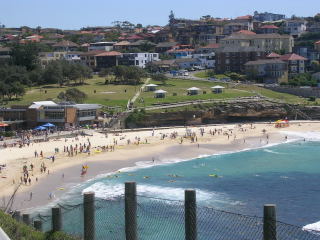
Coming down from the cemetery, you reach the next beach and home of a great place for a juice – Bronte. I always have a break at Bronte and get myself a freshly squeezed juice from the juice shop. I try to get something different each time I do the walk, and Sunday’s choice was pineapple, orange, lemon and ginger – yum! I’ve been to Bronte several times with students, as there’s a large grassy area at the back of the beach, with barbecues, so when I was teaching FCE we used to go there for a barbecue and do practice speaking tests.
Tamarama
The next beach, Tamarama, is very small. And that’s all I know about it!
Bondi

And finally, over some more cliffs and wonderful views back across the route, you get to the famous Bondi! Hurray! And by that time it’s definitely time for lunch, so what could be better than fish and chips at the beach? (That’s a very English thing to do, by the way, but I’m proud to be a Pom!). My only problem with fish and chips in this country is they are always served with tartare sauce, and in my opinion the ONLY way to eat fish and chips is with VINEGAR!!!!! (Let’s have a quick poll – who’s for tartare sauce and who’s for vinegar with fish and chips? Send your votes in …) And of course, to finish off, an ice-cream! Perfect!
Well, I hope you enjoyed that little excursion through Sydney’s beaches as much as I did! I don’t think I’ll be doing it again until summer’s over, as it was already pretty hot on Sunday, and it’s only going to get hotter! I was surprised, actually, by how many people were doing the same thing; the first part of the walk from Coogee to Clovelly was more like a highway than a relaxing stroll – we kept having to pull over to the side to let the serious walkers past!
And now for the serious stuff!
Satya, thanks for the pictures – the robot looks really complicated. How long did it take you to design and make it? I loved your story about the exam papers! It was a bit like James Bond or something! And even better, your use of past tenses was pretty much prefect, so well done! Goodonya*!
There were just two little errors in your post; I’ll put them below so you can have a go at correcting them …
1. I asked them whether they have placed it safely or not.
2. And do you know what we had done the next day?
Thank you all for having a go at the homework – here’s what I think:
After I had written my last post, I went back to the campus to watch some other events. I was watching curiously when one of my friends came and told me that one of the co-ordinators had scolded our friend. We immediately rushed to the spot to check it out.
• past simple: went, came, told, rushed
• past continuous: was watching
• past perfect simple: had written (had scolded – see below)
• reported speech: had scolded
• timeline:
---------1----------------2~~~~~~~3~~~~~~~~~~~~4--5------------------NOW
1. wrote the post
2. went back to the campus
3. watching curiously (this is a longer action, interrupted by 4)
4. my friend came and told me
5. rushed to the spot
6. scolded
You’ll notice I haven’t put had scolded (6) on the timeline. If I decided to write it somewhere on the timeline, would it go before or after friend came? What do you think?
Can anyone suggest any creative ways of saying “hi” for Satya? So far I’ve come up with a grand total of two – hello and g’day – there must be more than that, surely?!
I would love to hear about any walks that you really enjoy doing, so if you'd like to have a go at some descriptive writing, post a comment for us!
I think there’s a couple of things I really need to do – one is the give you the definitions for the past fortnight’s vocab, which I will do as soon as possible (not now, ‘cos it’s bedtime!). You’ve all been fantastic at having a go, and from what I can see, you’re all doing really well with guessing the meaning from the contexts, so well done!
And the next thing is to write about Aussie sport – watch this space! I should warn you now, though, that I am far from being an expert on this, so I’ll probably get Chris to read it before I post it in case I make any hideous mistakes!!
Goodnight from Oz,
Rachel
* I should have told you this one before, really – Goodonya = Good on you = well done!
Today’s vocab (not much!)
clamber (vb)
catch your breath (expr)
way out of my league (expr)
to be perched (vb)
poll (n/vb)
stroll (n/vb)
hideous (adj)
posted on Monday, 15 October 2007 | comment on this postVocabulary!!Hi everyone!
As promised, here are the definitions for the vocab we’ve looked at over the past couple of weeks. For those of you who are new, the reason I don’t include a definition for the new words straightaway is I’d like you to try to guess them from the context (that’s a really good skill to have when dealing with vocab). I also try and reuse the new words in my other posts, if I can, so you can see other ways they are used.
To give you something to think about, I’ve organised the vocab in groups from each post, and done the answers as a matching activity. For example, number 1 in the first group (to have butterflies) matches definition f (to be nervous about sth (sth = something)). If anyone is really keen, there are couple of extra questions at the end! You don’t need to post the answers – just keep a record in your vocab book and I’ll give you the answers in my next post so you can check them then.
Also, just be aware that some of these words can have more than one meaning (especially the phrasal verbs!), and the meaning I’ve given is the one I used in the original post. I would really encourage you to look back at the posts and see the words in context, just to refresh your memory!
Here are a couple of other possible activities you could do to practise these words and expressions:
• write an example sentence using the new vocab
• choose seven or eight of the words and use them in a story
• use an online dictionary to see other example sentences
By the way, a big thank you for all your get well messages for Chris – he’s back on his feet again now & looking forward to the noodle markets on Thursday!
Catch you all soon – enjoy the vocab!!!
Rachel
1st October
1. to have butterflies (expression)
2. technophobe (n)
3. (to keep your) fingers crossed (expr)
4. to keep me on my toes (expr)
5. antics (n.pl)
6. start off (v)
7. hustle and bustle (n)
8. to pinch (v)
9. to figure out (v)
10. to get up to (something) (v)
a. to stay alert and busy
b. noise and activity
c. sb who fears new technology
d. find a solution to a problem
e. begin
f. to be nervous about sth
g. steal
h. to hope sth happens the way you want it to
i. to do sth (often sth that others would disapprove of)
j. amusing, silly or strange behaviour
3rd October
1. way back (adv)
2. to plot (v and n)
3. to let the cat out of the bag (expr)
4. to be bowled over (phr vb)
5. corny (adj)
6. a Sydney institution (n)
7. cheap and cheerful (adj –can be used as a noun informally)
8. upmarket (adj)
9. a doggy bag (n)
10. have a go (expr)
a. high quality and expensive
b. to reveal a secret
c. a long-established and well-known custom, tradition or business
d. a long time ago
e. to try
f. repeated too often to be interesting / lacking new ideas
g. a container provided by a restaurant to take home uneaten food.
h. inexpensive but pleasant (of restaurants)
i. a secret plan
j. to be surprised and pleased
4th October
1. get round to (phr vb)
2. keep up with (phr vb)
3. pick up on (phr vb)
4. cast a critical eye over (expr)
5. to be a bit picky (expr)
6. set myself up (phr vb)
7. takes over (phr vb)
8. snooze (vb/ /n)
9. ample (adj)
10. allot (v)
11. take pains to (expr)
a. notice
b. gain control
c. look at something and judge it
d. plenty
e. make time to do sth
f. a short sleep
g. to provide sb with necessary things
h. to try hard
i. to give or allocate
j. stay up-to-date with
k. to pay attention to small (maybe unimportant) details
7th October
1. to live up to your expectations (expr)
2. hands-on (adj)
3. to roam about (phr vb)
4. to have a ball (expr)
5. scorcher (n)
6. thrill (n)
7. deadly (adj)
8. diligent (adj)
9. put you off (phr vb)
a. a really hot day
b. likely to cause death
c. to discourage
d. to be as good as you hoped
e. to walk around freely
f. excitement
g. careful, making a lot of effort
h. practical and involved
i. have a great time
10th October
1. to keep an eye out for sth (expr)
2. to brush up (phr vb)
3. to make your skin crawl (expr)
4. a chinwag (n, informal)
5. to be pleased to bits (expr)
6. to provoke sb (v)
7. goodonya (Aus. slang)
8. disparaging (adj)
9. to be onto sth (expr)
10. there's light at the end of the tunnel (expr)
11. to pluck up (one's) courage (expr)
12. to bring (a memory or experience) flooding back (expr)
13. squeamish (adj)
a. force yourself to be brave about sth
b. have a good idea
c. easily upset by sth unpleasant
d. to make sb very anxious or frightened
e. to be very happy
f. to improve your knowledge of sth
g. to see hope for the future
h. to try to make sb angry
i. to watch carefully for
j. to criticise, show that you disrespect sb
k. a chat
l. make sb remember the past very vividly
m. well done
12th October
1. packed (adj)
2. to end up (phr vb)
3. downside (n)
4. to bolt (food) down (phr vb)
5. to go for (phr vb)
6. knackered (adj – informal)
7. gutted (adj – informal)
8. dodgy (adj – informal)
a. exhausted
b. disadvantage
c. very crowded
d. unpredictable
e. choose
f. to eat very quickly
g. very disappointed
h. to finally decide sth
15th October
1. to clamber (vb)
2. catch your breath (expr)
3. way out of my league (expr)
4. to be perched (vb)
5. poll (n/vb)
6. hideous (adj)
a. to be too good for sb
b. begin to breathe normally after exercising
c. a study in which people are asked for their opinions
d. extremely ugly or bad
e. to climb with difficulty
f. to be in a high position, or positioned on the edge of something
Extra questions – all you need to do is complete the gap with one of the words or phrases in the vocab lists. They’re in the same order as they appear above.
1. Technophile is the opposite of …
2. Work out has a similar meaning to …
3. To give the game away has a similar meaning to …
4. Cheap and nasty is the opposite of …
5. Downmarket is the opposite of …
6. A nitpicker is someone who is …
7. Scorching is the adjective of …
8. To be thrilled to bits has a similar meaning to …
9. Upside is the opposite of …
10. … can also mean risky OR likely to cause pain OR dishonest
posted on Tuesday, 16 October 2007 | comment on this postThe biggest “loser” sport in the world!Good evening campers!
(This is a catchphrase from a very popular 1980s comedy show in the UK called “Hi-de-Hi”, about a holiday park.)
I was really impressed with those of you who wrote about your favourite walks – you used some very evocative language to describe the scenery, to the extent that I really felt I was there. (You’ve also inspired me to start planning a major trip round the world!). So thank you for that, and well done!
Satya, you probably won’t see this until you get back, but I hope you have a wonderful time at home, and I can’t wait to hear all about it!
Well, as promised, today’s post is all about sport. Actually, I was quite clear in my head about how I was going to write this, and then I had a crazy conversation with Chris, and all my ideas changed …In fact, the title of today’s post is something he said while we were talking (much more interesting than what I was originally going to put!). By “loser” he means a sport that only sad, pathetic people (like me!) would play …
So, I’ll stop being mysterious and start writing! We were actually having a conversation about the sports we played at primary school, particularly on sports day. Did your schools have a sports day too? We used to have one once a year, just before the summer holiday. Anyway, at primary school, there were different kinds of races: the egg-and-spoon race (you run holding an egg on a spoon, and the winner is the person who reaches the end without the egg falling off), the sack race (yes, you’ve guessed it – you try to run whilst standing in a sack; it’s more like jumping, actually) and the three-legged-race (your right leg is tied to your partner’s left leg and you run together). My best friend and I were really good at the three-legged-race – in fact we won three years on the trot!
So this led onto a more general discussion of sports we played at the village gala (in my case) and the school fête (in Chris’s case). I think I’ll just give you the conversation …
C: The tug-of-war* …
R: Yes, the tug-of-war. And of course, welly*-throwing.
C: What? Welly throwing?
R: Yeah, you stand behind the line, and you take a welly boot by the heel, and you throw it as far as you can, and the person to throw it the furthest wins.
C (collapsing into hysterical laughter): Welly-throwing? You’ve got to be kidding! That has to be the biggest loser sport in the world!
R (highly offended): Actually it’s really hard. And if you’re so tough, what did you use to play?
C: The greasy pole*.
R (completely bewildered): The what?
C: You sit on a greasy pole, and your opponent sits opposite you, and you hit each other with pillows until someone falls off.
R (imagining all kinds of bizarre behaviour): And is the pole vertical or horizontal?
C (hitting R with a cushion): It’s horizontal, you idiot!
*Tug-of-war – two teams hold on to each end of a rope and pull. The winner is the team who manages to pull the other team past the centre line.
*Welly – Wellington boot (also known as a gumboot).
*A pole covered in soap and water to make it slippery and difficult to sit on.
So, we would really love to know – do any of you guys know of anything stranger than welly-throwing or the greasy pole? Do tell!!!!
And now on to more serious sport!! I thought I might start you off with a little quiz (answers below). Can you match the names of the Aussie sports people with the sport they play (they’re not all current players)?
Ian Thorpe ----- Rugby League
Lleyton Hewitt ----- Cricket
Brett Lee ----- Football (Soccer to non-Poms!)
George Gregan ----- Swimming
Andrew Johns ----- Australian Rules Football
Mark Viduka ----- Formula One
Chris Judd ----- Tennis
Mark Weber ----- Rugby Union
Answers:
Ian Thorpe – Swimming; Lleyton Hewitt – Tennis; Brett Lee – Cricket; George Gregan- Rugby Union; Andrew Johns – Rugby League; Mark Viduka – Football; Chris Judd – Australian Rules Football; Mark Weber – Formula One.
Probably the most popular sports here in Oz are rugby, Aussie rules and cricket, although football is also making a bit of a comeback. I should probably explain some of the terms that Aussies use to talk about the various forms of football:
NRL – National Rugby League – “footy” or “League”
AFL – Australian Rules Football – “footy”
A League - Soccer / Football – “footy” or “soccer”
Rugby Union – “footy” or “Rugby”
Now that’s not actually as confusing as it might look –
NRL is played mainly in New South Wales and Queensland (there’s only one Victorian team in the league); New Zealand teams also play as part of the league.
AFL is played in Victoria, South Australia, Western Australia, Tasmania and the Northern Territory (there’s one New South Wales team in the league, and none from Queensland).
Soccer has had a bit of a revival in recent years, with the formation of the nationwide league for soccer, known as the A-league, which is starting to attract some international faces such as Juninho.
Rugby Union is played in New South Wales, ACT and Queensland. The Australian team (the Wallabies) has a very good international reputation – or at least they did until England knocked them out of the World Cup a couple of weeks ago!!!!! (Sorry, Chris!)
As for attempting to explain cricket, I’m afraid that is beyond me! (Paulraj, maybe you could have a go in your next comment? You know a lot more about it than I do!). I can give you the basic facts – a game can last up to 5 days, with each team batting twice and fielding twice. And the players wear white. Unless it’s a one day international match and then they wear their national colours (Aussies call it “pyjama cricket”!). And that’s it! As I think I’ve told you, Chris loves cricket – playing it and watching it.
And I shouldn’t forget to tell you about the three major racing events in this nation of sports-fans! There’s the Melbourne F1 (obviously), plus Bathurst and the Melbourne Cup. Bathurst is a touring car race over a 100km circuit, and only two makes of car are allowed to compete: Holden (you might know Holden as Opel or Vauxhall) and Ford. It takes place in early October in the NSW town of ... can you guess … yes – Bathurst! The Melbourne Cup is held in early November and is Australia’s most famous horse race. The whole nation stops to watch it, even though it only lasts about three minutes (it’s even known as “the race that stops a nation”), and it’s actually a public holiday in Victoria. I won’t say any more about it as it’s on in a couple of weeks, so I’ll give it a post all to itself!
All this talk of sport has reminded me of the only real experience of culture shock I’ve had since I’ve been here, but I’ll leave that for another time as you’ve probably had enough of this for today!
Let’s have a quick look at the homework on those past tenses:
Satya, your corrections were spot on:
1. I asked them whether they had placed it correctly or not.
2. And do you know what we did the next day
Satya, you asked for an explanation about number 2 – we use the past simple here because the story and the events you describe are still in the past, even though you’re using the expression “the next day”.
And for those of you who had a go at putting “scolded” on the timeline, you are absolutely right – it goes somewhere before number 4. We don’t know exactly when the scolding happened, so we could put it anywhere on the timeline as long as it’s before my friend came.
As Satya’s going to be away for a few days, this might be a good time to have a look at those wonderful things called gerunds and infinitives! Hurray! So here’s a little bit of preparatory homework for you – have a look through today’s post and the post about the beach walk and see if you can find any examples of where I’ve used gerunds (-ing forms) or infinitives (verb + to or base verb), and start thinking about any patterns you can see, and we’ll talk about it next time.
I’ll put the answers to the vocab here as well, so you can check it if you’ve done it (if you haven’t done it, don’t look and then check it later – no hurry!). I'm blown away by your positive feedback on the vocab – after I’d posted it I felt terrible about bombarding you with so much stuff, and worried that I might have turned you all into "Englishvocabularyphobes"! (Thanks Pilar!!). Anyway, I’m relieved that you’re not giving up in despair! I think that I might do vocab exercises every couple of days so I’m not throwing thousands of words at you all at once – would that be a bit more manageable? And now I know you liked the matching, I’ll try and come up with some more activities for vocab review. (And if anyone hated it, please let me know – all feedback is welcome!) Anyway, here are the answers:
1st Oct:
1-f; 2-c; 3-h; 4-a; 5-j; 6-e; 7-b; 8-g; 9-d; 10-i
3rd Oct:
1-d; 2-i; 3-b; 4-j; 5-f; 6-c; 7-h; 8-a; 9-g; 10-e
4th Oct:
1-e; 2-j; 3-a; 4-c; 5-k; 6-g; 7-b; 8-f; 9-d; 10-i; 11-h
7th Oct:
1-d; 2-h; 3-e; 4-i; 5-a; 6-f; 7-b; 8-g; 9-c
10th Oct:
1-i; 2-f; 3-d; 4-k; 5-e; 6-h; 7-m; 8-j; 9-b; 10-g; 11-a; 12-l; 13-c
12th Oct:
1-c; 2-h; 3-b; 4-f; 5-e; 6-a; 7-g; 8-d
15th Oct:
1-e; 2-b; 3-a; 4-f; 5-c; 6-d
Gapfill:
1. Technophobe
2. Figure out
3. Let the cat out of the bag
4. Cheap and cheerful
5. Upmarket
6. A bit picky
7. A scorcher
8. To be pleased to bits
9. Downside
10. Dodgy
And finally, today’s vocab!
(three years) on the trot (expr)
gala (n)
evocative (adj)
kidding (vb)
opponent (n)
make a comeback (expr)
knock sb out (of a competition) (phr vb)
spot on (adj)
Well, that’s enough for me today – I don’t know about all of you! Oh, by the way, we did go to the noodle markets tonight (all of us this time) – but it was just as crazy as last week, so no photos! Sorry!
Back soon,
Rachel
PS - BIG thanks to Chris for reading this before I posted it and increasing my knowledge of Aussie sport. If there are any mistakes, they're all mine!
posted on Thursday, 18 October 2007 | comment on this postCulture Shock!Hi Satya and everyone!
Hope you all had a great weekend, and thanks for all your stories of your school sports days – I really enjoyed reading them! Ana Paula, your description of the Brazilian version of the greasy pole was great; have you ever tried to do it?
I thought, since we’re on the subject of sport, I would continue talking about it today and tell you about the only time I’ve really had culture shock here in Oz. I’d only been here a few months, and Chris decided to introduce me to the wonderful world of rugby league by taking me to a live match between his team, the Cronulla Sharks, and their local rivals St George. Previous to this, I had only been to one other live sporting event before, which was a 1st division football match in England between – I can’t even remember! It must have been Sheffield United (because we saw it at their home ground) – but I can’t for the life of me think who the other team were!
Anyway, let me tell you about what happens at the football in England (maybe I should say “used to happen” because the time when I went was about 10 years ago!) and then you’ll see why the rugby here made such an impression on me. Firstly, tickets to the football in the UK are quite expensive and can be hard to come by. As football is played in the winter months, it’s absolutely freezing, usually rainy, so you have to wear several layers of warm clothing, and take a flask of tea or soup or something to keep you warm. English football fans are very vocal during the match – they sing, chant and yell at the opposing team, so the noise in the stadium is tremendous. To try and prevent violence, the stadiums are divided into areas for home team fans and areas for away team fans, and the entrances to these areas are separate. For the same reason, there is often a very large amount of police on patrol both inside and outside. You can’t buy alcohol at the stadium, and you can’t take any in with you – if you want a drink before or after the match, there are designated pubs for away fans where they can drink without any trouble from the home fans. I hope I haven't made it sound too negative, as I really enjoyed myself despite the cold – being surrounded by people who were passionate about one thing (their team winning) was really exhilarating.
So, with this as my only experience of live sport, we set off on the train down to Cronulla (it’s about an hour by train from the city centre). The train was full of fans from both sides, but they mainly kept to themselves and there was no trouble (I can’t even remember any police on the train). We had no problems getting tickets at the door, and (this was the most surprising part), supporters of both teams sat together! Next to each other, even! There was even a family area for people with children, who were sitting, watching the game and having picnics. Apart from one side of the stadium, which had designated seating, you could sit where you liked, or stand on the side. And they were selling beer! At a bar! Amazing! Oh, and the other thing – even though it was winter, it was sunny, blue skies, and lovely weather – no rain or sleet or biting wind in sight! What I really remember is how good natured it all was – some people were sledging the other team, but no-one got really wound up about it. Aussies tend not to sing and chant at sports matches, so compared to England it was very quiet.
So there you go – a Pom’s culture shock Down Under!
Right, let’s talk about gerunds and infinitives! (If anyone is really unenthusiastic about this, please feel free to stop reading now!)
As I mentioned last time, gerunds are the –ing form of the verb, and infinitives are the base form, and can be used with or without “to”.
Gerunds look like verbs, but they are actually nouns, which means they can be used:
• as the subject of a sentence:
Cooking is a really good way to relax
• as the object of a sentence:
I really like cooking
• after a preposition:
I’m good at cooking
Now, here’s the tricky bit: some verbs in English are followed by a gerund, and some by an infinitive, and, mostly, you just have to learn it. (Isn’t English horrible? Sorry!!)
If we have a look at the gerunds and infinitives I used last time and today, we might be able to sort them out a bit … I really recommend that you take some time to make a note of the headings below in your notebooks, and then every time you come across an example you can write it in.
So, let’s have a look at these examples from my last couple of posts and see which heading they fit under … I’ll do the first three with you, and then you can try the rest on your own and see how you do.
OK: number 1 - inspire me to start. Inspire is the verb, me is the object, and to start is an infinitive. So, inspire fits into pattern two: verb + object + infinitive.
Number 2 – can’t wait to hear. Can’t wait is the verb, and to hear is an infinitive. There’s no object in this example, so can’t wait fits into pattern one: verb + infinitive.
Number 3 – start writing. Start is the verb, and writing is a gerund, so start fits into pattern three – verb + gerund.
These verbs are followed by an infinitive:
Can’t wait
These verbs are followed by an object + infinitive:
Inspire
These verbs are followed by a gerund:
Start
1. inspire me to start
2. can’t wait to hear
3. start writing
4. manage to pull
5. would really love to know
6. keep stopping
7. attempt to explain
8. love playing and watching cricket
9. tend to go
10. get Chris to read
11. enjoy reading
12. continue talking
13. decide to introduce
OK so far? I hope so! Here are a couple more things that might help you:
Look at these examples.
What part of speech are the highlighted words? Can you complete the pattern?
hard to come by
interesting to walk through
proud to be a Pom
………………… are followed by an infinitive
Do the same for these examples:
felt terrible about bombarding
thanks to Chris for reading
………………… are followed by a gerund
And one other thing – verbs that talk about how we feel (love, hate, enjoy etc) are usually followed by ………………………
And now for the nasty bit – some verbs can be followed by an infinitive or a gerund, and the meaning doesn’t change (start is one of these verbs). However, in some cases (not many, fortunately!) the meaning does change depending on whether we use a gerund or an infinitive. I won’t go into that today, as I think that’s probably enough grammar for now, but let me know if you’d like to look at those as well and we can do it some other time.
Well, once again I've stayed up too late, so I'll say goodnight for now!
Catch you all soon,
Rachel
Today’s vocabulary;
to sledge (vb – slang)
to be / get wound up (expr)
good natured (adj)
designated (adj)
to come by (phr vb)
biting wind (collocation)
vocal (adj)
Down Under (n)
exhilarating (adj)
live (adj) (watch your pronunciation of this one – it rhymes with five, not with give)
posted on Monday, 22 October 2007 | comment on this postGlebeG’day all!
There’s an absolutely massive thunderstorm going on as I write this, so I really hope we don’t have a power failure and I lose everything!! (I guess the trick is to save it after every sentence, which I shall do immediately!) I love thunderstorms, especially here in Oz – they’re so violent; the rain comes down in spades and the sky just lights up – amazing! I’ve just spent 5 minutes with Owen (he’s supposed to be asleep, but it’s pretty noisy out there) telling him about storms and how amazing they are, and how it won’t rain in his bedroom …
Anyway, welcome back Satya! How was your time at home? (I won’t comment on your post from Tuesday except to say thank you for telling us about such a personal story).
I feel like I’ve been a bit slack myself this week, but I do have an excuse – Tuesday was my birthday, so I decided to take the day off! Yay! I actually spent most of the day in Glebe, which I thought might be an interesting subject for a post, so I decided to take my camera as you haven’t had any pictures from me for a while!
Anyway, about Glebe! Glebe is quite dear to my heart because it’s where I lived when I first came to Sydney. In fact, I still go to Glebe for all the essentials (doctor, dentist, and hairdresser). It’s quite close to the city – I used to be able to walk to work in about 30 minutes, which was great exercise! The main street is Glebe Point Road, which runs north from Sydney Uni to Blackwattle Bay, and the suburb clusters around it on both sides.
Here’s why I like it; at the Uni end of Glebe Point Road is a huge shopping centre with a cinema complex, and at Blackwattle Bay there are wonderful views over the bay to the ANZAC Bridge and the Harbour Bridge beyond – in fact it’s a great place to spend New Year’s Eve.

The ANZAC Bridge, with Sydney Harbour Bridge in the background.

The other end of the ANZAC Bridge, looking towards the city.
There are some lovely old buildings, including St John’s Church (on the corner of the street where I used to live), the neighbourhood centre and the Post Office. And, all along the street from one end to the other are lots of interesting shops and restaurants. For the shops, there’s a British shop that sells all my childhood favourite sweets (VERY bad for the teeth!), an excellent bookshop, a really great fruit and veg shop that’s owned by a family from Italy and stocks wonderful fresh produce, plus all sorts of boutiques, antique shops and groceries. There’s a market every Saturday in the school grounds that sells all sorts of things.

St John's Church
And the restaurants? Well …the best Thai takeaway in Sydney (in my opinion!) is in Glebe, as are two really good Indian restaurants (I think some of you were beginning to wonder when I was going to mention Indian food!), plus numerous other cuisines. A Spanish chocolateria has just opened up that has the most amazing varieties of hot chocolate (including one with cinnamon and chilli) and is doing a roaring trade. There’s also a very nice French place (it used to be a great Japanese restaurant, then a pretty awful noodle restaurant, and now it’s French), which is where Chris took me for my birthday dinner – I’ve been saying for ages that I wanted to try it and I have to say I wasn’t disappointed in the slightest! It was fantastic!
I do have a very sad story about one restaurant, though – it was a Greek place that we went to on my very first night in Sydney, and we loved so much that we kept going back over and over again; mainly for the food but also because of the owner, who we got to know well over the years and who was (and I’m sure still is) a really nice bloke. We got engaged there and even had our wedding reception there. Anyway, the owner decided he’d had enough, and sold it on – we went back once after he’d gone, but it just wasn’t the same, and now it’s an empty building with To Let signs in the windows … I know things have to change, but it’s sad to see it standing empty.
And Owen’s favourite part of Glebe? The fire station! Actually, they’re doing a lot of roadworks at the moment (a “streetscape upgrade”) so there are diggers and steamrollers and concrete mixers all over the place, which to a two-year-old boy is the best thing in the world! (It’s a bit of a pain if we’re in a hurry, because he always wants to stop to watch all the machines!).
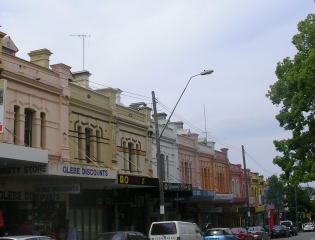
Glebe Point Road - notice how all the buildings are a different colour!
Well done to all of you who had a go at the gerunds and infinities; I’ll start by giving you the answers to Monday’s questions, and then we can have a look at some of the tricky ones. And if you’re still with me after all that, there might even be some vocab from today!
OK, the homework:
These verbs are followed by an infinitive:
Can’t wait
Manage
Would love
Attempt
Tend
Decide
These verbs are followed by an object + infinitive:
Inspire
Get
These verbs are followed by a gerund:
Start
Keep
Love
Enjoy
Continue
The next three are general rules that can help you
Adjectives are (usually) followed by an infinitive.
Prepositions are followed by a gerund.
Verbs that talk about how we feel (love, hate, enjoy etc) are usually followed by a gerund.
A couple of you were asking about the differences between gerunds and present participles – good question!
Remember that gerunds are NOUNS, so if we look again at the examples from last time, you can see that we can replace each of the gerunds with a noun:
• Cooking is a really good way to relax / Tennis is a really good way to relax
• I really like cooking / I really like tennis
• I’m good at cooking / I’m good at tennis
Present participles, on the other hand, are parts of VERBS and so are used to talk about actions:
• I was watching a really interesting TV show last night. (The present participle watching is part of the main verb.)
• I got really wet walking in the rain. (This tells you what I was doing when I got wet.)
I would really encourage you to start looking for examples of gerunds and infinitives (maybe start by looking through some of the teacher’s posts on the blog here, and not just mine!) that you can add to the list above. I think the thing is not to try and do it all at once, otherwise it’ll be too much. Build it up slowly, and then you’ll have a record that you can refer back to when you’re not sure.
OK, so are you ready to have a look at the tricky ones?
Something easy to start you off ...
• Start, begin and continue can be followed by either a gerund or an infinitive without any change in meaning.
And now the harder ones ...
Try
Have a look at these examples from some of my posts:
Ana Paula, have you ever tried to climb the greasy pole?
You try to run whilst standing in a sack.
Do you think it’s easy to climb a greasy pole? Or stand in a sack and run? No, it’s not!!
So, we use try + infinitive to talk about something that’s difficult or impossible.
Here’s a real life story for you – Owen really doesn’t like going to bed at the moment, so he always thinks of ways to get out of bed and come and sit with us.
• He has tried saying his leg is stuck in the bars of the cot.
• He has tried asking for a drink of water.
• He has tried telling us that he needs a clean nappy.
• He has tried complaining that there’s something in his eye.
• He has even tried offering to help us tidy up!
What does he want? To get out of bed
How does he do this? By testing lots of different tricks to see if one of them will work.
So, we use try + gerund to talk about an experiment or a test of something.
Go on
Can you see a difference in meaning in the following sentences?
• Rachel went on talking about gerunds and infinitives for 3 weeks!
• After doing gerunds and infinitives, Rachel went on to talk about vocabulary.
Which one means Rachel continued talking about the same thing?
Which one means Rachel started talking about a new subject?
Can you complete the pattern?
We use go on + gerund to talk about …………………………………
We use go on + infinitive to talk about ………………………………
Mean
Again, can you see a difference in meaning in the following sentences?
• I’m so sorry, Owen, I didn’t mean to put your teddy bear in the microwave
• Understanding gerunds and infinitives means working really hard
In the first example, we could use intend instead of mean.
In the second example, we could use involves instead of means.
So, we use mean + infinitive to talk about an intention.
We use mean + gerund to talk about what is involved in something.
And the last one for today – stop.
Here are some examples from my posts:
The Coogee-Bondi walk takes about 2 hours if you keep stopping to stare at the views.
Whenever we go down Glebe Point Road, Owen always makes me stop to watch the diggers.
In these examples, there are two actions:
Walk – stare at the views – walk again
Go – watch the diggers – go again
Walking is interrupted by staring at the views, and going down the street is interrupted by looking at the diggers.
So, we use stop + infinitive to talk about an action that is interrupted temporarily.
Let’s look at some examples with a gerund:
I’ll stop being mysterious and start writing
If anyone is really unenthusiastic about this, please feel free to stop reading now
Can you see the difference? In these examples we’re talking about finishing an activity, perhaps permanently.
So, we use stop + gerund to talk about the end of an activity.
Phew! I hope that has helped you and not made it more complicated! There are a couple more we should look at, but I think that will do for today and we can pick up again next time. And that really will be the end of gerunds and infinitives, I promise!!
If you’re really keen and want some more practice, you could:
• Write some example sentences with today’s grammar points and post them as comments for us to have a look at.
• Have a look on the web – there are lots of grammar practice exercises you can do online. Try typing “gerund infinitive practice exercises” into a search engine and see what comes up.
Well, in the time it has taken me to write this the storm has passed, my computer didn't conk out, and both my boys have gone to sleep, so I guess I’m off to bed too!
Back soon,
Rachel
Oh, and not forgetting today’s lovely vocabulary …
the rain comes down in spades (expr)
slack (adj – informal)
dear to my heart (expr)
doing a roaring trade (expr)
pretty (adverb - NOT an adjective here!)
streetscape (n)
upgrade (n / v)
conk out (phr vb) posted on Thursday, 25 October 2007 | comment on this postFood, glorious food!Hello everyone,
How are you all doing? Satya, how are you feeling? I hope you’re OK, and I’m keeping my fingers crossed for you during your mid-term exams – I hope they all go well for you. And thank you for your birthday wishes – I had a lovely day.
We’ve had another celebration today – it’s our wedding anniversary! We thought we’d go out for lunch, so we went to a place in Darling Harbour (where Owen could watch all the boats) and shared a big plate of seafood. Yum! And that got me thinking about a subject for today’s post – food! A lot of you have been asking me about Aussie food, and what better place to start than with seafood?
Seafood and fish here in Oz are great – you can get them in most places. Sydney Fish Markets are on the water near Glebe (just a bit further round from the ANZAC Bridge) and the stalls there are stocked with all sorts of interesting things. The markets get really busy around Christmas as everyone is stocking up on prawns and things for Christmas lunch. I think most of the produce is local, although some things are imported.
Fresh produce here is wonderful – because Australia is such a big country with a range of climates, most fruit and veg are locally grown. As we’re just coming into summer, mangoes are coming into season – hurray! I love mangoes – I don’t think I’ve ever had one before I came here, and I’m hooked! Queensland produces most of the tropical fruit like mangoes, pineapples and bananas, whereas the cooler states (Tasmania, Victoria and southern NSW) produce stone fruit like peaches and nectarines, and things like apples.
Australia is quite well-known for its beef and lamb, although meat is getting more expensive (as are fruit, veg, milk and bread) because the drought is starting to have an effect on prices. Many areas of the country have been in drought for 10-15 years and the farmers and primary producers are really starting to suffer. Meat features prominently in that great Aussie culinary tradition – the barbie (barbecue), especially as we’re coming into summer and the days are getting warmer and longer.
I should also probably talk about wine and beer – there are some very famous wine-growing areas in Oz, notably the Yarra Valley in Victoria, the Margaret River in WA, the Barossa Valley in South Australia and the Hunter Valley in NSW. Australia exports a lot of its wine – in fact, when we went back to England in May I was surprised by how many Aussie wines I recognised. Many states are known for one particular beer – the most widely-drunk NSW beer is probably Toohey’s New, and there are a lot of smaller breweries opening up and producing boutique beers. In Sydney, there are also restaurants devoted to Belgian, German, and Czech beer, so there’s a really wide variety!
I was thinking about sharing some traditional Aussie dishes with you – here are a couple of sweet things you may have heard of – lamingtons and pavlova. Lamingtons are made from sponge cake which is cut into squares, covered in chocolate and then dipped in coconut. Pavlova (which both Chris and I love!) is made from egg whites and sugar, which are beaten together until they’re stiff, and then baked until crispy. This crispy meringue base is then filled with thick cream and fresh fruit (usually strawberries, but you could use anything really). It’s delicious, but also really bad for you!! (But most desserts are, I suppose!) If you’d like me to find a proper recipe for pavlova so you can have a go at making it yourself, let me know and I’ll see what I can do!
How did you do with the gerunds and infinitives? As Satya says, it is a tricky topic, so keep coming back to the posts and reading them again – hopefully they’ll be around on the site for a while, so you can come back and look at them as often as you need to.
Did you work out the use of go on for yourselves?
Go on + gerund means that an action is continued
Go on + infinitive means that a new subject has started
Well, I’m sure you’ll all be very happy to know there are only three more to look at, and the same patterns can be applied to all three. Isn’t that good news? And I promise that my next post will be much less grammar-heavy!!
OK, let’s look at forget, remember, and remind.
With the gerund:
• I still remember eating mangoes for the first time.
• I’ll never forget watching England beat Australia in the 2005 Ashes series.
• I regret not working harder at University.
These examples with the gerund all refer back to the past, to things that I did (or didn’t do). You could also say:
• I can still remember the first time I ate mangoes.
• I’ll never forget the 2005 Ashes series when I watched England beat Australia.
• I regret the fact that I didn’t work harder at University.
With the infinitive:
• Please remember to pay the phone bill.
• I forgot to buy an anniversary card for Chris.
• I regret to tell you that you failed the exam.
These examples with the infinitive are looking forward in time.
• Remember / forget + infinitive look forward in time to the things that you still need (or needed) to do.
• Regret looks forward in time to something that you are (or were) going to do but that you feel sorry about.
If you’d like a bit of practice, see if you can complete the gaps in the following sentences with either the gerund or infinitive form of the verb in brackets. I’ll do the first one for you as an example.
1. Cityrail regrets to inform you that the next train has been cancelled. (inform)
2. I mustn’t forget ………… some vocab at the end of this post. (include)
3. I can remember ………… snowmen in the garden with my sister when we were little. (make)
4. I’ll never forget ………… Chris’ face when he realised he was having a birthday party. (see)
5. You must remember ………… a drink for Owen next time you go to the park. (take)
6. I still regret ………… away my husband’s best shoes – I didn’t mean to do it. (throw)
Answers next time! I’ll also try and reply to all of you again, as it’s about time I did that, especially as you’re all so good about posting comments for me to read. We might have a look at some of the new vocab too, if I can think of a more user-friendly way to do it!
Hope you’ve all had (are having?) a great weekend,
See you soon,
Rachel
Today’s vocab (not much, really!)
to stock up (phr vb)
come into season (expr)
hooked (adj)
boutique (adj)
posted on Sunday, 28 October 2007 | comment on this postGoodbye Satya!Hello Satya and everyone,
I can’t believe it! October is over, and it’s time to say goodbye :-( Satya, a big thank you for making such an effort to post your blog when you’re so busy, and I wish you all the best with your studies. Please keep coming back to the site to say hello, though, as it would be great to keep in touch.
And welcome to our new student blogger, who some of you might recognise (I’m being mysterious again, aren’t I?!) – I’m really looking forward to getting to know you over the next few weeks!
I’d also like to say thank you to all of you for your birthday/anniversary wishes! October is a bit mad in that regard, as there’s only five days between the two – I was so happy that Owen wasn’t an October baby, as I think you really can have too much of a good thing!!
Well, today’s post is all for you, really; I’ll give you the answers to the gerunds and infinitives practice – well done to all of you who had a go! – and then if you keep reading I’m sure you’ll find your name somewhere!
1. Cityrail regrets to inform you that the next train has been cancelled.
This is talking about a regret in the immediate future
2. I mustn’t forget to include some vocab at the end of this post.
Again, this is looking forward to something I still need to do.
3. I can remember making snowmen in the garden with my sister when we were little.
Here, I’m looking back at my childhood, and remembering a past event.
4. I’ll never forget seeing Chris’ face when he realised he was having a birthday party.
Again, I’m looking back (the party was in the past), even though the verb “will never forget” is in a future tense.
5. You must remember to take a drink for Owen next time you go to the park.
This one is about the future – next time you go to the park.
6. I still regret throwing away my husband’s best shoes – I didn’t mean to do it.
The action of throwing away the shoes is in the past (about 6 years ago – I can tell you the story if you like), so we use the gerund because we’re looking back (even though I still regret it now).
OK, and now over to you!
Paulraj from India – Yes, I have eaten Indian food several times and love it! As I mentioned, there are two really good Indian places in Glebe where we like to go. I still can’t do really spicy food, though! Chris really loves Indian food – the spicier the better; can you guess his favourite dish? Vindaloo!! Actually, you might find this interesting; we were in England earlier in the year visiting family, and we had Indian food a couple of times from local restaurants. I really enjoyed the dishes I had, but Chris said the vindaloo in England was totally different from vindaloo in Oz, and he preferred the Aussie version. Any ideas why there might be such a difference? All we could think was that the chefs were using slightly different ingredients …
Your description of how you cheated in the exam (12 Oct) was spot on; I would make one small change, though. You wrote: Till that very moment I had taken resolution not copying in the exam what ever the consequences of the results. I stick on that till now. I would use the present perfect here because you’re talking about a past decision which is still true now, and say “since then, I have made the resolution … I have stuck to that til now.”
By the way, Chris says to tell you that although he enjoys the one day matches, he’s a bit of a traditionalist and prefers the full test matches – I hope you know what he means!!
I really enjoyed your description of your school sports day – what a great idea to make the teachers do the tug-of-war. And the balloon game sounds like a lot of fun – much better than welly-throwing!
I’m glad you’re using the blog to help you with grammar notes, and I hope your daughter’s tests go well – wish her good luck from Oz! Your questions about the drought are interesting; it’s a huge subject and would probably take up a whole post, so I might save them for later!
Ana Paula from Brazil – Ana Paula, thank you for all your detailed comments! I always look forward to reading them and finding out what’s happening in Brazil. It was so interesting to read about your patron saint, and also about children’s day and the gincana and Festa Junina (you’re right, I would love being in Brazil for that, and I can just see you as a little girl, all grubby from sliding down the pole!) - it’s funny, I’ve taught a lot of Brazilians here in Oz, but have learnt very little about the country! Does it often rain a lot at this time of year in Brazil?
About the FCE, I’m sure your speaking isn’t as bad as you say it is. For part 2, do you have a list of useful expressions for comparing and contrasting? (If not, let me know.) I’m sure you don’t really want to hear this, but honestly, the best way to improve is to practise comparing the pictures within a time limit. I used to take a kitchen timer into class and set it for 2 minutes for my students, so maybe you have something like that you can use? You can use any sort of pictures to practise, (maybe just whatever you have in a magazine at home?) as long as there’s something in common between them. And don’t forget there’s always a second part to the question “Compare, contrast, and say …” so leave time to answer that part as well. I hope that helps! (When are you doing the exam?)
I’ll have a think about some Aussie writers that you might like – what kind of books are you into? (And if anyone else has any thoughts on this, please let me know!)
Duy Ngyuen from Ha Noi – Thank you for your comments and welcome to the blog! I agree, listening is one of the harder things to practise, especially if you’re not easily able to access listening texts. Are there any English TV or radio programmes in Vietnam that you could listen to for practice? Or how about joining an informal conversation class? Does anyone else have any ideas about practising listening that might be useful?
Hoo Wai from China – I really like the idea of having a street party where you can eat from one end of the street to the other – fantastic! And what a great way to experience traditional food! I was sorry to read what you said about some traditional foods disappearing; that’s really a shame. Do you think there’s any way to preserve the traditions?
Lam Tran from Vietnam – Chao co! (Are there any other important Vietnamese words you think I should know?) Great to hear you’re a good cook! What’s your speciality dish? I enjoyed reading about the culinary fairs in Vietnam; they sound wonderful – the only thing is you made me really hungry!! (I guess I did the same to you, though, so let’s call it quits!)
I loved your description of your camping trip – I almost felt like I was there! And also the “float game” – maybe next time I go to the beach I can try and organise an Aussie version! You asked about one of your sentences; I understood what you were saying, but we could rewrite it like this to make it better: “I’m trying to imagine how funny the people look when they fall off a pole covered with soap and water.”Chris also likes watching the football; he supports Middlesborough, a team in the English Premier League who (like the Cronulla Sharks) never seem to do very well! He did join a team once, but it was formed from the cricket team and no-one really knew very much about football, so it was a bit of a disaster! I went to every match in their first season and took a tub of oranges for the boys at half-time. Again, the meaning of the sentence you asked me about in this post was very clear; I would say it like this, though; I hope there will come a day when I can watch …About the pronunciation issues you mentioned (ch/sh) etc, I’ll have a think about that and get back to you if anything helpful occurs to me …
Good luck with all your job interviews – I’ll keep my fingers crossed for you!
Adriana from Brazil – I was interested to read your description of the movie “Elite Squad”; I’ve never heard of it and was wondering if it’s a Brazilian movie? I have to say the last movie I saw was about as un-violent as you can get – I went with a friend to see “Hairspray” (have any of you seen it?) and we loved it! I did embarrass myself a bit, though (I always seem to do that at the movies) – all the way through I was wondering who the actor was who played the mother, as her face looked really familiar (it’s really annoying when that happens, isn’t it?!), and when the credits came up at the end it was John Travolta!! So I said (much louder than I intended) “It’s John Travolta” and everyone turned round to look at me, and my friend just shook her head pityingly and said “Didn’t you know that?” Oops!
I loved your story about your son and the cars – hilarious! Owen just cracks me up sometimes, the things he does and says. He fell over today and when I picked him up and asked him what he’d hurt, he said “Myself”. So I had to try not to laugh, and ask him which bit of himself he’d hurt!
I’ve never actually seen a shark around Sydney’s beaches – I have seen dolphins, though, and whales occasionally come right into the harbour, which is just amazing!
I agree with you about football and racism; I don’t know what it is about sport but it certainly seems to bring out the worst in some people. I think you have the right attitude, though – it really does seem to be a minority and not everyone thinks and behaves like that.
Timejit from Morocco – You are absolutely right, I could also say “I’d never been there before”. Either way is fine – I didn’t need to use “there” in the sentence because it was clear what I was talking about, but it would also have been OK to use it. As regards the vocab, try and work it out from the context if you can, and keep checking my posts as I give you the definitions (and maybe a bit more practice) every couple of weeks or so.
Hyoshil from Lincoln – Hello! And greetings from my cheeky monkey! I loved your story about Guinness/Coca Cola, and you know what, I bet a similar thing has happened to anyone who has been overseas! In fact I had a very similar experience when I lived in Prague – I needed to go to Ikea to get some things, and my friends told me how to get there. It was at the end of one of the metro lines, and there’s a special Ikea bus stop and a bus that takes you there. Well, I found the bus stop, and there was a bus, so I paid my money and got on. I didn’t really notice that the other people on the bus looked more like they were going to work in a factory rather than shopping … Anyway, the bus left the bus station, drove past Ikea, didn’t stop, and kept going onto the motorway!! I’d only been in Prague a few weeks and didn’t speak Czech, so I was really panicking! Eventually, I got a grip of myself, got off the bus at the next stop (which happened to be a factory in the middle of nowhere), crossed the road and waited in the snow for the next bus back to Prague (which came an hour later!!). And I never did get to Ikea!
I’m glad you like Lincoln; I’ve only been there a couple of times, but as you say it seemed like a very compact, friendly place. Do you mind if I ask where you’re from originally? (No reason, I’m just curious!)
Hameed Wali from Baghdad (but Pakistani) – Welcome to the blog! Please keep adding comments; your first one really made me laugh when you described your friend interrupting you! We’d love to hear more from you, even if you don’t think you have anything to say!
Marian from China – Thanks for your comments; I am a big fan of Chinese food, and, as I’m sure you know, there are many Chinese restaurants in Sydney. We like to go for yum cha, although we haven’t been for a while. I keep saying to Chris we should take Owen, as I’m sure he’d like to try all the different things. I wonder if you would consider Chinese food here to be authentically Chinese …it’s hard to know, really. I will tell you a story about Chris, though – he has relatives in the north of England and once, a long time ago when he was staying there, they decided to get a Chinese takeaway. Chris was horrified when they asked him if he wanted chips or rice with it – he couldn’t believe anyone would serve Chinese with chips!
Naheed from Pakistan – Hello, and thank you for posting your comments (and doing homework!) so regularly – it’s always nice to hear from you. I was interested to read about the Palla fish, as I’d never heard of it before; I’m learning so much from this blog! And I’m glad you agree with me about the vinegar!! Did you really use to play cricket at school? At my school girls got two sports – hockey in the winter (when it was freezing cold) and tennis or netball in the summer; and guess what – I hated all of them! Actually, hockey wouldn’t have been so bad if it hadn’t been so cold, but we had to play whatever the weather and we weren’t allowed to wear scarves or gloves or tracksuits to keep warm; we had to wear proper hockey skirts and T-shirts! Oh, and I will try and find a pavlova recipe for you!
Jaylan from Sweden – If you can explain a bit more what you mean by “building sentences”, I will do my best to help you!
Amit from Noida, India – Welcome to the blog! You ask a good question about working individually to clear up mistakes. Firstly, I’d recommend using a good grammar book and/or dictionary (you can do this online if it’s easier). Secondly, if you have any friends or colleagues with good English, you can discuss it with them. Thirdly, if you’re really stuck with something, post a comment and I’ll see if I can help! By the way, what does everyone else do if there’s something you’re stuck on – it would be really interesting to know!
Myen from Vietnam – Please can you tell me the name of the beef / vinegar / rice paper / vegetable dish that you describe? It sounds absolutely delicious, and if I can find it here in Sydney I will certainly try it! Yum! And thank you for being so diligent about the homework – well done! (Don’t feel sorry for Owen and his addiction to machines – save your sympathy for me! He’s starting to ask about what the machines do and what their different parts are called and I don’t know the answer! Help!)
Adek from Poland – Tartare sauce!!! Noooooo!! Only joking – in fact when I was in the Czech Republic I enjoyed tartare sauce with fish and chips (or even chips on their own), because that’s how they are served there too, but tartare sauce here in Oz just doesn’t taste the same (or maybe it’s the chips that aren’t the same!). I absolutely agree with you about the beach – it’s the whole experience that makes it so enjoyable, not just the views!
I think the thing with gerunds and infinitives is that native speakers use them naturally, without thinking about it, and if you asked someone on the spot to explain, they would be stuck. They are very tricky things, and you are certainly not stupid if you find them difficult! I really encourage you not to give up – just do a little at a time, and keep making notes that you can refer back to when you need to.
I agree with you about promoting alcohol, but I thought what you said about the popularity of Aussie wine was very interesting – we don’t actually get many foreign wines over here (unless you’re prepared to pay a lot of money) except ones from New Zealand, because it’s expensive to import them. When we go to England we always enjoy trying wines from different parts pf the world, as there’s much more variety over there (England is NOT famous as a wine-producing country!!)
Marianna from Bojnice, Slovakia – Jak se mas? (I’m just showing off now!)Yes, I have been to your country, although only to Bratislava and only for a weekend. I had a great time, and would really like to go back (unfortunately it’s a bit far from Oz, but I live in hope!). I speak a tiny bit of Czech (enough to buy a train ticket and order food), but I believe that it’s quite similar to Slovak – is that true? Your town sounds lovely; I bet it’s getting cold now and you’re drinking svazeny vino on your walks to keep you warm! I loved your description of the rosehips – beautiful! (And such accurate English too – well done!).
Don’t be ashamed to admit you don’t like grammar – I completely understand!! In fact, students of my generation were never taught English grammar at school; we just worked it out for ourselves, really. I think it’s starting to make a comeback, now though. As you say, there are lots of little rules in English, but I really think you’re approaching it in the right way, by doing a little at a time. And please don’t let your worries about grammar stop you from writing comments on the blog – you make some great contributions to our “class” and it’s always good to hear from you!
Silwal Kishor from Nepal – I’m glad you like the pictures, and I will try and think of some more virtual tours of Sydney for you! Thanks for all your comments – keep posting! I’d love to hear about how you celebrated the Dasain festival …
Mohd Naeem from Afghanistan – Welcome to the blog! Thank you for your comments; I hope you keep coming back and that we hear from you again!
Stevieboy from China – G’day! I hope your friends have kept their promise and cooked an authentic Aussie barbeque for you – would love to hear more about it if they have! I would use “to put sth into perspective” in two ways:
1. to compare two things more accurately
e.g. I worked 20 hours last week. To put that into perspective, that’s twice as many as last week.
2. with a more idiomatic meaning, (and this is probably more common) to use someone else’s bad experience to think about your own situation
e.g. My friend’s husband had a car accident last week and now she’s got to bring up two children on her own. It really puts things into perspective, doesn’t it?(Notice that this one is a fixed expression – puts things into perspective)
Rossana from Durango, Spain – Welcome! Great to hear that you’re working so hard to improve your English; let me know how I can help.
Yvonne from NRW Ahaus, Germany – How’s it going? I’m really glad you’re still finding time to drop us a line, even if you are really busy!
Pilar from Spain – Wow! What a great use of the new vocab! And congratulations on inventing a new word “Englishvocabularyphobe” – I love it!
Filippo from Italy – Yes, most of Sydney’s beaches are swimmable, although not all of them are patrolled by lifeguards. And, obviously, some are better for surfing and some are better for swimming. A lot of people go snorkelling at Clovelly, for example. A lot of the beaches have swimming pools attached that are supplied with water from the sea (probably the most famous one is Icebergs, at Bondi). Most suburbs also have a pool or Aquatic Centre with two or three different pools, so there are lots of opportunities here for swimming.
By the way, although I have tried prosecco and merlot (and like them both, I have to say!) I had no idea that Veneto was famous for rice, or the barbecue ribs that you describe – they sound wonderful! Yum!
Carolina from Argentina – 80km! Wow! You absolutely didn’t bore me to death with your story; in fact, I was really interested. I’d like to know how many people do the walk each year (on average), and what the age range is? I just can’t imagine myself walking 80km, although I can totally appreciate why you did it.
Your description of “pañuelito” was far from boring – you described it very well and it sounds like a lot of fun, even if a bit chaotic! Football in Argentina sounds even crazier than football in England – isn’t it extraordinary that one sport can have such an effect on people?
I’m sorry I couldn’t explain cricket any better – I just don’t get it myself! And I can completely understand how you feel about losing to South Africa – as I’m sure you know, it happened to us too!!! :-(
Well done with your example sentences for the gerunds and infinitives – great work! I’m going to make one very picky little comment (sorry!) – I’d say “my husband and I stopped going out” because you’ve used “had” later on in the sentence. And you’re right, someone is expecting a baby in December, but not me – Amy, the teacher for August/September!
Your description of the elections was really interesting; we have a federal election coming up here in Oz next month, and things are certainly hotting up … And the food! I’m almost ready to jump on the next plane to Argentina! I love avocadoes too, especially with seafood or in salads. Owen is really not convinced about them, but I keep trying; Chris is a lost cause and really hates them! Food preferences really are individual things, aren’t they?
And I just want to say thank you for such dedication in posting your comments; it’s always great to hear from you!
Pary from Iran – You’re absolutely right, I didn’t do the beach walk with Owen, although he and Chris dropped me off at Coogee. There’s not really any private land on the beach walk, as it’s footpaths or streets most of the way, so you don’t have to worry about trespassing. Access to the beaches is pretty easy, it’s just the higher bits of the walk that are quite rocky (sandstone, mainly) although the amount of clambering you have to do is up to you, really – if you stick to the paths it’s a fairly easy walk.
As for the babysitting – good question! I actually work two nights a week, Mondays and Wednesdays, from 5-9pm, plus Saturdays. On Mondays Chris is able to leave work early and come home, so I take Owen to the station and we do a hand over there. On Wednesdays we have a great babysitter who does all sorts of fun things with him that I would never have thought of (putting food colouring in the bath, for example, so he has a different colour bath every Wednesday night). And Saturdays are fine unless Chris is playing cricket, and then Chris’ mum comes over. So it’s all working out well, so far!
Hualan from Melbourne – Glad I could help with the sports! I’m guessing if you’re in Melbourne your workmates generally follow AFL, am I right? And what a great idea to practise the new vocab in conversations – let us know how it goes!
Tian Qing from Beijing – Many apologies if I forgot to provide an answer, and goodonya for reviewing all my posts – great stuff! I used the present simple even when talking about the past to make the story seem more immediate. It’s OK to do this in English, although it’s more common in speaking.
Rafique from Pakistan – Thank you for your feedback on the vocab exercises; no offence taken! I guess I was expecting you to have the words written down in a vocab book, which you would also use to write the answers before looking back at the previous post to check the context. So I’m sorry if you found it too cumbersome. I still think it’s a really good skill to be able to work out words from context, and I also think that most people learn better by trying to think things out for themselves, but next time I do a vocab review (probably in my next post) I’ll try to make it easier. I hope I haven’t put you off the blog completely!
Abdul Razaq from Afghanistan – I really take my hat off to you for enjoying sports so much – I wish I did! In fact I hated sport at school so much that I spent as much time as I could avoiding it! Do you still follow the football? Chris says he totally agrees with you about Brett Lee, by the way! (He also says, proudly, that Brett Lee is from Sydney, or if not Sydney, at least NSW!)
Kakafung from Hong Kong – Welcome to the blog, and thank you for your comments! I hope I’ve helped you with gerunds and participles, but please let me know if you’d like a bit more explanation! I think a lot of people are happy to think about the –ing form without worrying too much about what it actually is, but it can also be helpful to know the difference.
Paula from Venezuela – Thank you! Hope you feel a bit better about gerunds and infinitives now (let me know if you don’t!)
Vinh-Phu Nguyen from Delft – You’re absolutely right, the atmosphere at a live game is really amazing (if a little scary!), and I’m sure seeing Man Utd play at Old Trafford would be an unforgettable experience. Do you really think English grammar is easier than French? Interesting! (I agree with you on pronunciation – I find French really difficult to pronounce, although I love hearing it spoken properly).
Fakru from UAE – Welcome to the blog, and I hope you will find it a useful way to improve your English. Please keep in touch!
Antonio from Belgium – Hope you managed to recover your notes on the gerunds!
Hello-loc from Vietnam – Thanks for your comments – unfortunately, most of the time, the only thing you can do with gerunds and infinitives is just to learn them – sorry! Your use of the gerund was correct, so well done! (I would say confused about rather than confused on, though). And well done for having a go at some example sentences – all of your examples were right except one, so great work! I’d say I’m trying to finish my post rather than I’m trying finishing my post because in this case you’re not really experimenting, you’re doing something that you find difficult.
I’m glad you enjoy Aussie wines – I’ll try and talk about them some more in another post.
Tiasha from Sri Lanka – I’m very impressed that you’re trying to use gerunds and infinitives in your writing to help you improve – that’s great! If you want more practice, and if you have access to the internet, there are lots of websites with practice exercises; try typing “gerund and infinitives practice” into a search engine and see what comes up.
Sam from Amman – Yes, slack can be quite rude. It’s definitely an informal word, so you could probably use it with your friends, but you would need to be careful who else you said it to (e.g. it wouldn’t be a good idea to call your boss a “slacker”!).
Ruth from China – Thank you for your comment and for your question about to and of! I really need to think about that for a while, but I will get back to you on that one!
Valentina from Russia – I’m really glad you find the blog helpful; that’s great to know! As to your excellent question, in my opinion there is no real difference in meaning between “try to do sth” and “try and do sth” (in fact I wrote “try and do” in one of my example sentences, and then had to change it!). I would say, though, that it’s much more common to use “try and do sth” in spoken English, as it’s a bit more informal. Both are correct, and I think in most situations you could use either.
Sujan from South Korea – G’day! It sounds like you had a great time here in Oz – did you get to see much of the country while you were here? What was your favourite place?
Rocio from Mexico – Wow! Such amazing food! (And of course Corona, that famous beer. Do you really drink it with a wedge of lime, or is that just advertising?) And Happy Birthday for last week (the cake sounded wonderful!). So your birthday is just one day after mine … which of us is older? (I suspect it’s me!) And I can make you happy by telling you that there are indeed some Mexican restaurants in Sydney (one in Glebe, in fact), and I have tried Mexican food and really enjoyed it! Hurray! (Never tried tamales, though – what are they?)
Golden from China – Thank you for you comments! I’m always happy to talk about food! Have you had any success getting a pavlova recipe off the internet? If not, keep watching, as I’m on a mission to post one here for everyone …
Wow! This has to be the biggest post in the history of the world, and if you’re still with me at this point, well done!! I have to say that for most of the time I’ve been writing this I’ve had a yellow builder’s hat on my head, a blue furry rabbit on my knee, and a small boy crashing trucks into my feet! So if I’ve made any typos (or forgotten anyone), I hope you will understand, and forgive me!!
I’m off for a cuppa and a chocolate biccie, and I think anyone who’s read to the very end deserves one too!
Until we meet again,
Rachel (in a yellow hat)
And if you're not totally exhausted, here's a bit of vocab ...
to be spot on (expr)
grubby (adj)
to crack sb up (phr vb)
to show off (phr vb)
things are hotting up (expr)
cumbersome (adj)
take your hat off to sb (expr) posted on Wednesday, 31 October 2007 | comment on this post | |


