


Green spaces
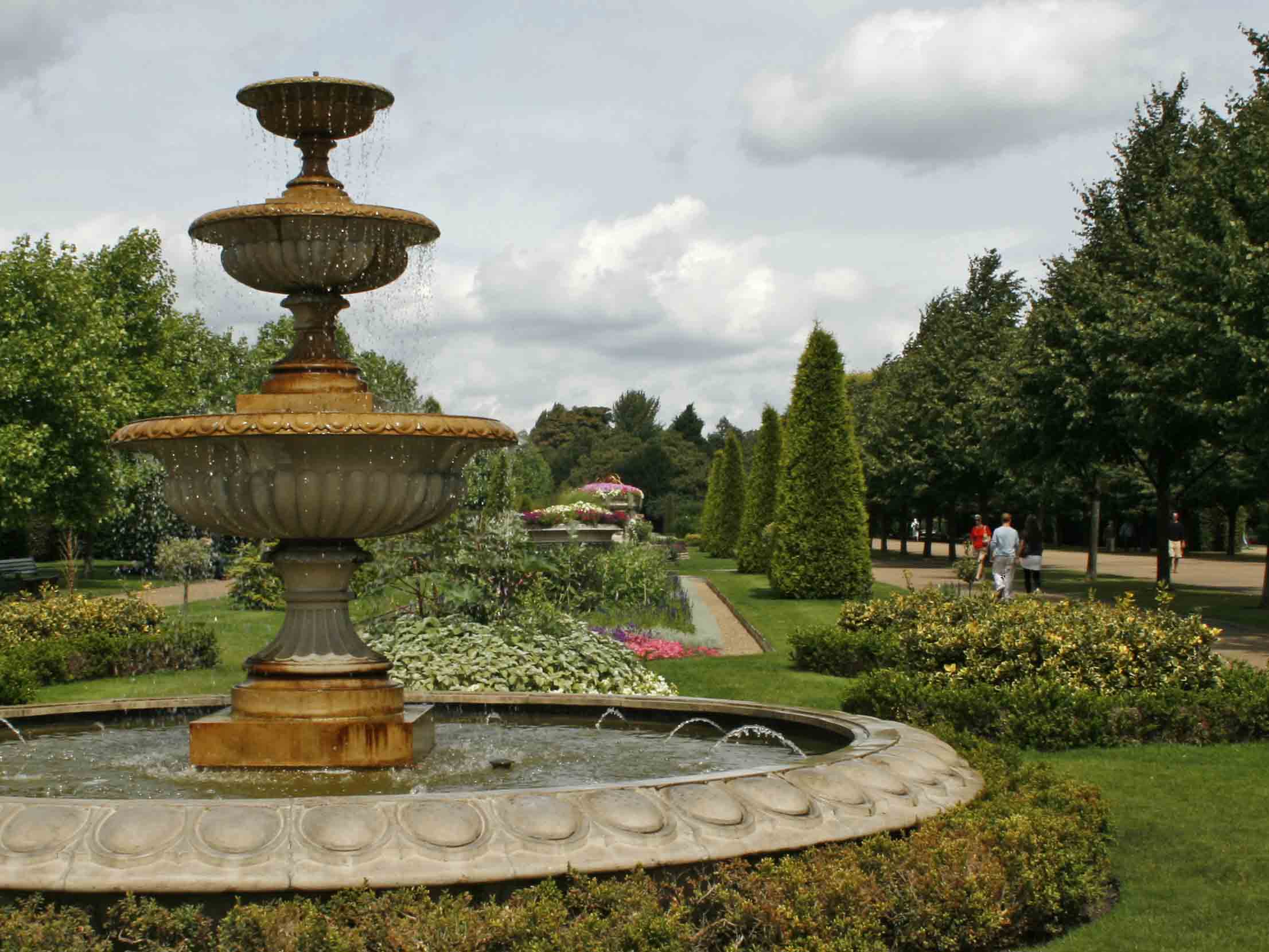
Regent's Park in London
Just like any large city, London has many problems. We've already talked about transport, commuting and overcrowding. Then there's the pollution, the litter on the streets, the anonymity and the fact that we don't know our neighbours. But one thing which London doesn't have a problem with is 'green space'. It has a huge number of parks and open spaces which are a kind of refuge from the urban rat race, a place where we can go and have a few minutes away from it all. Some of the parks are so big that you can almost feel as if you are in the countryside, and forget about everything going on around you. These green spaces are sometimes called the 'lungs of the city', and, if they weren't there, London would not be half the city that it is.
Now, your comments have been building up, and it's a while since I replied to any so, here goes:
Comments Corner
(from July 20th post – aka ‘better late than never!’)
Tamara – where on earth did you learn English? You tell your story of the wedding in such a natural way, and your use of the Present tense to make the story more immediate and interesting is spot on. Very impressive! It’s true, babies are often a liability at weddings, but normally it’s them crying, not their parents…. The person you ask about is called a ‘registrar’.
Vladimir, your questions are all valid in my view. I think it would be very useful for students to write about their own educational background and I have done this before with some groups. One thing though, I’m not exactly sure what you mean with your last question – could you rephrase it for me?
Hi Cheikh Vall. I really think that a good fit of giggles is beneficial for the health. It must release some tension don’t you think? It seems logical that living in an English speaking country should improve a student’s knowledge of the language more quickly than staying in their own country. However, what often happens is that some students naturally tend to hang around with people from their own country, end up sharing accommodation with those people, going to restaurants and socialising with their own nationality. The fastest learners are those who are genuinely curious about other cultures and make the effort to go out and meet people and get involved.
Henrique, that’s the thing about the giggles – you never know when they might strike, sometimes at the most inopportune moment!
Adriana, thank you for your kind words. I think diplomacy is a very underrated skill!
Ana Paula, I like your story. It’s great when people do things like that – it’s just like the person walking around looking for their glasses who later realises that they are on their head. I put a cup of tea in the fridge by mistake the other day...
Thanks for posting your questions Rabail – I think they’re all valid.
Atsumi, with a heavy heart, I have to say that the ‘gentlemanly manner’ which you speak of appears to be dying out. Not sure if it’s the pressure of living in the rat race or what, but people are getting ruder and less respectful, and I can imagine the new crossing at Oxford Circus being complete chaos. (or maybe I’m just getting older and more grumpy…) Very nice questions, thank you.
Ramilton, yes indeed I have heard of, and read, Edgar Allan Poe – I remember reading The Fall of the House of Usher when I was younger. He’s quite well-known in England I would say.
Hyoshil, it’s interesting to hear the questions you would ask as a student – very practical and perhaps born of experience?
And thanks to Toni and P for your questions...
Comments 23rd July
Jingjing – thanks for your thorough and interesting comments. I think it has to be a good thing if the education system is changing and gradually the importance of English as a means of communication is being given more emphasis, not just in China but all over the world.
Henrique, if English gives opportunities then it must be a good thing, but I can’t help wondering when the ‘tipping point’ will come… I guess some day it will be a skill that is expected, perhaps like computer literacy now, and that it will no longer confer any great advantage or opportunities. At that point, it may be time for me to start looking for another job!
Mauricio, as you say, methodology in schools may be slow to change, but there are many more possibilities for the keen language learner these days, internet being perhaps the best example. A lot certainly depends on the person learning the language – wanting to learn and liking the language are two very important factors in my view.
Atsumi, I think fear of making mistakes and ‘losing face’ is a large part of why many students prefer to keep quiet. Something else which strikes me is the thinking time before answering. As you know, I teach multilingual classes which contain a really eclectic mix of students – many of my Asian students like to consider for a few seconds before answering a question, something which I believe is perfectly natural in many Asian cultures. The European or South American students often take this to mean that these students have nothing to say – they are used to an immediate response, rather than a considered response. From this, misunderstandings can so easily arise. Part of my job is trying to make people aware of these differences, because once they start their undergraduate or postgraduate course, the cultural challenge may be as big as the linguistic one…
Paulraj, I wonder if the situation is changing at all in India? With such a vast population, any type of country-wide education reform must be incredibly difficult. I read that the Indian government want to introduce ‘biometric ID’ cards for all Indian citizens – what a big job that will be!!!
James Wu, your comment is very interesting and raises a really important issue. I must confess, as a teacher (and a person…) ‘I’m not always right!’ You say that in Taiwan students shouldn’t question their teacher, the teacher is always right and this seems to be quite a common attitude in some educational cultures. Of course, the teacher is often right, and usually knows more about the subject than the students, but I think it is vital to encourage students to approach everything with an attitude of enquiry – to ask why something is the case, to be curious and to want to find out more, rather than simply to accept a bunch of facts without question, and to do this, a two-way interaction with teachers is essential.
Abdisamad – I forgive you!
Xavi, you’re spot on with what you say about motivation. There is no better motivation than survival to make you learn a language, and this is why studying in a country where the language is spoken is so important. You asked about the languages I speak. Well, my degree was in modern languages, French and Spanish, so I speak (or at least I used to..) those two languages, plus a tiny bit of Portuguese and an even tinier amount of Hungarian. The problem for an English speaker trying to learn a language is that the survival motivation which you mentioned is often not there because you find so many people who speak English wherever you go! Hasta luego..
Toni, although your experience at school wasn’t a positive one, it’s good that you were able to come back to it later on...communication is the key, and you're doing that right here.
Ramilton, it’s great to hear that language teaching is developing in the right direction in Brazil. If students are able to see the need and use for learning a language, then hopefully they will be more enthusiastic about it.
Ana Paula, well done in your FCE and good luck with CAE! After that - CPE?? It’s pretty tough I must say. I heard a statistic claiming that 70 – 80% of native speakers would fail Cambridge Proficiency if they had to take it and, having taught it before, I can well believe it!
Lucy, I’m happy you were able to experience the eclipse last week – 6 minutes, wow! Is Li Yang Crazy English and that method of teaching still popular in China?
That's all for now - keep blogging! Till the next time...
Comments
Hello Jim, the parks are my best memory of my travel in London. After the restless throng of people in the streets, the tube (but where are they going??), the museums, the stores, ..., I think there is nothing better than a long and relaxing walk in the green! Above all I loved Regent's and the Kew Garden. I read in your blogs that you travelled a lot abroad, so I wonder: have you ever been in Italy? Bye
Hi Jim! This question surely ought to be just hypothetic for you. What would it be in case you would have to start another job? Would you like to do that? Lucky you, with such a wide knowledge of languages you hardly ever would have be pressed to solve the problem. Best of luck forever for you!
Yes Jim, Lungs are vital to the city. I’m living in Moscow on the 19th floor – 60 meters from the ground. Every workday evening I step to the balcony and enjoy the sightseeing: on the left hand – semitransparent grey air covers the central part of the city and on the right hand – fresh almost innocent 99% Oxygen over the Filevskiy park near which I’ve happened to live. Here green spots give way to the roads and buildings. We expel fresh air and health and welcome more people and cars. London is the host of coming Olympic Games. It is interesting how the balance will change between rural, green areas and urban facilities? Will London remain the half the city that it is?
Hi Jim! Green places do make a difference in a city. You breath once and you can notice the purity of the air. I live in a city called João Pessoa and some years ago it bore the title of "The second greenest city in the world", only behind Paris. I don't know if João Pessoa is still considered as that, but thre is a lot of forested land here. Unlike London, the green spaces here are not due to a huge number of parks. After a major destruction of the Atlantic Forest through centuries, João Pessoa was left with a considerable area of forest inside its boundaries. These areas are now forest reserves and botanic gardens. The smell of the wet forest is something amazing. Regards.
Hi Jim! Well, after the CAE the CPE wil be my next goal. My teacher told me that CPE is one of the toughest exam she´s ever taken so I know that I have to study hard to get there. However, I had no idea about this statistic. It´s interesting to know that native speakers would also have problems with this exam. One of the things I enjoyed most in my FCE preparation was all the learning journey. It was fantastic to come across with new words and get over the difficulties. By the way, do you have any tips about these exams? The Regent´s Park seems a wordenful place to unwind. I´ve just picture myself reading a good novel near the fountain in a sunny day :-). It´s pouring down here. My house is getting all mouldy. See you, Ana Paula.
Hi Jim, I’ve been to Regent’s park in London. It’s a far cry from my country’s parks. The most l like about the garden is I can dine in elegant surroundings like wonderful landscape, sculptures, wildflower grassland and so on. It’s peppered with all sorts of beautiful flowers and trees that I’ve never seen so many different flowers in a park. I love to watch wildfowl dip their heads in water and elegantly glide on the lake in the park, too. I must move on bidding you farewell because the time’s come to… It’s been fantastic time learning English from you. Being given your feedbacks or comments has been the ice on the cake for me therefore I do really feel my English’s been improving in leaps and bounces. I also appreciate that you have shared slices of your positive and experimental philosophy of life, culture, work and so on with us. I wish you be happy where you are and enjoy whatever you do. A huuuuuuuge thanks whole-heartedly!!!!!!!
Hi Jim. Through your response to Lucy’s comment, you mentioned Li Yang Crazy English. Do you know this well? Yes, it’s quite popular in China years ago. But currently I don’t think it’s as popular as before. But Li Yang is still very active. Sometimes I see him selling books and DVDs which he edits on TV. And in his blog, you can see some pictures describing his country-wide lectures. He always says ‘don’t be afraid of losing face and enjoy it’. He claims of shouting English. I think his spirit is good, but the method he recommends is just not exactly my cup of tea. Very admire you have those green parks around you. Do they charge or are they all free? Must be a good place to have a rest, look around and take some fit sports. Take care and with my best. Jingjing.
Hi, Jim. When it comes to green spaces in large cities, it is similar to what you have said that they are a kind of refuge from the urban rat race. With the modernization of our cities, we are now surrounded by numerous skyscrapers and loads of cars. Meanwhile, we own more money than we used to. However, it seems that additional wealth doesn’t easily translate into additional sense of well-being. On the contrary, we sometimes feel a bit down. Why? I guess most of us by nature are actually more of nature persons. We need to find a place to get away from that kind of fast-paced life. In terms of Li Yang Crazy English, I think students nowadays have more choices than we used to in learning English. For example, BBC learning English website may be bee’s knee’s for them.
Hi Jim, In my last comment,I've missed out on the opportunity to mention that I'm one of the former bloggers. Thanks for replying. Don't mention it. When I see people like you that have this skill, I'm so impressed that I always try to mimic this kind of behaviour. As I've already lived in a big city like Rio de Janeiro and everyday I have to face the commuting from the countryside to the centre of my town Vila Velha, located in the Espírito Santo state, I can say that we human beings are eternal insatiable creatures. Unlike you, I love commuting because in my journey I can see everyday a breathtaking landscape with the spectacular sunrise in the background. Here it's impossible for you not knowing the neighbours. If you bake a cake, it's always a good idea giving a piece for your neighbour and vice-versa. On my first day of hollidays I was so tired that I decided to stay at home, get up later but at the end of the day, my lovely neighbour came to see if I was ill because I had not showed my face outside yet. That is the life in the countryside. However sometimes I feel as I was in an island sending a message inside a bottle. A friend of mine living in London told me that I would love visiting your city because it has many museums. I myself think the life in London must be vibrant, exciting and if you have these quiet places to visit it's the best of both worlds. I'd like to see with my own eyes the Thames river and to know more how the British managed to clean the waters, which technology was applied on it. Well this is my humble view and that's it. Have a nice beggining of the weekend. Take care.
Thanks for all your contributions. This blog has now closed and can no longer accept new comments.


