


Playgrounds, zoos and collocations..
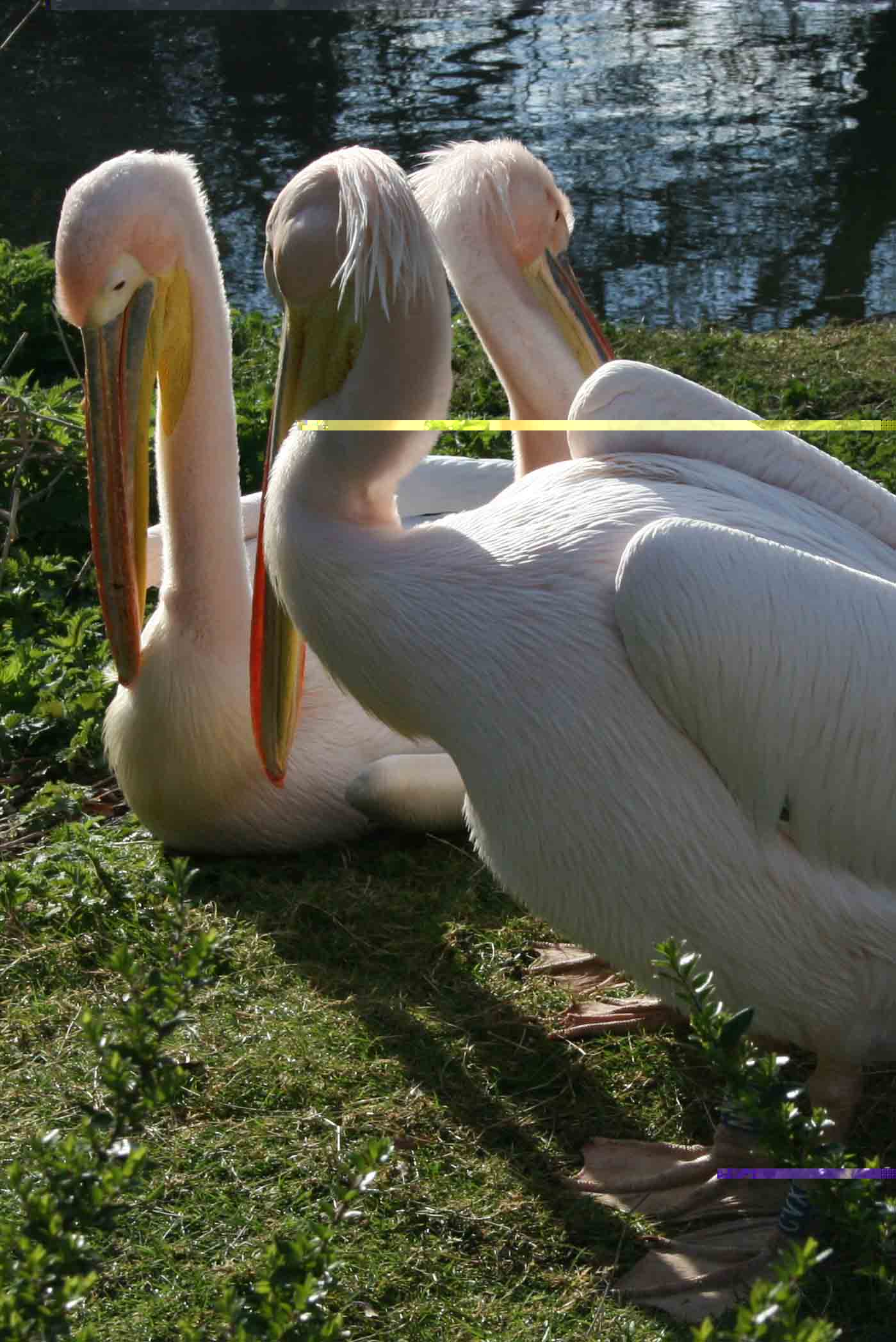
3 pelicans ponder the meaning of 'culture' at London Zoo
Hi Taru. It looks like you all had a lot of fun on your course, but I can also see why you would be knackered after all that. If a picture speaks a thousand words, then the 2 small photos inset in your final photograph say it all! I like the idea of an indoor playground for adults. Did you have a go?
The playground reminds me of a fad back in the 90s for men’s crèches at shopping centres. The idea was for a specific relaxation area to be set up for men who were out bargain-hunting with their other halves. It had TVs showing sport, magazines, and other things supposed to keep them quiet while their partners went round the shops looking for that killer outfit. I’m not sure where the idea originated from, but it never really got off the ground in the UK…
I live quite near London Zoo (not in it, though). A few years ago I used to play football in Regent’s Park. The pitch was a stone’s throw from the zoo and we could sometimes hear lions roaring in the background as we played – they weren’t watching, of course, probably just hungry. If we kicked the ball over the fence, one of us would have to climb over and retrieve it, being careful not to get bitten. (actually I made that last bit up, but we really could hear them...).
The last time I went to the zoo was about a year ago. I have mixed feelings about zoos. I know that they do lots of good work in terms of conservation and education, but it gets me down a bit seeing some of the animals in their confined spaces and thinking of how different it is to their natural habitat. Having said that, I think some zoos are better than others, and London Zoo seems to take care of its animals well. It’s been open since 1828, so they’ve had plenty of time to develop it in the right way.
Vocabulary
Some informal words and expressions this time, most commonly found in spoken English and less formal writing.
Knackered - Exhausted
fad - a trend or fashion for something which does not last for a long time
bargain-hunting - Searching the shops for products which are good value for money
other half - partner/wife/husband etc.
killer - Excellent/in-demand
get off the ground - to become successful or establish itself (usually of a business or project of some sort)
a stone's throw - close (in distance)
get sby down - to make somebody feel depressed/sad
Now, time for some language.
Well done everyone who correctly identified that the problem with the sentences from Taru’s blog was prepositions. Choosing the correct preposition is something which always gives students problems, so don’t worry Taru – you’re not alone!
The correct answers were:
1. The studies consist of 210 units and they are divided into seven parts.
2. We have a small group and we arrange free time activities for the students.
3. We left campus and walked through the city and arrived at the harbour of the Kemijoki River.
4. He laughed at it.
I would love to be able to say that there are some very simple rules which help us to decide which preposition to use but sadly, there aren’t any such rules. So how can you improve your use of prepositions in English?
1) Read a lot.
2) Try to become aware of which prepositions cause you most difficulty (for example, prepositions of place) and find some practice exercises on them.
3) If you are noting down a word or phrase which is often used with a particular preposition (often called a ‘dependent preposition’), make sure you record both the word and its preposition. For example ‘have an influence ON’, ‘accuse OF’, ‘satisfied WITH’ etc.
4) Remember certain fixed prepositional phrases like ‘at home’ ‘at school’ ‘in bed’ etc.
The following website has a useful page on prepositions.
Capital Community College Foundation - prepositions
Collocations
Taru, for your post from yesterday, I’d like to focus on collocations.
I’m sure many of you will be aware of the importance of collocation for English learners. It’s really important to familiarise yourself with combinations of words, and there are many different types of collocation. For example:
Adjective + noun: a warm smile (not a hot smile)
Adverb + verb: vaguely remember (not weakly remember)
Verb + noun: commit murder (not do murder)
These are just a few examples. The point is that the words in the collocation are often found together in English. There is no grammatical reason for this so there are no rules to learn. A bit like prepositions, you need to read a lot, expose yourself to as much English as you can, and when recording vocabulary you should make sure you write down collocations whenever you can. Using a decent concordance programme can help you learn collocations. (for more on how to use concordance programmes see Rachel’s entry below)
LE Teacher blog - concordance
In your blog post, you wrote the following:
it has made a research
it will be really far-reaching view
I would like to tell my best regards
raised our experience
In these examples, the problem is collocation. I’ve given you some correct alternatives below:
It has done/conducted/carried out research
It will have a panoramic/good/great view
I would like to give/send my best regards
Increased/enhanced/deepened our experience
You’ve used prepositions very well in this post, Taru. Well done!
Here's a quick test for everyone - if you have read my first welcome blog post, without scrolling down to look at it, how many of the 14 words and expressions in bold can you remember??
A big thank you to everyone for your comments. In my next post I’ll return to the subject of culture and reply to your comments. Keep up the good work!
Comments
Hello!Jim.Although i can not recall your 14 words and expressions in your first blog,i am sure when i see them next time in a different context,i will understand them and recognise their meanings. thanks to you.Jim how did you read the pelicans ' minds ?I did not know that somebody who lives just a throw-stone to the zoo can guess what the zoo residents are thinking! By the way ,what you think of this difinition of the culture (culture is what remains after every thing of a certain comunity had gone)? looking forword to your next blog
Hi Jim, I hope everything's Okey with you. You really gave us a useful piece of advice on how to improve our English. I didn't tell you, but I have been to Cambridge dictionaries before, and I found them very useful. I know, you've got a good technique of teaching English. Also, I've got a collocation book for Intermediate students and above, and it's very useful,too. And I'd recommend to students out there to have that kind of book. Its name is English collocations in use. I hope that you don't mind if I ask you a question, and it's gonna be next time, hopefully. I wish you a relaxing weekend. All the best, Abdisamad
Hi Jim! Your post made me remember of a teacher I had some years ago who used to play footbal at a farm in which an old lion was kept as a pet. This lion was the attraction of a circus that went bankrupt and then the farmer had pity on it and took the lion in order to look after it. So, the lion´s cage was quite near the pitchy and even though my former teacher knew that the lion was old, well fed and it didn´t have all its teeth, he felt scared to death everytime the ball was near the lion´s cage :-). Have a nice weekend ( we´re going to have a series of events to celebrate Bloomsday this weekend in São Paulo), Ana Paula.
Pls explain how to use "Having" word and what is its proper meaning.pls make some sentances using this word
Thank you for the method of how to improve the use of prepositions. I am sorry that I cannot remember any of the 14 words and exxpressions. It is very easy for me to forget what I leart due to my poor memory.
Hi Jim I greatly appreciate your explanation about prepositions and the website about prepositions is panoramic (I have used the word panoramic for the first time, so not sure if I used it in the right context). I sometimes find it difficult to use some prepositions and the website you provided seems to be very helpful. I am also thankful for letting us know about the importance of collocation in English language. It is important to be aware of the basic rules in any language. Now about your memory test: I tried to remember the words from your last entry but unfortunately, I was unsuccessful. I would probably remember them when I see the words but not from memory. Can you help me with the use of words such as “don’t, won’t, isn’t”. Is it right to use these words in formal writing? Can you also tell me the difference between its and it’s? Your help will be greatly appreciated. Regards Rabail UK
Hello Jim! Great to e-meet you. I follow your installments on BBC LE and I am very happy that you are our new teacher blogger. I am sure we will learn some new English words. Flat out, squeeze in and far-flung are stuck in my mind As for the zoo, I completely agree with you. A couple of years ago there was a debate over the use of animals in the circus in Italy. I do not know whether or not they eventually approved a ban. About football, what football team do you support? Have a good week ahead!!
Hi Jim! Hope you had a nice weekend! I went to a bargain hunting with my other half and son at car boots sale ground yesterday. It was packed with people and children, and we enjoyed the hustle and bustle of atmosphere even though we could find nothing we were hoping for. We felt really knackered after the long walk through cars and stalls under the heat. I am glad to know you are a human being, not an animal living in the zoo, and I really enjoyed reading your witty and friendly entry very much. I used to dress to kill due to my job but I wear loose sweatshirts and a pair of jeans nearly everyday, as I am a lady of leisure. About the test, I was disappointingly able to remember about 10 words and expressions. I should have pulled my finger out to remember words and expressions more. Have a good day!
Hello Jim! The same sadness I feel as you do by seeing bad treated animals. The worst conditions provided in zoos on wheels. Small cages as well as poor treatment by occasional staff are not good for captives. I have not visited London zoo yet so it’s impossible for me to compare with the best zoo I’ve ever seen at the North Thailand.
Hi Jim! Actually, I wanted to stop with commenting, but, here are three far good comments so I am joining my too. It´s the only training for my English after all. It was last weak only that two old lions casted out from a circus were replaced into our ZOO. We will have the creatures here after seventeen years again. Years ago I was lucky enough to see a newborn thing on its first walk. Incedibly nice clumsy pet. Back to the language. I agree with delight that your teaching techniques are good cue for less skilled person to try possibilities of an internet. I stopped to buy language books, except literature, they are filling my shelves with no use long time. Nevertheless, searching a collocation book will be a good reason to visit a bookshop. Regards!
Hello Jim! It's very interesting to read your blog, thanks once again for your useful tips. I have to admit that about zoos I feel pretty much the same as you. In Lithuania we have Kaunas Zoo and I have to say it's terrible! The cots are really small and awkward, so watching poor animals living in the place like that is really hard. Well, I hope later living conditions in this zoo as well as other similar zoos will change. I want to ask you one question. Can you recommend some good, not very difficult to read and, of course, interesting English books? I mean, original ones, not those adapted for learners of English. I have tried "To kill a mockingbird" by H.Lee and "Marley and me", and I enjoyed reading both of them, especially the first one. But these are books written in American English and now I want to try something British. I would be very grateful for your help;)
Hi Jim, Thanks for your useful tips because preposition is still a huge challenge for/to me. For me to learn preposition is very difficult. It is one of the things which I have made my other-half to get sby down. I hope you keep the motivation to help us improve English.
Thanks for all your contributions. This blog has now closed and can no longer accept new comments.


